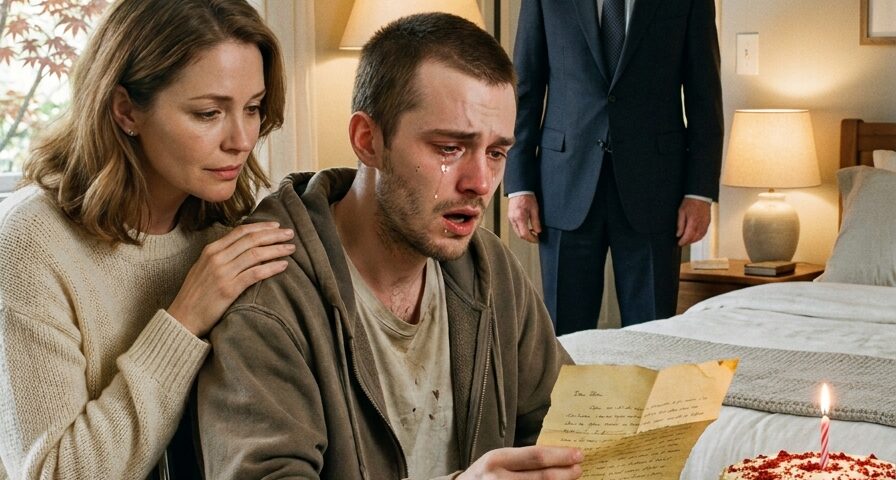
PART 2: The Letter My Late Wife Left Behind
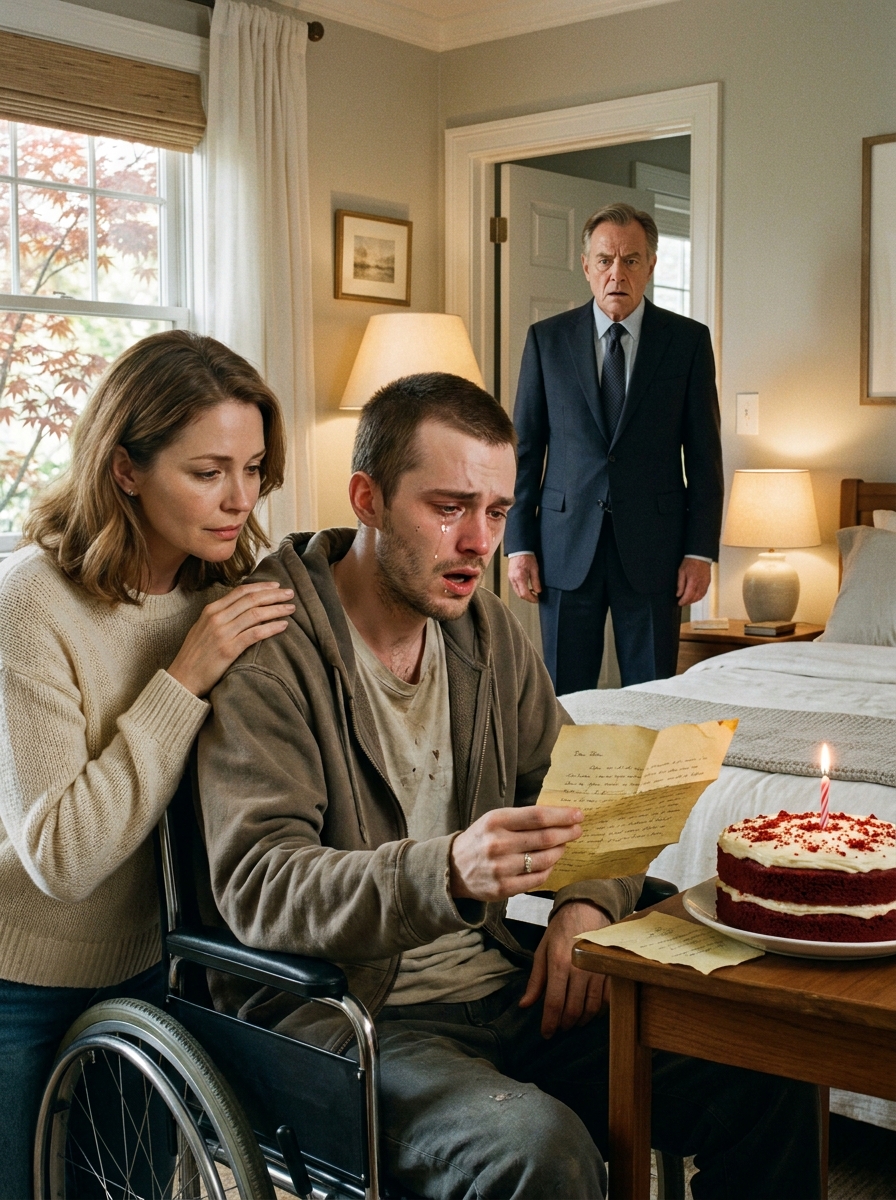
Grace’s handwriting.
There was no mistaking it. The soft curve of the capital O. The slight lean in every line, as if the words were hurrying toward someone she loved. The tiny heart she always placed over the i in Whitmore, even on grocery lists and dry-cleaning notes. I had not seen it in ten years, and yet my body recognized it before my mind could question it.
“That’s not possible,” I said.
My voice came out harsher than I intended.
Clara looked at me, not offended, not frightened. Just quiet.
“I found it with the recipe,” she said.
“That recipe box has been locked away.”
“It was in the second pantry drawer,” she replied gently. “Behind the old linen napkins.”
I shook my head. “No. Mrs. Ellis packed it after Grace died.”
“I didn’t know that,” Clara said.
Owen’s gaze moved between us. For the first time in weeks, there was something alive in his eyes. Not strength exactly, not even hope. But curiosity. A thread of it, thin and shining.
“Dad,” he whispered, “please.”
One word.
Please.
It stopped me.
For months, I had begged him to eat, to sit up, to try therapy, to speak to doctors, to keep fighting a battle his body was losing. Now he was asking me for something, and my first instinct had been to take it away because I was afraid.
Afraid of the letter.
Afraid of what it might say.
Afraid of Grace coming back into the room in ink and paper, when I had spent ten years teaching myself how not to look for her.
I stepped back.
Owen unfolded the letter slowly.
A faint scent rose from the paper. Vanilla. Not perfume. Grace hated heavy perfume. She smelled of vanilla because she baked when she was sad, happy, worried, celebrating, angry, or thinking. Our house used to smell like sugar and cocoa every December, every birthday, every bad day when Owen came home from school pretending he had not been hurt by something someone said.
Owen read the first line silently.
Then his face crumpled.
“What does it say?” I asked, though I was not sure I wanted to know.
He swallowed and read aloud.
“My dearest Owen, if this letter has found you on your twenty-fifth birthday, then somewhere, somehow, your father finally opened the drawer I told him not to forget.”
The room tilted.
I gripped the edge of the dresser.
Owen looked up at me.
“You knew?” he asked.
“No,” I said immediately. “No, I didn’t.”
But memory stirred in me, unwelcome and sharp.
Grace in the kitchen a week before she died, standing by the pantry with flour on her cheek. Grace laughing when I tried to kiss it away. Grace saying, “Nathan, promise me you won’t let this house become a museum.” Me answering distractedly, already checking my phone. Her hand covering the screen. Her voice softer then. “There are things Owen will need later. Not now. Later.”
Had she mentioned a drawer?
Had I nodded without listening?
Owen looked back at the letter and continued, his voice barely above a breath.
“I hope you are reading this with cake nearby. If not, please pause immediately and demand cake. Life is too short for dry milestones.”
A broken laugh escaped him.
I closed my eyes.
That was Grace. Even in a letter written for a future she would never see, she had found room for humor.
Owen read more slowly now.
“Twenty-five sounds impossibly grown-up to the mother who still sees you with grass stains on your knees and chocolate on your chin. But I know you, my sweet boy. You will be thoughtful. Stubborn. Too hard on yourself. You will pretend you are fine when you are not, because you inherited that unfortunate habit from both your parents.”
Owen’s lips trembled.
“I hope your father is beside you. If he is, please look at him and remind him that love is not proven by how much he provides, but by whether he stays in the room when things are hard.”
The words entered me quietly.
That made them worse.
I had been in the house. I had paid every bill, signed every medical authorization, hired every specialist, arranged every treatment. I had stood in hallways and spoken to doctors. I had answered emails beside my son’s hospital bed.
But had I stayed in the room?
Owen did not look at me.
He kept reading.
“I need you to know something, Owen. There will come a day when life asks you to be brave in a way no one else can see. If that day comes, don’t mistake silence for peace. Say what hurts. Ask for what you need. Let people love you, even when it embarrasses you.”
His voice broke on the last line.
Clara quietly reached for the glass of water on the bedside table and moved it closer, then retreated to the window as if she understood this moment belonged to a family she had only just entered.
Owen took a sip of water.
Then another.
The sound was ordinary, almost nothing, but I watched it the way starving men watch rain.
He was drinking because he wanted to keep reading.
“I wish I could promise to be there for every birthday,” he continued. “I wish I could see the man you become. But if I am not there, remember this: you were never an interruption to my life. You were the best part of it. Every cake, every bedtime story, every muddy pair of shoes by the back door—those were not burdens. They were proof that I had been trusted with something holy.”
Owen lowered the letter.
Tears slipped down his hollow cheeks.
For a long while, no one spoke.
Then he whispered, “She knew.”
I sat on the chair beside his bed.
“What?”
He pressed the paper to his chest. “She knew I’d need this.”
I wanted to say she wrote it because she loved birthdays. Because she planned ahead. Because Grace had always been sentimental with paper and ribbon and little notes tucked into lunchboxes.
But beneath those explanations was a truth I could no longer avoid.
Grace had known things I had missed.
Maybe not about Owen’s illness. Maybe not about this exact day, this frail body, this diagnosis that had turned time into a countdown. But she had known grief. She had known men who hid from pain by staying busy. She had known our son would someday need words I might not know how to give.
I looked at Clara.
“Where exactly did you find it?”
“In the recipe box,” she said. “There were several envelopes tied together with blue thread. This one had Owen’s name and twenty-five written on it.”
Several.
The word lodged in my chest.
“Several envelopes?” I repeated.
Clara nodded. “I didn’t open the others. They looked private.”
Owen turned toward her. “There are more?”
“I think so.”
He closed his eyes.
Something changed in his face. Not health. Not recovery. I knew better than to confuse a moment of light with a cure. But the flat resignation that had settled over him like dust was gone.
He had something to look toward.
Something beyond the next dose, the next lab result, the next doctor’s careful expression.
He had his mother’s voice waiting somewhere in the house.
“I want to see them,” he said.
“Tomorrow,” I answered.
His eyes opened. “No.”
“Owen, you’re exhausted.”
“I’ve been exhausted for months.” His voice was weak but clear. “I want to see them tonight.”
I almost refused.
Then I looked at the cake. Half a slice gone. The first food he had willingly eaten in days. I looked at the letter in his hands. I looked at Clara, who had entered our house with a worn suitcase and somehow found the one thing all my money had not been able to buy.
A reason for Owen to reach forward.
“Mrs. Ellis,” I called.
Our housekeeper appeared in the doorway almost instantly, as if she had been hovering nearby. Her eyes were red.
“Yes, Mr. Whitmore?”
“The recipe box. Do you know where it is?”
Her face changed.
It was subtle. A small tightening around the mouth. A flicker of recognition she tried to hide too late.
“You found it,” she said.
It was not a question.
I stood slowly. “You knew?”
Mrs. Ellis looked at Owen, then at the floor.
“Mrs. Whitmore asked me to put it away after she passed.”
“You told me everything had been packed.”
“I did pack it,” she said quietly. “Then I unpacked that box when I remembered what she asked.”
“When you remembered?”
Her eyes filled. “Sir, the week after Mrs. Whitmore died, you were not yourself.”
That was a generous way to describe it.
I had moved through those days like a man underwater. I remembered the funeral only in fragments: white flowers, black coats, Owen’s small hand gripping mine, someone telling me to eat. Afterward, the house had felt unbearable. Grace was everywhere. Her scarf on the chair. Her handwriting on the calendar. Her slippers beneath the bed.
I told Mrs. Ellis to remove anything that made Owen cry.
I had called it protecting him.
Maybe I had been protecting myself.
“She left instructions,” Mrs. Ellis said. “Not formal ones. Not legal. Just a note to me, asking that the recipe box stay in the house and be opened when Owen turned certain ages.”
My throat tightened. “Why didn’t you tell me?”
Mrs. Ellis finally looked at me.
“Because she asked me not to give them to you all at once.”
The answer landed softly, but it hurt.
Owen watched me from the bed.
“Dad,” he said, “it’s okay.”
It was not okay.
Not entirely.
A decade had passed inside this house with pieces of Grace hidden in drawers while I walked past them every day, unaware or unwilling to notice. I wanted to be angry at Mrs. Ellis. It would have been easier. But grief has a way of rearranging blame into something convenient.
The harder truth was that Grace may have known I would close every door she left open.
“Bring the box,” I said.
Mrs. Ellis hesitated.
Then she nodded.
While she left, Clara moved quietly to pick up the cake plate.
Owen stopped her.
“Can you leave it?”
“Of course.”
He touched the edge of the frosting with his fork, not quite eating, just tracing the surface as if it were a memory he could feel.
“You really made this from her recipe?” he asked.
Clara smiled. “I tried. The frosting fought me.”
“My mom always said frosting knows fear.”
Clara laughed softly. “Then mine knew I was terrified.”
Owen smiled.
I had forgotten what that smile did to a room.
It was smaller now, fragile at the edges, but it was his. It was the boy building blanket forts. The teenager pretending he was too old for birthday candles. The young man who, before illness stole his strength, used to call me from college just to complain that dorm coffee tasted like regret.
I sat down again.
“Owen,” I said carefully, “I’m sorry.”
He looked at me.
The words were too small for everything behind them, but they were the only ones I had.
“I thought if I worked hard enough, if I found the right doctor or paid for the right treatment, I could fix this. Fix you. Fix everything.” My voice roughened. “I didn’t know how to sit still with you. I didn’t know how to be helpless.”
His eyes softened.
“I didn’t need you to fix it all,” he said. “I just needed you to stop looking at me like a problem you were losing.”
That sentence found every unguarded place in me.
I bowed my head.
“I’m sorry,” I said again.
This time, Owen reached for my hand.
His fingers were cold.
I held them gently, afraid of hurting him, afraid of letting go.
When Mrs. Ellis returned, she carried a wooden recipe box I had not seen in years. It was painted pale yellow, worn at the corners, with tiny red cherries on the lid. Grace had bought it from an antique market in Wisconsin the summer Owen turned six. She had insisted it had “a cheerful soul.”
Mrs. Ellis placed it on Owen’s lap.
He ran his fingers over the lid.
For a moment, he looked afraid to open it.
Then he did.
Inside were recipe cards, folded notes, clippings from magazines, and envelopes tied in bundles with different colored threads. Some were labeled with birthdays: eighteen, twenty-one, twenty-five, thirty. Others simply had phrases written across them.
For a bad day.
For when you fall in love.
For when your father is being impossible.
Owen let out a breath that was almost a laugh.
I leaned closer despite myself.
There was one envelope with my name on it.
Nathan.
I stared at it.
Grace’s handwriting sat there calmly, as though she had only stepped into the next room and expected me to follow.
Mrs. Ellis noticed where I was looking.
“She asked that you open yours after Owen opened the twenty-five letter,” she said.
My hand hovered over the envelope.
Then I withdrew it.
“Not tonight.”
Owen looked surprised. “Dad.”
“Tonight is yours.”
He studied me a moment, then nodded.
It was a small choice, but it felt like the first honest thing I had done in years.
We spent the next hour sorting the envelopes without opening them. Owen grew tired quickly, but he refused to sleep until each one had been placed carefully in a stack on his bedside table.
Clara stayed quietly in the background, occasionally adjusting his blanket or refilling his water. She never inserted herself where she was not needed. She had an instinct for silence that no nurse, no specialist, no well-meaning visitor had shown.
Before leaving the room, she paused near the door.
“Would you like me to bake another small cake tomorrow?” she asked Owen.
He looked at the half-eaten slice.
“Maybe lemon,” he said. “Mom made lemon cake when Dad forgot anniversaries.”
I winced.
Clara’s mouth twitched.
“I’ll look for the recipe.”
After she left, Owen settled back against the pillows.
“You like her,” I said.
He closed his eyes. “She doesn’t talk to me like I’m already gone.”
I had no answer.
That night, I did not go to my office.
I sat in the chair beside Owen’s bed until he fell asleep with Grace’s letter tucked beneath his hand. The house beyond his room was quiet, the kind of quiet that used to feel expensive and now felt empty.
Near midnight, I stepped into the hallway and found Mrs. Ellis waiting by the linen closet.
“You should have told me,” I said.
“I know.”
Her face had aged in the last few hours. Or perhaps I was only seeing the years for the first time.
“Why didn’t you?”
She folded her hands in front of her. “Mrs. Whitmore believed you would throw yourself into making everything perfect. She worried you would treat the letters like a project. Preserve them. Catalog them. Lock them away to protect them.”
A painful smile tugged at her mouth.
“She said grief made you efficient.”
I looked down.
Grace had known me too well.
“I did what she asked,” Mrs. Ellis said. “But I should have found a way to help you remember.”
I wanted to say there was nothing to forgive.
Instead I said, “Thank you for keeping them safe.”
Her eyes shone.
“You’re welcome, sir.”
I slept badly.
Just before dawn, I woke on the couch in Owen’s sitting room to the sound of voices.
For one wild second, I thought Grace was there.
Then I realized it was Clara.
She was speaking softly to Owen near the window.
The sky was pale blue beyond the glass. The Japanese maple stood still in the morning light, its bare branches dark and delicate.
“I used to think houses remembered things,” Clara said.
Owen’s voice was faint. “Like ghosts?”
“Not ghosts. More like echoes. A good laugh in the kitchen. Someone running down stairs. A door opening when people were happy to come home.”
“My dad would pay a fortune for that description and turn it into a luxury condo ad.”
I nearly laughed.
Clara did.
“I’ll be sure to charge him if he uses it.”
Owen was quiet for a while.
Then he asked, “Why did you take this job?”
The question made me still.
Clara did not answer immediately.
“I needed one,” she said.
“That’s not the whole answer.”
“No,” she admitted.
I should have moved then. I should have made my presence known.
But something in Clara’s silence held me where I was.
“My mother was sick for a long time,” she said. “Not the same illness. But the same kind of quiet in the house. People whispering in hallways. Meals no one ate. Clocks getting louder.”
Owen murmured, “I’m sorry.”
“Me too.”
“Did she get better?”
“No.”
The honesty did not frighten him. If anything, it seemed to relax him.
“Were you with her?” he asked.
“At the end? Yes.”
Owen looked out the window. “Was she scared?”
Clara’s voice softened. “Sometimes. But not every minute. That surprised me. There were still ordinary moments. She worried about my coat. Asked whether I’d paid the electricity bill. Told me the neighbor’s roses were planted too close together.”
Owen smiled faintly.
“People don’t become only one thing because they’re dying,” Clara said. “They’re still themselves.”
I closed my eyes.
How many times had I forgotten that?
To me, Owen had become his illness. His numbers. His weight. His scans. His declining function. I had loved him desperately, but I had loved him through fear, and fear had narrowed him until I saw only what I was losing.
Clara saw him.
Not the patient.
My son.
Later that morning, Dr. Pierce came to the house expecting refusal, silence, another day of watching Owen turn away from every offered meal.
Instead, Owen asked for tea and half a slice of lemon cake.
Dr. Pierce looked at me as if I had secretly rearranged the laws of medicine.
“He ate?” the doctor asked.
“Some,” I said.
Owen rolled his eyes. “I’m still in the room.”
Dr. Pierce smiled, a little startled. “So you are.”
The change did not alter the prognosis. Dr. Pierce was careful about that. Owen’s heart was still failing. His body was still fragile. But eating helped. Drinking helped. Speaking helped. Not because it promised a cure, but because it returned dignity to the hours we still had.
After the doctor left, I went looking for Clara and found her in the kitchen with Grace’s recipe cards spread across the counter.
Sunlight fell through the tall windows, brightening flour dust on her sleeve. She had tied her hair back with a ribbon Mrs. Ellis must have given her, and for a second the kitchen looked almost like it had years ago—not because Clara resembled Grace, but because something warm had returned to the room.
She looked up when I entered.
“Lemon cake was a success,” she said.
“So I hear.”
“I made it too dense.”
“Owen ate it anyway.”
“That was generous of him.”
I leaned against the counter. “Clara, I owe you an apology.”
Her hands stilled.
“For yesterday,” I said. “When I questioned the letter. I was startled, but I spoke sharply.”
“You were grieving.”
“That explains it. It doesn’t excuse it.”
She looked at me for a long moment, then nodded. “Thank you.”
I was not used to apologies being accepted without ceremony. David from the construction board would have negotiated one. Investors would have searched for weakness in it. Grace would have smiled and said, “There you are,” as if apology was not humiliation but return.
“You’ve done more for Owen in two days than anyone else has managed in months,” I said.
“I made cake and listened.”
“Exactly.”
A shadow crossed her face.
“Sometimes people underestimate those things.”
I heard the weight beneath the sentence.
“Your mother?” I asked.
Clara glanced toward the recipe cards. “Among others.”
She did not offer more.
I did not press.
That afternoon, Owen asked to sit downstairs for an hour.
It took planning. Oxygen. A blanket. Clara’s steady hands. Mrs. Ellis hovering with enough pillows to furnish a hotel suite. But when we finally settled him near the living room fireplace, his eyes moved over the room with quiet wonder.
“I forgot how big this place feels,” he said.
“You grew up here,” I replied.
“Doesn’t mean I noticed the ceilings.”
Clara arranged a tray beside him with tea, cake, and Grace’s twenty-five letter. Owen had started carrying it from room to room.
“Read another one,” he said suddenly.
I looked at the recipe box on the coffee table.
“Which?”
He reached inside and lifted the envelope labeled For when your father is being impossible.
“No,” I said immediately.
Owen’s grin was tired but wicked. “Definitely this one.”
Even Clara smiled.
I sighed and opened it.
Inside was a short note written on pale blue stationery.
Nathan, if Owen is reading this because you are being impossible, please stop being impossible.
Owen laughed so hard he had to catch his breath.
I kept reading.
I know you think worrying is productive because you wear expensive suits while doing it. It is not. Listen to your son. If he says he needs space, give space. If he says he needs you, stay. If he says nothing, bring tea and sit nearby. Do not try to solve every silence. Some silences only need company.
I lowered the page.
Owen looked at me gently.
“Well,” he said, “she got you.”
“She usually did.”
For the first time in ten years, speaking of Grace did not feel like touching a bruise. It hurt, yes, but the hurt had warmth in it.
We spent the next days differently.
Not miraculously.
Differently.
Owen still had pain. He still slept often. There were difficult nights when his breathing frightened me and Dr. Pierce came at odd hours with his black bag and careful eyes. There were mornings when Owen refused food, not from despair but exhaustion. There were moments when I walked into the bathroom and gripped the sink until my hands stopped shaking.
But now there were other moments too.
Clara made soup from Grace’s old cards. Sometimes Owen managed only a spoonful, sometimes more. Mrs. Ellis told stories about Grace burning a Thanksgiving pie and serving ice cream with such confidence that guests complimented the “modern dessert.” Owen asked to hear about his mother at fifteen, at twenty, before she became only “Mom” in his memories.
I told him everything I could.
How Grace had worn yellow shoes to our first date because she said practical colors were for filing cabinets. How she once convinced an entire restaurant to sing happy birthday to a stranger who looked lonely. How she kept a notebook of phrases Owen mispronounced as a child, including “pasketti,” “hostipal,” and “businessman shoes,” which he called my dress shoes.
Owen laughed.
Then cried.
Then slept.
On the fifth evening after Clara arrived, snow began to fall beyond the windows. Lake Forest became soft and hushed beneath it, the estate grounds turning silver in the dusk.
Owen asked for the Christmas lights.
“It’s March,” I said.
“I’m aware.”
“You want Christmas lights in March?”
“I want Mom’s lights.”
So we opened the attic.
Mrs. Ellis found the boxes first, labeled in Grace’s careful hand. Clara helped carry them down. I expected the task to break me, but instead it became something almost tender. Owen supervised from his wheelchair near the doorway while I untangled strands of white lights and Clara discovered ornaments wrapped in tissue paper.
One ornament was a tiny red velvet cake made of clay.
Owen held it in his palm.
“She bought that at the school fair,” he said. “I made fun of it because it looked like a tomato.”
Grace had written on the bottom: Owen, age 9, critic of fine art.
We hung it near the fireplace.
By the time the lights were draped across the mantel and around the window overlooking the Japanese maple, the room glowed with a season that did not belong to the calendar but belonged to us.
Owen stared at it for a long time.
Then he whispered, “I don’t want to die angry.”
The room went still.
I sat beside him.
He looked at me, eyes bright with tears. “I was so angry, Dad. At my body. At you. At Mom for leaving first, even though that makes no sense. At everyone walking around healthy, wasting time.”
I nodded because anything else would have been dishonest.
“I’m still angry,” he said.
“You’re allowed.”
He breathed carefully. “But I don’t want anger to be the last thing I give you.”
My vision blurred.
I took his hand.
“You don’t have to give me anything.”
“Yes, I do,” he said. “I need to give you permission.”
I shook my head. “Owen—”
“To live after.”
The words stopped me.
He looked so young beneath the Christmas lights. Twenty-five and ancient. My son and somehow my teacher.
“Mom left letters,” he said. “Maybe because she knew you’d need a map.”
I pressed my fingers against my eyes.
“I don’t want a map.”
“I know,” Owen said. “You want a contract, a plan, and three backup options.”
A laugh broke through my tears.
He smiled faintly.
“I’m scared,” he admitted.
I leaned closer. “I am too.”
It was the first time I had said it.
Owen closed his eyes, and relief moved across his face.
Not because I had comforted him.
Because I had joined him in the truth.
The next morning, I opened Grace’s envelope.
I did it alone in the library, where rain tapped against the windows and the house smelled faintly of lemon and sugar.
Nathan, my love,
If you are reading this, then Owen has opened the letter I left for him, and you are probably trying to pretend you are handling everything better than you are.
Please stop.
I smiled despite myself.
You have always believed love means building walls strong enough to keep pain out. But pain is not a burglar, Nathan. It does not leave because you lock the doors. It sits outside and waits until the house becomes too quiet.
I need you to make a promise.
Not to me. To Owen.
Promise you will let him speak honestly, even when it hurts you. Promise you will not turn his fear into a problem to manage. Promise you will tell him stories about me, not only the polished ones, but the ridiculous ones. Especially the ridiculous ones.
And one more thing.
If someone named Clara Bennett ever comes to the house, let her in.
The letter slipped from my hand.
For a long moment, I could only stare at the page lying on the rug.
Clara Bennett.
Grace had written her name ten years ago.
I picked up the letter again, my heart beating hard.
You will want to ask questions. You always do. But Clara’s story is not mine to tell. Only know this: I made a promise once, before you and before Owen, and I could not keep it the way I hoped. If life is kind, perhaps she will find her way to you when you need her most.
Please do not mistake coincidence for accident.
Grace
The room seemed to narrow around me.
I read the letter again.
Then a third time.
Clara’s name did not change.
I went to the kitchen with the page folded in my hand and found Clara washing mixing bowls at the sink. She turned when she heard me enter.
Something in my expression must have told her.
Her face went still.
“You knew my wife,” I said.
It was not an accusation.
Not yet.
Clara dried her hands slowly on a towel.
“I knew of her,” she said.
“That is not the same thing.”
“No.”
I placed the letter on the counter.
Grace’s handwriting faced upward.
Clara looked at it, and the color left her face.
“She wrote about you,” I said.
Clara’s eyes filled before she spoke.
“I didn’t know she would.”
“Then tell me how she knew your name.”
For several seconds, Clara said nothing. Outside the kitchen window, snowmelt dripped steadily from the bare branches.
Finally, she pulled the chair from the breakfast table and sat down.
“My mother worked at a shelter years ago,” she said. “Before I was born, before Grace married you. Your wife volunteered there every Thursday night.”
I slowly sat across from her.
“She never told me that.”
“She didn’t tell many people. My mother said Grace didn’t like charity that needed an audience.”
That sounded like her.
Clara folded the towel in her lap.
“My mother was young and pregnant when she met Grace. Alone. No money. No family willing to help. Grace stayed with her through appointments, helped her find housing, brought food.” Her voice softened. “She was there the night I was born.”
A strange ache moved through me.
Grace, younger than I ever knew her, holding another woman’s hand in a hospital room.
“Your mother kept in touch with her?”
“For a while. Then life became complicated.” Clara looked down. “My mother struggled. Jobs. Rent. Illness later. She kept a box of old letters from Grace. I grew up hearing her name like a kind of prayer.”
I could barely speak.
“Why didn’t you tell me?”
“Because I didn’t come here to take anything from you.”
“Take?”
Clara’s eyes lifted to mine.
“My mother told me Grace had wanted to help us more than she was allowed to. There was some disagreement with the shelter board, paperwork, boundaries. I don’t know all of it. When I saw the housekeeping position, I recognized the Whitmore name.” She swallowed. “I applied because I needed work. That part is true. But also because I wanted to see the house of the woman who once kept my mother alive.”
The honesty in her voice unsettled me more than a lie would have.
“And the recipe box?”
“I found it by accident.”
“Did you know there would be letters?”
“No.” She shook her head. “I swear.”
I believed her.
I did not know why, but I did.
That evening, I told Owen.
He listened without interrupting, Grace’s letter resting in his lap. Clara had offered to leave, but Owen asked her to stay.
“So Mom knew Clara’s mom,” he said.
“Yes.”
“And somehow wrote Dad a letter saying to let Clara in.”
Clara looked uncomfortable. “She couldn’t have known I’d come here now.”
Owen smiled faintly. “My mom was dramatic like the tree.”
I laughed softly.
But later, when Owen slept, I returned to the recipe box.
There were still unopened envelopes inside.
One was tucked beneath a stack of stained recipe cards, almost hidden.
It had no birthday.
No instruction.
Only one word.
Clara.
My hand hovered over it.
I knew I had no right to open it.
So I carried it upstairs and knocked gently on Clara’s door.
She opened it wearing an old blue sweater, her hair loose around her shoulders. She looked tired, younger than twenty-six for once.
“I found this,” I said.
Her eyes dropped to the envelope.
She did not take it at first.
Then, slowly, she reached out.
Grace’s handwriting rested between us like a bridge neither of us understood.
Clara sat on the edge of the bed and opened the envelope with trembling care.
I turned to leave.
“Mr. Whitmore,” she said.
I stopped.
“You should hear this too.”
So I stayed by the door as she unfolded the page.
Her voice shook as she read.
Dear Clara,
If this reaches you, then life has been more mysterious than I had any right to hope.
I knew your mother when she was carrying you. She was braver than she believed and lonelier than she deserved. I wanted to remain in your lives, but sometimes adults make choices from fear and call them wisdom. I have regretted that distance for years.
There is something you should know.
Clara stopped reading.
Her face had gone very still.
“What?” I asked.
She looked up at me, and for the first time since she entered my home, I saw fear in her eyes.
“She says there’s something my mother never told me.”
The paper trembled in her hands.
I crossed the room slowly.
Clara looked back down and read the final lines in a whisper.
Nathan has a son named Owen. You and Owen were born in the same hospital, on the same night, under circumstances I never fully understood.
If you are reading this in his house, please ask Mrs. Ellis about the blue hospital blanket.
I stared at her.
From down the hall, Owen’s monitor beeped softly in the silence.
And in the doorway, unnoticed until that moment, Mrs. Ellis stood frozen, one hand pressed against her mouth.