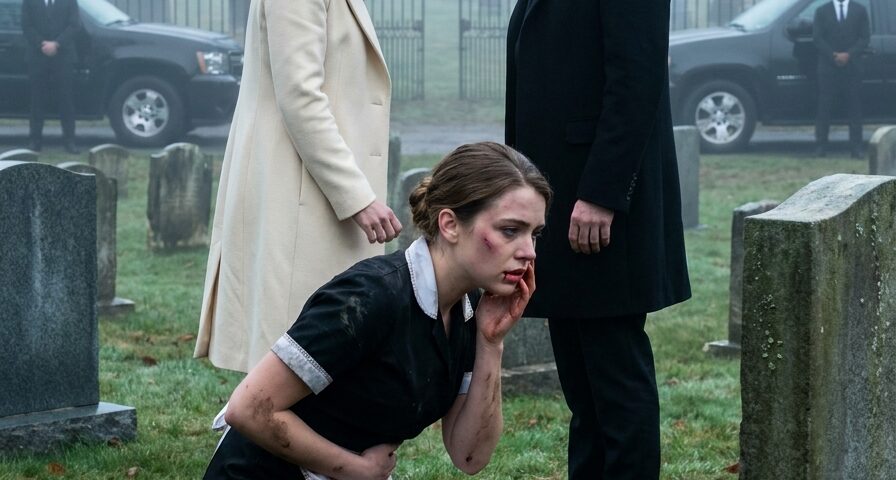
PART 2: The Child Beneath the Wildflower Bracelet
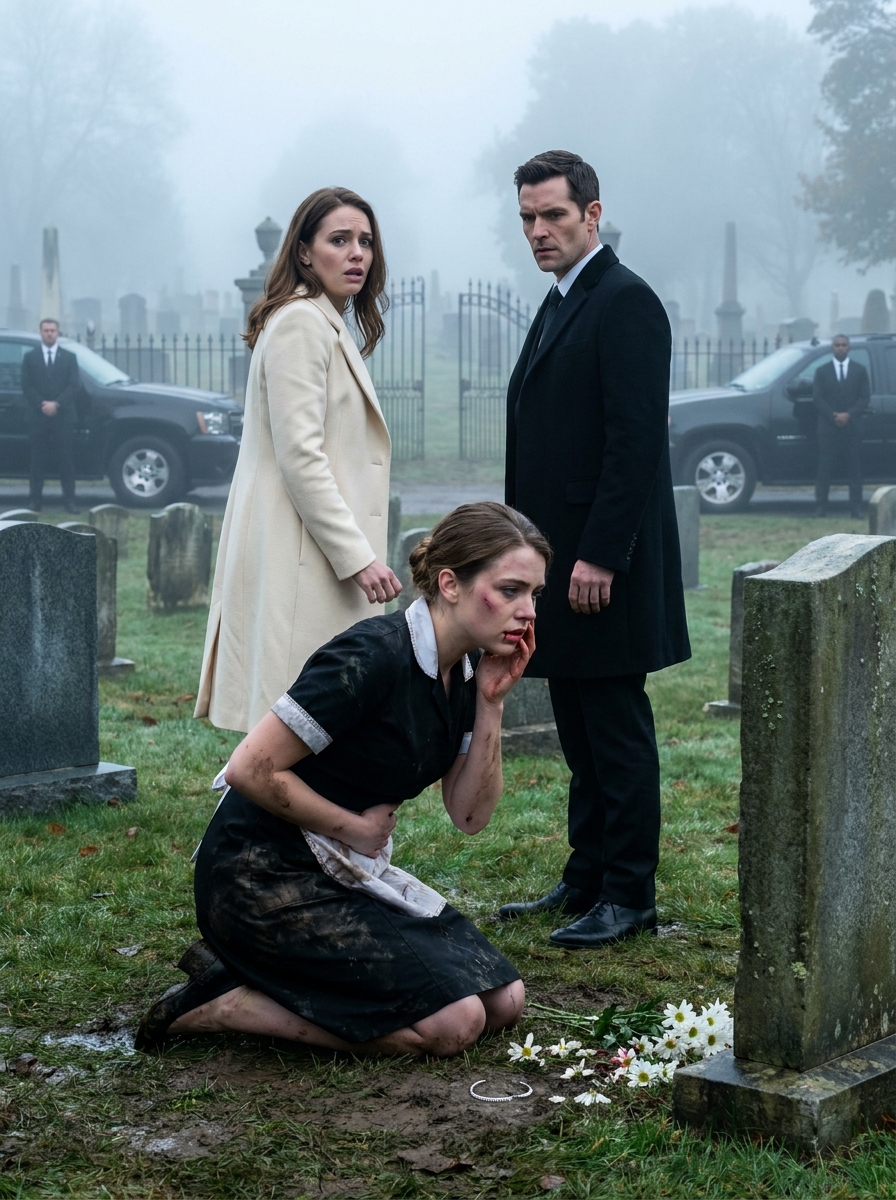
“What did you say?” she whispered.
Damon did not repeat himself.
He stepped around her and crouched beside me, the hem of his black overcoat brushing the wet grass. Up close, the cold composure everyone feared was still there, carved into every line of his face. But his eyes, when they met mine, were different.
Not soft exactly.
Focused.
As if the rest of the cemetery had disappeared and there was only me, shaking beside my mother’s grave with blood on my lip and rain in my hair.
“Emma,” he said quietly. “Can you stand?”
I wanted to say yes.
I had spent most of my life saying yes when the truth was no. Yes, I could work another shift. Yes, I was fine. Yes, I did not mind eating whatever was left after the Caldwell family finished dinner. Yes, I could carry laundry up three flights of stairs even when the early months of pregnancy made me dizzy.
But my legs trembled beneath me, and the baby seemed to press low against my fear.
“I don’t know,” I admitted.
Damon’s jaw tightened, but his voice stayed calm.
“That’s all right.”
He removed his coat and draped it carefully around my shoulders. It was warm from his body and heavy enough to make me feel hidden. Protected. That frightened me almost as much as Vanessa had.
I had learned young that protection always came with a price.
Behind us, Vanessa found her voice again.
“This is absurd,” she said, though the words shook. “She works in my house. She has been sneaking around my husband for months.”
Damon stood slowly.
“She told you the child is not Caleb’s.”
“She lies for a living.”
I flinched.
Damon noticed. So did Vanessa, and some small part of her seemed pleased by it.
His eyes moved to the crushed daisies near my mother’s grave, then to the broken bracelet half-buried in mud beneath Vanessa’s heel. He said nothing for a long moment. Then he walked over, bent down, and picked it up.
Vanessa stepped back as though the bracelet had become evidence.
Damon wiped the silver band with his thumb. The wildflower engraving caught faintly in the gray light.
“This belonged to your mother?” he asked me.
“My grandmother first,” I said. My voice sounded far away. “Then my mother.”
He held it with surprising care.
Vanessa lifted her chin. “You’re making a mistake, Damon. My father will not appreciate being threatened in public.”
“Then you should be grateful I did not threaten him,” Damon replied. “I gave you practical advice.”
Her eyes flashed. “You think you can humiliate my family over a maid?”
The word struck me as she intended.
Maid.
Not Emma. Not woman. Not expectant mother kneeling at a grave. Just a role. A uniform. Someone who folded linens, polished silver, and disappeared before guests arrived.
Damon’s expression did not change, but something in the air did.
“Miss Caldwell,” he said, “your family’s reputation does not depend on Emma Harper’s silence. It depends on your conduct.”
Vanessa’s mouth opened, then closed.
For the first time, she looked toward the cemetery gate. One of Damon’s men stood beside the SUV, speaking quietly into a phone. No one approached. No one acted dramatically. They were simply present, and that presence was enough to remind Vanessa that this was no longer a private scene she could rewrite.
She turned back to me.
“You’ll regret this,” she said.
Not loudly.
Not theatrically.
Almost sadly, as if regret were something she had known for a long time but preferred handing to other people.
Then she walked away.
Her heels sank slightly into the wet grass with every step.
I watched her disappear through the fog, and only after the door of her car closed did I realize I had been holding my breath.
Damon came back to me.
“Emma.”
I looked up.
He extended his hand.
I hesitated before taking it.
His fingers closed around mine, steady and warm, and he helped me to my feet with such careful restraint that my eyes unexpectedly filled with tears. I was tired enough that kindness felt dangerous. One gentle gesture and every defense I had spent years building began to loosen.
“I’m taking you to a doctor,” he said.
“I don’t need—”
“Yes,” he interrupted softly. “You do.”
I almost argued. Pride rose automatically, familiar and useless.
Then the baby moved beneath my hand.
A small flutter.
A reminder.
Not just me anymore.
“All right,” I whispered.
Damon’s gaze lowered briefly to my stomach, then returned to my face. There was wonder there, quickly hidden. Grief too, though I did not yet understand why.
As he guided me toward the cemetery path, I looked back at my mother’s grave. The daisies were ruined. Mud streaked the stone. My throat tightened.
Damon followed my gaze.
“We’ll come back,” he said.
I did not ask how he knew I needed to hear that.
At the car, a man with silver hair opened the back door. His expression was kind but unreadable.
“Hospital or private clinic, sir?” he asked.
“Dr. Vale,” Damon said. “Call ahead.”
The man nodded.
I stopped before getting in.
“I can’t go anywhere with you.”
Damon turned to me.
“You can.”
“No.” My voice came out stronger than I expected. “You don’t understand. I work for the Caldwells. I live in the staff room over their garage. My things are there. My papers. My mother’s photographs. If Vanessa gets back before I do, she’ll throw everything away.”
A muscle moved in Damon’s cheek.
“What papers?”
“My birth certificate. Medical records. A lease application I’ve been filling out.” I swallowed. “And the ultrasound.”
His eyes changed at that.
For one second, something unguarded crossed his face.
“You have an ultrasound?”
I nodded.
“From last week.”
His voice lowered. “May I see it?”
“Not now.”
He looked at me, surprised.
I held his gaze as firmly as I could. “You don’t get to appear out of nowhere and take over my life.”
Rain slipped down the side of his face. He did not wipe it away.
After a moment, he nodded.
“You’re right.”
The answer unsettled me more than resistance would have.
“I’ll send someone to retrieve your belongings,” he said. “You can list what matters.”
“No. I’ll go myself.”
“Emma—”
“They already think I’m helpless,” I said. “I’m not proving them right.”
His eyes searched mine.
Then, to my surprise, he opened the car door wider.
“Then we go together. Doctor first. Your belongings after.”
I wanted to refuse again. But the cemetery seemed to tilt slightly, and I gripped the door before I could hide it.
Damon noticed.
He said nothing.
That silence became the first mercy he gave me.
The clinic was unlike any doctor’s office I had ever entered. It sat inside a quiet brick building on a tree-lined street, with no sign except a small brass plaque by the door. The waiting room smelled faintly of lavender and raincoats. No one stared when Damon walked in with me wrapped in his coat, my maid’s uniform muddy and my cheek swollen.
A nurse named Helen brought me tea I could barely drink.
Damon stayed across the room while Dr. Vale examined me, close enough that I knew he was there, far enough that I did not feel crowded. I appreciated that more than I wanted to.
The baby’s heartbeat filled the room twenty minutes later.
Fast.
Steady.
Alive.
I closed my eyes.
My whole body trembled with relief.
Dr. Vale smiled gently. “The baby sounds strong.”
A sound escaped me, almost a sob.
Damon turned away toward the window, but not before I saw his hand close around the back of the chair. His knuckles whitened.
“Emma,” Dr. Vale continued, “you need rest. You’re underweight, and your blood pressure is higher than I’d like. Stress can make things harder on you. I know circumstances may be complicated, but you need somewhere safe and stable.”
Somewhere safe.
I looked at the ceiling.
There had never been much of that in my life.
After the exam, Helen gave me a small packet of crackers and insisted I eat them before leaving. I sat in a private consultation room with a blanket over my lap while Damon stood near the door, speaking quietly into his phone.
“No police report unless Emma wants one,” he said. “Make sure Mrs. Caldwell cannot access the staff quarters before we arrive. Quietly, Marcus. I mean it.”
He ended the call and turned.
“You heard that?”
“Yes.”
His expression was careful. “I should have asked before making arrangements.”
“You should have.”
He accepted the correction with a small nod.
“I’m used to solving problems quickly.”
“I’m not a problem.”
“No,” he said. “You’re not.”
The answer was so immediate I looked away.
For three months, I had tried not to think about the night I met him.
It had been snowing then, the kind of bitter Boston snow that turned streets silver and made loneliness feel sharper. I had just finished a late shift at the Caldwell townhouse, and the buses were delayed. I ducked into a quiet hotel bar to warm my hands around a glass of water and wait out the storm.
Damon had been sitting alone at the end of the bar, wearing a dark suit and the expression of a man who had nowhere to go despite owning half the city.
I did not know who he was.
That had mattered.
He did not speak to me at first. He only noticed when my hands would not stop shaking and asked the bartender to bring tea instead of another drink.
“I didn’t order that,” I told him.
“No,” he said. “But you looked cold.”
I should have left. Instead, I stayed.
We talked for two hours without names that mattered. I told him my mother had died the year before. He told me he hated February. I told him I worked in a house where people could spend more on flowers than I made in a month. He told me wealth made some people louder and others lonelier.
He listened.
That was all.
And somehow, that was everything.
I learned his name only at the end, when the bartender said, “Good night, Mr. Cross,” and my heart dropped because even a woman like me knew that name.
Damon saw the change in my face.
“I’m still the man who ordered tea,” he said.
But he wasn’t only that.
No one powerful ever was.
Now he stood in the clinic room as the father of my unborn child, and I did not know which version of him was real.
“Why didn’t you call me?” he asked.
The question was quiet, but I heard the hurt beneath it.
I folded the cracker wrapper in my hands until it became a narrow square.
“I didn’t know what you would do.”
“I would have helped.”
“That’s exactly what scared me.”
His face shifted slightly.
I forced myself to continue. “Men like you don’t just help. They rearrange lives. They open doors people never asked to walk through. They make decisions and call them protection.”
He absorbed that without interruption.
“My mother spent her life working for people who said they were helping,” I said. “Sometimes help meant owing. Sometimes it meant silence. Sometimes it meant being reminded forever who rescued you.”
Damon took a slow breath.
“I don’t want your silence.”
“What do you want?”
His eyes lowered briefly to my stomach.
Then back to me.
“To know my child,” he said. “If you allow it.”
The words loosened something painful inside me.
If you allow it.
Not demand.
Not claim.
Allow.
I looked down at my hands.
“I was going to tell you,” I said. “After I found a room. After I saved enough. After I understood what kind of mother I was going to be.”
“And now?”
“Now Vanessa knows, but not the truth. Caleb knows nothing. The Caldwells will turn this into whatever protects them.” I touched my cheek lightly and winced. “And you arrived at my mother’s grave like a storm.”
A faint sadness crossed his face.
“I’m sorry.”
“You’re sorry you came?”
“No.” His voice was steady. “I’m sorry you needed me to.”
That answer stayed with me all the way back to Beacon Hill.
The Caldwell townhouse stood on a polished street of brick facades, black shutters, and brass knockers shined bright enough to reflect the gray afternoon. I had entered through the staff door for eight months. I had polished the marble foyer, arranged guest towels, carried trays past portraits of people who would never have noticed me unless something went wrong.
Today, Damon walked beside me through the front entrance.
Mrs. Caldwell met us in the foyer.
Not Vanessa. Her mother-in-law, Celia Caldwell.
Celia was elegant in the quiet way of old money, wearing pearls and a navy dress that probably cost more than my winter wages. She looked first at Damon, then at me. Her eyes paused on my swollen cheek.
For the first time since I had known her, she seemed unsure.
“Emma,” she said.
I had never heard my name sound like an apology before.
“I came for my things,” I replied.
Her gaze flickered toward Damon.
“Of course.”
Damon said nothing.
He did not need to.
Celia turned and gestured toward the hallway. “I asked Mrs. Lang to pack your room.”
My stomach tightened.
“I said I would do it myself.”
“Nothing was removed,” she said quickly. “Only folded.”
I did not believe her until I reached the narrow staircase behind the kitchen and climbed to the small room above the garage.
Everything was there.
My two dresses. My worn suitcase. My mother’s framed photograph wrapped carefully in a towel. The old biscuit tin that held letters, pay stubs, and the ultrasound tucked inside its white envelope. Even the chipped mug I used for tea sat on the windowsill.
I stood in the doorway, suddenly unable to move.
This room had been small, cold in winter, hot in late summer, and lonely on most nights. But it had been mine. Mine in the thin, temporary way rented spaces are when life has not given you roots yet.
Damon stopped behind me.
“I’ll wait downstairs,” he said.
“Thank you.”
He left without argument.
I packed slowly.
Not because there was much to pack, but because each object required a decision. Keep. Leave. Fold. Wrap. Begin again.
At the bottom of the biscuit tin, beneath my mother’s letters, I found the ultrasound.
I touched the small gray image with my thumb.
The baby looked like a question.
A tiny, beautiful question I had no idea how to answer.
A knock sounded at the door.
I quickly slid the photo back into the envelope.
Celia Caldwell stood in the hallway.
“May I come in?”
I almost said no.
Then I saw the strained dignity in her face and stepped aside.
She entered the room as if seeing it for the first time, though she owned the house. Her eyes moved over the narrow bed, the radiator, the sloped ceiling, the single small window facing the alley.
“I did not realize it was this small,” she said.
I gave a tired smile. “Most people don’t notice rooms they never have to sleep in.”
She accepted that quietly.
For several seconds, she stood with gloved hands clasped in front of her.
“What happened at the cemetery,” she said, “should not have happened.”
“No.”
“I won’t excuse Vanessa.”
I looked at her. “But you’ll protect her.”
Celia’s lips pressed together.
There was honesty in her silence.
“She is carrying a great deal of fear,” she said finally.
“So am I.”
Her gaze dropped to my stomach.
Something in her face softened, then closed again.
“Does Caleb know?” she asked.
“The baby isn’t Caleb’s.”
“I know.”
The words stunned me.
Celia looked toward the small window. “Caleb told me weeks ago that Vanessa had become convinced of something that wasn’t true. He said you barely spoke to him unless it concerned household work. He tried to reassure her, but she would not listen.”
I sank slowly onto the edge of the bed.
“Then why didn’t anyone stop her?”
Celia’s face tightened with shame.
“Because in families like mine, we are trained to avoid scenes more than we are trained to prevent harm.”
It was not enough.
But it was true enough to hurt.
She reached into her handbag and removed an envelope.
“This is the remainder of your wages for the month, plus severance. Proper severance,” she added when she saw my expression. “Not charity.”
“I don’t want hush money.”
“It isn’t.”
“How do I know that?”
She placed the envelope on the small desk.
“Because silence would serve no one anymore.”
I studied her.
For the first time, Celia Caldwell looked less like a wealthy woman managing inconvenience and more like a mother who had discovered the cost of looking away.
“Vanessa’s father called,” she said. “He wants this contained.”
“Of course he does.”
“I told him containing something is not the same as resolving it.”
That surprised me.
Celia gave a faint, humorless smile. “Do not mistake me for brave. I am late to decency, Emma. But I am trying not to miss it entirely.”
I did not know what to do with that.
Anger was easier when people remained exactly as cruel as you expected.
“I need to finish packing,” I said.
She nodded.
At the door, she paused.
“Be careful with Damon Cross.”
My hands stilled over the suitcase.
“People say that like warning me is a kindness.”
“It is not his power I mean,” Celia said. “It is his grief.”
I looked up.
She seemed to regret the words as soon as they left her mouth.
“What grief?”
Celia hesitated.
Then she said, “Ask him about Elise.”
Before I could respond, she was gone.
Downstairs, Damon stood near the front door speaking with Caleb Caldwell.
Caleb was tall, fair-haired, and usually so easygoing that people mistook avoidance for kindness. He turned when I entered with my suitcase.
His face flushed with embarrassment.
“Emma,” he said. “I am so sorry.”
I did not answer immediately.
For months, Caleb had been polite to me in the way some people are polite to furniture they do not want scratched. He had never insulted me. He had also never truly seen me.
“Did you know Vanessa was going to the cemetery?” I asked.
“No.” He looked stricken. “I swear.”
“But you knew she suspected me.”
He lowered his gaze. “Yes.”
“And you said nothing to me.”
“I thought ignoring it would make it fade.”
I almost laughed.
So many people trusted silence to perform miracles.
“It didn’t,” I said.
“No.”
He glanced at Damon, then back at me. “If you need me to make a statement, I will.”
That was unexpected.
Damon’s expression remained unreadable.
I studied Caleb for a moment.
“Why?”
“Because Vanessa was wrong,” he said simply. “And because I should have corrected the lie before it reached you.”
It was not heroic. It was late, imperfect, uncomfortable.
But it mattered.
“Thank you,” I said.
His shoulders dropped slightly, as if he had not expected even that much.
Outside, the rain had stopped. Damon’s driver placed my suitcase in the trunk while I stood beside the car with my mother’s photograph held against my chest.
Damon opened the rear door.
I did not get in.
“Who is Elise?” I asked.
The question changed him instantly.
Not visibly to most people, perhaps. His posture remained straight. His hands remained still. But the air around him seemed to tighten.
“Who told you that name?”
“Celia.”
His eyes moved toward the Caldwell house.
“Of course she did.”
“Who is she?”
He looked down the quiet street.
For a moment, I thought he would refuse to answer. Powerful men, in my experience, loved closed doors. They built entire lives behind them.
But Damon only looked tired.
“Elise was my wife.”
The word struck me harder than it should have.
Wife.
Of course a man like him had a past. Of course there had been someone before a snowstorm, before a hotel bar, before me.
“What happened?”
“She died.”
I waited.
He seemed to understand the answer was too small for the shadow it cast.
“Five years ago,” he said. “Complications during pregnancy.”
My hand moved instinctively to my stomach.
Damon saw it and closed his eyes briefly.
“The baby?” I asked.
“Our daughter died the same day.”
The street blurred at the edges.
“I’m sorry,” I whispered.
He gave a small nod, but the words did not reach him. Perhaps words like that never did.
“Afterward,” he continued, “people expected grief to make me reckless. It did the opposite. I became careful. Controlled. Efficient.”
I thought of my mother after my grandmother died, washing the same plate three times because she did not know what else to do with her hands.
“Celia thinks I should be careful with your grief,” I said.
“She’s right.”
The honesty startled me.
Damon looked at me then, and something raw moved behind his eyes.
“When I saw you at the cemetery, with your hand over the baby, I felt something I had no right to feel.”
“What?”
“Terrified,” he said. “And grateful. And ashamed of both.”
I held my mother’s photograph tighter.
“I can’t be Elise.”
“I know.”
“I can’t heal what happened to you.”
“I know that too.”
“Do you?”
He looked away.
That was answer enough.
I stepped back from the car.
“I need somewhere quiet tonight. Not your house.”
A brief conflict passed across his face, but he mastered it.
“All right.”
“I have an appointment tomorrow with a housing office. I was going before any of this happened.”
“I can arrange—”
“No.”
He stopped.
I softened my voice. “I know you mean well. But I need to choose something myself.”
After a moment, he nodded.
“There’s a small guest apartment above my office on Charles Street,” he said. “Separate entrance. You can stay one night. No staff unless you ask. Tomorrow, I’ll drive you wherever you need to go.”
“Not drive. Take me.”
A faint hint of amusement touched his mouth. “There’s a difference?”
“There is to me.”
“Then I’ll take you.”
The apartment above his office was small but beautiful, with sloped ceilings, shelves of old books, and windows overlooking a narrow street lit by amber lamps. There were fresh towels in the bathroom, clean sheets on the bed, and a basket of fruit on the kitchen counter that looked like someone had arranged it too carefully.
Damon noticed me looking.
“Marcus,” he said. “He thinks pears solve emergencies.”
Despite everything, I smiled.
Damon stood by the door, making no move to enter farther.
“My number is on the table. So is Dr. Vale’s. The downstairs office is empty after six, but security is in the lobby.”
“Damon.”
He stopped.
“Thank you.”
He looked at me for a long moment.
Then he reached into his coat pocket and pulled out my bracelet.
“I had it cleaned at the clinic while you were resting.”
He placed it in my palm.
The silver still showed a faint bend where Vanessa had stepped on it, but the wildflower was visible again.
My throat tightened.
“My mother used to say wildflowers survive because they don’t ask permission,” I said.
Damon’s expression softened.
“She sounds wise.”
“She was tired more than wise. But sometimes tired people know the truth.”
He nodded slowly.
At the door, he paused.
“Emma, I won’t make decisions for you.”
I wanted to believe him.
“I may remind you of that.”
“I expect you will.”
Then he left.
For the first time all day, I was alone.
The apartment was quiet in a way that did not demand anything from me. I washed my face carefully, wincing at the bruise blooming along my cheek. I changed into the soft sleep shirt Marcus had somehow found in my suitcase without disturbing anything else. Then I sat on the bed and took out the ultrasound.
The baby’s tiny shape floated in gray and white.
I touched the image.
“Today was a lot,” I whispered.
The room gave no answer.
I placed my mother’s photograph on the bedside table beside the ultrasound and tried to sleep.
Instead, I dreamed of the cemetery.
Vanessa’s white coat.
Daisies in the mud.
Damon’s voice across the fog.
And my mother standing by her grave, not dead but young again, wearing the blue dress she used to save for church. She looked at me with sad, urgent eyes and held out the wildflower bracelet.
When I woke, morning light filled the room.
For several seconds, I could not remember where I was.
Then my phone buzzed on the nightstand.
I sat up quickly.
The message came from an unknown number.
Miss Harper, this is Celia Caldwell. I found something among Vanessa’s papers after she left for her father’s house. You need to see it before Damon does.
My heart began to pound.
A second message arrived.
It concerns Elise Cross.
Then a photograph appeared.
Not of Vanessa.
Not of Damon.
It was an old hospital bracelet, yellowed slightly with age, photographed against a dark wooden desk.
The printed name made my breath stop.
BABY GIRL CROSS.
Date of birth: March 14.
Five years ago.
My hand shook so badly I almost dropped the phone.
Because beneath the hospital bracelet, half hidden in the corner of the photograph, was a second bracelet.
Newborn Harper.
My last name.
And beside it was my mother’s handwriting on a folded note.
Ruth knows the truth.