PART 2: I Called My Dangerous Ex-Husband About the Son He Never Knew — Twenty Minutes Later, His Helicopter Landed on the Hospital Roof
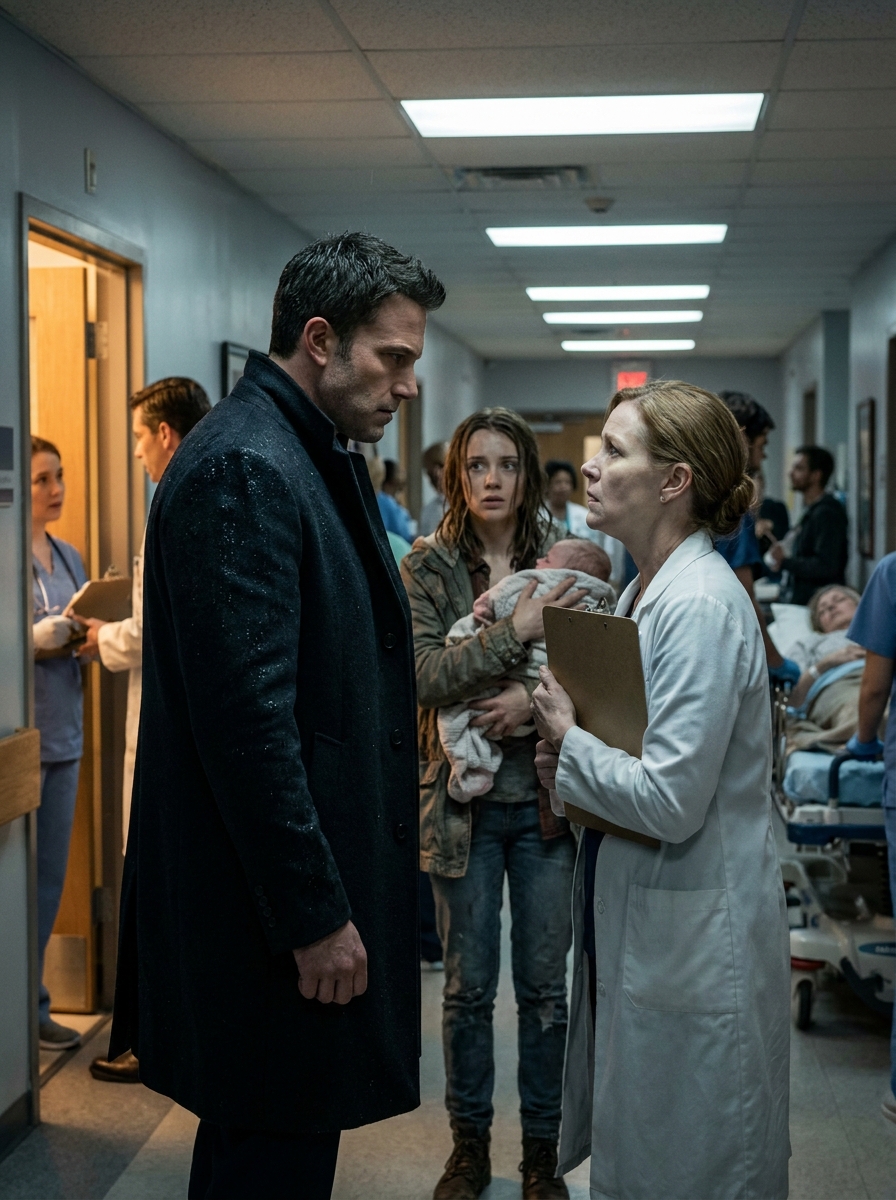
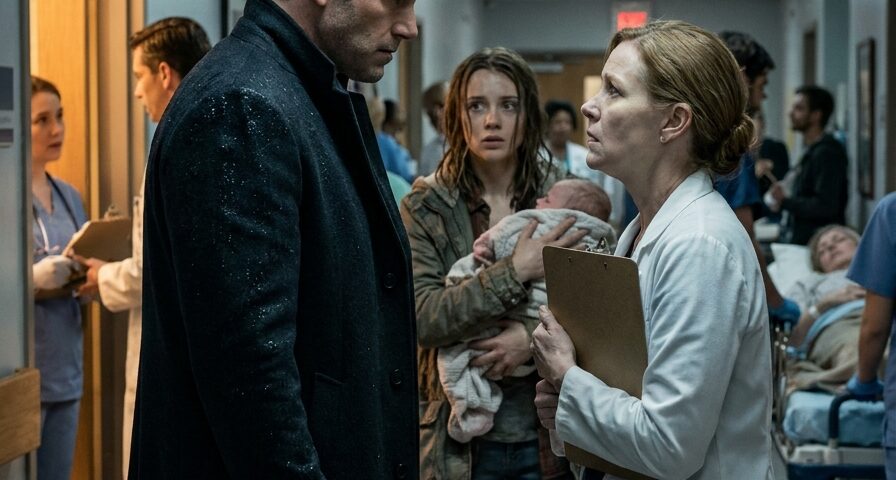
Giovanni Moretti stood in the center of it, tall and still in a dark overcoat, water beading on the shoulders. His hair was damp from the storm, his face unreadable except for his eyes.
Those eyes were on Marla Hensley.
She had been so sharp with me minutes earlier, so certain of her authority, but now her clipboard was pressed flat against her chest like a shield.
“I asked a question,” Giovanni said.
Dr. Sullivan stepped forward before Marla could speak.
“No one delayed treatment,” he said firmly. “Your son is receiving care. We began intervention as soon as we assessed him. Administrative issues did not prevent medical action.”
Giovanni turned his gaze to the doctor.
For a second, I thought he might argue. Giovanni had never liked being corrected. But then Luca cried from behind a nearby curtain—thin, weak, frightened—and every trace of confrontation drained from his face.
He looked at me.
The room disappeared.
For fifteen months, I had imagined seeing him again in a hundred different ways. In a courtroom. In a restaurant doorway. On the street, by accident, with enough time to cross before he saw me. I had imagined anger in his face, accusation, maybe even indifference.
I had not imagined this.
The man I had left stood before me having just learned he had a son, and the first emotion I saw in him was not rage.
It was fear.
“Lauren,” he said quietly. “Where is he?”
I pointed toward the curtained bay because my voice failed.
He moved past me, then stopped, as though remembering he had not been invited. His hand tightened once at his side.
“May I see him?”
That question nearly broke me.
Giovanni Moretti, who could make half a city move with one phone call, was asking permission to stand beside a sick baby.
I nodded.
He stepped through the curtain.
I followed.
Luca lay on the small hospital bed wearing only a diaper, his cheeks flushed, dark curls damp against his head. A nurse adjusted a monitor while another prepared medication. His tiny chest rose and fell too quickly. An IV had been taped to his hand, and he kept trying weakly to pull at it.
Giovanni stopped at the foot of the bed.
He did not touch Luca at first.
He simply stared.
I watched recognition move across his face in pieces. The black hair. The shape of the brows. The little crease between Luca’s eyes when he whimpered. Features I had seen every morning and feared he would one day inherit more deeply than bone.
Giovanni’s hand rose slowly to his mouth.
“Madonna,” he whispered.
Luca cried again, small and hoarse.
Giovanni looked at me with something raw in his eyes. “He’s mine.”
It wasn’t a question.
“Yes.”
His jaw worked once.
“Seven months?”
“Yes.”
His gaze fell briefly to my left hand, bare of the ring he had given me in Florence, the one I had mailed back through my attorney because I couldn’t bear to see him receive it.
“You were pregnant when you left.”
“I didn’t know yet.”
That was true.
Not the whole truth, but true.
I had discovered it five weeks later in a grocery store bathroom after buying the test with trembling hands and pretending to read pasta labels until the aisle cleared.
Dr. Sullivan entered, saving me from the rest.
“Mr. Moretti,” he said, “I need medical history. Any family history of immune disorders, neurological conditions, severe allergies, clotting issues, adverse reactions to antibiotics?”
Giovanni turned fully toward him, the businessman returning just enough to organize fear into usefulness.
“No severe allergies. My mother had an autoimmune condition—lupus, diagnosed late. My younger sister had febrile seizures as a child. My father’s side has a history of clotting problems. I can have complete records sent immediately.”
“That would help.”
Giovanni looked at one of the men who had arrived with him. “Marco.”
The man was already pulling out a phone.
Dr. Sullivan continued. “We’re treating aggressively because Luca’s symptoms suggest possible bacterial meningitis. We’ve started antibiotics and fluids. We may need a lumbar puncture to confirm.”
The phrase made the floor tilt beneath me.
Giovanni noticed before anyone else. He reached toward me, then stopped, his hand suspended in the air between old instinct and new boundaries.
I hated that I wanted him to finish the motion.
I hated more that he didn’t.
“Lauren,” he said. “Sit.”
“I’m fine.”
“You are not.”
“I said I’m fine.”
His eyes flashed, but he lowered his voice. “This is not the time to prove you can stand alone.”
That sentence cut too close.
Because for fifteen months, standing alone had been the only proof I had.
Before I could respond, a nurse brought a chair. I sat because my knees had begun shaking, not because Giovanni told me to.
Marla appeared at the edge of the curtain. She had regained some color but not confidence.
“Mr. Moretti, I need to verify—”
Giovanni did not look away from Luca. “Speak to my attorney.”
“This is a hospital procedure.”
“Then follow it without approaching my son’s mother like she is trespassing in her child’s emergency.”
Marla’s lips pressed together.
Dr. Sullivan turned toward her. “Ms. Hensley, leave this bay.”
She left.
The nurse beside Luca exhaled quietly, almost imperceptibly.
I lowered my face into my hands.
The adrenaline that had carried me through the rain, the waiting room, the call, and Giovanni’s arrival began to collapse. I was cold. My socks were wet. My hair stuck to my neck. My son was sick, and his father was standing five feet away after more than a year of silence I had chosen.
I felt Giovanni crouch beside my chair before I looked up.
He spoke quietly enough that only I could hear.
“Why didn’t you tell me?”
There it was.
Not shouted. Not sharp.
Worse.
Wounded.
I looked at Luca because I could not look at him.
“Because I was afraid.”
“Of me?”
My silence answered.
Giovanni went very still.
The last time we had been in the same room, we were standing in our bedroom in the Back Bay townhouse while rain hit the windows much like tonight. I had a suitcase by the door. He had blood on his cuff—not his blood, he told me. Never enough explanation. Always enough danger.
I had asked him whether the life he lived would ever be safe.
He had said, “Safe is a word people use when they do not understand power.”
That was the night I left.
Now he looked at our son, tiny beneath hospital blankets, and the old certainty in him seemed to fracture.
“I never would have hurt him,” he said.
“I know.”
His eyes came back to me.
“I didn’t know that then,” I whispered. “I knew you loved me. I also knew men with enemies don’t get to decide who those enemies notice.”
Pain moved through his face. He stood slowly.
For once, he did not argue.
Hours blurred after that.
A private pediatric infectious disease specialist arrived, though Dr. Sullivan made it clear that Boston General remained in charge of Luca’s care. Giovanni accepted that with surprising restraint. He had records sent, then reviewed, then translated where necessary. His attorney appeared, spoke to patient administration, and resolved guardianship questions without fanfare. No threats. No performance. Just paperwork handled by people who knew how to move fast.
Marla did not return.
I stayed beside Luca’s bed.
So did Giovanni.
He removed his overcoat eventually and rolled up his sleeves. His white shirt was damp at the collar. The expensive watch on his wrist caught the fluorescent light when he rested his hand on the bed rail.
Luca woke briefly around three in the morning.
His eyes opened, glassy and unfocused.
“Hi, baby,” I whispered, leaning close. “Mama’s here.”
His little mouth trembled.
Giovanni’s face changed at the word Mama. He looked away quickly, but not before I saw it.
Luca whimpered again.
I touched his cheek. “You’re okay. You’re so brave.”
Giovanni stood frozen.
“Talk to him,” I said softly.
He looked at me.
“He knows voices,” I said. “He doesn’t know yours yet, but he can hear you.”
For a second, I thought he might refuse. Not out of pride, but fear. Giovanni understood negotiations, loyalty, risk, money. Babies were another language entirely.
Then he moved closer.
He placed one hand carefully near Luca’s foot, not touching at first.
“Luca,” he said.
His voice broke on the name.
He cleared his throat.
“I am Giovanni,” he continued in a low voice. “Your father.”
Luca blinked slowly.
Giovanni swallowed.
“I am late,” he said. “That is my fault and not yours.”
My eyes filled.
He touched Luca’s foot then, just one finger against the tiny heel.
“I need you to fight,” he whispered. “Your mother has done enough fighting alone.”
I turned away before he could see me cry.
By morning, Luca’s fever had begun to respond.
Not enough for relief.
Enough for hope.
Dr. Sullivan explained that the next twenty-four hours mattered. The initial labs were concerning, but the early treatment seemed to be helping. We still needed results. We still needed observation. We still needed to wait.
Wait.
The cruelest medical instruction.
Giovanni’s men rotated outside the room, never entering unless asked. Marco brought coffee no one drank. A woman named Valentina arrived at dawn with dry clothes for me, selected in my size with unnerving accuracy. Soft gray sweatpants, a sweater, socks, a raincoat.
“I don’t need—”
Giovanni looked at me from beside the window. “Please.”
Just that.
Please.
I took the clothes.
In the family restroom, I changed slowly, my body shaking from exhaustion. I caught sight of myself in the mirror and barely recognized the woman looking back. Pale. Hollow-eyed. Hair tangled from rain. A mother trying not to fall apart because a baby in the next room needed her whole.
When I returned, Giovanni was sitting beside Luca.
He had one hand resting on the mattress near our son, close enough to comfort but not crowd. He was speaking Italian under his breath.
I stopped in the doorway.
His voice was softer than I remembered it ever being.
Not the commanding voice used in boardrooms or the dangerous calm I had heard when men came to our house at midnight. This was a voice from somewhere older. A voice that belonged to kitchens, lullabies, childhood.
“What are you saying?” I asked.
He looked up.
“A prayer my grandmother used to say when children were sick.”
“You pray?”
“Badly.”
I almost smiled.
He looked back at Luca. “But she was very convincing. I am hoping influence carries across generations.”
The almost-smile became real for half a second.
Then faded.
Because grief and fear always returned when the room grew quiet.
At ten, Dr. Sullivan asked us to step into a consultation room while nurses performed another check. I didn’t want to leave Luca, but the nurse promised she would call immediately if he stirred.
The consultation room was small, with a round table, four chairs, a box of tissues, and a framed print of a sailboat that seemed painfully optimistic.
Giovanni closed the door behind us.
The silence changed.
Away from Luca’s monitors, we were no longer only parents beside a hospital bed. We were ex-husband and ex-wife again, standing among everything unsaid.
He spoke first.
“Tell me about him.”
I wrapped my arms around myself. “Now?”
“Yes.”
The answer was immediate, almost desperate.
I sat.
Giovanni sat across from me, but not too close.
I told him Luca was born during a thunderstorm. That he hated peas but loved sweet potatoes. That he had one dimple in his left cheek. That he slept with his fists tucked beneath his chin. That he laughed whenever I sneezed and cried when the vacuum ran. That his first word had not arrived yet, but I was fairly certain he was considering “duck” because of the yellow bath toy he refused to release.
Giovanni listened to every word as if I were reading a sacred text.
When I finished, his eyes were wet.
He did not wipe them.
“I missed all of that,” he said.
“Yes.”
“You chose that.”
“Yes.”
He flinched, but I would not soften the truth for either of us.
“And you know why I chose it,” I said.
His jaw tightened. “I left that world.”
I stared at him.
He reached into the inside pocket of his suit jacket and removed a folded document. He placed it on the table between us.
“What is this?”
“Proof.”
I did not touch it.
He understood and opened it himself.
Legal filings. Corporate dissolution records. Asset transfers. Names I recognized from whispers during our marriage. Names I had trained myself not to ask about.
“After you left,” he said, “I began dismantling everything my father built outside legitimate business.”
I looked up slowly.
“My father had two empires,” Giovanni continued. “The public one and the one everyone politely pretended not to see. When I inherited both, I believed control was the same as responsibility. You told me it was not.”
“I told you many things.”
“I heard some too late.”
I looked down at the papers.
“Is it over?”
“No.”
The honesty made my stomach twist.
“But it is smaller,” he said. “Weaker. And there are people who hate me for making it so.”
“There it is.”
His eyes closed briefly. “Lauren—”
“That is why I didn’t tell you. Not because I thought you’d hurt Luca. Because your name alone turns a child into leverage.”
He looked down at his hands.
For years, Giovanni’s hands had fascinated me. Elegant, strong, capable of tenderness and command. He used to trace circles on my wrist when he couldn’t sleep. He used those same hands to close doors before conversations I was not allowed to hear.
“I thought I could build a wall high enough,” he said.
“Around me?”
“Around everything.”
“And when I said I couldn’t breathe behind it?”
His face tightened with regret. “I called it protection.”
“You called it love.”
He nodded once. “I was wrong.”
Those three words landed quietly.
Not enough to undo anything.
Enough to change the room.
Before I could respond, the door opened.
Marco stood outside, expression controlled but tense.
“Giovanni.”
The shift in his voice made Giovanni stand.
“What?”
Marco glanced at me, then back at him.
“There was an incident at Lauren’s apartment.”
My blood went cold.
“My apartment?”
Giovanni’s face hardened. “What kind of incident?”
“Someone entered. No sign of forced access. A neighbor saw a man leaving through the rear stairwell around dawn. Police are there now.”
My first thought was Luca’s crib.
His blanket.
The little blue sweater draped over the chair.
My life, small and carefully hidden, opened by a stranger’s hand.
I gripped the table.
Giovanni turned to me. “Did anyone know you were coming here last night?”
“No. I just ran.”
“Who has a key?”
“My landlord. My friend Nora. The sitter, but she’s seventy and terrified of elevators. That’s it.”
Marco’s phone buzzed. He read the message, and something in his expression darkened.
“What?” I demanded.
He looked to Giovanni first.
“Tell me,” I said.
Marco handed me his phone.
The photograph showed my apartment nursery.
Luca’s crib stood in the center. His mobile hung above it, little felt moons and stars suspended in the dim light. On the wall, someone had taped a white envelope.
Written across it in black marker were three words:
HE HAS RIGHTS.
I sat down hard.
Giovanni took the phone from my hand. The air around him changed, growing dangerously still.
“No,” I said immediately.
He looked at me.
“I know that look. Do not become the man I ran from.”
His eyes held mine, and for one second I saw the battle in him—old instinct against the new promise he had not yet learned how to keep.
Then he set the phone down carefully.
“You are right,” he said.
Marco looked surprised.
So was I.
Giovanni took out his phone. “Send everything to Detective Ames. Full cooperation. No private action.”
Marco nodded and stepped away.
I stared at Giovanni. “Detective Ames?”
“I have worked with him during the transition away from my father’s old network.”
“You have a detective now?”
“I have several apologies that require law enforcement.”
Despite myself, a breath of laughter escaped me. It sounded almost painful.
Giovanni sat again, slower this time.
“Whoever entered your apartment knows about Luca,” he said. “They may have known before last night.”
The room tilted.
“No.”
“Lauren.”
“No. I was careful. I changed neighborhoods. I used my maiden name. I paid cash for the sitter. I didn’t post pictures. I didn’t tell anyone connected to you.”
“You told your attorney.”
“Caroline would never—”
“I am not accusing her.”
I closed my eyes.
The walls I had built around Luca suddenly seemed made of paper.
Giovanni’s voice softened. “You protected him well.”
“Not well enough.”
“You got him to the hospital. You called me when his life required it. That is protection.”
I wanted to believe him.
Instead, I thought of a stranger standing over Luca’s crib while we were in the emergency room.
When we returned to Luca’s bay, his fever had dropped another fraction. His small body seemed less rigid. The nurse smiled cautiously and said, “He’s responding.”
I nearly collapsed with relief.
Giovanni’s hand found the back of a chair. He gripped it hard enough for his knuckles to whiten.
Hours later, Luca opened his eyes properly.
He looked first at me.
Then, slowly, at Giovanni.
Giovanni did not move.
Luca blinked, suspicious in the solemn way babies can be suspicious of furniture, ceiling fans, and men who arrive by helicopter.
Then he made a small sound.
Not quite a cry.
Giovanni looked at me. “What does that mean?”
“It means he’s deciding whether you are acceptable.”
“How long does that take?”
“With Luca? Depends on your references.”
For the first time that night, Giovanni smiled.
A real smile.
Small. Uncertain. Devastatingly familiar.
I hated how much I had missed it.
Luca lifted one hand weakly.
Giovanni looked to me again.
I nodded.
He offered his finger.
Luca wrapped his tiny hand around it.
Giovanni’s face changed completely.
Powerful men often looked foolish in the presence of babies. Their certainty had nowhere to stand. Giovanni stared at Luca’s fist around his finger as though he had just been handed both a crown and a sentence.
“He is very strong,” he whispered.
“Yes.”
“Like you.”
I looked away.
Too much.
By evening, the test results confirmed bacterial meningitis caught early enough that the doctors were cautiously optimistic. Luca would need days of treatment, monitoring, and follow-up. There could still be complications. But the immediate terror had loosened its grip.
I cried in the hallway where Luca could not hear me.
Giovanni found me there.
He did not touch me.
He leaned against the wall beside me, leaving careful space.
For a long time, neither of us spoke.
Finally, he said, “When you left, I looked for you.”
“I know.”
His eyes moved to mine.
“I made sure you found enough to know I was alive and enough to think I was gone for good.”
“I thought so.”
“I’m sorry.”
He nodded.
“Were you alone?” he asked.
The question was quiet.
“No,” I said. “Not always. Nora helped. My neighbor Mrs. Bell brought soup. A nurse from the clinic taught me how to swaddle because Luca screamed every time I tried. There were kind people.”
His face softened with gratitude and pain. “Good.”
“But at night,” I admitted, “yes. I was alone.”
He absorbed that.
“I should have been someone you could call before tonight.”
“Yes.”
“I want to become that.”
I closed my eyes. “Giovanni—”
“Not for you,” he said quickly. “Not like that. I have no right to ask anything from you. But for him. And if you allow it, for the parts of your life that need help carrying weight.”
I opened my eyes.
The old Giovanni would have said, I will fix this.
This man said, If you allow it.
That difference frightened me more than arrogance because it made hope possible, and hope had once nearly ruined me.
“I don’t know how to trust you,” I said.
“Then don’t start with trust. Start with rules.”
That sounded like him.
I almost smiled again.
“Rules?”
“Yes. Written. Legal. Clear. Where Luca lives. Who sees him. Security that you approve. No men following you without your consent. No decisions made over your head. No private retaliation. No contact with my family until you choose it.”
“Your family?”
His expression closed slightly.
“My mother will know by morning.”
A new fear entered me.
I had met Isabella Moretti only twice during our marriage. She was elegant, devout, and terrifying in the quiet way of women who had survived by understanding every room before entering it. She never insulted me. She never raised her voice. But once, at dinner, she touched my wrist and said, “The Moretti name protects what belongs to it.”
At the time, I thought it was affection.
Later, I wondered if it was warning.
“She can’t come near him,” I said.
Giovanni nodded immediately. “Not without your permission.”
“You didn’t even argue.”
“I am trying to learn.”
The hallway lights hummed above us.
At midnight, Giovanni’s attorney arranged a temporary written agreement at my request. It was simple: I remained Luca’s sole residential parent until formal family court proceedings. Giovanni would have supervised hospital access with my consent. No public announcement. No photographs. No private security assigned to me without mutual agreement. All threats would go through law enforcement.
He signed first.
Without hesitation.
When he handed me the pen, our fingers brushed.
Memory moved between us.
A vineyard in Tuscany. His hand at the small of my back. The first time he told me he loved me, not in English, but in Italian, because he said the words belonged closer to his bones that way.
Then another memory.
A locked study door.
A whispered warning from a driver.
Blood on his cuff.
I signed.
The next morning, sunlight broke through after the rain.
Luca slept more peacefully, his fever down, his color better. The nurse called him “a little fighter,” and Giovanni looked proud enough to embarrass all of us.
Around ten, Caroline, my divorce attorney, arrived.
She was small, sharp-eyed, and furious on my behalf before she even reached the room.
“I leave you alone for one night,” she said, “and you summon an international incident.”
“I called my ex-husband.”
“Same thing, in this case.”
Giovanni stood when she entered. “Ms. Price.”
“Mr. Moretti.”
Their handshake was brief and cold.
Caroline turned to me. “How is Luca?”
“Improving.”
Her face softened. “Thank God.”
Then she saw Giovanni sitting beside the bassinet and sighed. “Well. This will be complicated.”
“It already is.”
She lowered her voice. “There’s something you need to know.”
My stomach tightened. “What?”
She glanced toward Giovanni.
“You can say it in front of him,” I said.
Caroline didn’t look happy about that, but she continued.
“When you asked for Giovanni’s number, I pulled your divorce file from archive. There was a sealed addendum I had never seen.”
Giovanni’s eyes sharpened. “Sealed by whom?”
“That’s the problem,” Caroline said. “The filing stamp appears legitimate, but it was never logged through my office. It was attached to the final decree fifteen months ago.”
“What does it say?” I asked.
She removed a copy from her bag.
My hands felt cold before I even touched it.
The document was a notarized declaration.
Signed with Giovanni’s name.
Dated two weeks before our divorce finalized.
I scanned the lines once.
Then again.
No.
I looked up at him.
His face had gone blank, but his eyes were burning.
“I did not sign that.”
Caroline’s voice was tight. “I hoped you would say that.”
“What is it?” Giovanni asked.
I forced myself to read aloud.
“In the event Lauren Grant Moretti is found to be pregnant at the time of dissolution or within three hundred days thereafter, Giovanni Alessandro Moretti waives all parental claim, custody interest, inheritance attachment, and notice rights regarding any child born of the marriage.”
The room seemed to vanish around me.
For seven months, I had believed I was hiding Luca from Giovanni.
For fifteen months, I had carried guilt like a stone beneath my ribs.
But someone had filed a document making it look like Giovanni had abandoned a child before he even knew that child existed.
Giovanni’s voice was dangerously soft.
“Who notarized it?”
Caroline turned the page.
Her face had already answered.
“Thomas Bell.”
Giovanni went still.
“Who is Thomas Bell?” I asked.
He did not respond immediately.
Then he looked toward Luca, asleep beneath a white blanket, and something like dread crossed his face.
“My father’s attorney,” he said. “But he died three years ago.”
Caroline placed another page on the table.
“Then someone is using a dead man’s seal.”
Before anyone could speak, Marco appeared at the door.
His face was pale.
“Giovanni.”
“What?”
“Your mother is downstairs.”
My pulse jumped.
“I said no,” Giovanni replied.
“She is not alone.”
He glanced at me, then lowered his voice.
“She brought a priest. And a woman claiming she has the legal right to examine Luca.”
Caroline stood. “Absolutely not.”
Giovanni’s face hardened. “Name.”
Marco swallowed.
“Dr. Elena Bell.”
The name struck Caroline like a physical blow.
She turned toward the forged document on the table.
“Bell,” she whispered.
I looked between them. “Who is she?”
Giovanni’s gaze moved to the glass wall of the hospital room, where beyond it an elegant woman in black stood at the far end of the corridor, perfectly still, watching us.
Beside her was a woman in a white coat holding a leather medical bag.
Giovanni spoke quietly, and for the first time since he had arrived, he sounded afraid.
“Elena Bell was the doctor who signed my birth certificate.”
Luca stirred in his sleep.
The woman in the corridor lifted her head as if she had heard his name through the glass.
Then my phone buzzed.
An unknown number.
The message contained only one photograph.
A newborn baby wrapped in a blue hospital blanket.
On the back of the photo, someone had written:
Giovanni Moretti — property of Bell custody file.
A second message arrived before I could breathe.
Like father, like son.
I looked up at Giovanni.
His face had gone white.
And in the hallway, his mother smiled as though she had been waiting thirty-four years for this moment.