PART 2
Dr. Sloan did not press the emergency button.
Her fingers hovered above it for one terrifying second, long enough for my heart to forget how to beat, then she pulled her hand back and reached instead for the phone mounted beside the monitor.
“Melissa,” she said calmly, though I could hear the tightness under her voice, “please ask Dr. Patel to step into Room Three when he’s available.”
Adrian’s hand closed around the edge of the examination chair.
“What’s wrong?” he asked.
Dr. Sloan kept her eyes on the screen. “I don’t want anyone panicking.”
“That is not an answer.”
“Adrian,” I warned softly.
His jaw flexed, but he went silent. He had promised.
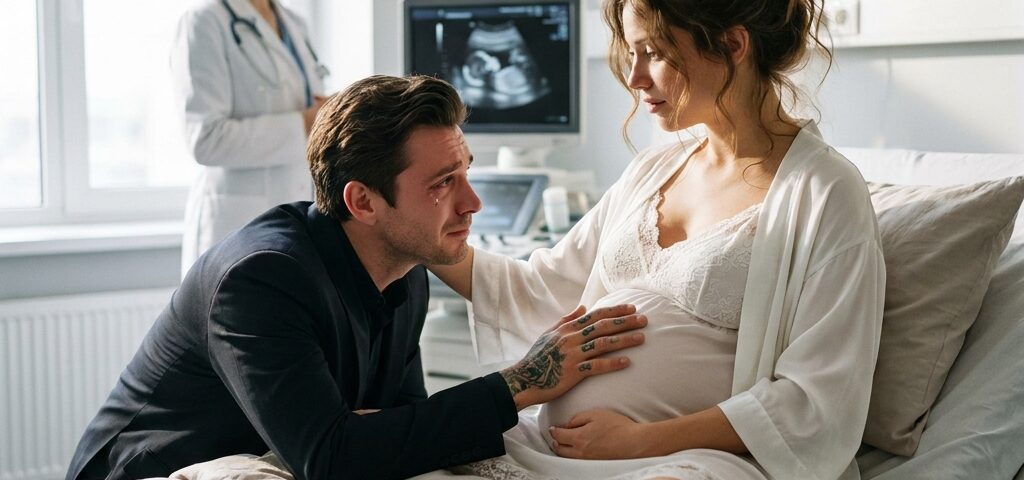
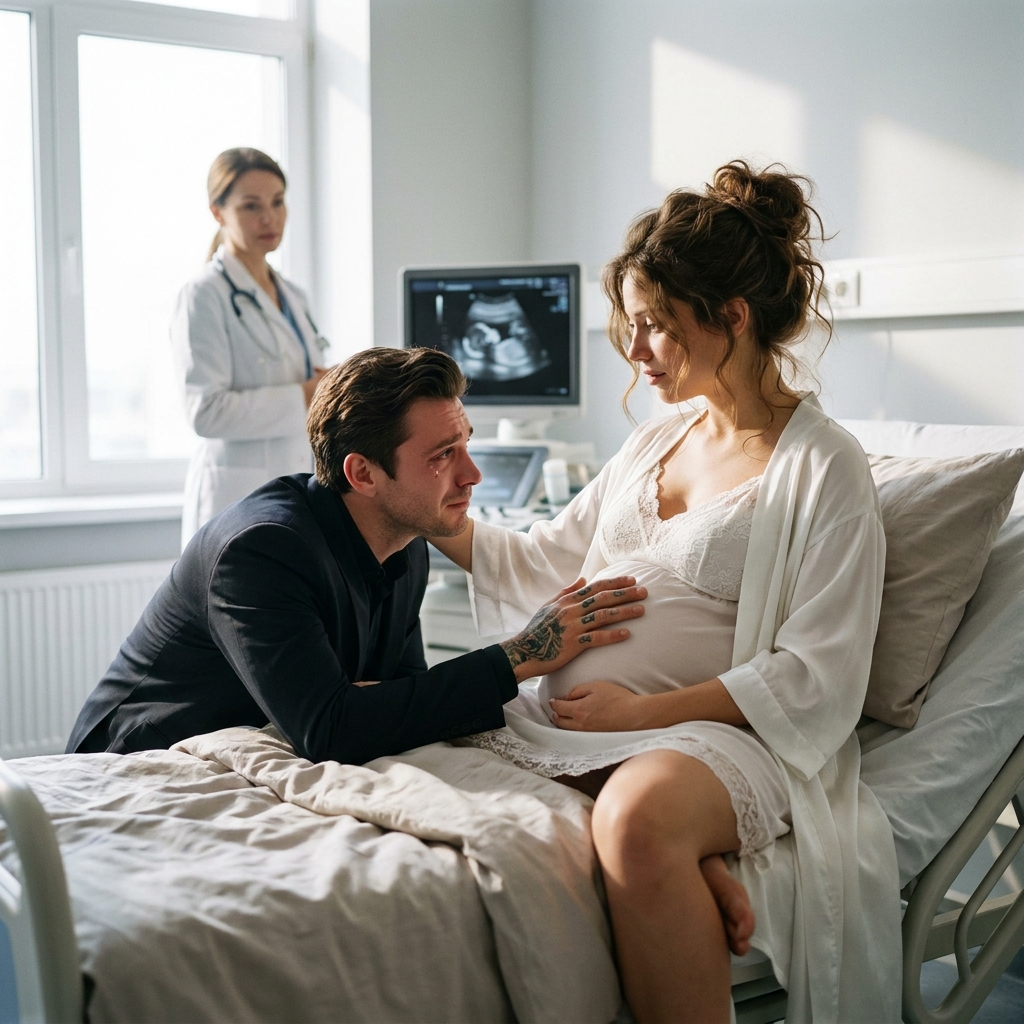
Dr. Sloan turned the monitor slightly away, studying the shifting gray image with a frown she was trying to hide. I watched her face because I could not bear to watch the screen. My daughter had been kicking me all morning, stubborn and strong, but suddenly every movement felt fragile.
“Is she okay?” I whispered.
Dr. Sloan finally looked at me. “Her heartbeat is steady. That’s good. But I’m seeing something I want another specialist to look at.”
“What kind of something?”
“Possibly a placental issue. Possibly nothing. At thirty-four weeks, we take every uncertainty seriously.”
Adrian moved closer, then stopped himself beside my shoulder. That small restraint unsettled me. The man I had married would have filled the room with commands until everyone obeyed him. This man stood with both hands at his sides, fighting every instinct he had.
“Can I do anything?” he asked me.
I almost said no.
For months, no had been my shield. No, I would not call him. No, I would not cry over him. No, I would not let his world swallow my child whole.
But fear has a way of stripping pride down to bone.
“Just stand there,” I said. “Please.”
He nodded once. “I’m here.”
Dr. Patel arrived five minutes later, a silver-haired maternal-fetal medicine specialist with reading glasses tucked into his coat pocket. He greeted me gently, glanced at Adrian only long enough to register the tension, and repeated the ultrasound himself.
The room became a cathedral of small sounds. The hum of equipment. The soft drag of the scanner across my stomach. My breath catching whenever the doctor paused too long.
Adrian never touched me again without asking, but his presence warmed the air beside me. I hated that it comforted me. I hated more that I needed it.
At last, Dr. Patel straightened.
“I want you admitted for monitoring,” he said.
My mouth went dry. “Today?”
“Yes. Your baby is stable, but the blood flow through part of the placenta is not ideal. We may only need to watch you overnight. We may need to deliver earlier than planned. I don’t want you going home until we know which.”
Adrian’s face turned to stone. “Then she goes to the best hospital in Chicago.”
“She goes where her medical team can coordinate her care,” Dr. Sloan said evenly. “That’s currently Northwestern, where Dr. Patel has privileges.”
“I’ll arrange private transport.”
“I can walk,” I snapped.
Everyone looked at me.
I pressed a hand to my stomach, embarrassed by the tremor in my voice. “I’m not helpless.”
“No,” Adrian said quietly. “You’re not.”
The agreement disarmed me more than an argument would have.
Dr. Sloan helped me sit up. “Elena, I know this is frightening, but you came in at the right time. That matters.”
At the mention of my name, Adrian’s eyes softened.
Elena Moretti.
No. Elena Walsh again, at least on paper. I had taken back my maiden name with the same shaky determination that had carried me through nights alone in my rented studio, folding tiny onesies on a mattress because I could not afford a dresser yet.
Adrian saw me wince as I swung my legs over the side.
“May I help?” he asked.
That question again.
I nodded because I was tired of pretending my back didn’t ache and my ribs didn’t feel bruised from the inside.
He offered his arm. Not his command. Not his authority. Just his arm.
I took it.
Outside the exam room, the waiting area had returned to its usual rhythm, though curious eyes followed us. Adrian’s bodyguards stood near the exit like two dark columns. His security chief, Luca, gave me a look that was unexpectedly gentle.
“Mrs. Moretti,” he said, then corrected himself. “Elena.”
Adrian noticed the correction. Pain moved across his face, brief and hidden almost immediately.
“I need my bag,” I said. “It’s at my apartment.”
“I’ll have someone get it.”
“No.”
He paused.
“My friend Mara has a key. I’ll call her.”
“Of course.”
The words were simple. The effort behind them was not.
In the ambulance, Adrian rode beside me after asking the paramedics and me both. He filled out no forms, made no demands, and did not once mention his name as if it were currency. He only watched the monitor strapped around my belly, listening to the galloping rhythm of our daughter’s heart.
After a while, he said, “Do you have a name?”
I looked toward the window. Chicago blurred past in winter-gray streaks, all glass, brick, and wet pavement.
“I was thinking Sofia.”
His breath changed.
“That was my mother’s name,” he said.
“I know.”
Silence settled between us, not empty, but crowded with all the things we had failed to say when we still shared a home.
“She would have liked you,” Adrian said.
“Your father didn’t.”
“My father didn’t like anyone who made me human.”
I turned to him. “Is that what I did?”
“For a while.” He looked at the monitor again. “Then I let him convince me it made you unsafe.”
There it was—the shadow behind our marriage.
Adrian’s father had died three years earlier, but men like Santino Moretti did not need to be alive to haunt a family. His lessons had been carved into Adrian so deeply that even love had entered our house wearing armor.
At Northwestern, I was placed in a private room because Dr. Patel requested quiet monitoring, not because Adrian threatened anyone. At least, that was what I chose to believe.
Mara arrived an hour later carrying my overnight bag, a paper sack of pastries, and the expression of a woman prepared to fight a war with her bare hands.
She froze when she saw Adrian by the window.
“Oh,” she said. “So the secret is out.”
“Mara,” I said.
Adrian stood. “Thank you for taking care of her.”
Mara’s eyes narrowed. “I took care of her because someone had to.”
He accepted that without flinching. “I know.”
She looked disappointed not to receive a worse answer.
While nurses adjusted monitors and checked my blood pressure, Mara unpacked my things with sharp little movements. She put my socks in the drawer, my charger beside the bed, and the pastries on the tray table like offerings to an anxious goddess.
When we were alone for a moment, she leaned close.
“Do you want him here?”
I watched Adrian through the glass wall, where he stood speaking quietly to Luca in the hallway. He looked older than he had that morning, as if fatherhood had descended on him all at once and found him unprepared.
“I don’t know,” I admitted.
“That’s allowed.”
“He asked permission before touching my stomach.”
Mara blinked. “Adrian Moretti asked permission?”
“Twice.”
“Well.” She sat back. “That’s either growth or a head injury.”
A laugh escaped me, shaky and grateful.
Adrian looked through the glass at the sound, and something in his expression broke open. It was not possessiveness. Not victory. Relief, maybe, at hearing proof that I could still laugh.
By evening, the doctors decided to continue monitoring overnight. The baby’s heartbeat remained steady, but my blood pressure drifted higher than they liked. Dr. Sloan explained everything in calm, careful sentences. Steroid shots to help the baby’s lungs. Bloodwork. More scans in the morning.
Adrian listened to every word, then asked questions instead of issuing orders.
“What signs should we watch for?”
“What would make delivery necessary?”
“What does Elena need tonight?”
Dr. Sloan answered him with a hint of approval.
I hated that, too.
After she left, Adrian stood beside the bed. “I should go.”
I looked up, surprised.
“You don’t want to stay?”
“I want to stay more than I’ve wanted anything in a long time.” His voice lowered. “But I don’t know whether my staying helps you or pressures you.”
The monitors clicked and sighed around us.
Six months earlier, on the night the divorce papers arrived, I had waited until sunrise for him to call. Every hour had passed like a verdict. By morning, my hope had turned into something brittle.
“You didn’t come,” I said.
His face tightened. “I was told you refused to see me.”
“What?”
“My attorney said your lawyer threatened a restraining order if I approached you.”
“I never had a lawyer.”
The room seemed to tilt.
Adrian stared at me. “Elena.”
“I signed because your lawyers sent everything already prepared. I thought you wanted it clean and fast.”
“I never signed divorce papers.”
Cold moved over my skin.
“That’s not funny.”
“I’m not trying to be.”
Mara, who had been quietly scrolling near the window, lowered her phone. “Wait. What do you mean you never signed?”
Adrian’s eyes did not leave mine. “I signed a separation agreement after Luca convinced me we needed distance until we found the leak in my organization. I never filed for divorce.”
I gripped the blanket. “I have the decree.”
“Then someone filed it without me.”
The baby kicked, hard enough to make the monitor jump.
For a moment, none of us spoke.
Then Adrian took out his phone, called someone named Russo, and said in a voice so controlled it chilled me, “Pull every court record connected to my marriage. Now. Quietly.”
He ended the call and looked at me as if the floor had vanished between us.
“All this time,” I said, “you thought I left you.”
“I thought you chose safety.”
“And I thought you chose power.”
Mara whispered, “Somebody wanted both of you apart.”
The sentence settled into the room like a fourth heartbeat.
Adrian sat down slowly in the chair beside my bed. “The leak started shortly before the separation. Shipments intercepted. Accounts exposed. Men I trusted turning nervous. Then I received photographs of you leaving your office, grocery shopping, walking near the river.”
My throat tightened. “Someone was watching me?”
“Yes.”
“Why didn’t you tell me?”
“Because I was arrogant enough to think fear was something I could carry alone.”
The honesty hurt worse than an excuse.
“I would have carried it with you.”
“I know that now.”
“No,” I said, tears burning. “You knew it then. You just didn’t trust love to survive the truth.”
He flinched.
Good, I thought. Then immediately felt exhausted by the cruelty of wanting him wounded.
A nurse came in to check the monitor, and we fell silent. She smiled at the screen. “Baby girl looks active.”
“She’s nosy,” Mara said. “Already involved in adult business.”
The nurse laughed, and the tension eased enough for me to breathe again.
Later, after Mara went downstairs for coffee and the hallway dimmed into hospital quiet, Adrian remained in the chair. He had removed his suit jacket and rolled up his sleeves. Without the polished armor, he looked less like the feared man Chicago whispered about and more like someone who had not slept well in months.
“Did you know?” I asked. “About the pregnancy at all?”
“No.”
“If you had known, would you have come?”
“Elena.” His voice broke around my name. “I would have torn the city apart looking for you.”
“That’s what I was afraid of.”
He nodded slowly. “Fair.”
Outside, snow began to fall, softening the skyline beyond the glass. Hospital lights turned every flake silver.
“I didn’t hide because I hated you,” I said. “At first, I told myself I did. It made everything easier. But the truth was… I was afraid if I saw you, I would forgive you before you understood what you had done.”
“And now?”
“I don’t know what forgiveness looks like when the damage may have been arranged by someone else.”
“Some of it was still mine.”
I looked at him.
He leaned forward, elbows on knees. “I made a life where enemies had access to our door. I let people speak for me. I let silence become a decision. Even if someone forged papers, they used the distance I created.”
That was the first apology that felt like a foundation rather than a key he expected to unlock me.
My eyes filled.
“I was so lonely,” I whispered.
His face crumpled before he mastered it. “So was I.”
The monitors continued their steady music.
At midnight, Mara returned and insisted Adrian leave long enough to eat. He refused until I told him to go. Even then, he asked whether I wanted Luca outside my door.
“No guards,” I said.
His brow furrowed.
“I mean it.”
He looked toward the hallway, then back at me. “One person at the elevator, not your door. You won’t see him.”
“That sounds suspiciously like compromise.”
“I’m learning.”
Mara waited until he left before climbing into the chair he had vacated.
“Okay,” she said. “I hate to say this, but he seems less awful than expected.”
“He was never awful.”
“No, he was emotionally constipated and surrounded by criminals. Different category.”
“Mara.”
“What? I’m being supportive.”
I smiled despite myself.
Her expression softened. “Are you okay?”
“No.”
“Good. Honest answer.”
I touched the side of my stomach. “What if she has to come early?”
“Then she comes early, and she will be tiny and furious and loved.”
That undid me. I cried quietly while Mara held my hand and pretended not to cry with me.
Morning brought pale sunlight, another scan, and slightly better news. The blood flow was still concerning, but not worse. Dr. Patel recommended staying admitted for at least another day.
Adrian returned wearing the same shirt, freshly pressed somehow, with coffee for Mara, tea for me, and a small stuffed rabbit from the hospital gift shop.
“It was the least ridiculous one,” he said, placing it on my tray.
The rabbit had one ear flopped over its eye.
“It looks like it knows too much,” I said.
Mara lifted her cup. “A perfect family mascot.”
For a few hours, things felt almost normal. Strange normal, hospital normal, but normal enough. Adrian read pamphlets about premature delivery with the seriousness of a man reviewing peace treaties. Mara knitted half a baby hat badly. I answered messages from the bookstore, telling my manager I had been admitted for monitoring and leaving out the part where my supposedly ex-husband had reappeared like a storm in an expensive coat.
By afternoon, Russo called.
Adrian stepped into the hallway, but through the glass I saw his posture change.
When he came back, the room seemed colder.
“What?” I asked.
He closed the door.
“The divorce decree is real,” he said. “Filed four months ago. Digitally signed by both of us.”
“I signed on paper.”
“Your signature was scanned. Mine was authenticated through my legal office.”
Mara sat upright. “So someone in your office did it.”
“Yes.”
“Who had access?”
Adrian looked at me. “My general counsel. Two senior associates. My brother.”
The last two words landed softly, which made them worse.
“Matteo?” I said.
Adrian’s younger brother had always been charming in a restless, wounded way. He brought flowers to dinners and stayed late to help me clear plates. He called me Ellie when Adrian was not listening because he knew Adrian disliked nicknames. After the divorce, he had sent one message: I’m sorry he chose the family over you.
I had deleted it, then cried for twenty minutes.
“Matteo wouldn’t,” I said automatically.
Adrian’s face was unreadable. “I don’t know what Matteo would do anymore.”
Before we could say more, there was a knock.
A nurse I didn’t recognize entered carrying a small white envelope. She was young, with freckles and nervous hands.
“Sorry,” she said. “This was left at the nurses’ station for Ms. Walsh.”
Adrian stood. “By whom?”
“I’m not sure. Volunteer desk, maybe.”
He reached for it, then stopped and looked at me.
My pulse quickened. “Give it to me.”
The envelope had no stamp, no return address. Only my name, written in blue ink.
Elena Walsh.
Not Moretti.
My fingers trembled as I opened it.
Inside was a single photograph.
At first, I didn’t understand what I was seeing. It was old, slightly grainy, taken from a distance. A woman stood outside a brownstone beneath an awning, one hand raised to shield her face from rain.
The woman was me.
Except the date printed in the corner was impossible.
It had been taken nine months ago.
Before Adrian had asked for separation.
Before the first threat.
Before anyone should have been watching me.
On the back, someone had written one sentence.
Ask Adrian what happened the night your father died.
The room went completely still.
My father had died in a car accident two years before I met Adrian.
At least, that was what I had always believed.
I looked up at him, and for the first time since he walked into the clinic, Adrian Moretti looked not broken, not angry, but afraid of me.