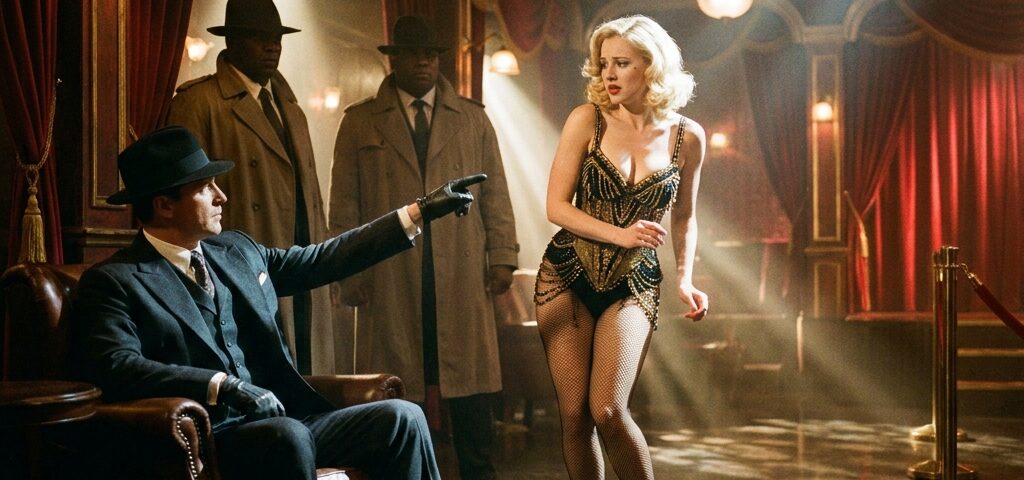
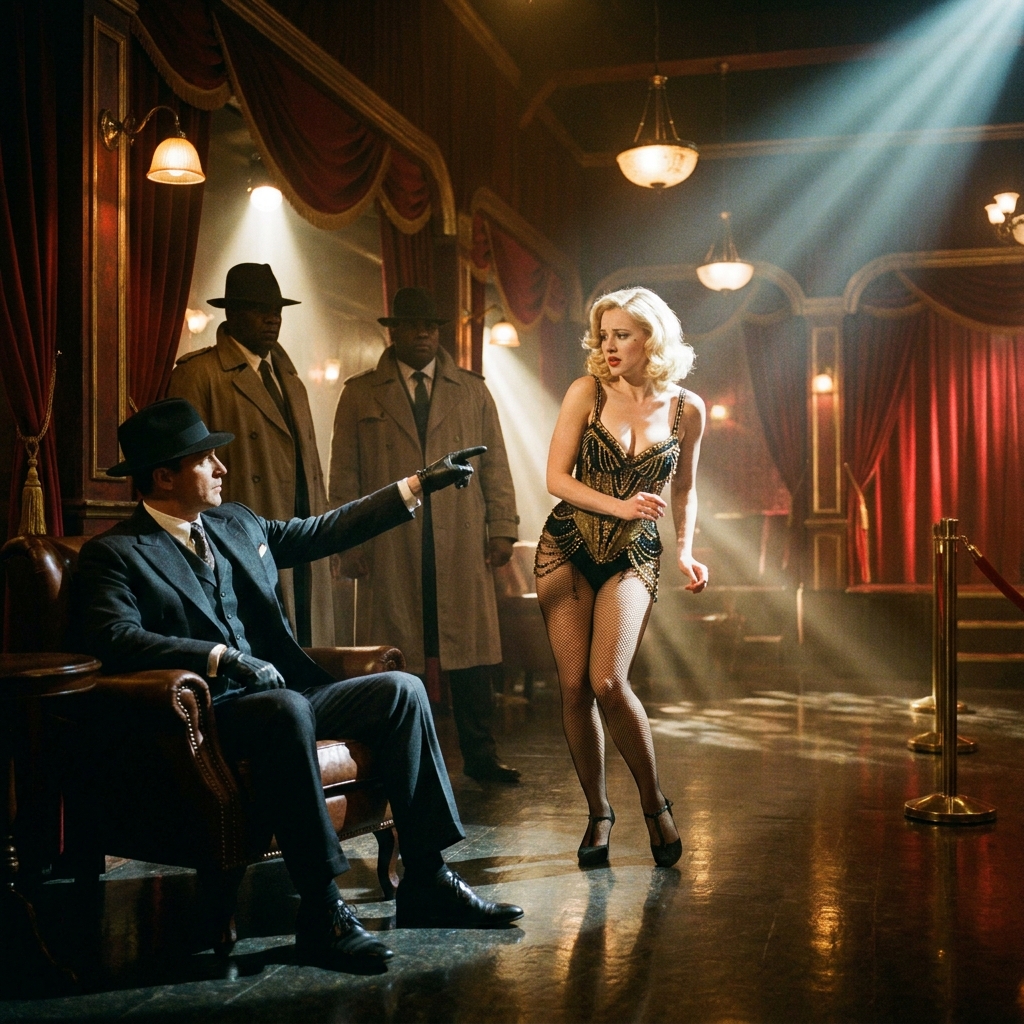
Dante Marchetti had lowered his wife and their unborn child into the same patch of earth, and somewhere in that ceremony, he had lowered the last soft piece of himself right along with them.
Three winters had passed since then. Three winters in which no woman had dared to rest a hand on his sleeve, let alone his heart.
Then, on an ordinary Thursday night thick with cigar smoke and bass, a dancer he had never met leaned into his private booth and breathed four words that cracked his carefully rebuilt world in half: “Your son is breathing.”
Inside The Onyx Room — the kind of club where senators shared bottles with men who didn’t officially exist — everyone knew the shape Dante Marchetti cut across a room. At thirty-nine, he owned the piers, half the security contracts south of the river, and enough buried secrets to bury half the city council along with them.
He sat that night the way he sat every night: alone, boxed in by six men who would die before letting a stranger get within arm’s reach of him. Women drifted past all evening, offering smiles built like invitations. He looked through every one of them like glass.
Grief had turned him into something closer to a sentence being served than a man being lived.
Then a new girl took the stage. The emcee called her Sienna Cole.
She wore silver, but she didn’t wear it like a woman chasing attention — her shoulders sat too high, her gaze kept flicking toward the fire exit like she was rehearsing an escape route mid-performance. Dante recognized fear on sight. He’d built an entire empire out of teaching people to feel it.
Halfway through her routine, her eyes locked onto him — not his tailored jacket, not the old scar carved across his knuckles, but the gold signet ring stamped with the Marchetti crest. Her face drained of color. She stumbled, barely caught her footing, and fled backstage before the final note landed.
His consigliere, Salvatore Conti, leaned in with the calm of a man who’d buried three generations of Marchettis. “New girls get nervous,” he said.
Dante didn’t answer.
Two minutes later, a scream tore through backstage. A bouncer hauled Sienna out by the wrist, shouting that she’d lifted a wallet from a customer’s jacket.
“I didn’t take anything,” she said, twisting against his grip. Her eyes found Dante again, and this time the fear in them had turned to something closer to desperation. She broke free, sprinted toward his booth, and slammed straight into the table. Glass exploded across the marble floor.
Every gun in his section came out at once.
Salvatore’s hand slid inside his jacket.
Sienna froze between six barrels and a man who hadn’t moved a muscle.
“I’m sorry,” she whispered — and then she leaned close enough that Dante felt her breath shaking against his ear. “Your wife delivered before she died.”
The music kept playing. Everything else in the room went silent.
He caught her wrist before the bouncers could drag her away. “Say that again.”
“Elena’s baby lived,” Sienna said. “He’s alive. I’ve watched him grow for three years.”
Dante’s grip tightened — not to hurt, only to keep her from bolting. “My son died in that explosion.”
“That’s what you were told.” Her eyes cut past his shoulder — to Salvatore. “By the man who arranged the lie.”
Salvatore’s face didn’t change. His hand slid deeper beneath his jacket. Dante saw it. So did Sienna.
She reached into her neckline and pulled out a small gold locket. Dante stopped breathing. He had placed that locket around Elena’s throat the night he proposed. It had never been recovered from the wreckage.
“My brother pulled her from that car,” Sienna said. “She lived forty-three minutes. Long enough to give birth.”
He opened the locket with hands that no longer felt steady. Their photograph sat on one side. Folded behind it, a strip of paper stained the color of old rust — a hospital identification number.
“My brother hid your son,” Sienna whispered, “because someone came to that hospital to finish what the bomb started.”
Dante rose to his feet. The entire booth went still around him.
“Where is he?”
“He was safe this morning.”
“This morning?”
“They found us.”
Salvatore’s gun cleared his jacket a half-second before Dante’s arm was already moving — hauling Sienna behind him, flipping the table as the first bullet buried itself in the wall exactly where her heart had been standing.
The club dissolved into screaming and smoke. Salvatore vanished through a side exit, firing twice behind him as Dante’s men gave chase.
Dante turned to Sienna, his voice gone glacier-cold. “Who else knows where my son is?”
“No one. That’s why I’m terrified.” Her hands shook as she pulled out her phone. “Salvatore sent this an hour ago.”
The screen showed a sleeping boy with dark curls, one small fist wrapped around a red toy car. Beside his pillow lay a black envelope stamped with the Marchetti crest.
Dante stared at the face of the son he had spent three years mourning.
Beneath the photo, seven words waited like a blade: Bring Dante to the old church — or the boy dies.
He looked at his men. “Bring her to the car.”
Sienna recoiled. “I am not going anywhere with you.”
He stepped closer, close enough that she had to tilt her chin to meet his eyes. “You walked in here carrying my dead wife’s locket and a photograph of the son I buried.”
He shrugged off his coat and settled it over her shaking shoulders. “Tonight, you’re the safest woman in this city.”
Twelve black cars sealed off the street outside within ninety seconds.
But when Dante’s convoy reached the address where the boy had been hidden, flames were already tearing through the roofline — and hanging from the front gate, soaked through with blood, was a single small red mitten.
The safe house was ash before the convoy’s tires stopped rolling.
The boy was gone.
And in the wreckage, Sienna found a message left behind by a woman supposedly dead for three years.
Dante held her back as firefighters rushed the collapsing frame. “Milo!” she screamed. “His name is Milo!”
A wounded caretaker crawled out from behind the garage. Dante’s men carried her clear of the smoke.
“Four men,” she gasped. “They knew every code we had.”
“Where did they take him?” Dante demanded.
The caretaker pressed something small into Sienna’s palm — a child’s shoe. Sienna tore the heel open and pulled free a tiny blinking tracker.
Dante expected a warehouse. An airport. Salvatore’s private estate.
Instead, the signal pulsed from inside Marchetti Cemetery.
“They took him to Elena’s grave,” Sienna said.
“That coffin has been sealed three years.”
She flipped the shoe over. Words were scratched into the sole in black ink: Ask Dante why he never saw the body.
Dante went still. He remembered the closed casket. Salvatore’s voice, gentle and final, insisting the fire had left nothing fit to view.
Then the locket in Sienna’s hand clicked open on its own — a hidden seam beneath the photograph, releasing a sliver of memory card. Dante slid it into her phone.
Elena appeared on the screen, pale against hospital sheets, a newborn cradled against her chest. “If you’re watching this,” she whispered, “Salvatore has already betrayed us. But he was never working alone.”
A shadow shifted behind the camera. Elena’s eyes lifted toward it, and she began to cry. “The person who ordered the bombing shares your blood, Dante.”
The recording cut to static.
At that exact instant, his phone lit up with an incoming call. Salvatore’s face filled the screen, standing inside the Marchetti mausoleum, Milo held against his side beside the coffin that was never supposed to open again.
Then another figure stepped into frame.
Dante’s younger brother. Nico. Smiling.
“Come alone,” Nico said. “Or this time your son actually joins his mother.”
Dante had shielded his brother from prison, from rival families, from their father’s cruelty more times than he could count. Nico had answered that loyalty by helping murder his wife. Now he stood above Elena’s grave with a three-year-old boy locked against his hip.
The convoy stopped outside Marchetti Cemetery at seventeen minutes past one in the morning. Rain hammered the marble angels lining the private drive. Beyond the iron gates, the family mausoleum sat on its hill, lit in flashes of lightning like something out of an old nightmare.
Dante checked the weapon holstered beneath his coat. Sienna caught his wrist before he could open the door.
“You can’t walk in there alone.”
“That’s exactly what he asked for.”
“You believe him?”
“No.”
“Then why are you walking straight into it?”
“Because my son is inside it.”
The words landed and neither of them spoke for a moment. For three years Dante had trained every soft edge out of himself, turning grief into discipline and discipline into a wall nobody could climb. Then this woman had walked into his club with his dead wife’s locket in her fist, and in under two hours she had handed him back a son, exposed his own brother’s betrayal, and reintroduced him to the particular terror of having something left to lose.
He turned to his captain, Bruno Castellano. “Circle the hill. Nobody fires until I give the signal.”
Bruno glanced at Sienna. “And her?”
“She stays in the car.”
“No,” Sienna said.
Dante opened the rear door anyway. “That wasn’t a request.”
“Milo calls my name when he’s scared.”
“He’ll have his father.”
“He doesn’t know you.”
The sentence hit harder than any insult could have. Sienna softened her voice, but she didn’t take it back.
“For three years I’ve been the one who wakes up when he has nightmares. I know which lullaby settles him. I know he won’t sleep unless the hallway light stays on because he hates the thunder.”
Dante’s jaw tightened. “You kept him from me.”
“I kept him alive.”
“You should have come sooner.”
“My brother tried.”
She pulled the coat tighter around the silver dress she still hadn’t had time to change out of. “Ray sent letters. He called your office more than once. Salvatore intercepted every one. Then Ray disappeared.”
Dante studied her face in the dashboard light. “You told me he was murdered.”
“I believe he was.”
“You believe?”
“His body was never found.”
The story shifted under him again. “What else haven’t you told me?”
“There isn’t time.”
“Make time.”
Sienna took a shaking breath. “The night Elena died, my brother wasn’t the only one in that ambulance.”
“Who else was there?”
“I was.”
Dante stared at her. “You saw her?”
“I held her hand while she was dying.” Rain streaked down Sienna’s face like it was doing her crying for her. “She made me promise not to bring Milo to you until we knew who had betrayed her. She said the danger was inside your own family. Ray wanted to trust you immediately. I was the one who was afraid.”
“So you let me bury an empty box.”
“I watched Salvatore’s people search every hospital in this city. I watched them kill the doctor who signed Milo’s birth record. If I’d carried that baby to your front door, he’d have been dead before sunrise.”
“And the dancing?”
“Salvatore found my brother’s old storage unit six weeks ago. He realized someone had taken the locket. I knew he’d come looking for whoever had it, so I put myself somewhere he’d already be watching.”
“You made yourself bait.”
“I needed to know if he was still circling you.”
Dante’s anger wrestled with something closer to reluctant respect. “That was reckless.”
“It worked.”
“It nearly got you killed tonight.”
“And now you know your son is breathing.”
Lightning cracked over the hill. Dante looked toward the mausoleum one more time. “Stay behind me.”
She nodded, and they walked into the cemetery together.
The mausoleum had been built by Dante’s grandfather, a man who believed a family should flaunt its wealth even in death. White columns framed a bronze door flanked by stone lions. The door stood open, candlelight flickering across generations of carved names.
Milo sat on top of Elena’s coffin, clutching the same red toy car from the photograph. Nico stood behind him. At thirty-four, he wore a rougher copy of Dante’s face — same dark hair, same gray eyes, but where Dante’s features held restraint, Nico’s held years of quiet resentment.
Salvatore stood beside him, a gun leveled at the back of Milo’s small head.
“Brother,” Nico said. “You actually came.”
Dante kept his hands where they could be seen. “Let the boy go.”
“Your boy?” Nico laughed without any warmth in it. “You’ve known him for less than an hour.”
“I’ve known you my whole life. Don’t make me regret every time I stood between you and our father’s fists.”
Nico’s smile disappeared. “You protected me? You humiliated me every time you cleared my debts like I was a child who couldn’t be trusted with money.”
“I paid what you owed.”
“You made sure I lived beneath you.”
“You chose that. I never asked you to.”
Salvatore’s grip tightened on the gun. “Enough.”
Dante turned toward the older man. “My father trusted you with everything.”
“Your father used me,” Salvatore said. “Exactly the way you have.”
“I treated you like family.”
“That was your mistake to make.”
Sienna stepped out from behind Dante. Milo’s whole face changed the second he saw her.
“Nora — Sienna!” His voice cracked.
She fought every instinct telling her to run to him. “I’m right here, sweetheart.”
The boy started to cry. Nico’s hand landed on his shoulder.
“Stay still.”
Dante’s voice dropped into something almost inhuman. “Take your hand off my son.”
For the first time, uncertainty flickered across Nico’s face — and then, deliberately, he tightened his grip instead of loosening it.
“You always had everything,” Nico said. “Father’s respect. The organization. Elena.”
“This was about her?”
“She knew exactly what you were, and she chose you anyway.”
“She was my wife.”
“She should have been mine. I met her first. I brought her into this family. The moment you walked into a room, I stopped existing to her.”
“So you murdered her for it?”
“I only meant to frighten her.”
“You wired a bomb under her car.”
“It was set to go off after she got out of the vehicle.”
Salvatore made a small, disgusted sound. “You still believe that?”
Nico turned on him. “What?”
“The device was built to kill her the moment the engine started. I told you what you needed to hear to keep your hands steady.”
Dante watched the realization crack across his brother’s face. Nico had betrayed him — but Salvatore had been steering them both from the shadows the entire time.
“Why?” Dante asked.
Salvatore lowered the gun from Milo just long enough to level it at Dante instead. “Because your father promised me this organization thirty years ago. When he died, I expected you to honor that.”
“There was no such arrangement.”
“There were three decades of loyalty.”
“There were three decades of theft,” Dante said. “You were bleeding money through our shipping accounts. Elena found the records.”
Salvatore’s expression sharpened. Dante finally understood.
“She found your ledgers.”
“She should have kept them to herself.”
“So you killed her for it.”
“I told Nico to frighten her. He was too jealous to ask the right questions before agreeing.”
Milo’s crying grew louder. Sienna took one slow step forward. “Milo, look at me.”
Salvatore swung the gun toward her instead. “One more step, and the boy watches you die.”
She froze.
Dante shifted his weight fractionally, calculating angles, distances, the likely positions of anyone hidden behind the inner columns. Salvatore held one visible weapon. Nico likely carried another beneath his jacket. Bruno’s team was closing on the hill from three directions, but they needed a signal, and there was no clean way to give one without a bullet finding Milo first.
Sienna’s hand drifted to the gold locket at her throat.
Then she began to sing — barely louder than a breath.
“You are my moon when the sky turns gray…”
Milo’s crying slowed.
“You are my light at the end of the day…”
Nico frowned. “Stop that.”
She kept going. “When the night runs cold and the world feels far…”
Dante recognized the melody instantly. Elena used to hum it while she cooked, off-key and completely unaware anyone was listening.
“Follow the sound of the morning star.”
Sienna let the locket fall. It struck the marble floor with a sharp metallic crack — the signal.
Gunfire erupted outside the mausoleum. Salvatore spun toward the entrance, and Dante moved. He closed the distance in three strides, striking Salvatore’s wrist as the older man fired — the bullet shattered a candleholder instead of a person. Nico grabbed for his own weapon, and Sienna threw herself over Milo as Dante drove Salvatore into a column.
A blade came free from Salvatore’s sleeve and opened a line across Dante’s ribs. He grunted, caught the older man’s arm, and slammed it against the stone until the knife dropped.
Behind them, Nico raised his gun toward Sienna. “Move away from the boy!”
She only pulled Milo tighter. “No.”
“I will shoot you.”
“Then you’ll have to look him in the eyes while you do it.”
Milo turned his tear-streaked face toward his uncle. “Why are you hurting us?”
Nico’s hand began to shake.
“You’re his uncle,” Sienna said quietly. “You can still be the one who protects him instead.”
Salvatore, pinned against the column, shouted, “Shoot them, now!”
“You said the boy would never be harmed,” Nico snapped back.
“He’s leverage.”
“He’s family.”
“He’s the reason your brother will always be stronger than you!”
Something in Nico’s face broke apart. Dante shoved Salvatore harder into the stone. “Listen to him, Nico. He was never going to hand you anything.”
Salvatore laughed through the pain. “You could never have led this family. You wanted the throne without ever becoming the man who deserves to sit in it.”
Nico’s gun swung slowly away from Sienna and toward Salvatore instead. “You lied to me about the bomb.”
“I improved your plan.”
“You murdered Elena.”
“You gave me the access to do it.”
Nico fired. The bullet caught Salvatore in the shoulder, and he screamed, wrenching free of Dante’s grip long enough to snatch up the fallen knife and lunge for Nico. Dante intercepted him, and the two men crashed against Elena’s coffin hard enough to shift the marble lid.
Something inside cracked. A stack of documents spilled loose through the gap.
Salvatore froze mid-struggle. Dante saw account ledgers, passports, photographs, sealed envelopes — an entire archive spilling out of his dead wife’s grave.
The coffin had never been empty. It had been Salvatore’s private vault.
Sienna dragged Milo behind a column as Bruno’s men stormed through the entrance, exchanging fire with two gunmen who’d been hiding in the rear chamber. Nico stood frozen, staring at the paperwork scattered across the floor. “You hid everything in here?”
“No one searches the grave of a pregnant woman,” Salvatore said, pressing a hand over his bleeding shoulder.
Dante picked up a photograph — Salvatore shaking hands with federal agents, rival crime bosses, judges, police officials. Decades of bribes and bodies compressed into a single stack of paper.
Enough to bury the entire Marchetti empire. Enough to send half the powerful men in this city to prison alongside him.
Salvatore read the realization on his face and smiled through blood-soaked teeth. “You can’t release any of that. Your name is written all through it too.”
Dante opened a ledger. Payments routed through companies he controlled filled the pages — some approved before he’d even inherited the organization, others disguised behind legitimate transactions. To a courtroom, none of that distinction would matter much.
“Kill me,” Salvatore said, “and you spend the rest of your life running from what’s sitting in that box.”
Sienna stepped out from behind the column. “Or he hands it to the authorities himself.”
Every head turned toward her. Salvatore laughed. “He’d lose everything.”
Dante looked at Milo, still clinging to Sienna’s hand, tear tracks drying on his small face. Everything. For years that word had meant territory, obedience, fear, the particular silence that came from being feared correctly. Now everything stood in front of him wearing a wrinkled shirt and holding a red toy car.
“What happens to him,” Dante asked, “if I surrender all of it?”
Salvatore’s smile widened. “He grows up visiting his father through a plate of glass.”
“He grows up,” Sienna said, “knowing his father chose him over an empire.”
Salvatore lunged for Nico’s dropped weapon. Dante’s gun was already up. One shot. Salvatore fell against the coffin and didn’t move again.
The mausoleum went silent except for the rain hammering the roof. Nico dropped his own weapon without being asked. Bruno kicked it aside and forced him to his knees.
Dante stood over the man who had orchestrated three years of grief, blood soaking through his torn shirt, breathing hard. Sienna rushed to him.
“You’re hurt.”
“It’s shallow.”
“That’s exactly what men say right before they collapse.”
“I’m not going to collapse.” He took one step and nearly proved himself wrong. Sienna caught him around the waist before he hit the floor.
For three years he had refused to let anyone close enough to touch him. Her arm around him now felt entirely different — it didn’t ask him to forget Elena. It only reminded him that he was still, somehow, alive.
Milo crept closer, cautious. “Are you Dante?”
Dante lowered himself despite the pain screaming through his side. “Yes.”
“Sienna said you’re my dad.”
He looked at her. She nodded.
The boy studied his face with the unbearable honesty only children seem to manage. “Were you lost?”
The question undid something in Dante that three years of grief and violence hadn’t touched. He had rehearsed how to explain death, betrayal, stolen time. He had never once prepared for his son to ask, so simply, whether he had merely lost his way home.
“Yes,” he said, voice raw. “I was lost.”
Milo pressed the red toy car into his father’s palm. “You can keep this so you don’t get lost again.”
Dante closed his fingers around it. Then his son’s arms wrapped around his neck, and for half a second he didn’t move at all — before he pulled the boy in and held him like the whole world was still trying to take him away.
Sienna turned her face and wiped her cheeks. Sirens climbed the hill from every direction.
Bruno approached. “We need to move.”
“No,” Dante said.
“The documents tie us to everything.”
“I know.”
“If the police take them—”
“They’re going to.”
Nico lifted his head from where he knelt on the marble floor. “You’d burn the family down over this?”
“You burned it down,” Dante said, “the day you helped plant that bomb.”
“I didn’t know Salvatore meant to kill her.”
“You knew enough.”
Nico’s eyes dropped in shame. “What happens to me?”
Dante glanced at Elena’s name carved into the coffin. “You tell the truth for once in your life.”
“And if I refuse?”
“Then you live the rest of your life knowing you murdered the only person who ever believed there was something worth saving in you.”
Nico lowered his head and said nothing more.
When federal agents entered the mausoleum, Dante handed the ledgers over himself.
The weeks that followed hit the city like a controlled demolition. Salvatore’s records exposed a corruption network stretching across the entire state — judges resigned in disgrace, police commanders were led out in handcuffs, business fronts collapsed overnight. Nico agreed to testify in exchange for leniency. Dante surrendered every financial record he controlled and accepted responsibility for what his signature had touched, even when he hadn’t understood, at the time, exactly what he was signing.
Sienna stayed close to Milo through all of it. She visited Dante once, in the secure medical wing where he recovered under guard, sitting near a barred window in a plain gray shirt. Without the suit, the men, the weapons, he looked less like a feared name and more like a tired man finally sitting still.
“Where’s Milo?” he asked.
“With my aunt. He’s safe.”
“Does he ask about me?”
“Every morning.”
Dante studied his own hands. “I don’t know how long this is going to take.”
“The prosecutor says your cooperation matters.”
“I signed orders without asking where the money went. I let men use fear in my name and looked away every time. I’m not innocent just because Salvatore turned out worse.”
Sienna sat across from him. “I didn’t come here to call you innocent.”
“Then why did you come?”
“To tell you Milo had his first nightmare since the cemetery.”
Dante’s face tightened. “What happened?”
“He woke up calling your name.”
Dante looked away. Sienna reached across the table and rested her hand over his. He went rigid — and then, slowly, turned his palm upward and held her fingers instead of pulling back. It was the first time he had willingly let a woman touch him since Elena died.
“I can’t ask you to wait for me,” he said.
“I’m not waiting.”
His eyes came back to hers.
“I’m raising Milo. I’m helping the investigation. I’m rebuilding an entire life.”
“Good.”
“And every Friday, I’ll bring him here to see his father.”
“You don’t owe me that.”
“No. But he does.”
Dante nodded slowly. Sienna started to rise, and he didn’t let go of her hand.
“What was the last secret?” he asked.
She went still. “The last one?”
“You told me your brother vanished. That his body was never recovered.”
She sat back down. “Ray’s alive.”
Dante’s expression shifted. “Where?”
“Federal protection.”
“He abandoned you and Milo?”
“He was already working with investigators before the bombing. Elena had found Salvatore’s accounts and reached out to him directly. He helped her build a case.”
“Then why didn’t he come to me?”
“Salvatore had judges, cops, and federal agents on his payroll. Ray had no idea who he could trust.”
“But he trusted you with my son.”
“Because I wasn’t part of his investigation.”
Dante absorbed it slowly. “Did he send you into that club?”
“Yes.”
“So all of it was planned.”
“Getting the locket to you was planned. Salvatore taking Milo was never part of anyone’s plan.”
“Your brother used you as bait.”
“I volunteered for it.”
Dante let her hand go. Sienna felt the distance return instantly.
“You’re angry.”
“I’m wondering if anything between us was real.”
Her heart sped up. “What exactly happened between us?”
“The way you looked at me in that cemetery. The way you’re touching my hand right now.”
“You think I spent three years raising your son just to manipulate you into this?”
“I think everyone who’s ever gotten close to me has had a reason.”
Sienna stood. “My reason was Milo.”
“And now?”
She looked down at him. “Now I think you’re so afraid of being betrayed again that you’d rather accuse me than admit it would actually hurt you if I walked out that door.”
Dante’s face gave nothing away. Sienna turned toward the exit.
“Sienna.”
She stopped without turning around.
“I do care.”
The admission came out quiet — and it was also the most exposed thing she’d ever heard him say. She faced him again. Dante stood, ignoring the guard’s sharp warning through the glass.
“I care enough to know you deserve a man who doesn’t come with locked doors, court dates, and enemies who don’t forget.”
“I decide what I deserve.”
“You deserve peace.”
“Then stop shoving it away from yourself.”
She crossed the room to stand in front of him. “You never got a choice about losing Elena. You never got a choice about missing Milo’s first three years. But you have one now.”
“What choice?”
“Keep living as the man Salvatore convinced you that you were — or become the man your son already believes you to be.”
Dante’s gaze dropped to her mouth, then lifted back to her eyes. Slowly, he raised one hand, giving her every chance to step back.
She didn’t.
His fingers brushed her cheek — nothing forceful in it, nothing owed.
“Sienna.”
“Yes?”
“I haven’t kissed anyone since my wife.”
“I know.”
“I might not remember how to do this without feeling like I’m betraying her.”
“Then don’t kiss me trying to replace her.”
“I’m not.”
“Then why are you kissing me?”
“Because the night I thought my life had ended, you walked into a room terrified out of your mind and still chose to tell me the truth.”
Her eyes filled. “You had your men drag me into a car.”
“I was trying to keep you alive.”
“You were terrifying while you did it.”
“I’ve heard that before.”
She smiled — the first real one since walking into the room. Dante closed the distance and kissed her, brief and careful, restraint outweighing everything else in it. When they separated, he rested his forehead against hers.
“I won’t ask you to wait.”
“And I won’t promise to.”
“Fair.”
“But I’ll be here Friday.”
For the first time in three years, Dante Marchetti smiled like he meant it.
Six months later, the court handed down eighteen months under strict federal supervision — time already served counted against it — in exchange for dismantling the network entirely and testifying against every official Salvatore had owned. He lost the clubs. He lost the piers. He lost the estate where generations of Marchetti men had ruled through fear alone. He kept one legitimate security firm the investigators cleared outright.
More than anything, he kept his son.
On the morning he walked out of federal custody, Milo was waiting outside with Sienna. The boy took off running before the gate had even finished opening.
“Dad!”
Dante dropped his bag and caught him mid-air. Sienna stood a few feet back in a simple blue dress, hair moving in the spring wind, no armed men anywhere in sight, no convoy, no empire left standing behind either of them.
He carried Milo toward her. “You came.”
“I said I would.”
“You also said you wouldn’t wait.”
“I didn’t.”
He looked around, half-serious. “Then where’s the man who replaced me?”
She pretended to consider it. “Turns out he had trouble competing with a terrifying ex-mob boss who makes genuinely terrible pancakes.”
“I’ve improved.”
“You burned water last Friday.”
“The pan was defective.”
Milo laughed between them, squirming down to run toward Sienna’s aunt waiting by the car. Dante turned back to her.
“I have something for you.” He pulled the gold locket from his pocket. She shook her head.
“That belongs to Milo.”
“Eventually.” He opened it. Elena’s photograph still sat on one side. On the other, he’d placed a new picture — Milo, Sienna, and himself, taken during a supervised visit months earlier.
“I’ll never erase her,” he said.
“I’d never ask you to.”
“But I don’t want grief to erase what’s allowed to come after it.”
Sienna touched the new photograph gently. “What comes after?”
He held out his hand. “No promises built on fear. No orders. No secrets left in coffins.”
She slid her hand into his. “And no more men dragging terrified dancers into cars?”
“I gave you my coat.”
“You also surrounded the building with twelve vehicles.”
“Protection requires transportation.”
She laughed, and he pulled her gently closer. Three years earlier he had believed that loving anyone again would be a betrayal of the wife he’d lost. Now he understood love wasn’t a grave a man buried the rest of his life inside — it was the courage to carry the past forward without letting it decide the shape of everything still to come.
He kissed her under the morning light while Milo shouted from the car that he was hungry, and there was no music, no gunfire, no audience except the small boy who had somehow, impossibly, brought all three of them home.
Dante Marchetti had once ruled this city by teaching people exactly how to fear his name. But the day he finally walked away from everything he’d built, he found something far more powerful waiting for him instead — a little boy who called him Dad, a woman who had faced down armed men to hand him back his own life, and a home where nobody had to be afraid of anything, ever again.
Because the terrified dancer he had once ordered his men to drag into a car had never been his prisoner at all. She had been the one person brave enough to finally set him free.