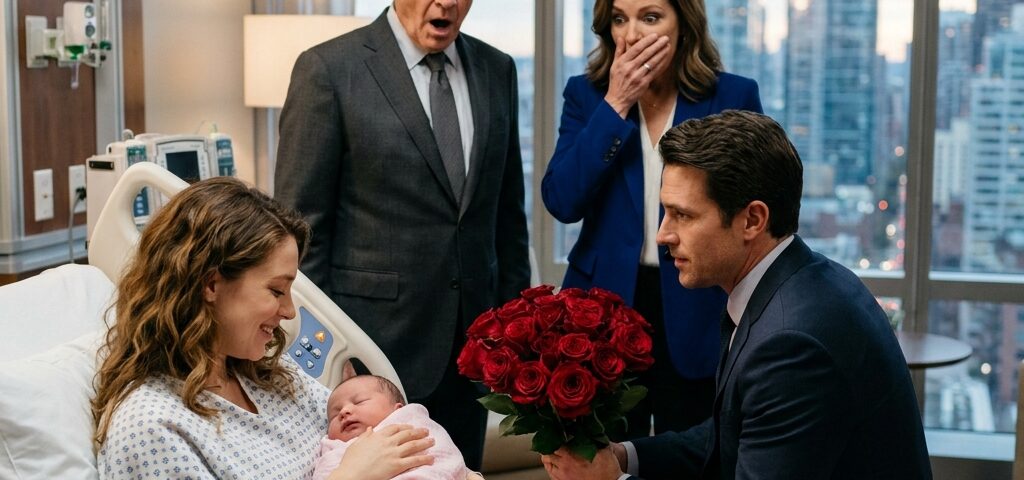
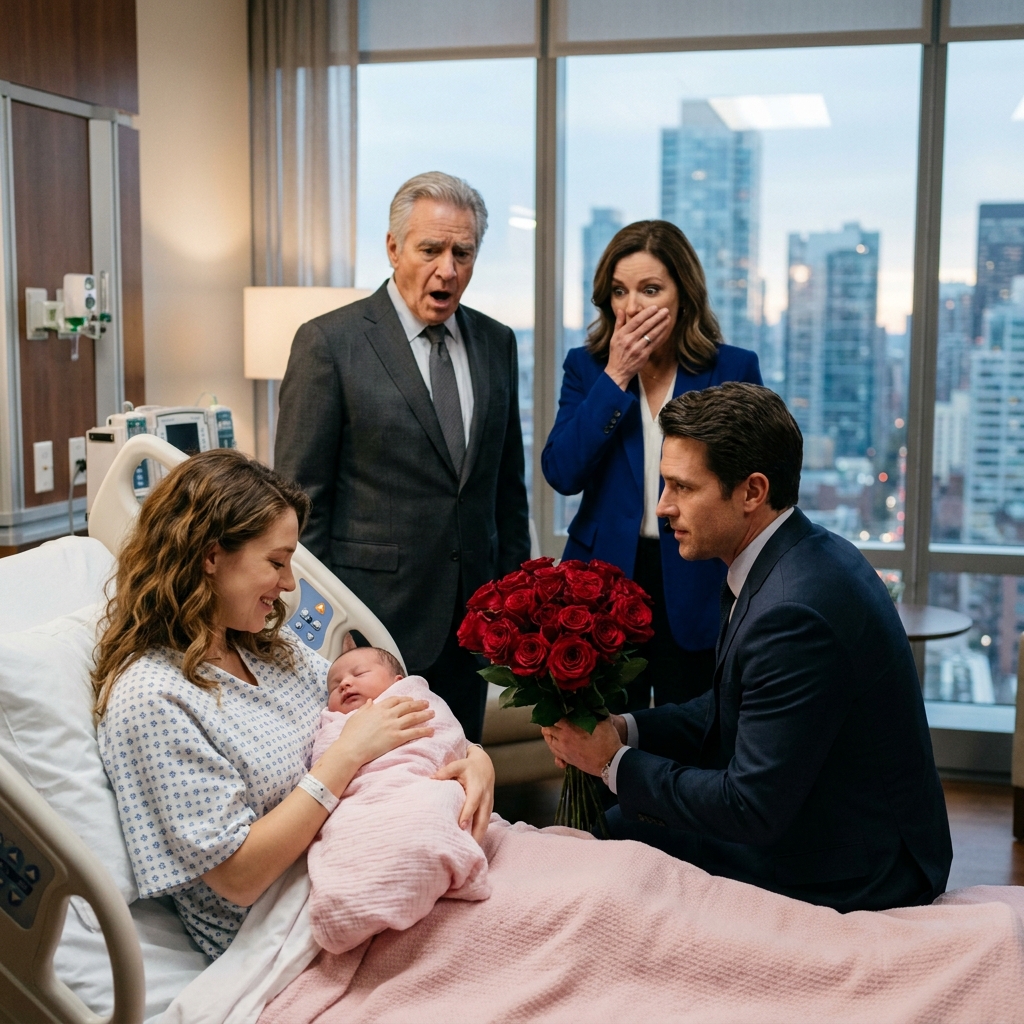
For one suspended second, no one in the hospital room breathed.
My mother’s hand remained frozen near the folder she had thrown onto my blanket. My father’s face, usually so rigid with arrogance, had gone the dull gray of wet cement. Even the nurse near the bassinet stood completely still, her eyes darting from Alistair Sanders to the two attorneys behind him.
Alistair did not raise his voice.
He didn’t need to.
Power had a sound of its own, and in that room, it was the silence that followed his question.
“Did I hear correctly,” he repeated softly, “or did you just call my son fatherless?”
My father swallowed. “Mr. Sanders, there seems to have been a misunderstanding.”
Alistair’s gaze slid to the folder on my lap.
“A misunderstanding,” he said.
“Yes,” my father said quickly. “We had no idea—”
“That I was the father?” Alistair finished for him.
My mother forced a brittle smile. “Natalie never told us.”
I looked at her over Kirk’s tiny head. “You never asked.”
The words struck harder than I expected. Not because they were cruel, but because they were simple. Plain truth had always been the one weapon my parents never knew how to defend against.
Alistair turned his head slightly toward the hospital administrator. “Dr. Ellis, would you please make sure Ms. Vale and the baby are not disturbed again unless she personally approves the visitor?”
“Of course, Mr. Sanders,” the administrator said immediately.
My mother’s mouth dropped open. “You can’t ban us from seeing our own daughter.”
Alistair’s expression didn’t change. “I can prevent anyone from entering the private wing I paid to secure. And I can certainly prevent anyone from harassing the mother of my child hours after delivery.”
My father tried to recover his dignity. He straightened his jacket and pointed toward the folder.
“This is a family business matter. It has nothing to do with you.”
One of Alistair’s attorneys, a sharp-faced woman with silver-rimmed glasses, stepped forward.
“Actually,” she said, “it may have quite a lot to do with him. Those documents appear to involve a transfer of corporate shares under coercive circumstances. If you attempted to pressure a recovering patient into signing away assets while she was under medical care, that becomes legally significant.”
My mother snatched the folder off my blanket, suddenly protective of the evidence she had carried in like a trophy.
The attorney smiled faintly. “Thank you for confirming possession.”
My father’s eyes flashed. “Are you threatening us?”
Alistair looked at him then, and the air seemed to tighten.
“No,” he said. “I haven’t started yet.”
Kirk stirred in my arms, releasing a tiny sound that pulled my attention away from everything else. His face scrunched, his little mouth searching blindly. The entire empire of hatred and money and control my parents had built could have collapsed at my feet in that moment, and still my son’s whimper would have mattered more.
Alistair noticed. His expression softened instantly.
“May I?” he asked me.
That one question nearly broke me.
Not because he asked to hold Kirk. But because, after a lifetime of being commanded, cornered, judged, and used, someone was asking.
I nodded.
Carefully, as though he were accepting something more precious than anything his billions had ever bought, Alistair reached down and took our son into his arms. Kirk fussed once, then settled against his chest as if he had known that heartbeat all along.
My mother stared.
Something like calculation flickered behind her eyes.
“Oh,” she whispered, suddenly changing her voice into something warm and trembling. “He has your nose, Alistair.”
I laughed before I could stop myself.
The sound startled everyone.
My mother’s face hardened. “What is so funny?”
“You refused to acknowledge him three minutes ago,” I said. “Now you’re studying his features like you’re preparing a birth announcement.”
Her lips thinned. “I was shocked. Any mother would be.”
“No,” I said. “A mother would have asked if I was all right.”
The room went quiet again.
For the first time, my father looked less angry than exposed.
Alistair shifted Kirk gently in his arms. “Here is what is going to happen. Natalie and our son will rest. You will leave. My attorneys will review every communication you’ve sent her concerning her shares, her pregnancy, her position in your company, and any threats tied to financial support or inheritance.”
My father let out a humorless laugh. “You think you can walk into our lives and dictate terms?”
“No,” Alistair said. “I think I already have.”
My mother’s fear sharpened into desperation. “Mr. Sanders, please. This doesn’t have to become ugly.”
“It became ugly the moment you looked at my child with contempt.”
“But we’re family,” she said.
Alistair’s eyes cooled. “Not to him, apparently.”
My father reached for my mother’s arm. “We’re leaving.”
But as they turned toward the door, my mother looked back at me.
There was no apology in her eyes.
Only warning.
“You don’t know what you’ve done, Natalie.”
For once, I didn’t flinch.
“No,” I said. “But I know what I stopped doing.”
Her expression faltered.
“I stopped being afraid of you.”
They left without another word.
The door closed behind them with a soft click that felt louder than thunder.
For a moment, I simply sat there, listening to the small sounds of the hospital room—the monitor beside my bed, the whisper of Alistair’s coat as he rocked Kirk, the distant footsteps beyond the door.
Then my strength abandoned me.
I covered my mouth and began to cry.
Alistair was at my side instantly.
He lowered himself carefully onto the chair beside the bed, still holding Kirk with one arm while taking my hand with the other.
“I’m sorry,” he said.
I shook my head. “Don’t be. You came.”
“I should have come sooner.”
“You were in Singapore.”
“I own aircraft.”
Despite everything, I gave a shaky laugh.
He brushed his thumb across my knuckles. “Natalie, why didn’t you tell them?”
“About you?”
“Yes.”
I looked at our son. “Because I wanted to know who they were when they thought I had no protection.”
Alistair went still.
I had not told him that part.
For months, he had offered to meet my parents. For months, I had refused. At first, I told myself it was because the timing wasn’t right, because my pregnancy was complicated, because business matters were tangled enough already. But the truth had always sat beneath those excuses like a stone at the bottom of a lake.
I needed proof.
Not for the world.
For myself.
My parents had humiliated me gently for years, always with polished smiles and careful phrasing. They had called control concern, cruelty discipline, favoritism tradition. My brother inherited opportunities; I inherited obligations. When I earned my 12% stake through the expansion deal I built from scratch, they treated it as a clerical error they intended to correct someday.
Then I became pregnant.
And suddenly someday arrived.
Alistair’s jaw tightened. “You endured all that just to test them?”
“No,” I whispered. “I endured it because part of me still hoped they would pass.”
Kirk released a tiny sigh against his father’s chest.
Alistair looked down at him. “They failed.”
“Yes.”
He was quiet for a while.
Then he said, “There is something I need to tell you.”
The tone of his voice changed the temperature of the room.
I wiped my tears with the back of my hand. “What is it?”
He looked toward the attorneys. “Give us a moment.”
They stepped outside with the administrator, leaving only the three of us in the room.
Alistair stood, carried Kirk to the bassinet, and laid him down with a tenderness that made my throat ache. Then he returned to my bedside.
“I didn’t come here only because you went into labor,” he said.
My heart began to pound.
“What do you mean?”
“This morning, before your message reached me, my legal team finalized an acquisition plan.”
I stared at him.
“For what?”
He didn’t look away.
“Vale Consolidated.”
For a moment, the words meant nothing.
Then they landed.
My family company.
The company my great-grandfather had founded. The company my father ran like a throne. The company my brother believed he would inherit as naturally as his own name.
“You were buying my family’s company?” I asked.
“Not exactly.” His voice remained controlled. “We were preparing a hostile takeover.”
My mouth went dry.
Outside the window, the city blurred behind a thin veil of rain.
“When were you going to tell me?”
“Tonight,” he said. “After Kirk was born. After you were safe.”
I pulled my hand from his.
He let me.
The small space between us filled with things neither of us said.
Alistair Sanders had never lied to me. That was one reason I had fallen in love with him. He could be ruthless in business, cold when necessary, frightening when crossed—but with me, he had always been honest.
Until now.
“You knew they wanted my shares,” I said slowly.
“Yes.”
“And you let them push?”
His eyes darkened. “I suspected. I did not know they would come here today.”
“But you were waiting.”
“Yes.”
The answer was immediate. Brutally honest.
I should have hated him for it.
A part of me tried.
But another part remembered every quiet warning he had given me. Every time he asked whether I wanted him to intervene. Every time I said no because I was still clinging to the fantasy that my parents would change before the final line was crossed.
“Why Vale Consolidated?” I asked.
“Because your father has been hiding debt.”
My breath caught.
Alistair continued. “For the last eighteen months, Vale has been borrowing against future contracts that are not guaranteed. Your brother signed off on inflated projections. Your mother helped move funds through a private charitable foundation to disguise liquidity problems.”
The room tilted.
“No,” I said instinctively.
“I have the records.”
“My father wouldn’t risk the whole company.”
“He already did.”
I looked toward the door where my parents had disappeared.
All my life, they had taught me that reputation mattered more than love, that the company mattered more than comfort, that family survived only when each person understood their place.
Now I understood.
They had not wanted my shares because I embarrassed them.
They needed my shares because they were losing control.
Alistair leaned forward. “Your 12% is not symbolic, Natalie. It can block certain emergency restructuring votes. If they forced you to transfer it to your brother, they could approve a deal that would bury evidence and save themselves.”
My fingers curled around the blanket.
The folder.
The hospital visit.
The insults.
It had all been staged for one signature.
My child’s birth had been nothing more than their opening.
I felt something cold awaken beneath my exhaustion.
Not rage.
Rage was too hot, too reckless.
This was clearer.
Sharper.
“What happens now?” I asked.
Alistair studied me carefully. “That depends on you.”
I laughed once, bitterly. “Does it?”
“Yes.”
“You planned a takeover without telling me.”
“I planned a takeover to protect the company you helped build before your father destroyed it.”
“And to destroy him.”
His silence answered before his mouth did.
“Yes,” he said finally. “If necessary.”
I turned away from him.
Kirk slept peacefully, unaware that he had been born into a war older than his first breath.
Alistair’s voice softened. “Natalie, I love you. But I will not pretend I am harmless. Your father tried to corner you. I intend to corner him first.”
There it was.
The truth.
Not polished. Not romantic.
Alistair was not a prince arriving with a sword.
He was a king arriving with an army.
And kings did not rescue without conquering.
I closed my eyes.
“What if I don’t want you to take Vale?”
“Then I won’t.”
I opened my eyes and looked at him.
He meant it.
That terrified me more than if he hadn’t.
Because now the choice belonged to me.
The girl my parents trained to obey.
The woman they underestimated.
The mother they had just threatened.
I reached for Kirk, and Alistair placed him gently back in my arms. My son’s weight settled against me like an answer.
“Call your attorneys back in,” I said.
Alistair’s expression changed almost imperceptibly. “Natalie—”
“Call them.”
He did.
When the attorneys returned, I was sitting straighter despite the pain pulling through my body. My hair was loose around my shoulders. My hospital gown was wrinkled. My face was probably pale.
But my voice did not shake.
“I want every document my parents brought here copied and preserved,” I said. “I want my phone records downloaded. Every message. Every voicemail. Every threat. I want my 12% placed in a protected trust with voting instructions that only I can change.”
The female attorney nodded, already taking notes.
“And,” I continued, “I want a full forensic audit of Vale Consolidated.”
Alistair watched me without speaking.
The attorney looked at him, then back at me. “That may trigger significant consequences.”
“I’m counting on it.”
By evening, the first article appeared online.
VALE CONSOLIDATED HEIRESS GIVES BIRTH AMID RUMORS OF FAMILY BUSINESS DISPUTE
By midnight, the rumors had mutated.
Some claimed Alistair had abandoned me. Others said he had bought me off. A gossip account posted that my parents had disowned me because I refused to identify my baby’s father.
At 12:17 a.m., Alistair posted one photograph.
Not of my face.
Not of the hospital room.
Just his hand holding Kirk’s tiny foot.
The caption contained nine words.
My son. My heir. My family. No further comment.
The internet detonated.
By morning, Vale Consolidated’s board requested an emergency meeting.
My father called eighteen times.
I answered none of them.
My mother texted once.
Think carefully. Blood remembers betrayal.
I looked at the message while Kirk nursed sleepily against me.
Then I typed back:
So do daughters.
I sent it, then blocked her.
Two days later, I left the hospital through a private exit with my son in my arms and Alistair beside me. Outside, rain polished the black cars waiting at the curb. Security surrounded us, but cameras still flashed from beyond the barricade.
“Ms. Vale! Is Alistair Sanders the father?”
“Did your family disown the baby?”
“Are you selling your shares?”
“Is Vale Consolidated under investigation?”
Alistair placed a hand at my back, shielding me without rushing me.
I stopped.
He looked down at me. “Natalie?”
I turned toward the cameras.
For years, my family had spoken for me. They decided what silence meant. They decided what obedience cost. They decided which truths stayed locked behind mahogany doors and which lies became public statements.
Not anymore.
“My son has a father,” I said clearly. “My son has a name. And my son has nothing to prove to anyone.”
The shouting doubled.
I continued anyway.
“As for Vale Consolidated, I will be exercising my rights as a shareholder.”
That was all.
It was enough.
By the time we reached Alistair’s penthouse, the company’s stock had begun to slide.
My brother called next.
Unlike my parents, Graham did not shout.
He pleaded.
“Natalie, listen to me. Dad is furious. Mom is hysterical. The board is panicking. Whatever Sanders told you, it’s worse if this goes public.”
I stood near the nursery window, watching Alistair place Kirk into a white cradle carved by some European craftsman whose name I couldn’t pronounce.
“What is worse?” I asked.
Graham went quiet.
“Tell me.”
“You don’t understand the pressure Dad was under.”
“Then explain it.”
“He made some moves. Temporary moves.”
“Illegal moves?”
Silence.
That silence was the first honest thing my brother had ever given me.
“Graham,” I said softly, “did you sign the projections?”
His breath hitched.
I closed my eyes.
Of course he had.
The golden son. The chosen heir. The boy who had never been allowed to fail because everyone else was forced to carry the weight beneath him.
“Nat, I didn’t know how bad it was at first.”
“But you knew.”
“I thought I could fix it.”
“No,” I said. “You thought someone else would.”
His voice cracked. “Dad said your shares were the only thing blocking the restructuring. He said if we could just consolidate control, we could save everything.”
“By forcing me to sign in a hospital bed?”
“I didn’t know they went there.”
I believed him.
That didn’t save him.
“Send me everything you have,” I said.
“What?”
“Emails. Board packets. Draft agreements. Anything Dad asked you to sign.”
“He’ll destroy me.”
“He already has.”
Another silence.
Then Graham whispered, “Will you protect me?”
I looked at Kirk, sleeping beneath a mobile of silver stars.
“No,” I said. “But I’ll tell the truth about what you give me.”
He laughed weakly. “That sounds like something Sanders would say.”
“No,” I said. “That sounds like something I learned after surviving our family.”
He sent the files an hour later.
By sunset, Alistair’s attorneys had enough evidence to stop my father’s restructuring vote.
By sunrise, they had enough to freeze three private accounts.
By noon, my father appeared on financial television wearing his favorite navy suit and the calm expression he used when lying to investors.
“These rumors are the unfortunate result of a private family matter being exploited by outside interests,” he said smoothly. “Vale Consolidated remains strong. We are united.”
I watched from the penthouse sofa with Kirk asleep on my chest.
Alistair stood behind me, one hand resting on the back of the couch.
The interviewer leaned forward. “Are you referring to Alistair Sanders?”
My father smiled.
“I am referring to anyone who believes he can use my daughter’s vulnerable condition to interfere with a legacy company.”
My vulnerable condition.
I almost admired the audacity.
Almost.
Alistair reached for the remote, but I stopped him.
“No,” I said. “Let him talk.”
My father continued.
“My daughter has recently given birth, and emotions are high. We hope she returns to the family when she is ready.”
The family.
The same family that had refused to hold my son.
The same family that had come to rob me between contractions and discharge papers.
Something inside me became very still.
“Get me a camera,” I said.
Alistair looked at me. “Are you sure?”
“I’m done letting him narrate my life.”
Within forty minutes, I was seated in Alistair’s private library before a single camera. No makeup artist. No stylist. No prepared tears.
Just me.
A woman five days postpartum, holding her newborn son.
The video went live on my verified account at 2:03 p.m.
“My name is Natalie Vale,” I began. “This morning, my father suggested I was being manipulated because I recently gave birth. So let me be clear while holding the child he refused to acknowledge.”
The world seemed to hold its breath with me.
“My parents came to my hospital room hours after my son was born. They insulted him, threatened me, and demanded I sign away my 12% share of Vale Consolidated. I did not sign. I will not sign.”
My voice stayed calm.
That made it worse for them.
“I have requested a forensic audit. I have placed my shares beyond the reach of coercion. And I will cooperate with any lawful inquiry into Vale Consolidated’s finances.”
I looked down at Kirk.
Then back at the camera.
“My son was born into love. Not shame. Anyone who says otherwise is protecting something ugly.”
The video ended.
Within ten minutes, it had been shared half a million times.
Within an hour, Vale’s board postponed the emergency vote.
Within three hours, regulators announced preliminary inquiries.
That evening, my father came to Alistair’s building.
He was not allowed upstairs.
So he stood in the lobby, beneath a chandelier worth more than his first factory, and called me from a security desk.
This time, I answered.
“You vindictive little girl,” he said.
I felt nothing.
Not fear. Not sadness.
Nothing.
“That’s not a negotiation,” I replied.
“You think Sanders loves you? You think men like him build homes? They acquire. They possess. When he’s done using you against me, he’ll put you and that child aside like every other asset.”
Across the room, Alistair stood near the window, pretending not to listen.
But I knew he heard every word.
“You should have thought of that before you made him the safer choice,” I said.
My father inhaled sharply.
Then his voice changed.
Low.
Ugly.
“You want truth, Natalie? Ask your billionaire why he was investigating Vale before he ever met you.”
My spine stiffened.
“What?”
My father laughed once.
“Oh, he didn’t tell you that part?”
The room seemed to narrow.
Alistair turned from the window.
My father continued, each word slow and poisonous.
“Ask him about the Henderson file. Ask him about the accident twenty-six years ago. Ask him why he really came to our charity gala last year.”
My hand tightened around the phone.
Alistair’s face had gone unreadable.
Too unreadable.
“Dad,” I said carefully, “what are you talking about?”
But my father had already found the wound he wanted.
“Enjoy your happy family,” he said. “Just remember, sweetheart, predators don’t stop being predators because they learn to hold babies.”
The line went dead.
For a few seconds, I could not move.
The city glittered beyond the glass walls. Kirk slept in his cradle. Somewhere below us, my father was being escorted out of the building.
I looked at Alistair.
He did not ask what my father had said.
That was how I knew.
“It’s true,” I whispered.
Alistair’s silence answered first.
Then he said, “Not the way he made it sound.”
A cold laugh escaped me. “That is never a comforting sentence.”
He stepped toward me. “Natalie—”
“What is the Henderson file?”
His face tightened.
The name meant something.
Not just business.
Not just strategy.
Something buried.
Something old.
Before he could answer, his phone rang.
He looked down.
For the first time since I had known him, I saw real alarm cross his face.
“Who is it?” I asked.
He answered without putting it on speaker.
“Yes?”
He listened.
His eyes moved to Kirk.
Then to me.
“What happened?” I demanded.
Alistair lowered the phone slowly.
The man who had faced my parents, my father’s threats, and a collapsing corporation without blinking now looked as though the floor had shifted beneath him.
“That was my security chief,” he said.
I stood, ignoring the pain that pulled through me.
“Alistair. What happened?”
He looked toward the cradle.
Then he said the words that turned my blood to ice.
“The paternity test results from the hospital lab were just accessed.”
I stared at him. “Why would anyone access them?”
His jaw clenched.
“Because someone changed them.”
The room tilted.
From the nursery, Kirk began to cry.
And on Alistair’s phone, a message appeared from an unknown number.
Congratulations, Mr. Sanders. Now tell Natalie what really happened the night her mother disappeared for three days in 1998.
Alistair’s question seemed to hang in the hospital room like a blade.
“Did I hear correctly… or did you just call my son fatherless?”
My mother’s mouth opened, but no sound came out.
For the first time in my life, Celeste Vale looked small. Not elegant. Not untouchable. Not the polished queen of the Vale family empire.
Just small.
My father recovered first. Donovan Vale had built his reputation by never letting fear remain on his face for more than three seconds.
“This is a family matter,” he said stiffly.
Alistair looked at the folder on my blanket.
“Then why did you bring corporate transfer documents into a maternity ward?”
The room tightened.
One of the attorneys stepped forward, opened a leather case, and removed a slim tablet.
My father’s eyes narrowed. “What is this?”
“Evidence,” Alistair said.
The attorney tapped the screen, and suddenly my mother’s voice filled the room.
“Sign these papers. Transfer your shares to your brother.”
Then my father’s voice followed.
“And don’t expect us to ever hold that baby.”
My mother staggered back as though the sound had struck her.
“The room records audio?” she whispered.
The hospital administrator folded her hands. “Only when a patient requests security documentation due to a prior threat.”
My parents turned toward me.
I held Kirk closer.
Three weeks earlier, my mother had called me and said that if I refused to give Pierce my shares, she would “make sure childbirth became the loneliest moment of my life.”
So I had signed one small hospital form.
Not a corporate transfer.
A protection request.
Alistair rocked Kirk gently, his dark eyes never leaving my parents.
“You were so desperate to make her sign before discharge,” he said. “You didn’t wonder why.”
My father’s face drained of color again.
Alistair gave the smallest nod to the second attorney.
She opened a navy folder and placed a document beside my bed.
“Eleanor Vale’s original trust amendment,” she said.
My mother whispered, “No.”
I looked at her.
For years, my grandmother’s will had been treated like a locked room. Everyone knew my 12% share came from her. Everyone knew my parents hated it. No one ever explained why it mattered so much.
The attorney continued.
“Upon the birth of Maren Vale’s first living child, her 12% stake converts into voting shares with expanded control rights under Article Fourteen.”
My father snapped, “That clause is invalid.”
“No,” Alistair said softly. “It was dormant.”
He stepped closer to me, still holding our son.
“Until Kirk was born.”
My mother’s nails dug into her handbag.
I could barely breathe.
“What does that mean?” I asked.
The attorney looked at me, and for once, someone in the room answered me as if I mattered.
“It means your son’s birth activated your grandmother’s protection clause. Your shares now carry enough voting power to block any sale, merger, liquidation, or executive appointment at Vale Meridian.”
Alistair’s mouth hardened.
“And it means your parents weren’t here to punish you for having a child.”
He looked at the folder on my blanket.
“They were here to stop that child from making you powerful.”
My father moved toward the papers.
Alistair’s attorney reached them first.
“Don’t touch those.”
My mother found her voice at last. “Maren, you don’t understand what you’re doing.”
I looked at her carefully.
She was not afraid of scandal.
She was afraid of me.
For the first time, I realized the difference.
Alistair placed Kirk back in my arms. His fingers brushed mine, warm and steady.
Then he turned to my parents.
“There’s more.”
My father froze.
Alistair’s voice lowered.
“Last month, Sanders Capital purchased the debt your company hid from its board. Every overdue note. Every emergency loan. Every private guarantee.”
My father’s lips parted.
“You can’t have.”
“I can,” Alistair said. “I did.”
My mother gripped the foot of my hospital bed.
Alistair stepped between us.
“And as of this morning, Vale Meridian is in breach of six debt covenants.”
The room tilted.
My parents had entered carrying a folder.
Alistair had entered carrying an empire.
PART 4 — The Secret My Grandmother Left Behind
My mother tried to laugh, but it came out cracked.
“You think money frightens us?”
“No,” Alistair replied. “Exposure does.”
That was when my father made his first real mistake.
He looked at me and hissed, “You ungrateful little orphan.”
The word landed harder than anything else he had said.
Orphan.
My mother shut her eyes.
The room fell silent.
I felt Kirk stir against my chest. His tiny face wrinkled, then settled again, unaware that a single word had split open my life.
“What did you call me?” I asked.
My father’s jaw clenched.
“Maren,” my mother said quickly, “he didn’t mean—”
“Yes,” Alistair interrupted. “He did.”
I turned toward him.
He looked at me with sorrow, and suddenly I knew.
This was the secret he had not wanted to reveal here, not while I was still weak, not while our son was minutes old in my arms.
But my parents had dragged the truth into the room themselves.
Alistair reached into his coat and removed a sealed envelope. The paper was old, cream-colored, and marked with my grandmother’s handwriting.
For Maren, when they finally try to steal what is hers.
My hand trembled as I touched it.
My mother whispered, “Where did you get that?”
“From Eleanor Vale’s former solicitor,” Alistair said. “The one you paid to disappear.”
My father said nothing.
I opened the envelope.
Inside was a letter and a faded photograph.
A young man stood beneath the willow trees behind Vale House, smiling with my eyes. Beside him was a woman with windblown hair and a newborn wrapped in white.
On the back, my grandmother had written:
Callum, Vivienne, and baby Maren.
My throat closed.
Callum Vale.
My grandmother’s only son.
The man my parents had always called unstable, reckless, dead before I was born.
Except I had been born.
I stared at the photograph until the faces blurred.
“My real father was Callum,” I whispered.
My mother’s face hardened. “We raised you.”
“No,” I said, voice shaking. “You used me.”
Alistair stood beside my bed, quiet and unyielding.
The attorney explained what I could not yet absorb.
“After Callum Vale died in the Montenegro boating accident, Donovan and Celeste petitioned for guardianship. They claimed your mother, Vivienne, had also died.”
I looked up sharply.
“Claimed?”
My father snapped, “Enough.”
But Alistair’s eyes were on me.
“Maren,” he said gently, “your mother didn’t die.”
The air left my lungs.
My mother whispered, “Don’t.”
Alistair did not look at her.
“She was injured. She survived. And someone paid to have her identity buried under a sealed medical conservatorship.”
My ears rang.
For thirty years, I had believed I was the disappointing daughter of cold parents.
But I was not their daughter.
I was the key to an inheritance they could not reach without pretending to love me.
My father pointed at Alistair. “You have no idea what you’ve uncovered.”
Alistair’s expression turned dangerous.
“I know exactly what I’ve uncovered.”
My mother stepped toward me, desperate now.
“Maren, listen to me. Your grandmother was cruel. Callum was weak. Your mother was unstable. We did what was necessary.”
The baby stirred again.
I looked down at Kirk, at the perfect curve of his tiny mouth.
Then I looked at the woman who had watched me grow up without ever once brushing my hair tenderly, without ever once holding me after a nightmare, without ever once telling me I was wanted.
“You stole my mother from me,” I said.
My mother’s face twisted.
“She would have ruined everything.”
And there it was.
Not denial.
Not grief.
A confession.
Alistair’s attorney quietly marked something on her tablet.
My father noticed and lunged forward.
The hospital administrator opened the door.
Two security officers stepped inside.
Alistair’s voice remained calm.
“Donovan. Celeste. Leave this room.”
My mother stared at Kirk.
For one strange second, I thought regret might come.
Instead, she said, “That child will destroy you.”
I kissed my son’s forehead.
“No,” I whispered.
“He already saved me.”
PART 5 — The Boardroom With a Cradle in It
Two weeks later, I entered Vale Meridian’s boardroom with Kirk asleep against my chest.
My stitches still pulled when I walked. My body still felt borrowed, tender, and exhausted. But my spine was straight.
Alistair walked beside me, not in front of me.
That mattered.
For years, every powerful person in my life had either dragged me or blocked me. Alistair did neither.
He simply stayed close enough that I knew I would not fall.
The boardroom smelled of polished walnut and fear.
My father sat at the head of the table, though he no longer had the right. My mother sat beside him in pearls, perfectly dressed for a funeral that had not yet been announced.
My brother Pierce slouched in his chair, pale and furious.
“You brought the baby?” he said.
I smiled.
“Of course. He has more rights in this company than you do.”
A few directors looked down to hide their reactions.
My father struck the table with his palm.
“This meeting is illegal.”
“No,” said Alistair’s attorney, Ms. Rowe. “This meeting was called under emergency governance provisions triggered by creditor default, shareholder misconduct, and breach of fiduciary duty.”
Pierce laughed sharply. “Big words. Still our company.”
I placed one hand over Kirk’s back.
“Not anymore.”
The screen at the end of the room lit up.
First came the hospital recording.
Then the forged transfer drafts.
Then bank statements.
Then private emails between my father and the company’s chief financial officer.
Every document was a stone dropped into deep water.
Hidden debt. Inflated assets. Phantom suppliers. Company funds used to pay for private estates, political favors, luxury trips, and silence.
My mother did not flinch.
My father did.
That told me who had believed they would never be caught.
Then Ms. Rowe played the final file.
It was a video.
The image shook as though filmed from inside a drawer. My father stood in his study at Vale House. Across from him sat Mr. Harlan, the CFO, sweating through his collar.
My father’s voice filled the room.
“Keep Maren weak until she signs. Once Pierce has the shares, we dissolve Eleanor’s trust and sell the assets before Sanders can collect.”
Pierce went white.
On the video, my mother entered and said, “Make sure she gives birth before the announcement. Once the baby arrives, the clause activates.”
The boardroom went utterly still.
Then video-Celeste smiled.
“If she signs before leaving the hospital, the child won’t matter.”
A director whispered, “My God.”
My mother finally moved.
She reached for her water glass with a steady hand.
“You have no right to judge us,” she said. “We saved this company.”
I stared at her.
“No. You fed on it.”
My father turned to the board. “This is a family dispute dressed up as corporate theater.”
The oldest director, Mrs. Haversham, spoke for the first time.
“I served under Eleanor Vale,” she said. “She warned us this day might come.”
My mother’s eyes flashed. “Eleanor was a sentimental fool.”
Mrs. Haversham smiled sadly.
“No. She was a strategist.”
Ms. Rowe distributed the voting packets.
“Under Article Fourteen, Maren Callum Vale now holds activated voting control over protective matters. Sanders Capital holds the defaulted debt. The employee pension fund holds a swing vote. The board may either remove Donovan Vale as chairman today, or face immediate creditor enforcement.”
My father stared at me as if I had become a stranger.
Maybe I had.
Maybe I had finally become myself.
Kirk woke and made a soft sound against my chest.
Every eye turned to him.
My mother’s lips curled.
“That baby doesn’t belong in this room.”
I looked directly at her.
“Neither do you.”
The vote took seven minutes.
It ended a dynasty.
Donovan Vale was removed as chairman.
Celeste Vale was suspended from all advisory authority.
Pierce lost his executive appointment.
And I, still aching from childbirth, still leaking milk through the silk blouse my mother would have mocked, was named interim protector of the Vale Meridian trust shares.
My father rose slowly.
“You think you’ve won?”
I stood too.
“No,” I said. “I think I survived.”
Then the boardroom doors opened.
And the woman who entered made my mother scream.
PART 6 — The Woman They Buried Alive
She was thinner than the woman in the photograph.
Older, of course.
Her hair was silver at the temples, and she walked with a cane, each step careful but determined. A nurse stayed near her elbow, but the woman did not lean on her.
She looked around the boardroom, past the directors, past Alistair, past my father.
Then her eyes found me.
The room disappeared.
I knew her.
Not from memory.
From somewhere deeper.
Her hand rose to her mouth.
“Maren,” she whispered.
My mother stood so abruptly her chair fell backward.
“No. No, this is impossible.”
The woman’s eyes never left mine.
“I was told my baby died.”
My knees weakened.
Alistair’s hand touched my back.
I stepped forward with Kirk pressed between us like a tiny bridge across thirty years of theft.
“Vivienne?” I asked, though my heart already knew.
She nodded, tears spilling silently.
“My daughter.”
Two words.
That was all it took.
Something inside me broke open, not with pain, but with a kind of grief so bright it almost felt like light.
My mother lunged toward her.
“She’s lying!”
Vivienne turned.
For the first time, I saw anger in her face.
Not loud anger.
Not cruel.
The kind that had survived locked doors, false names, wrong medication, and decades of being told no one was looking for her.
“You told them I was unstable,” Vivienne said. “You told the doctors I had abandoned my child. You signed papers as my sister-in-law and paid them to keep me sedated.”
My father muttered, “Careful, Vivienne.”
She smiled then.
It chilled me.
“Careful?” she repeated. “I was careful for thirty years. I remembered everything in pieces. Your voices. The lake. Callum shouting. Celeste telling someone the baby was the only thing that mattered.”
My mother looked at the board, calculating.
But there was nowhere left to hide.
Alistair stepped forward.
“Vivienne Vale was found six months ago in a private care facility in Switzerland under the name Vivian Kross. Her expenses were paid through a shell vendor connected to Vale Meridian.”
A director swore under his breath.
Pierce stared at our parents in horror.
“You knew?” he asked them.
My father said nothing.
My mother’s face hardened into stone.
Pierce pushed back from the table. “You told me Maren was adopted because her mother died.”
“She should have,” Celeste snapped.
The room recoiled.
Even my father looked at her then.
Vivienne took another step toward me.
“May I see him?” she asked.
No demand.
No entitlement.
Just a trembling question from a woman who had lost everything and still knew how to ask gently.
I placed Kirk carefully into her arms.
The moment she held him, he opened his eyes.
Vivienne laughed through tears.
“He has Callum’s mouth.”
I cried then.
Not prettily. Not quietly.
The sob tore out of me before I could stop it.
For years, I had thought my loneliness was proof that I was difficult to love.
But here was my mother, holding my son as if both of us had been searched for across lifetimes.
I had not been unwanted.
I had been stolen.
My mother looked at me with hatred.
“You think this changes anything? Blood doesn’t run a company.”
Vivienne kissed Kirk’s tiny hand.
“No,” she said. “But truth can end one.”
Ms. Rowe placed another document on the table.
“Vivienne Vale has filed an emergency petition to restore her identity, assets, and voting rights.”
My father grabbed the table edge.
“What assets?”
Alistair answered.
“The 34% Callum left to his wife.”
My mother’s face collapsed.
That was the secret beneath the secret.
They had not only stolen my childhood.
They had stolen my mother’s ownership.
And now she had come back to claim it.
PART 7 — The Fall of Vale House
By sunset, Vale House was surrounded by reporters.
By midnight, my parents’ lawyers had stopped answering calls.
By morning, the authorities had frozen three accounts, seized two private ledgers, and opened investigations in three countries.
Yet the moment that stayed with me was not the flashing cameras.
It was Pierce standing in the nursery doorway at Alistair’s penthouse, holding a cardboard box.
“I brought your things,” he said.
I stared at him.
“My things?”
He looked ashamed.
“From the attic. I found them after Mom started burning files.”
Inside the box were pieces of my childhood I thought had vanished.
A yellow blanket.
A silver rattle engraved with my birth date.
A stack of letters tied with blue ribbon.
Vivienne saw the ribbon and nearly fell.
Alistair caught the box before it slipped.
“My letters,” she whispered.
Pierce swallowed hard.
“I didn’t know. I swear I didn’t.”
I wanted to hate him.
Part of me did.
Pierce had mocked me, dismissed me, enjoyed being the golden son in a house built over my silence.
But he looked broken now, like someone who had just discovered the throne he wanted was made of bones.
He handed me a final envelope.
“This was in Dad’s safe.”
My name was written across it.
Inside was a letter from Callum.
My real father.
Maren,
If your grandmother’s plan works, you will never need this letter. If it fails, then know this: your mother and I loved you before you had a name. We chose you before we knew your face. Whatever they tell you, you were wanted.
Protect your share. It is not money. It is proof.
One day, someone may try to make you feel ashamed of your own child. Never believe them. Children are not scandals. They are witnesses that love existed.
I pressed the letter to my chest and wept until there was nothing left in me but breath.
Vivienne sat beside me and held my hand.
Alistair stood at the window, looking down at the city that had spent all day devouring the Vale name.
“You don’t have to attend tomorrow,” he said.
Tomorrow was the final emergency hearing.
The day my parents would attempt to stop Vivienne’s restoration and challenge my authority over the trust.
I looked at Kirk sleeping in his cradle.
“Yes,” I said. “I do.”
The courtroom was packed.
My mother arrived dressed in white.
My father arrived without his wedding ring.
Pierce arrived alone and sat behind me.
That surprised everyone.
It surprised me most of all.
When Celeste took the stand, she performed grief beautifully. She spoke of burden. Sacrifice. Difficult decisions. A fragile young mother who had supposedly vanished. A troubled child they had raised out of duty.
Then Vivienne’s doctor testified.
Then the former solicitor.
Then Mr. Harlan.
Then Pierce stood.
My mother turned sharply.
“Pierce,” she warned.
He looked at her, eyes wet.
“You taught me that winning mattered more than truth,” he said. “I believed you.”
His voice shook.
“But I won’t lie for you anymore.”
He testified about destroyed records, forged signatures, secret payments, and the night he overheard my mother say I should have been left with Vivienne.
My mother stared as if he had stabbed her.
Maybe he had.
The judge listened for hours.
At last, she removed her glasses.
Her ruling was precise.
Vivienne’s identity was restored.
Her ownership claim could proceed immediately.
My voting rights remained active.
Donovan and Celeste Vale were barred from company control pending investigation.
And the attempted hospital transfer was referred for criminal review.
My father sat motionless.
My mother slowly turned to me.
“You think this is a happy ending?” she whispered.
I looked at Vivienne.
At Pierce, shattered but honest.
At Alistair, holding Kirk in the back row because our son had slept through the fall of an empire.
“No,” I said.
“I think it’s the first honest beginning we’ve ever had.”
PART 8 — The Child They Refused to Hold
Three months later, Vale Meridian did not collapse.
That was what shocked everyone.
The headlines had predicted ruin. Competitors circled. Investors panicked. Former allies vanished overnight.
But Alistair did not destroy the company.
Neither did I.
Instead, Vivienne and I did something no one expected.
We saved it.
Not the old empire of polished lies and private cruelty.
Something better.
We sold Vale House and used the proceeds to repay employees whose pensions had been raided. We dissolved three shell companies. We canceled the luxury development my father had planned on protected land. We opened the books, fired the loyalists who had helped bury the truth, and promoted the people who had been ignored for years because they were honest instead of connected.
Then Vivienne made the decision that stunned the board.
She transferred half of her restored voting power into an employee trust.
The newspapers called it sentimental.
Alistair called it brilliant.
My mother called it theft during one of her final interviews before her attorneys told her to stop speaking.
My father disappeared into legal strategy and silence.
Their trial would come later.
But my life no longer revolved around their punishment.
That was the strangest freedom of all.
One spring morning, I stood in the renovated lobby of Vale Meridian with Kirk in my arms. The old portrait of Donovan had been removed. In its place hung a photograph of Eleanor, Callum, Vivienne, and me as a baby beneath the willow trees.
Beside it was a new inscription:
A company is not a family. But it should never be allowed to destroy one.
Pierce arrived late, nervous in a plain gray suit.
He was no longer an executive.
He had asked for an entry-level position in operations.
I had laughed when he first suggested it.
Then I realized he was serious.
“You’ll report to Mrs. Haversham,” I told him.
He grimaced. “She terrifies me.”
“She should.”
He looked at Kirk.
“Can I…” He stopped himself. “May I hold him?”
For a moment, the old pain stirred.
My parents had refused to hold my son because they thought he made me weak.
Now my brother stood before me, humbled, asking permission as though Kirk were something sacred.
I studied him.
Then I placed my son in his arms.
Pierce froze.
Kirk grabbed his tie.
Pierce laughed, and the sound cracked halfway through.
“He’s strong,” he whispered.
“Yes,” I said.
Alistair came up behind me and kissed my temple.
Across the lobby, Vivienne watched with tears in her eyes, one hand resting on her cane.
There was still grief.
There would always be grief.
Thirty years could not be returned. Childhood could not be replayed. My father’s letter could not become his voice. My mother’s first embrace could not erase the years she had spent locked away.
But life, I learned, did not always heal by giving back what was stolen.
Sometimes it healed by placing something new in your arms and asking whether you were brave enough to love it.
That afternoon, we held a small ceremony in the courtyard.
No cameras.
No society guests.
Just employees, a few directors, Alistair, Vivienne, Pierce, and my son.
I stood beneath the willow trees where my parents once thought their secrets were buried.
“My grandmother protected twelve percent because she knew truth sometimes survives only in small pieces,” I said. “My son activated that truth simply by being born.”
Kirk yawned loudly.
Everyone laughed.
I smiled down at him.
“When my parents came to the hospital, they thought they were looking at my weakness.”
Alistair’s hand found mine.
Vivienne stepped closer.
Pierce lowered his head.
“But he was never my shame,” I said.
My voice strengthened.
“He was my witness. My heir. My beginning.”
Later, as sunset spilled gold across the courtyard, Vivienne asked to walk alone with me.
We moved slowly beneath the trees.
“I used to dream of finding you,” she said. “In the dream, you were always little.”
I swallowed.
“I’m sorry I grew up without you.”
She stopped walking.
“No, Maren.” Her hand trembled as she touched my cheek. “I’m sorry they made you believe that was your fault.”
For a long moment, I was a child again.
Then I was a mother.
Then I was both.
From across the courtyard, Kirk began to fuss.
Alistair tried rocking him. Pierce tried making faces. Mrs. Haversham offered advice no one understood.
Vivienne smiled.
“He wants you.”
I looked at my son, red-faced and furious with the world.
Then I looked back at my mother.
My real mother.
“Come with me,” I said.
Together, we crossed the grass.
I took Kirk into my arms, and he quieted instantly.
Alistair shook his head in amazement.
“How do you do that?”
I kissed our son’s forehead.
“I don’t know.”
Vivienne brushed her fingers over Kirk’s tiny hand.
“He knows where he belongs.”
I thought of that hospital room. My mother’s sneer. My father’s folded arms. The folder dropped on my blanket like a sentence.
We will never acknowledge a fatherless child.
We will never hold that baby.
They had believed rejection was power.
They had believed blood could be hidden, love could be buried, and a newborn child could be used as leverage.
They were wrong.
Because the child they refused to hold had pulled every secret into the light.
And the man they thought had abandoned me had only been walking toward the door.
That night, after everyone left, Alistair and I stood beside Kirk’s crib.
The city glittered beyond the window.
“Do you ever regret it?” I asked.
He looked at me. “Regret what?”
“Walking into that hospital room.”
He smiled and wrapped his arms around me from behind.
“Maren, I was never walking into a room.”
Kirk sighed in his sleep.
Alistair kissed my shoulder.
“I was coming home.”
And for the first time in my life, the word did not hurt.
It opened.
It warmed.
It stayed.
Because home was no longer a mansion full of locked doors.
Home was my son sleeping safely.
My husband’s heartbeat beside me.
My mother alive.
My name restored.
And in the quiet, impossible happiness that followed, I finally understood the secret my grandmother had hidden inside that fragile 12%.
She had not left me a company.
She had left me a way back to myself.
And Kirk, the child they called fatherless, became the reason every lost piece of my life found its way home.