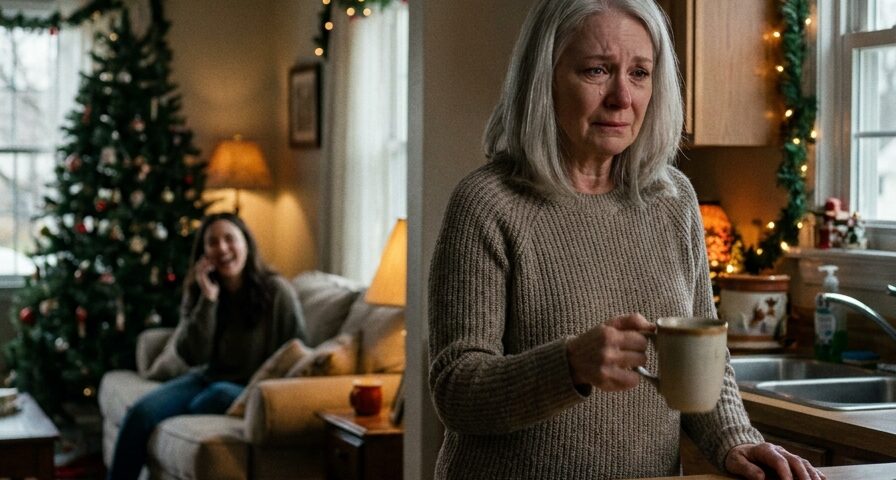
PART 2: A Grandmother Finally Chose Herself for Christmas
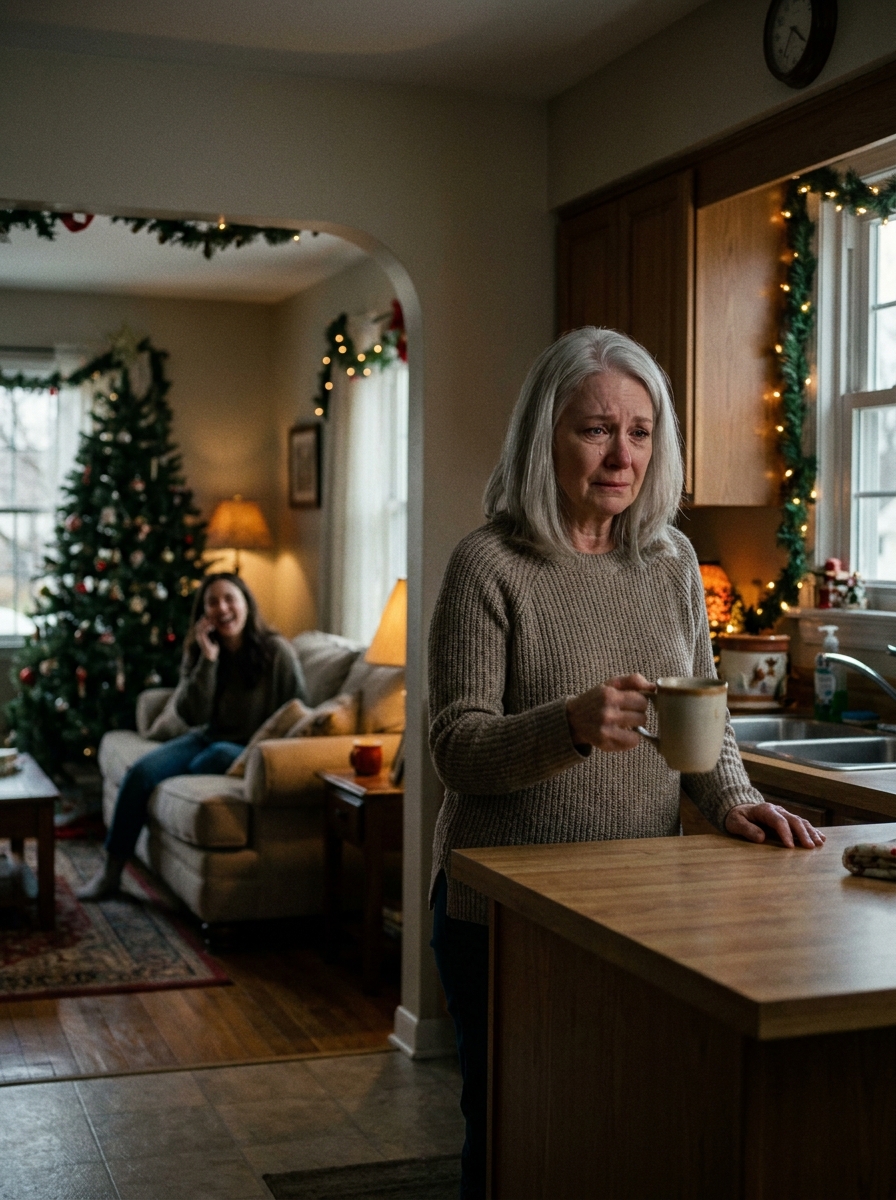
PART 2
The first hour on the highway felt unreal.
I drove with both hands resting lightly on the steering wheel, my suitcase tucked in the trunk, my purse on the passenger seat, and a thermos of coffee cooling in the cup holder. The sky was the color of pewter, heavy with the promise of snow inland, but ahead of me the road opened toward the coast, where winter arrived gentler, softened by salt air and gray waves.
For the first few miles, I expected guilt to climb into the car beside me.
It didn’t.
Instead, silence settled there.
Not the lonely silence that waited for me after everyone left my house each Christmas night. This silence felt different. Wide. Clean. Mine.
By the time I reached the turnpike, my phone had buzzed six times.
I did not look.
That small act required more courage than I expected. All my life, I had answered quickly. A ringing phone meant someone needed me. A text meant a question only I could solve. A missed call meant I had failed some invisible test of motherhood.
But that morning, I let the phone buzz against the leather seat until it stopped.
Snow dusted the shoulders of the highway, and Christmas songs played softly on the radio. I passed cars loaded with wrapped presents, families heading somewhere warm and bright, children pressing their faces to windows. For once, I was not the destination everyone was driving toward.
I was the person going somewhere.
My reservation was at a small inn called The Mariner’s Lantern, a place I had found after searching quietly in the middle of the night. The photographs showed blue shutters, white rocking chairs, a stone fireplace, and a dining room overlooking the Atlantic. It was expensive enough to make me hesitate, but not so expensive that I closed the page.
I booked three nights before I could talk myself out of it.
When I arrived just after noon, the ocean was dark and restless beneath a silver sky. Gulls wheeled above the parking lot, crying as if they had private complaints about the weather. The inn stood at the edge of a narrow street lined with cedar trees and little shops strung with white lights. Wreaths hung on every door.
I sat in the parked car for a moment, staring at the building.
Then I laughed.
It came out small and shaky, but it was laughter.
“What are you doing, Evelyn?” I whispered.
The answer surprised me.
“Exactly what you should have done sooner.”
Inside, the lobby smelled of pine, cinnamon, and woodsmoke. A Christmas tree stood near the fireplace, decorated with seashell ornaments and tiny brass boats. Behind the front desk, a woman with silver-streaked hair looked up and smiled.
“You must be Mrs. Vance.”
I blinked. “How did you know?”
“You have the expression.”
“What expression is that?”
“The one people wear when they’ve finally arrived somewhere they weren’t sure they deserved to go.”
For a second, I could not speak.
She came around the desk and extended her hand. “I’m Nora. Welcome to The Mariner’s Lantern.”
Her kindness nearly undid me. Not because it was grand, but because it was simple. She did not ask why I was alone. She did not tilt her head with pity. She simply handed me a key tied to a wooden tag shaped like an anchor.
“We put you in Room Seven. It has the best morning light.”
“My reservation was for a standard room,” I said.
“It still is,” Nora replied, eyes twinkling. “The morning light is free.”
Room Seven was at the end of the second-floor hallway. It had a quilted bed, a writing desk, a small balcony facing the sea, and a vase of evergreen branches on the windowsill. The wallpaper was faded blue, patterned with tiny white flowers. A ceramic lamp glowed beside the bed.
I set my suitcase down and stood in the middle of the room, waiting for the nervous feeling to catch up.
Still nothing.
Only the sea outside, breathing in and out.
Then my phone buzzed again.
I took it from my purse.
There were twelve missed calls. Four from Becca. Three from Garrett. Two from my daughter-in-law, Mara. Three from numbers I recognized as the older grandchildren using their parents’ phones.
The latest text was from Becca.
Mom, where are you?
Another followed seconds later.
We’re at your house. The door is locked. Did you run to the store?
I sat on the edge of the bed.
For a long moment, my thumb hovered over the screen. I pictured them standing on my porch with overnight bags, stuffed animals, booster seats, holiday pajamas, and the easy confidence of people who believed the world would rearrange itself for them.
My heart squeezed.
Not because I regretted leaving.
Because I loved them.
That was the complicated part no one admitted about boundaries. They were not built from anger alone. Sometimes they had to be built while love stood on the other side, calling your name.
I typed slowly.
I am safe. I made other plans this Christmas. The house is closed. Please take the children with you and enjoy the holiday together.
Before I could second-guess myself, I pressed send.
The three dots appeared almost immediately.
Then disappeared.
Then appeared again.
Finally, Becca’s reply came.
Other plans? What does that mean?
I turned the phone face down.
Downstairs, a bell chimed. Voices rose in the lobby, cheerful and unfamiliar. Somewhere, someone laughed. My own children were probably angry now, confused, inconvenienced. They might even be hurt.
I wished they had considered whether I had been hurt too.
I unpacked my suitcase carefully. Three sweaters. One wool skirt. Pajamas. A paperback mystery novel I had been meaning to read since October. My mother’s pearl earrings. The red scarf Arthur bought me our last Christmas together.
I had not worn it in six years.
Arthur had loved Christmas with the kind of devotion that made other people forgive his off-key singing. He used to stand in the kitchen doorway with a dish towel over one shoulder, asking what needed chopping, stirring, lifting, carrying. After he died, everyone said, “We’ll help you, Mom.”
For a while, they tried.
Then grief turned into habit, and habit turned into expectation.
I tied the red scarf around my neck and went downstairs.
The inn’s dining room had tall windows overlooking the water. Only a few tables were occupied. A young couple shared chowder near the fireplace. An elderly man read a newspaper with a magnifying glass. Near the window, a woman about my age sat alone, sketching in a notebook.
Nora brought me tea and a small plate of butter cookies.
“Lunch starts at one,” she said. “But cookies are available for emergencies.”
“This counts,” I said.
“I suspected it might.”
I warmed my hands around the cup.
Outside, waves folded over themselves and shattered against the rocks. The sight should have made me feel small, but instead it made my problems seem less permanent. Even the ocean did not hold one shape forever.
My phone buzzed again.
Garrett this time.
Mom, what is going on? Becca’s upset. The kids are asking why Grandma won’t open the door.
I breathed in.
Then out.
I wrote back.
Grandma is resting this Christmas. I love the children. I am not available to host or babysit.
His answer came quickly.
You could have told us.
I stared at those five words until the letters blurred.
You could have asked me, I typed.
This time, he did not reply.
After lunch, I walked along the beach. The wind bit at my cheeks, but the cold felt honest. I passed families bundled in coats, a man tossing a tennis ball for a delighted golden retriever, and a little girl collecting shells in a mittened hand.
Halfway down the shore, I found a bench facing the water. Someone had tied a red ribbon around one armrest. I sat and pulled my scarf tighter.
For years, I had believed sacrifice was proof of love. I told myself mothers gave until there was nothing left, then found more. My own mother had done it. Her mother too. We wore exhaustion like an heirloom necklace.
But sitting there with the ocean wind lifting my hair, I wondered what my children had learned from watching me disappear inside service.
Had I taught them love?
Or had I taught them not to notice me?
That question stayed with me through the afternoon.
When I returned to the inn, Nora was arranging gingerbread houses on a side table. The woman who had been sketching sat near the fire, now knitting something green and lopsided.
“You survived the wind,” Nora said.
“Barely.”
“Then you’ve earned cider.”
The knitting woman looked up. “Everyone earns cider here. Nora just likes making it sound heroic.”
Nora laughed. “Evelyn, this is June Bell. June has been coming here every Christmas for nine years and has criticized my cider every one of them.”
“It lacks clove,” June said.
“It does not.”
“It does.”
I smiled despite myself.
June patted the chair beside her. “Come sit before she makes you judge.”
I joined her by the fire with a mug of cider. June had sharp eyes, cropped white hair, and the relaxed posture of someone who had stopped apologizing for taking up space.
“First Christmas here?” she asked.
“Yes.”
“Alone by choice or by circumstance?”
The question was direct, but not unkind.
I watched flames lick around a split log. “A little of both.”
June nodded as though that made perfect sense. “The best trips usually are.”
We talked for nearly an hour. She had been a school librarian, divorced in her fifties, mother to one son who lived in Oregon. She came to the inn every December because, as she put it, “Families can love you deeply and still be terrible at seeing you clearly.”
I looked at her.
She raised one eyebrow. “Too accurate?”
“Uncomfortably.”
“Good. Truth should have a little texture.”
That evening, I ate dinner at a corner table while snow began to fall outside, delicate as sifted sugar. My phone remained in my room. I had left it there on purpose, tucked in the bedside drawer like a misbehaving child.
Afterward, Nora announced that guests were gathering in the parlor for board games. I almost said no. Then I remembered no one was waiting for me to wash dishes, pack leftovers, or locate someone’s missing mitten.
So I said yes.
There were seven of us: June, the elderly newspaper man whose name was Mr. Alvarez, the young couple, Nora’s nephew Ben, and a retired nurse named Clara who knew every rule to every game and obeyed none of them when losing.
We played Scrabble.
I had not played since Arthur died.
At first, I stayed quiet, arranging tiles carefully. Then June challenged Mr. Alvarez’s word, Clara accused Ben of inventing nautical terminology, and the young husband placed “joy” on a triple word score with such pride that his wife kissed his cheek.
Something loosened in me.
When I played the word “anchor,” June studied the board and said, “Interesting choice.”
“It was what fit.”
“Words usually do.”
Later, back in Room Seven, I finally checked my phone.
There were fewer messages now.
Becca had written several.
Mom, you embarrassed me.
Then:
The resort won’t let us check in with all the kids in one room.
Then:
I don’t understand why you’re doing this right before Christmas.
The final one was different.
Please call me.
I sat at the writing desk, the ocean a dark reflection in the window.
I did not call.
Not yet.
Instead, I opened the inn stationery drawer, found a sheet of cream paper, and began writing a letter I did not know I needed to write.
Dear Becca and Garrett,
I love you both more than you have ever understood. That is why this is difficult.
For years, Christmas has become something I survive instead of something I share. I have cooked, cleaned, hosted, shopped, wrapped, paid, planned, and cared for everyone. I did it because I wanted you to feel loved. But somewhere along the way, my willingness became an assumption.
I paused, pressing the pen against the paper.
The old Evelyn would have softened it. She would have added little excuses, apologies, jokes to make discomfort easier for everyone else.
This time, I continued.
I heard the plan to leave all eight children with me. No one asked. No one considered whether I was able, willing, or lonely. That hurt me more than I can say.
This Christmas, I am choosing rest. I am choosing peace. I am choosing to remember that I am a person, not only a grandmother, not only a mother, and not the person responsible for making everyone else’s holiday effortless.
I hope we can talk when we are ready to listen to one another.
Love,
Mom
When I finished, my hand trembled.
I folded the letter, though I had nowhere to send it. Then I placed it inside my book and turned off the lamp.
For the first time in many years, I slept through the night before Christmas Eve.
The next morning arrived pale and blue. Sunlight spilled across the quilt, and the ocean glittered beyond the balcony as if someone had scattered coins over the waves.
Downstairs, breakfast was served buffet-style: eggs, toast, berries, oatmeal, and coffee strong enough to make Garrett wince. I carried my plate to June’s table without waiting to be invited.
“You look different,” she said.
“I slept.”
“That’ll do it.”
We ate while Nora moved from table to table refilling cups. Near the fireplace, a small group of guests discussed the afternoon’s town market. There would be carolers, a craft fair, hot chocolate, and a lantern walk at dusk.
“You should come,” June said.
“I don’t know.”
“That usually means yes, but slower.”
I smiled. “You’re bossy.”
“I’m efficient.”
At ten, my phone rang.
Becca.
I let it ring three times, then answered.
“Hello.”
There was a pause. Then my daughter said, “Mom?”
Her voice was smaller than I expected.
“Yes.”
“Where are you?”
“At the coast.”
“The coast?” She sounded stunned. “You just left?”
“I made a reservation.”
“But Christmas dinner—”
“There won’t be Christmas dinner at my house this year.”
Silence stretched between us.
In the background, I heard children arguing, a television playing cartoons, and Garrett saying something muffled. Becca exhaled sharply.
“Mom, this has been a disaster. We had to get two motel rooms off the highway. The kids are cranky. Garrett and Mara are blaming me. Daniel’s barely speaking to me.”
“I’m sorry it’s difficult.”
“You don’t sound sorry.”
“I am sorry the children are uncomfortable,” I said carefully. “I am not sorry I left.”
Another silence.
Then, quieter, “You heard me on the phone, didn’t you?”
“Yes.”
“I wasn’t trying to hurt you.”
“I know.”
“I just thought…” She stopped.
“You thought I would do it.”
Her breath caught. “Yes.”
The truth sat there, plain and heavy.
I looked out at the ocean. A fishing boat moved slowly across the horizon.
“Becca, I have always loved having the grandchildren. But love does not mean I am available without being asked. It does not mean my time belongs to everyone else.”
“I know that.”
“Do you?”
She did not answer.
I pictured her at thirty-nine, hair probably twisted into the messy bun she wore when stressed, phone pressed to her ear, surrounded by children and luggage and the consequences of an assumption. I remembered her at seven, crying because she thought Santa would forget the neighbor’s dog. She had always felt everything strongly. Somewhere along the way, she had learned to move fast enough not to feel too much.
“I don’t know how to fix this before tomorrow,” she said.
“Maybe tomorrow does not need fixing.”
“But it’s Christmas.”
“Yes,” I said. “It is.”
Her voice broke. “The kids miss you.”
“I miss them too.”
“Then come home.”
The words pulled at me with old force. My body almost obeyed before my heart could answer. Come home. Open the door. Start the oven. Smooth everything over.
But outside, the ocean kept moving.
“No,” I said gently.
Becca made a sound like she had been slapped, though I had spoken softly.
“I will call them later,” I added. “I would love to wish them Merry Christmas Eve.”
“You’re really not coming?”
“No.”
When we hung up, I sat very still.
June, who had pretended not to listen from across the room, slid a napkin toward me.
“I’m not crying,” I said.
“Of course not. That’s for the table. It looks emotional.”
I laughed and cried at the same time.
By noon, I was walking through the town market with June. Stalls lined the square beneath strings of lights. Vendors sold candles, ornaments, knitted hats, jars of jam, watercolor paintings, and paper bags of roasted nuts. A children’s choir sang beside the courthouse steps, their voices bright and uneven.
I bought eight small shell ornaments, each painted with a child’s name in careful blue script. Not because I felt guilty. Because I loved them.
Then I bought one for myself.
Evelyn, it said.
I held it in my palm longer than necessary.
At a bookstall near the corner, I found an old volume of poetry with a cracked green cover. When I opened it, a pressed sprig of lavender slipped from the pages and landed at my feet.
The bookseller, a tall man with kind eyes behind round glasses, bent to pick it up.
“Careful,” he said. “That book has secrets.”
“Don’t they all?”
He smiled. “The good ones do.”
His name tag read Thomas.
Something about him felt familiar, though I knew I had never met him. Perhaps it was the way he handled books, as if they were living things deserving patience. Arthur had done that too.
“Are you staying at the inn?” he asked.
“Yes.”
“Room Seven?”
I looked up sharply. “How did you know?”
His smile faded into surprise. “Lucky guess. It’s the room most people ask about.”
“Why?”
He hesitated. “The view.”
But he looked away too quickly.
Before I could ask more, June appeared at my elbow holding a jar of cranberry honey. “Evelyn, tell this man ten dollars for honey is theatrical.”
Thomas laughed, the moment passing.
Still, as we walked away, I glanced back. He was watching me with an expression I could not read.
That evening, the lantern walk began at dusk. Dozens of people gathered by the harbor, each carrying a paper lantern lit from within by a small battery candle. The procession moved slowly along the seawall while carolers sang “Silent Night.”
My grandchildren called during the walk.
I stepped aside near a lamppost and answered the video call.
Eight faces crowded the screen.
“Grandma!” they shouted.
My chest filled so quickly it hurt.
There was Lily, twelve and serious, trying to keep the younger ones from knocking the phone sideways. Max with frosting on his chin. Sophie missing a front tooth. The twins waving candy canes. Little Oliver too close to the camera, showing me one nostril and half an eye.
“Merry Christmas Eve,” I said.
“Where are you?” Lily asked.
“At the ocean.”
“Why?”
Children asked the questions adults avoided.
I smiled gently. “Because Grandma needed a quiet Christmas this year.”
Oliver frowned. “Are you mad?”
“No, sweetheart. I love you very much.”
“Then why didn’t you open the door?”
Behind them, I saw Becca freeze.
I chose my words with care. “Because grown-ups have to ask before they make plans with someone else’s time.”
Lily’s eyes moved offscreen, probably toward her mother.
“That makes sense,” she said softly.
The call lasted fifteen minutes. I showed them the lanterns, the harbor, the moon rising over the water. They showed me paper snowflakes taped to the motel window and a crooked gingerbread house they had built from vending machine cookies and packets of peanut butter.
It was imperfect.
It was also theirs.
When the call ended, I remained by the lamppost, holding the dark screen.
A message arrived from Garrett a moment later.
That was actually good for them. Hard, but good.
Then another.
I’m sorry, Mom.
I read the words three times.
They did not fix everything.
But they began something.
Back at the inn, the parlor was warm and golden. Guests had gathered for cocoa, and Nora was placing wrapped books beneath the tree for the next morning’s exchange.
As I climbed the stairs, Thomas stepped out of the hallway near the front desk.
“Mrs. Vance?”
I stopped.
He held the green poetry book from the market. “You forgot this.”
“I didn’t buy it.”
“No,” he said. “But I think it belongs to you.”
I frowned. “Why would you think that?”
He opened the cover and turned it toward me.
On the inside page, written in familiar handwriting faded to brown, was my husband’s name.
Arthur Vance.
The hallway seemed to tilt.
I reached for the banister.
“That isn’t possible,” I whispered.
Thomas’s face softened. “I thought you might say that.”
My fingers touched the page. Arthur’s handwriting curved exactly as I remembered, elegant but slightly hurried, the way he wrote grocery lists and birthday cards and little notes tucked into my coat pocket.
Below his name was another line.
For Evelyn, when she finally finds the shore.
My throat closed.
“Where did you get this?”
Thomas glanced toward the parlor, then back at me. “From a box of books donated to my shop last spring. There was a letter inside too, but I didn’t understand who it was for until today.”
“A letter?”
He reached into his coat pocket and withdrew a cream envelope, yellowed at the edges.
My name was written across the front.
Not Mrs. Vance.
Not Evelyn.
Evie.
Only Arthur had called me that.
The inn around me blurred: the sound of laughter downstairs, the crackle of the fire, Nora humming in the kitchen, the sea breathing beyond the windows. I took the envelope with both hands.
It was sealed.
Thomas lowered his voice. “There’s something else you should know before you open it.”
I looked at him.
He hesitated, as if choosing between kindness and truth.
“Arthur booked Room Seven every Christmas for ten years,” he said. “Starting the year before he died.”
I stared at him, unable to speak.
Thomas continued quietly. “And he left instructions that the reservation should remain open until you came.”
The envelope trembled in my hands.
Downstairs, the grandfather clock began to strike midnight.
Christmas Day had arrived.
And inside that sealed letter was a secret my husband had kept from me for more than six years.
END OF PART 2