PART 2: I Divorced My Pregnant Wife to Protect Her
PART 2
Marcus’s words seemed to hang in the hospital room long after he said them.
The machines beside Emily’s bed continued their quiet rhythm, indifferent to the way my world had tilted. A monitor blinked green lines across a black screen. Somewhere beyond the door, nurses spoke in softened voices, shoes squeaking faintly against polished floors. But inside that room, the air had become thick enough to drown in.
“The person responsible has your last name.”
I looked at him slowly.
“Say it.”
Marcus swallowed. He had stood beside me in boardrooms where men twice his size had shouted threats. He had followed me through investigations, lawsuits, and nights when my father’s old enemies tried to crawl back into my life. I had seen him angry. I had seen him afraid.
I had never seen him look ashamed.
“Your mother,” he said.
For one heartbeat, I did not understand the words. They were too simple for what they implied. Too ordinary for the damage resting in that hospital bed.
“My mother is in Palm Beach.”
“She was,” Marcus said quietly. “She flew back to New York six weeks ago under a private booking. Not through the family office. I had one of our aviation contacts confirm it ten minutes ago.”
I looked toward Emily. Her hand still rested on her stomach, fingers pale against the blanket.
Six weeks ago.
While I had spent nights staring at unsigned messages, telling myself distance was the only way to keep her safe, my mother had been near her.
I reached for the sealed envelope with Emily’s handwriting. The paper trembled in my hand, though I hated myself for it. I had built a life on control. I knew how to read contracts designed to bury truth beneath polished language. I knew how to hear lies in a man’s pauses.
But I did not know how to open a letter from the woman I had abandoned for her own protection.
Marcus stepped back, giving me space.
I broke the seal.
Inside were three pages, folded unevenly, as if Emily had written them in a hurry or with shaking hands.
Luke,
If this reaches you, it means I could not keep pretending I was fine.
I know you told me not to contact you. I know you made it clear our marriage was over. I believed you for a while. I wanted to hate you. Some mornings I did.
But then strange things started happening.
My bank card stopped working. My appointments were canceled before I arrived. The landlord said I had violated a lease clause I had never seen. Two job interviews disappeared from my inbox. Every time I tried to rebuild even one corner of my life, someone quietly removed the floor beneath me.
At first, I thought it was grief. I thought I was forgetting things because losing you had broken something in me.
Then your mother came to see me.
I stopped reading.
The room narrowed around those five words.
Then your mother came to see me.
I could hear her voice as clearly as if she stood behind me: calm, elegant, expensive, sharpened by generations of entitlement. Vivian Mercer never raised her voice because she had never needed to. Servants leaned closer when she whispered. Lawyers took notes when she sighed.
My father had loved power loudly.
My mother loved it like a secret.
I forced myself to continue.
She told me you had regrets, but not about losing me. About “complications.” She said if I cared about your future, I would disappear quietly. She knew about the baby, Luke. Before I told anyone. Before I even knew what I was going to do.
I did not believe her at first.
Then she showed me documents. Medical releases with my signature, though I never signed them. A letter supposedly from you saying any child connected to me would be “handled privately.” I know your anger. I know your pride. But I never believed you would write that.
Still, I was tired.
So tired.
She said you had chosen your family over me. She said I was embarrassing you by carrying a child you did not want. She said every attempt I made to reach you would prove I was unstable.
Luke, I am not writing this to ask you to save me. I am writing because I am afraid our child will grow up inside a story written by people who never loved either of us.
If something happens, find the blue notebook.
Trust no one who says they are protecting the Mercer name.
Emily
By the time I finished, my vision had blurred. I folded the letter carefully because it felt like the only gentle thing left for me to do.
“The blue notebook,” I said.
Marcus nodded. “We need to find it before she does.”
A movement came from the bed.
Emily’s fingers twitched.
I was beside her in an instant, pulling the chair close, afraid to touch her and more afraid not to.
“Emily,” I whispered.
Her lashes fluttered, but she did not wake. Her lips parted on a breath so faint I leaned closer to hear it.
“Don’t let her…”
The words faded.
My chest ached.
“I won’t,” I said, though I did not know whether she could hear me. “Not again.”
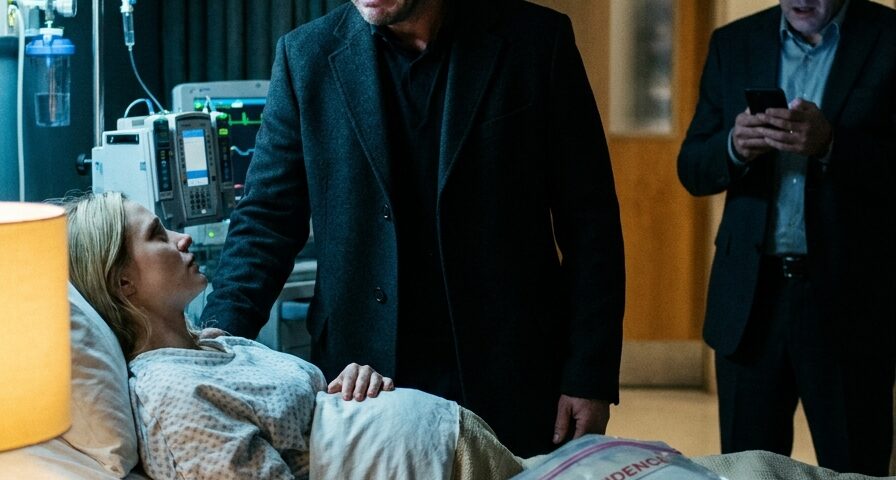
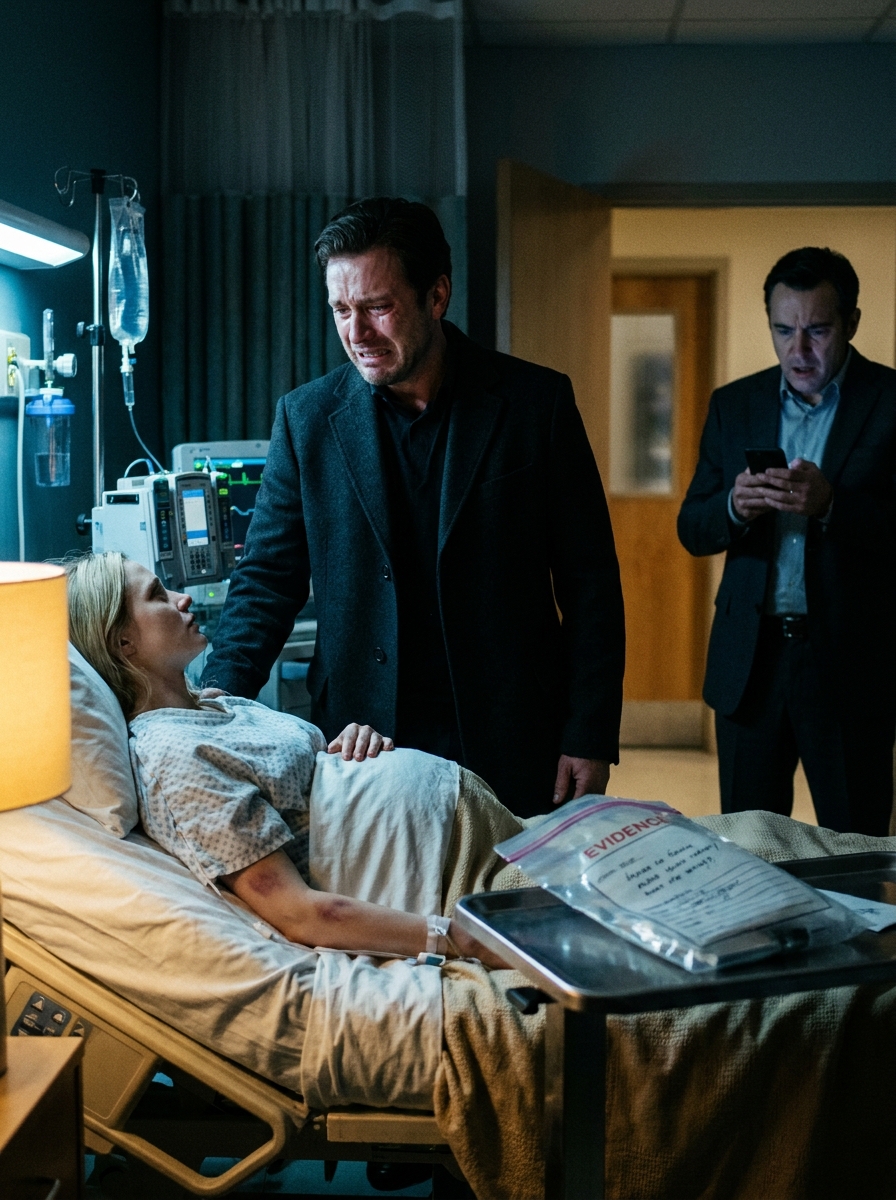
Dr. Bennett returned just after midnight. She found me seated beside Emily, one hand curled around the metal rail of the bed, as if I could hold the entire room in place through force alone.
“She stirred?” the doctor asked.
“She said something.”
“That is a good sign, but she needs rest. Her body has been under enormous stress.”
“What can I do?”
Dr. Bennett studied me. There was no softness in her expression, but there was something better: honesty.
“You can start by understanding that whatever happened before tonight, she is my patient. Not an extension of your family. Not a business problem. Not a scandal.”
“I know.”
“I hope you do.” She checked Emily’s IV, then lowered her voice. “Pregnancy under severe stress can become complicated quickly. Right now, the baby’s heartbeat is stable. Emily’s body is not. She needs nutrition, hydration, monitoring, and calm.”
Calm.
The word felt almost cruel.
“Can she be moved?”
“Absolutely not.”
“Then this hospital becomes secure.”
Her eyes narrowed. “Mr. Mercer—”
“No press. No unauthorized visitors. No calls transferred to this room unless you approve them. I’ll pay for private nursing, additional security, anything the hospital allows.”
“You may arrange security outside the room,” she said. “But you do not get to control her medical care.”
“I’m not trying to control her.”
Dr. Bennett looked from me to Emily, then back again.
“Good. Because when she wakes up, the decisions are hers.”
I nodded.
That sentence landed deeper than she could have known. Three months ago, I had made the greatest decision of Emily’s life without giving her the truth. I had told myself I was protecting her from the consortium circling Mercer Holdings, from threats buried in financial records, from men who had once used family members as leverage. I had believed that if I severed her from my name, she would be safer.
Instead, I had made her easier to isolate.
When Dr. Bennett left, Marcus came closer.
“I have men watching every entrance.”
“Discreetly?”
“Yes.”
“Good.”
“There’s something else.” He hesitated. “Your mother called my office twice.”
I looked up.
“She asked where you were?”
“No. She asked where Emily was.”
The temperature in the room seemed to drop.
“She knows.”
“Maybe. Or she’s guessing.”
My phone began vibrating before I could answer.
The screen showed a name I had not called in ninety-three days.
Mother.
Marcus’s jaw tightened.
I let it ring until it stopped.
Thirty seconds later, a message appeared.
Lucas, call me before you make a mistake you cannot repair.
I stared at the words until they blurred into a shape I recognized from childhood: warning dressed as concern.
I typed one reply.
Too late.
Then I turned the phone face down.
Emily woke at 4:17 a.m.
At first, I thought I had imagined it. Her eyes opened only halfway, unfocused and glassy beneath the dim hospital light. She looked toward the ceiling, then toward the window, then finally toward me.
For one fragile second, there was no anger in her face.
Only confusion.
Then memory returned.
Her eyes filled.
I stood, knocking the chair backward.
“Emily.”
She tried to pull her hand away from mine. I had not even realized I was holding it.
“Don’t,” she whispered.
I released her immediately.
Pain moved across her face, but whether it came from her body or from seeing me, I could not tell.
“Where am I?”
“St. Catherine’s. You collapsed.”
Her hand went to her stomach.
“The baby?”
“Heartbeat is strong.” My voice nearly failed. “The baby is strong.”
Her eyes closed. A tear slipped sideways into her hair.
For a moment, neither of us spoke.
Then she said, “You shouldn’t be here.”
“I know.”
That made her look at me again. She had expected defense, perhaps anger. I had given her neither.
“I read your letter,” I said.
Her face changed instantly. Fear broke through the exhaustion.
“No. Luke, you weren’t supposed to—”
“It said For Luke.”
“I wrote it when I thought…” She swallowed. “I don’t know what I thought.”
“You thought no one would believe you.”
She looked away.
That hurt more than accusation.
“Emily, I believe you.”
Her laugh was barely a breath. “Now?”
There it was.
One word, and I deserved every edge of it.
I sat slowly, keeping distance between us.
“Yes,” I said. “Now. Too late, but completely.”
She stared at the blanket. “Your mother said you knew.”
“I didn’t.”
“She had papers.”
“They were forged.”
“She had messages.”
“Not from me.”
“She knew things only you knew.”
That stopped me.
“What things?”
Emily’s fingers tightened over the blanket. “About the night in Vermont. About the song you played when the power went out. About the name we said we would use if we ever had a daughter.”
A coldness moved through me.
No one knew about Vermont except us.
No one.
“What name?” I asked softly.
Her eyes snapped to mine. Hurt flared.
“You don’t remember?”
“I remember,” I said. “I need to know exactly what she said.”
Emily studied me, searching for a trick, a cruelty, anything familiar from the version of me who had signed away our marriage with a face like stone.
Finally, she whispered, “Rose.”
I closed my eyes.
Rose Mercer, we had said once, laughing in a cabin while snow erased the world outside. Rose because Emily’s grandmother had grown roses in cracked clay pots on a fire escape in Queens. Mercer because back then she still believed my name could become something gentle in her mouth.
“How did she know?” Emily asked.
“I don’t know.”
But a memory stirred.
A phone on the counter in Vermont. My jacket thrown over a chair. A call from the office I had ignored. My mother’s assistant later mentioning she had been unable to reach me that weekend.
Had someone been listening then?
Or had the betrayal started even earlier than I understood?
Emily was watching me now.
“Why did you do it?” she asked.
The question was quiet. That made it worse.
I had imagined this conversation a thousand times and still did not know how to survive it.
“There were threats against Mercer Holdings,” I said. “Not ordinary ones. My father left behind enemies with access to offshore accounts, private investigators, old debts. Someone sent photographs of you leaving your studio. They knew your schedule. Your routes. The café where you wrote on Thursdays.”
Her face went still.
“I thought if I ended the marriage publicly, they would stop seeing you as leverage.”
“You thought?” she repeated.
“I was wrong.”
“You humiliated me.”
“I know.”
“You made me believe I had loved someone who could erase me in one afternoon.”
“I know.”
Her voice trembled. “You looked at me across that table and said there was nothing left worth saving.”
I gripped my knees so tightly my fingers hurt.
“That was a lie.”
“It worked.”
The words settled between us like ash.
I bowed my head.
“I am sorry,” I said. “Not because I got caught in the consequences. Not because my mother may have used it against you. I am sorry because I decided pain was safer than truth, and I gave you no choice.”
Emily looked at me for a long time.
Something in her expression shifted, not toward forgiveness, but toward weariness deeper than anger.
“I wanted to tell you about the baby,” she said. “I bought a tiny pair of socks from a street vendor in SoHo because they were yellow and ridiculous. I kept them in my purse for two days. Then the divorce papers came.”
My throat tightened.
“Where are they?”
“The socks?” She blinked. “I don’t know. Maybe in storage. Maybe gone.”
“They’re not gone,” I said, though I had no way to know.
For the first time, her mouth curved with the ghost of a smile that did not survive.
“Still making promises like money can scare the universe into obeying.”
“No,” I said. “This one is hope.”
She looked away, but she did not ask me to leave.
By morning, the hospital had changed around us. Sunlight washed the edges of the blinds. A nurse named Carla brought Emily broth and helped her sit up slowly. Dr. Bennett explained iron levels, fluids, and the need for several days of monitoring. Emily listened carefully, one hand never leaving her stomach.
I stood near the window, silent unless asked a direct question.
When Dr. Bennett finished, Emily turned to me.
“I need my apartment.”
Marcus, who had remained by the door, looked at me.
“What apartment?” I asked.
Emily’s cheeks colored with humiliation. “A sublet in Astoria. It was all I could get after the landlord issue.”
“You were in Astoria?”
Her eyes sharpened. “Don’t sound like that.”
“Like what?”
“Like someone failed to report a weather condition to you.”
I absorbed that.
“You’re right.”
She seemed surprised I did not argue.
“I need the blue notebook,” she said. “It’s hidden there.”
“Marcus can get it.”
“No.” She tried to sit straighter and winced. “I need to know it is the same one. I marked it.”
“You can’t leave.”
“I know that.”
The frustration in her voice was not stubbornness. It was fear.
“What’s in the notebook?” I asked.
Emily looked at Marcus, then back at me.
“Dates. Names. Things your mother said. Copies of letters. Screenshots I printed at the library because my phone kept losing files.” Her hand tightened over the blanket. “And something from my old doctor’s office.”
Dr. Bennett had mentioned little to no prenatal care.
“What thing?”
“A voicemail transcript. Someone called pretending to be me and canceled my first appointment. The receptionist recognized something was off and saved the recording.”
Marcus stepped closer. “Do you remember where it’s hidden?”
Emily nodded. “Behind the loose tile under the bathroom sink.”
“Who knows about it?”
“No one.”
The answer should have relieved me.
It did not.
Marcus left with two men I trusted more than most blood relatives. Emily watched him go, then leaned back, exhausted by the short conversation.
For several minutes, the only sounds were the monitor and the city waking below the window.
Then she said, “Your mother visited me four times.”
I turned.
“She never came angry,” Emily continued. “That was the worst part. She brought tea once. Ginger, because she said it would help with nausea. She talked about your childhood. About how lonely you were after your father sent you to boarding school. She made me remember loving you before she asked me to disappear.”
My jaw tightened.
“She was always good at that.”
“At what?”
“Making the knife feel like a ribbon.”
Emily’s eyes softened despite herself, as if some private understanding had passed between us.
“She said the Mercer family breaks women who confuse affection with belonging.”
I looked down.
“She told my sister something similar before Grace left for London.”
Emily frowned. “Your sister?”
“You met her once at the wedding. She came late and left before dinner.”
“The one your mother said was unstable?”
I almost laughed, but there was no humor in it.
“Grace was the only sane one in that house.”
“Why didn’t you ever talk about her?”
“Because she asked me not to.” I looked back at Emily. “She cut ties after my father died. I thought she wanted freedom from all of us.”
Emily’s expression changed.
“What?”
“The last time your mother came,” she said slowly, “she mentioned Grace.”
A pressure built behind my ribs.
“What did she say?”
“She said, ‘Lucas should have learned from his sister what happens when women mistake silence for safety.’”
For a moment, the room seemed to tilt again.
Grace had left seven years ago after a breakdown no one in the family discussed. My mother called it exhaustion. My father called it weakness. Grace called me once from London, told me never to trust any explanation that made Vivian Mercer look wounded.
I had been twenty-nine and too loyal to listen.
I took out my phone and searched for my sister’s number. It was still there, buried beneath years of cowardice.
I pressed call.
It rang five times.
Then a woman answered, voice cautious and familiar.
“Lucas?”
Hearing her say my name almost undid me.
“Grace.”
A pause.
“Who’s dead?”
“No one. But Emily is in the hospital.”
Silence.
Then Grace said, “Pregnant?”
I closed my eyes.
“You knew?”
“I suspected.”
“How?”
“Because Mother called me two months ago asking whether I still had contacts at a women’s clinic in Chelsea.”
Emily stared at me from the bed.
“Grace,” I said carefully, “what did she do?”
My sister exhaled. Across the line, I heard a child laughing faintly in the background, then a door closing.
“She did what she always does. She found the softest place in someone’s life and pressed until they mistook pain for fate.”
“Did she do this to you?”
Another silence.
“Not over the phone,” Grace said. “Not after seven years.”
“I need the truth.”
“No, Lucas. You need to decide whether you can survive hearing it.”
Before I could answer, Marcus appeared in the doorway.
His face told me something was wrong.
I ended the call with Grace only after she made me promise to call back from a secure phone. Then I turned to Marcus.
“The apartment was empty,” he said.
Emily pushed herself upright. “Empty?”
“No furniture. No clothes. No dishes. The building manager said a moving company came at six this morning with signed authorization.”
“That’s impossible,” Emily said. “I didn’t sign anything.”
Marcus held up a plastic evidence sleeve.
Inside was a single pale blue tile, cracked neatly in half.
“They knew where to look,” he said. “The notebook was gone.”
Emily’s face lost what little color it had regained.
I moved toward her, then stopped, remembering she had not invited comfort.
She pressed one hand to her mouth.
“I marked it,” she whispered. “I marked the inside cover.”
“With what?” Marcus asked.
Emily looked at me.
“With Rose.”
The name landed like a heartbeat between us.
Before anyone could speak, my phone rang again.
This time, the screen showed an unknown number.
I answered on speaker.
For two seconds, there was only static.
Then my mother’s voice filled the room, calm as winter sunlight.
“Lucas, darling. You always were faster than your father, but never quite careful enough.”
Emily gripped the blanket.
“Where is the notebook?” I asked.
A soft sigh. “Safe.”
“You forged medical documents. You isolated my wife. You endangered my child.”
“Your ex-wife,” Vivian corrected gently. “And you should be grateful someone in this family understands consequences.”
I felt Emily flinch at the word ex-wife.
My voice lowered. “You will not come near her.”
“My dear boy, I already have.”
Marcus stepped toward the door, signaling his men.
“What does that mean?” I asked.
But Vivian only continued, “There are truths in this family that Emily should never have discovered. That notebook was never the danger. It was what she found because of it.”
Emily stared at the phone.
“What did I find?” she whispered.
Vivian heard her.
“Oh, Emily,” she said, almost sadly. “You still haven’t remembered?”
The machines beside the bed kept their steady rhythm, but something in Emily’s expression changed. Confusion opened into fear, then into something stranger. Recognition, maybe. Or the edge of a memory surfacing from deep water.
Vivian’s voice softened.
“Ask Lucas about the night his sister disappeared. Ask him why the name Rose was never yours to choose.”
The call ended.
No one moved.
Emily’s eyes were fixed on me now, wide and searching.
“Luke,” she whispered. “What does she mean?”
I had no answer.
But in the terrible silence that followed, my phone lit up with one new message from Grace.
Do not trust Mother. And do not trust the baby’s first ultrasound.
END OF PART 2