PART 2: His Secretary Said My Husband’s Wife and Son Were Upstairs
PART 2
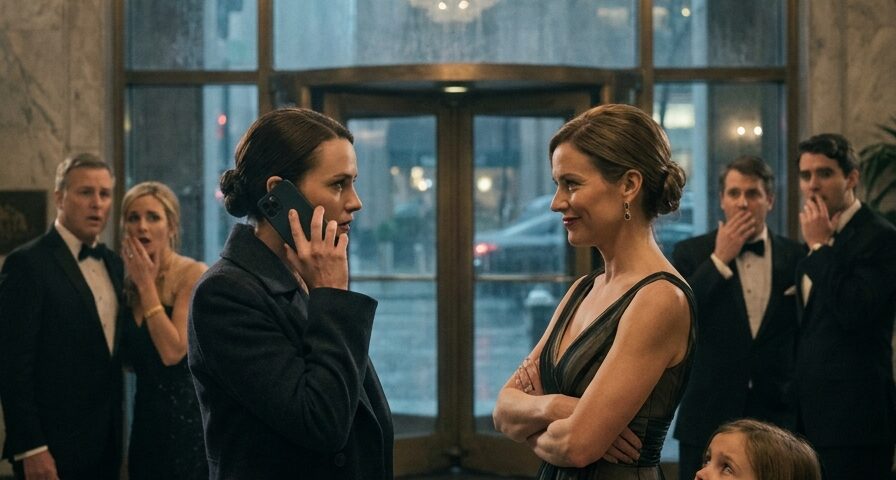
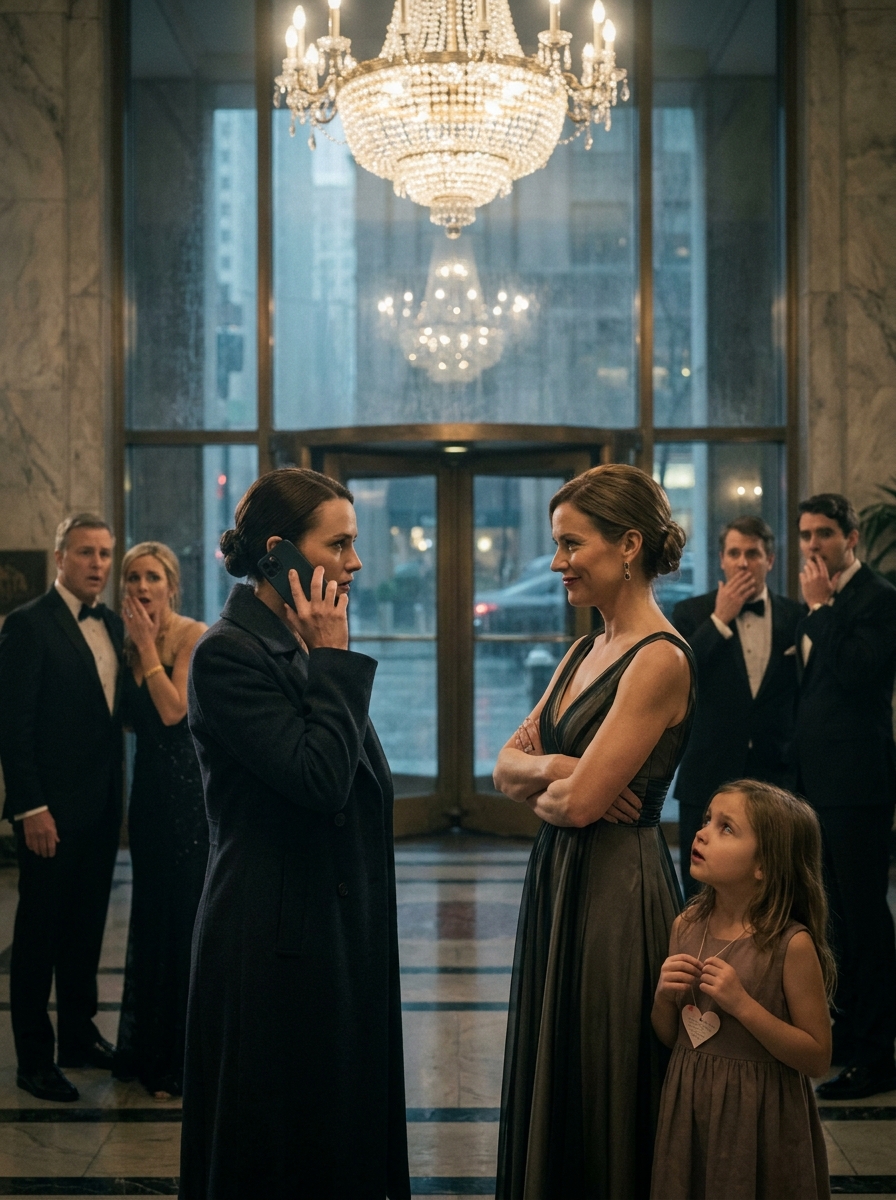
For one breath after Marcus spoke, the glittering lobby seemed to become a painting: chandeliers frozen above polished marble, champagne glasses paused halfway to laughing mouths, winter rain sliding silver against the high windows. Everyone around me still moved, still whispered, still pretended not to stare, but I heard nothing except my brother’s promise and Emma’s small, confused breathing beside me.
I lowered the phone slowly.
Brooke’s smile had begun to tremble at the edges.
It was the tiniest change, something most people would have missed. But I had grown up in rooms where men with billion-dollar confidence lost entire negotiations because of one nervous blink. Brooke had expected embarrassment. She had expected me to shrink, to apologize, to gather my daughter and disappear into the cold like a woman who had wandered into the wrong life.
She had not expected calm.
“Who was that?” she asked.
“Family,” I said.
The word landed between us with more weight than an explanation.
Emma looked up at me. Her mittened fingers tightened around the paper necklace until one glittered heart bent in half.
“Mommy,” she whispered, “is Daddy mad?”
That question almost broke me.
Not because Adrian might be angry. I no longer cared about the size or shape of his anger. It hurt because Emma still believed adults had simple reasons for hurting each other. Someone was tired. Someone was busy. Someone had forgotten. She did not yet know that grown people could build entire houses out of lies, furnish them beautifully, and invite innocent children inside.
I knelt, smoothing the hair away from her damp forehead. Snow had melted into tiny diamonds along her curls.
“Daddy is going to have some questions to answer,” I said gently. “But you did nothing wrong. Do you understand me?”
She nodded, though her eyes remained uncertain.
Brooke cleared her throat. “Elena, this really isn’t the place.”
“No,” I agreed, standing. “It isn’t.”
A flicker of relief crossed her face.
Then I turned to the young man at the reception table, whose name tag read Daniel. He had watched everything with the pale discomfort of someone trapped too close to another person’s disaster.
“Daniel,” I said, keeping my voice quiet, “please ask hotel security for a private room near the lobby. Not for removal. For privacy.”
Brooke laughed once, sharply. “You can’t order staff around.”
Daniel glanced at me, then at Brooke, then at the phone still in my hand.
“Of course, ma’am,” he said, reaching for the desk line.
Brooke’s expression tightened. “Daniel.”
But he was already speaking into the receiver.
I was grateful for that small act of decency. Sometimes courage looked less like grand speeches and more like refusing to obey the cruelest person in the room.
While he arranged it, I called my driver, then my housekeeper, Rosa, who loved Emma with the fierce practicality of a grandmother. Rosa answered on the second ring.
“Señora Elena?”
“Rosa, please have soup ready when we get home. And set up Emma’s room with the blue blanket.”
There was a pause. “Is she ill?”
“No. Just tired.”
Another pause. Rosa understood silence better than most people understood words.
“I will be ready,” she said.
I ended the call as Daniel came around the desk. “There is a sitting room down the corridor, ma’am. Security will make sure you aren’t disturbed.”
“Thank you.”
Brooke stepped into my path. Her perfume was expensive and cold.
“You’re making a mistake,” she whispered.
I looked at her carefully, noticing what I had ignored before: the tension beneath the polish, the way she kept glancing toward the elevators, the fear sharpening behind her eyes. Cruelty often hid insecurity, but fear hid something else.
“What did he promise you?” I asked.
Her face drained.
It was answer enough.
I took Emma’s hand and followed Daniel.
The sitting room was small, paneled in dark wood, with a fireplace that seemed ornamental but gave off real heat. Through the closed door, the gala became a distant murmur, like another world separated by more than walls. Emma climbed onto the velvet sofa and placed the necklace in her lap, smoothing it with both hands.
“Will Daddy still like it?” she asked.
I sat beside her. “It’s beautiful.”
“That isn’t what I asked.”
Six years old, and already she knew when adults softened the truth instead of answering.
I drew a breath. “I don’t know what Daddy will do tonight. But I know this necklace was made with love, and that makes it beautiful no matter what anyone else does.”
She considered that. Then she leaned against me, small and warm and trusting, and I wrapped my arms around her while my own world rearranged itself in silence.
My phone vibrated.
Marcus again.
“Are you alone?” he asked.
“With Emma.”
His voice shifted, softening. “Hey, button.”
Emma lifted her head. Even frightened, she smiled. “Uncle Marcus?”
“That’s right. Your mom and I need to talk about boring grown-up business for a minute. Are you being brave?”
“I made Daddy a necklace.”
“I bet it’s the best necklace in Manhattan.”
“It has purple hearts.”
“Then it’s definitely the best.”
Emma smiled a little more and tucked her face into my coat.
Marcus waited until her breathing steadied before speaking again.
“Listen to me,” he said. “I froze three pending guarantees tied to Adrian’s expansion package. Nathaniel’s bank has suspended review of the bridge loan. Andrew’s office isn’t touching this directly, obviously, but his counsel confirmed Adrian used your marital status in disclosures last quarter.”
My throat tightened. “In what way?”
“He listed Blackwood family support as a material relationship connected to spouse-backed continuity.”
“That sounds like nonsense.”
“It is nonsense dressed in expensive legal language. But it let him reassure investors without naming you.”
I closed my eyes.
For years, I had told myself I was letting Adrian stand on his own. I had asked my family to keep their help quiet so he would never feel diminished by my last name. I thought secrecy protected love from pride.
Instead, secrecy had become soil for rot.
“There’s more,” Marcus said.
I opened my eyes. “Tell me.”
“Not with Emma in the room.”
His restraint frightened me more than the words would have.
The door opened before I could answer.
Adrian stepped inside.
He wore a black tuxedo tailored so perfectly it seemed part of him. His dark hair was brushed back, his cuff links caught the firelight, and the public version of my husband stood framed in the doorway: admired, polished, untouchable.
Behind him was a woman in a champagne-colored dress, elegant but pale, holding the hand of a little boy with solemn gray eyes.
Vanessa Whitman.
I knew her name because I had seen it once on a card in Adrian’s jacket pocket, printed beneath the logo of a charity foundation. He had said she chaired children’s literacy events and helped the company with philanthropic partnerships. I had believed him.
The boy looked about eight. He stared at Emma’s necklace, then at Emma, and his brows pulled together as though he was trying to solve a puzzle no child should have been given.
Brooke appeared behind them in the corridor, no longer smiling.
Adrian shut the door.
“Elena,” he said.
My name sounded unfamiliar in his mouth.
Emma sat up at once. “Daddy.”
For a fraction of a second, something human crossed his face. Love, maybe. Or memory. Then he saw the woman beside him, the boy, me, and whatever instinct moved through him vanished beneath calculation.
“Emma,” he said carefully, “what are you doing here?”
She held up the necklace. “I made this for your big party.”
The room broke in a way no one else could hear.
Adrian looked at the necklace but did not step forward. Emma’s arm slowly lowered.
Vanessa inhaled sharply. “Adrian.”
He turned toward her. “Not now.”
Her face changed. Until that moment, I had assumed she knew exactly who I was, exactly who Emma was, exactly what role she played in the elegant lie upstairs. But the color leaving her cheeks was too sudden to be performed.
“Who is this child?” she asked.
Adrian’s jaw tightened.
Vanessa released the boy’s hand and moved closer to Emma, not threatening, only stunned. “Sweetheart, what’s your name?”
Emma looked at me first. I nodded.
“Emma.”
Vanessa pressed her hand to her mouth.
The boy whispered, “Mom?”
No one answered him.
I stood. “Adrian, we are not doing this in front of the children.”
For once, he seemed grateful for an instruction.
“Brooke,” he said, “take Leo upstairs.”
“No,” Vanessa said immediately.
Her voice was quiet, but it carried a steel I had not expected.
Adrian blinked. “Vanessa.”
“No,” she repeated. “My son stays where I can see him.”
My son.
Not our son.
The distinction slipped into the room like a key turning.
Brooke’s gaze darted to me, then to Adrian, as if measuring which lie still had legs.
I looked at Emma. “Baby, Daniel is outside. He’ll walk you to the pastry table in the lobby for five minutes. You can choose something with strawberries.”
She looked frightened. “Without you?”
“I’ll be right here. Uncle Marcus is on the phone. Daniel will stand by the door.”
Adrian finally moved. “Elena, don’t be dramatic.”
I turned to him slowly.
The words died in his throat.
Vanessa knelt beside Leo. “Go with the nice man, love. Just to the lobby. I’ll come soon.”
Leo hesitated, then nodded.
At the door, Emma paused. The paper necklace hung from her hand.
“Daddy,” she said in a tiny voice, “do you still want it?”
Adrian opened his mouth.
Nothing came out quickly enough.
Emma folded the necklace against her chest and walked out with Daniel and Leo.
When the door closed behind them, Vanessa turned on Adrian.
“You told me she left you.”
My heart gave one hard, painful beat.
Adrian’s face hardened. “This is complicated.”
“No,” Vanessa said. “Tax structures are complicated. Mergers are complicated. A child standing in front of me asking whether her father wants a necklace is not complicated.”
I almost liked her then.
Not because she was innocent. I did not know that yet. Not because she had not benefited from proximity to my husband’s lies. But because she had seen Emma. Truly seen her. In that moment, she had not treated my daughter as an inconvenience.
Adrian rubbed his forehead. “Everyone needs to calm down.”
Marcus’s voice came through the phone, still connected. “Put me on speaker.”
Adrian froze.
I tapped the screen.
Marcus said, “Hello, Adrian.”
The color in Adrian’s face changed. It did not vanish. It rearranged itself, like a man stepping from one mask into another and discovering both were cracked.
“Marcus,” he said. “This isn’t what it looks like.”
“It rarely is. That’s why paperwork exists.”
Brooke, still near the door, whispered, “Adrian, who is Marcus?”
Vanessa looked from her to me. “You don’t know?”
Brooke swallowed.
I almost laughed, though nothing was funny. Brooke had guarded doors to rooms she did not understand. She had mistaken proximity for power.
Marcus continued. “Adrian, as of six forty-two this evening, Blackwood-associated entities have suspended noncontractual support pending review. At six forty-eight, your proposed acquisition financing lost its anchor guarantee. At six fifty-one, I received copies of two investor decks naming Elena’s family resources as strategic stability.”
Adrian stared at my phone as though it had become a live wire.
“You had no right,” he said.
I stepped closer. “No right?”
His eyes moved to me, angry now, because anger was easier than shame.
“You don’t understand what you’ve done,” he said. “There are employees depending on this company. Families. Projects. You think pulling strings because your feelings are hurt makes you noble?”
I absorbed the blow because it was familiar. Adrian had always been skilled at taking the wound he made and asking why I was bleeding in such an inconvenient place.
“I haven’t touched payroll,” Marcus said. “Vendor payments remain active. Employee accounts remain protected. What has been suspended are discretionary supports tied to your personal expansion strategy.”
Adrian’s mouth closed.
That detail mattered. Marcus had not burned the village to punish one man. He had pulled away the scaffolding Adrian had painted gold and called a tower.
Vanessa looked at me. “You funded him?”
“My family did,” I said. “Quietly.”
“Why quietly?”
I smiled, but it hurt. “Because I was foolish in a very romantic way.”
Adrian stepped toward me. “Elena.”
I moved back.
He stopped.
Good. At last, he understood distance.
“I loved you,” I said, surprised by how steady my voice sounded. “I loved you when your office was one rented room above a dentist’s practice. I loved you when your suits came from discount racks and you slept with market reports under your pillow. I loved you when you were kind to waiters because you remembered being ignored. I loved that man.”
Something flickered in his eyes.
“I am that man,” he said.
“No. That man would have worn his daughter’s paper necklace.”
Silence filled the room.
Vanessa looked away first.
Brooke wiped beneath one eye so quickly I might have missed it if I had not been watching. Perhaps she had expected a scandal. Perhaps she had not expected grief.
Adrian’s voice dropped. “You don’t know what it was like.”
“Then explain it.”
He laughed without humor. “Growing beside you was impossible. Do you know that? Every room we entered, someone wanted to know which Blackwood you belonged to. Every achievement I made, your brothers looked at me like they were checking the construction of a bridge before letting you walk across it.”
“They were worried about me.”
“They were waiting for me to fail.”
“Maybe,” I said. “But I wasn’t.”
That landed.
For a moment, the only sound was rain tapping the windows.
Adrian looked exhausted suddenly, older than he had an hour ago. “Vanessa understood what I was building.”
Vanessa turned sharply. “I understood what you told me. That your marriage had ended privately. That Elena wanted distance from public life. That Emma lived with her mother overseas half the year.”
My stomach turned.
He had not erased us entirely. He had edited us into something convenient.
Vanessa’s eyes filled, but she refused to let tears fall. “You let my son call you Dad.”
Adrian closed his eyes.
That confession hurt differently. It did not excuse him. Nothing did. But it revealed the architecture of his deception. He had not merely betrayed me. He had borrowed fatherhood from two children, handing each an incomplete version of himself and hoping they would never compare notes.
Brooke spoke for the first time. “He said Elena knew.”
I looked at her.
Her bravado was gone.
“He said the marriage was arrangement only,” Brooke continued, voice unsteady. “He said you had an understanding. That you hated public events. That Vanessa was the person he needed beside him for appearances.”
“Then why threaten to call security?” I asked.
She flinched. “Because he told me to keep you away if you ever came.”
Adrian’s face darkened. “Brooke.”
“No,” she said, stepping back from him. “No. I have cleaned up your schedule and rearranged your stories and lied to callers without asking enough questions. I won’t stand here and be the only person blamed because I was stupid enough to believe you were important.”
There was no triumph in watching her unravel. Only a tired recognition that lies rarely damage one life at a time.
Marcus’s voice returned. “Elena, I need to speak with you privately soon. There are documents you must see tonight.”
Adrian looked toward the phone. “Marcus, listen to me. We can settle this.”
“Settle what?” Marcus asked.
“The financing. The review. Whatever you’re doing.”
“Interesting,” Marcus said. “You haven’t asked about your wife.”
Adrian’s expression tightened.
I did not need Marcus to defend me. Still, the quiet precision of his words steadied something inside me.
Vanessa picked up her clutch from the chair where she must have dropped it earlier. “I’m leaving.”
Adrian reached for her arm. She stepped away before he touched her.
“Vanessa, don’t make this worse.”
She looked at him with such sorrow that even he seemed diminished by it.
“You made this,” she said. “We are only discovering the shape.”
She turned to me. “Elena, I am sorry. I know sorry is too small. But I am.”
I believed that she meant it.
“I am sorry too,” I said.
Not for what she feared. Not for Adrian. For Leo. For Emma. For the women we had been when we believed the version of him we were given.
Brooke opened the door and left first, almost stumbling into the corridor.
Vanessa followed, composed by force.
Adrian and I remained.
The gala thundered faintly beyond the walls, applause rising from the ballroom. Perhaps someone had just introduced him. Perhaps a screen upstairs displayed his name in elegant gold letters. Perhaps an audience waited for a man who no longer existed in quite the same way.
“You really called them,” he said.
“I called my brother.”
“You knew what he’d do.”
“I knew he would protect me.”
Adrian laughed softly. “From me?”
I held his gaze. “Yes.”
He looked wounded then, truly wounded, and the sight startled me. I had expected anger, denial, calculation. I had not expected him to look like a boy who had finally found the locked door he built around himself and realized he had no key.
“I never stopped loving Emma,” he said.
“Love is not something you store safely in a drawer while you attend galas with another family.”
His mouth twisted. “And what about you? Hiding who you were from me? Letting your brothers decide whether I was worthy?”
“I hid my name, not my heart.”
“You hid the power behind it.”
“Yes,” I said. “Because I wanted to be chosen without it.”
“And I wanted to become someone who couldn’t be looked down on.”
I heard, beneath the bitterness, the old wound he had never let me touch. His father had gone bankrupt when Adrian was twelve. His mother had sold jewelry to keep the lights on. Pride had been his first language, ambition his second. I had once admired both.
But pain explained behavior. It did not erase consequence.
“Maybe we both hid things,” I said. “But only one of us brought a child into a room and made her wonder whether her father was ashamed of her.”
He looked down.
At last.
My phone buzzed with a message from Daniel: The children are safe. Emma chose strawberry tart. Leo is with his mother.
I exhaled.
“I need to take Emma home,” I said.
Adrian looked up quickly. “Let me see her first.”
“No.”
“Elena.”
“No,” I repeated, softer but firm. “Not tonight. Not after she offered you love and you hesitated in front of her.”
He looked as if I had slapped him, though I had only named what happened.
“I’ll speak to my attorney tomorrow,” I continued. “You can communicate through proper channels. You will not come to the house without agreement. You will not speak to Emma until I know what she can safely hear.”
“Safely?” he echoed.
“Emotionally safely.”
That silenced him more effectively than any threat.
At the door, I paused. “One more thing.”
He looked at me.
“The necklace is coming home with us.”
His eyes shone, but whether from regret or fear, I no longer knew.
In the lobby, Emma sat at a small table with a strawberry tart untouched before her. Leo sat across from her, both children silent in the strange companionship of the confused.
Vanessa stood nearby, speaking softly on her phone. Her face was turned toward the window, but I could see her reflection. She was crying without sound.
Emma ran to me. “Can we go home?”
“Yes.”
She leaned close. “The boy said Daddy reads him dragon books.”
My chest ached. “Did he?”
“He said maybe his daddy and my daddy have the same name.”
I closed my eyes briefly.
Children tried to make sense of impossible things by turning them into riddles.
Vanessa ended her call and approached. Leo stayed behind her, clutching the sleeve of her dress.
“Elena,” she said, “I gave Marcus my number. I don’t know what he needs, but I’ll cooperate.”
“Thank you.”
She hesitated. “Leo doesn’t know. Not really. Adrian came into our lives when Leo was four. His biological father isn’t involved. Adrian let him believe…” She stopped, swallowing. “I should have asked more questions.”
“So should I,” I said.
For the first time, there was no competition between us. Only the cold wreckage of trust, and two mothers measuring how to carry children across it without cutting their feet.
Emma tugged my coat. “Mommy, can Leo keep the tart? I don’t want it.”
Leo looked startled.
Vanessa gave him a small nod.
He took the plate carefully. “Thank you.”
“You’re welcome,” Emma whispered.
That simple exchange nearly undid me.
Outside, the rain had softened to mist. The hotel’s golden entrance blurred behind us as my driver opened the car door. Emma climbed in first, buckling herself with solemn concentration. I sat beside her, and only when the door closed did I let my shoulders fall.
She placed the necklace in my lap.
“Can you keep it safe?” she asked.
“Always.”
“Will Daddy come home?”
I looked through the rain-streaked window at my own reflection, fractured by droplets into a dozen versions of myself. The wife who arrived with hope. The daughter who had hidden her name. The mother who had learned, too late but not too late, that love without truth leaves children standing in doorways with gifts no one deserves.
“I don’t know,” I said. “But you and I will be okay.”
She leaned against me.
By the time we reached our townhouse, Emma was asleep, one hand still curled around my sleeve. Rosa met us at the door with warm eyes and no questions. She lifted Emma with practiced tenderness and carried her upstairs.
I remained in the entry hall, surrounded by the familiar quiet of home. Adrian’s shoes were still by the bench. His umbrella leaned in the stand. A half-read biography rested on the console table with his reading glasses folded neatly on top.
Ordinary objects can be cruel. They insist a life was real even after you learn parts of it were staged.
Marcus arrived twenty minutes later, not in one of his usual immaculate suits but in a dark sweater and raincoat, hair damp from the storm. He hugged me without speaking. That was rare for him. Marcus usually solved feelings by placing them into categories and attacking whichever category looked weakest.
Tonight, he simply held me until I remembered how to breathe.
Rosa brought tea, then disappeared upstairs.
Marcus set a leather folder on the kitchen table.
“I hate this part,” he said.
My laugh came out broken. “You hate every part involving feelings.”
“True. But I hate this one specifically.”
I sat across from him. “Show me.”
He opened the folder.
There were printouts of financial disclosures, copies of investor presentations, corporate diagrams with boxes and arrows, emails highlighted in yellow, and legal forms dense with language designed to discourage ordinary people from asking simple questions.
Marcus turned one page toward me.
“This is the continuity assurance Adrian’s firm submitted to secure the acquisition financing. It references spousal asset stability and contingent family support.”
“I never signed anything.”
“I know.”
He placed another document on top.
My name appeared near the bottom.
Elena Blackwood Hale.
The signature beneath it looked like mine at first glance. The same long E. The same decisive slant. A good imitation, but not perfect. The final stroke of Blackwood curled upward. Mine never did.
“That isn’t mine,” I said.
“I know that too.”
A coldness moved through me, deeper than anger. “Forgery?”
“Possibly. But that isn’t the strangest part.”
Of course it wasn’t.
Marcus pulled one final sheet from the folder. It was a notarized certification attached to the document. My eyes moved over the date, the stamp, the witness line.
Then I stopped.
The notary was a small private office in Connecticut.
The witness name was familiar.
Not Adrian’s.
Not Brooke’s.
Not Vanessa’s.
I stared at it until the letters blurred.
“That can’t be right,” I whispered.
Marcus said nothing.
The witness signature belonged to Claire Blackwood.
My mother.
For a moment, the house itself seemed to hold its breath.
Upstairs, Emma murmured in her sleep. Somewhere outside, a car passed over wet pavement. Marcus watched me carefully, as though waiting for the first crack in glass.
“My mother witnessed a forged signature?” I asked.
“I don’t know yet.”
“She wouldn’t.”
“I didn’t say she did.”
“But her name is there.”
“Yes.”
I pushed back from the table, suddenly unable to sit. My mother, elegant and exacting, who had warned me gently about Adrian without ever forbidding him. My mother, who sent Emma books wrapped in ribbons. My mother, who believed family loyalty was not spoken of because it was assumed.
“She must not know,” I said.
Marcus’s expression told me he wished he could agree.
“There is something else,” he said.
I looked at him.
He reached into his coat pocket and removed a small cream envelope, sealed with dark green wax.
My mother’s stationery.
“It was delivered to my office this afternoon,” Marcus said. “Before you went to the gala.”
My fingers felt numb as I took it. My name was written across the front in my mother’s careful hand.
Elena.
I broke the seal.
Inside was a single card.
Do not confront Adrian tonight. Bring Emma home. Trust no one until I explain.
Beneath the words, in a corner of the card, my mother had drawn a tiny black key.
The same symbol engraved on the necklace Adrian had given me the night he proposed.
END OF PART 2