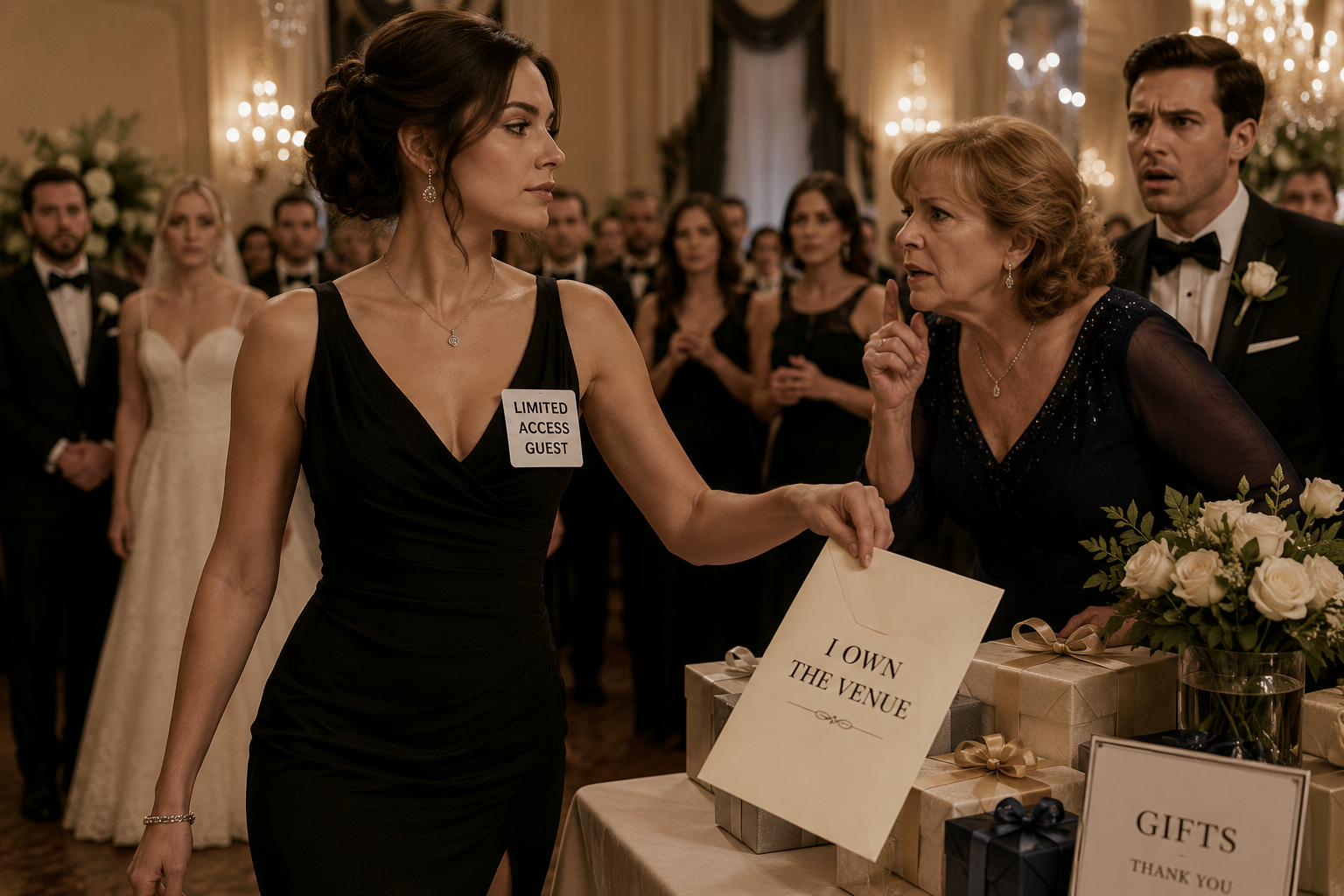
At My Brother’s Wedding, They Gave Me A Paper Badge That Said, “Limited Access Guest.” My Mom Leaned In And Said, “That Means No Dinner Plate.” I Looked Over, Walked To The Gift Table, Retrieved My….
Part 1
My name is Connie Hst, and I was thirty-two years old when my family decided I didn’t deserve a chair at my own brother’s wedding.
I didn’t know anything was wrong at first. The ceremony was fine, quick and polished, the kind that blurs together behind soft piano music and the sound of polite applause. Ryan stood tall at the altar like he’d always wanted to be seen as the calm one, the golden one. Cara looked beautiful in a way that made you almost forget weddings are built on stress and spreadsheets and arguments about napkin colors.
Ryan barely spoke to me that morning, but I told myself he was nervous. Weddings do that to people. They make them strange.
I wasn’t expecting special attention. I wasn’t expecting to stand beside him or make a toast or have anyone introduce me like a celebrity. I just assumed I was included. Family usually is.
When the ceremony ended, people flowed toward the reception venue, laughing, taking photos, passing around compliments like candy. The reception was in a bright hall with tall windows and white drapes that softened everything. Outside, early evening sunlight sat on the parking lot like warm honey.
I lined up at check-in behind a couple dressed in coordinated neutrals. The woman at the table smiled at them and handed each a thick, gold-trimmed badge. Their names were written in looping calligraphy, table numbers printed beneath.
Then it was my turn.
She didn’t look up. She reached under the table and handed me a badge made of thin white paper. No calligraphy. No ribbon. Just bold black text stamped across the front.
Limited Access Guest.
For a second, I stared at it and waited for her to say something. Anything. A correction. An explanation. A joke. Maybe someone behind the table would laugh and say, Oh my gosh, wrong badge, sorry.
Nothing.
She was already reaching for the next badge.
A strange pressure filled my ears, like the room had dipped underwater. I opened my mouth to ask if there’d been a mistake, but before I could, my mother appeared at my side as if she’d been standing just out of view.
She leaned in, her voice low and casual, like we were sharing a private joke.
“That just means no dinner plate.”
She said it so easily. No hesitation, no apology, no discomfort. Like she was telling me where the restrooms were.
Then she straightened and walked away.
I stood there holding the badge, the paper already bending slightly under my fingers.
For a moment, I tried to make it make sense. Weddings are chaos. Lists change. Someone forgets to print something. Someone misplaces a place card. The seating chart is always the last-minute battlefield.
So I walked into the hall anyway.
The first thing I noticed was the smell. Warm food, butter, roasted something, the faint sweetness of dessert waiting its turn. Servers moved like they belonged, carrying plates and baskets with the smooth rhythm of people who’ve done this a hundred times.
Tables gleamed under soft lights. Real plates sat at every seat, heavy ones. Linen napkins folded into tidy triangles. Place cards stood upright, the names written in careful script.
I scanned the closest table.
Then the next.
Then the long family table near the front, decorated with a slightly fancier centerpiece. My parents’ names were there. Ryan’s and Cara’s, her parents, cousins, aunts, friends.
Not mine.
I checked again, slower this time, my heart thudding harder with each pass. I even checked the far end where the extra chairs usually go, the place where someone might squeeze in a late RSVP.
Still nothing.
No chair. No plate. No place card tucked awkwardly at the edge.
That’s when it hit me.
I wasn’t a guest. I was a technicality.
I stood near the wall with my purse gripped too tightly, watching people settle in. Laughter bubbled around me. Chairs scraped. Glasses clinked. Someone’s perfume drifted by, sweet and expensive.
Ryan stood to give his first toast, smiling wide, confident, relaxed. The kind of smile you wear when you believe the world is still built to hold you.
My parents clapped enthusiastically. Cara leaned in and kissed his cheek. Phones lifted to capture the moment.
People saw me standing there.
They just didn’t care.
I waited. I don’t know what for. Someone noticing. Someone waving me over. Someone saying it was wrong.
No one did.
In that quiet humiliating space, something inside me went very still.
This wasn’t an oversight. Not with a badge already printed. Not with my mother explaining it like it was obvious. Not with every table set down to the last fork.
I turned and walked back toward the entrance where the gift table sat.
Earlier, it had been crowded with boxes and envelopes tied in ribbon, tags fluttering. Now it was quieter, just a few things left behind, pushed together.
My envelope stood out immediately. Plain white, slightly bent at the corner from when I’d set it down earlier. No ribbon, no sticker. Inside was a check for $7,500.
Money I’d saved over months. Extra shifts. Cancelled plans. Saying no to things I wanted because I wanted to do something meaningful for my brother.
I picked up the envelope and slid the check out. I held it for a moment, feeling the weight of everything I’d poured into it.
Then I put it back.
I didn’t shout. I didn’t cause a scene. I didn’t grab a microphone or flip a table like a movie villain.
I just said, not loudly, but clearly enough for the closest cluster of guests to hear:
“I don’t think you’ll need this anymore.”
And I walked toward the exit.
I didn’t make it ten steps before I heard a chair scrape hard against the floor. Someone called my name.
“Connie!”
Then Ryan’s voice, sharp and panicked.
“Connie, wait!”
My parents started shouting over each other, too.
“Connie, come back!”
“Don’t do this!”
“Not here!”
I didn’t turn around. I didn’t speed up. I just kept walking.
Outside, the air was cooler and smelled like fresh-cut grass and asphalt warming from the day. I got into my car, started the engine, and drove away without looking back.
They could toast and dance all they wanted.
But the honeymoon they were counting on just lost its funding.
That night, I didn’t sleep. Not because I was shaking with rage, though I was angry, but because every moment replayed itself behind my eyes. The badge. The tables. My mother’s voice.
By morning, the messages started.
First my mom, then my dad, then Ryan.
Can we talk?
Please don’t make this a thing.
Let’s not ruin the weekend.
No one said they were sorry.
My mom even wrote, We assumed you’d be fine standing since you always say you don’t care about fancy stuff.
Standing.
Like that was the problem.
Around noon, my dad called. I ignored it. He called again, then texted: Come over. We want to talk. Ryan’s here too.
I didn’t answer right away.
I took a shower. Made breakfast. Cleaned my kitchen.
I didn’t owe them urgency. I didn’t owe them forgiveness.
But part of me wanted to hear how they would explain it. Not because I thought it would fix anything, but because I wanted to know if they could even say the truth out loud.
So I went.
When I pulled into my parents’ driveway, both cars were already there. My father’s and Ryan’s. That alone told me this wasn’t a conversation. It was a strategy meeting.
I let myself in without knocking.
No one jumped. They’d been listening for my car.
My mom turned first, her face already arranged into something careful and pleasant, like she’d practiced it in the mirror.
My dad sat rigidly on the couch, hands clasped. Ryan stood near the window, half turned like he wasn’t sure whether to hug me or brace himself.
I sat down without saying anything.
Silence stretched. I let it.
Finally my dad cleared his throat.
“Yesterday didn’t go the way we hoped.”
Not we messed up. Not we hurt you.
Just: unfortunate.
My mom jumped in quickly. “There was some miscommunication. Logistics got complicated. Things slipped through the cracks.”
Cracks. Like I’d fallen through by accident.
Ryan rubbed the back of his neck. “I didn’t know it was going to be like that. I thought you’d understand.”
“Understand what?” I asked.
They all waited, like my words were a test and they’d studied only half the material.
I nodded slowly, listening to the cleanup tour of excuses. When the room finally went quiet again, all three of them looked at me waiting.
I said one word.
“I might.”
That was it. No explanation, no forgiveness. Just might.
The shift in the room was immediate.
My mom’s shoulders relaxed like she’d been holding her breath. My dad leaned back, relief flickering across his face. Even Ryan looked directly at me for the first time since I’d walked in.
Hope flooded the room.
They thought they’d pulled me back in.
My mom started talking quickly now, warmth layered over urgency. She said how generous it would be. How the money would go straight to the honeymoon. How she didn’t want this small thing to cast a shadow over such a happy time.
My dad added something about families having rough patches but sticking together.
Ryan still didn’t say thank you.
I smiled faintly, stood up, and told them I needed time to think.
I left them with might.
Not yes. Not no.
Let them sit with it.
Part 2
The next morning, my mother left a voicemail. Her voice was softer than usual, almost careful, like she was talking to someone who might bolt.
She said maybe things had been handled a little rigidly. That communication could have been better.
Still no apology.
Then she casually mentioned they were delaying the honeymoon. Not canceling. Just pushing it.
She said it like it was weather-related.
What she didn’t say, I already knew.
Without my check, they couldn’t afford it.
That afternoon, my dad called. His approach was different. Less emotion, more calculation.
He told me he was proud of me. Of how stable I was. Dependable. Responsible.
“Not everyone in the family can say that,” he added.
Then came the line I’d heard my whole life, dressed up as trust but always landing like a weight.
“We trust your judgment. I know you’ll make the right call.”
Praise. Pressure. Obligation.
They were layering it now, like frosting over a cake that was still raw in the middle.
That night I remembered the car.
Six months earlier, their second vehicle had broken down. I’d loaned them mine, my spare, because I had a decent job, reliable public transit nearby, and I’d told myself it wasn’t a big deal.
“It’ll be for a week or two,” my mom had said back then, looking relieved. “Just until we sort it out.”
A week turned into two. Two turned into a month. Then there were excuses.
Waiting on a part.
Waiting on the mechanic.
The mechanic disappeared.
The shop was backed up.
It wasn’t worth fixing.
They were looking for a used one.
I stopped asking.
The car was still registered in my name. Still on my insurance.
That night, I checked the records. Nothing had changed.
So I scheduled a tow for Friday morning.
No warning.
At 8:12 a.m., my phone rang.
Mom.
I didn’t answer.
It rang again. Then again.
The third time I picked up.
“There’s someone outside,” she said, panic cracking through her voice. “They’re towing the car. Connie, did you do this?”
“Yes.”
A pause, stunned silence.
“Why?”
“I’m changing insurance companies,” I said calmly. Not a lie. I’d been thinking about it anyway.
She started talking fast. They needed the car. They had plans. This was inconvenient.
I could hear my dad yelling in the background, angry and confused.
I said, “Maybe borrow one, rent one, figure it out. That’s what I’d have to do, right?”
She went quiet for a beat, then asked, “This is about the wedding, isn’t it?”
“It’s about patterns,” I said.
Then I hung up.
That evening, Ryan messaged me.
Can we talk? Just us.
I waited six hours before replying.
Soon, not today.
Let him sit with silence the way I once had, standing against a wall while the room pretended I didn’t exist.
The next day, he messaged again.
Please.
I left it on read.
From my parents, nothing. No follow-up, no apology, which told me everything.
They weren’t sorry. They were just scrambling, trying to keep options open in case I cut them off completely.
Three days later, I showed up unannounced.
My dad flinched when he saw me. My mom smiled too quickly, like her mouth knew what to do but her eyes didn’t.
I sat at the kitchen table. No coffee offered.
My dad started by saying Ryan was upset and never meant to exclude me.
My mom added they were looking at smaller honeymoon options now, maybe somewhere closer, maybe fewer days.
I listened until they ran out of words.
Then I asked, “Has anything been booked?”
They hadn’t.
“I might be able to help,” I said slowly. “But I was thinking of making it a loan.”
They froze.
“What kind of terms?” my dad asked, voice cautious now, like he’d entered a negotiation without paperwork.
“Monthly repayments,” I said. “With interest. Nothing extreme. Just fair.”
My mom stared at me like I’d started speaking another language. “But it was a gift.”
“It was going to be,” I said. “Then you gave me a paper badge and no seat.”
Silence filled the kitchen, thick and sharp.
“Also,” I added, “I’m stepping out of the family group chat. I’m not reading about pool parties unless I’m actually treated like family.”
I stood up.
“Or you can borrow the money elsewhere,” I said. “Ryan can pick up extra shifts. You can sell something. Figure it out.”
As I walked out, a car pulled into the driveway.
Ryan.
He jumped out fast, like he’d been waiting for the right moment.
“Wait, Connie.”
He looked exhausted. Genuine, maybe. Or just caught between anger and fear.
“I know they messed up,” he said. “I do. But you’ve made your point. Don’t keep going.”
I studied him. The brother I’d defended when we were kids. The one I’d driven to soccer practice and helped with homework. The one I’d once sworn I’d always show up for, even if nobody showed up for me.
I asked him one question.
“When you saw me standing there and walking out with the envelope, why didn’t you stop it?”
He opened his mouth, then closed it. His eyes flicked away.
He didn’t answer.
That was his answer.
I walked to my car and drove off.
That night, my phone buzzed.
A message from Cara.
I don’t know everything, but I’m really sorry. You didn’t deserve that.
I read it twice, then once more, as if repetition could make it heavier or lighter.
At least one person in that new household understood what had been done.
After that, everything went quiet.
Not the peaceful kind of quiet. The kind that waits.
No calls. No texts. No accidental check-ins disguised as concern.
The family group chat stayed silent. No jokes. No updates. No passive-aggressive memes from my mom.
It was like I’d been temporarily archived.
I canceled the birthday dinner I’d planned for myself that weekend. Ordered takeout instead. Ate alone on the porch, listening to the city hum around me.
No drama. No paper badge. Just quiet.
They probably thought they were freezing me out.
What they didn’t realize was I’d already left.
A week passed, then another.
Then late one night, a message came through from an unknown number.
Hey, I hope this isn’t too weird, but I felt like you should know something. It’s about the wedding and Ryan.
I stared at the screen for a long moment before responding.
Who is this?
She explained she was Cara’s cousin. She’d helped with the seating arrangements in the final days before the wedding.
What she said next made my chest go tight, not with shock, but with something colder.
I was originally listed as full-access family, seated with your parents and Ryan. Three days before the wedding, your mom sent a revised list. You were the only name moved.
I sat up straighter.
She told me Ryan approved the change.
The message continued.
I didn’t question it. I figured it was a family thing. But after seeing what happened to you, it didn’t sit right. I’m not trying to stir drama, but what they did wasn’t a mistake.
I didn’t respond right away.
I scrolled back through old texts.
Ryan venting about costs.
Ryan complaining about the venue.
Ryan joking, not joking, about how tight money was.
Man, I don’t know how we’re going to afford the honeymoon. Good thing I’ve got you.
He knew.
He knew I was bringing the check.
He knew exactly how much it was.
And he still let them hand me a paper badge and leave me standing against a wall.
They didn’t want me there.
They wanted the envelope.
That was the moment it stopped hurting, because pain needs uncertainty to survive.
And now I had proof.
The next morning, my mom texted:
Still delaying the honeymoon. Just waiting to see how things play out.
I stared at the screen, then typed one line.
So you’re still waiting on me?
The response came minutes later.
We’re hoping, yes, but it’s your decision.
Hope wrapped in guilt. Patience framed like virtue.
I waited a full day before replying.
Then I sent one final message.
I spoke to a financial adviser. If I help, it would be through a formal contract, interest, signatures, and one condition. All conversations about money are in writing.
Hours passed.
Then my dad texted.
Are you being serious right now?
I didn’t answer.
Later that night, my mom messaged again.
Maybe we should meet and talk calmly.
I sent a thumbs up emoji.
Part 3
We met at my parents’ house on a Sunday afternoon, the kind of day where the sunlight is pretty but the air still holds winter’s edge.
Everything was lighter when I walked in, like they were staging a version of the family we were supposed to be.
My mom had coffee ready. My dad had printed sheets on the table. They looked like options from a travel site, comparisons with prices and dates highlighted, like the problem was simply logistics.
Ryan wasn’t there.
“He doesn’t want to be part of this,” my mom said. “It’s too stressful for him.”
“That’s fair,” I replied, setting my purse down. “I’m stressed too.”
My dad slid the papers toward me. One suggested a partial payment now, more later after trust is rebuilt.
Trust is rebuilt.
Like the damage was a crack in the driveway that could be patched if you poured enough money into it.
I looked over the sheets, then folded them neatly and slid them back.
“I’ve made my decision,” I said.
My mom’s face tightened. My dad blinked like he was waiting for a punchline.
“You’ll need to figure it out without me,” I continued.
The hope drained out of the room so fast I could almost feel it move.
My mom’s voice went thin. “Connie, don’t punish us forever.”
I didn’t raise my voice. I didn’t cry. I didn’t point dramatically at the ceiling.
I said, “This isn’t punishment. This is a boundary.”
My dad leaned forward. “So that’s it? You’re going to throw away your relationship with your brother over one misunderstanding?”
I looked at him for a long moment.
“It wasn’t a misunderstanding,” I said. “It was a decision. And you want me to pay for it.”
My mom’s eyes flashed. “We didn’t know you’d take it so personally.”
I let out a quiet breath. “You printed the badge.”
She opened her mouth, then closed it.
Then she tried a different angle, softer. “You know I love you.”
I nodded. “I know you believe you do.”
That landed like a slap. She looked wounded, like I’d stolen something from her.
My dad’s tone sharpened. “You’re being dramatic.”
I stood up.
“If I was dramatic,” I said, “I would’ve stood up in the reception hall and explained to everyone why I didn’t have a seat. I would’ve told them about the badge. The plate. The way you said it so casually, like it was normal.”
They both stared.
“I didn’t do that,” I continued. “I walked out. Quietly. That’s me being merciful.”
My mom’s hands trembled slightly around her mug. “What do you want from us then?”
The question sounded sincere, but it wasn’t. It was the kind of question people ask when they want a list they can bargain with.
I answered anyway.
“I want you to stop treating me like a resource,” I said. “And if you can’t, then I want distance.”
My dad scoffed. “So we just lose you?”
“No,” I said. “You lose access.”
My mom’s eyes narrowed, the words from the badge hanging between us like a cruel echo.
“That’s not fair,” she whispered.
I tilted my head. “Funny. That’s exactly what I thought at the wedding.”
I left.
The next morning was silence.
A few days later, Cara texted.
They told me you shut everything down.
I stared at the message, then replied.
You’re the only one who said I was right.
Her reply came quickly.
I still think you were. I didn’t know families did stuff like that. In my family, even if someone’s mad, they still feed you.
That made me laugh. A real laugh. Quiet but genuine.
Maybe I’m just not used to this kind of family, she added.
Neither am I anymore, I typed back, and it surprised me how true it felt.
Weeks passed.
No birthday message. No holiday check-in. No reconciliation attempt.
They didn’t cut me off outright.
They just stopped reaching.
As if waiting long enough might make me forget.
I didn’t.
But something else happened in that space.
I stopped rehearsing conversations in my head. Stopped flinching when my phone buzzed. Stopped waking up with my stomach tight, wondering if I’d done something wrong.
I was just calm.
One evening, I came home from work and found a small envelope taped to my apartment door. No stamp, no return address.
Inside was a folded sheet of paper and a key.
The paper read:
Connie,
I don’t know if you’ll talk to me, but I need you to know I’m sorry.
Not for the money. For the badge. For the chair. For letting them do it.
I told myself it wasn’t that big of a deal because I didn’t want to fight before the wedding.
That’s not an excuse. It’s cowardice.
Cara found out the truth and she hasn’t looked at me the same since.
I’m trying to fix this, but I can’t fix it if you’re gone forever.
If you’re willing, meet me at the diner on Elm this Friday at 7.
No parents. Just me.
Ryan
I sat on my couch holding the key in my palm like it might bite.
The key was to my spare car.
He’d returned it.
Not through my parents. Not with excuses.
With a choice.
That alone was more than they’d done.
Friday came.
I almost didn’t go. Not because I was afraid, but because part of me didn’t want to reopen the wound.
But another part of me wanted to see if Ryan could say the word they all avoided.
Sorry.
The diner on Elm was the kind of place that never tried to be trendy. Vinyl booths, chipped mugs, the smell of grilled onions that never really leaves. I walked in at 6:58 and saw him sitting in the corner, hands wrapped around a glass of water.
He stood when he saw me, like he wasn’t sure what was allowed.
“Hey,” he said.
I slid into the booth across from him.
He looked thinner than I remembered. Tired. His eyes had the shadow of someone who’d discovered adulthood doesn’t forgive your family’s habits.
We sat in silence until a waitress dropped off menus and left.
Ryan swallowed. “I’m sorry,” he said.
There it was.
No qualifiers. No blame. No tiny joke to soften it.
Just sorry.
I nodded once.
“I approved the change,” he admitted, voice low. “Mom said it was about numbers. About making sure everyone important was seated. And I…” He shook his head, disgusted with himself. “I didn’t push back. I didn’t think about you as a person in that moment. I thought about the budget.”
My hands stayed steady. “You thought about the check.”
He winced. “Yes.”
He stared down at the table like it might open and swallow him.
“I knew you’d bring it,” he said. “I knew how much. And I told myself… I told myself I could smooth it over later. I told myself you’d forgive me because you always have.”
His voice cracked on the last word.
“Connie, I hate that I became that guy,” he whispered.
I let the silence sit.
Then I asked, “What changed?”
He looked up. “Cara.”
That surprised me.
He explained, slowly, honestly. She’d been confused after the wedding. Not angry at first, just unsettled. Why wasn’t Connie seated? Why did your mom talk to her like that was normal? Why did everyone act like it was fine?
Ryan tried to dismiss it at first. Tried to say I was being sensitive, that it was complicated.
Cara didn’t let it go.
She asked to see the seating list. Asked who revised it. Asked why a paper badge existed at all.
And when she learned the truth, her face changed in a way that made Ryan realize he wasn’t just risking me.
He was risking the kind of marriage he thought he was building.
“She said if I could treat my own sister like that,” Ryan told me, “what would I do to her when things got hard?”
I felt something shift, not softening exactly, but rearranging.
“What did you tell her?” I asked.
“I told her the truth,” he said. “That you’ve always been the dependable one and we’ve always taken it for granted. She asked me what I planned to do about it.”
“And?”
Ryan took a breath. “I returned your car. I told my parents the money is off the table. Not just yours. Mine too. I told them we’re not taking gifts that come with disrespect.”
My eyebrows lifted slightly.
He nodded, as if he could read my doubt. “They’re furious. They think Cara’s brainwashing me.”
I almost smiled at that.
Ryan’s gaze held mine. “I’m not here to ask for money,” he said. “I’m not here to ask you to fix anything. I’m here because I need to fix myself. And I can’t do that if I keep pretending what happened was okay.”
I studied him. The brother I remembered was in there somewhere, buried under years of being protected and favored and allowed to float while I learned how to swim alone.
“What do you want from me?” I asked.
He didn’t answer quickly. He thought about it.
“I want a chance,” he said. “Not the old version where you take the hit and I get to feel better. A real chance. Where I show up. Where I earn it.”
I looked out the window at the streetlights flickering on, one by one, steady and ordinary.
Then I looked back at him.
“I can give you a chance,” I said. “But I’m not going back to how it was.”
“I don’t want you to,” he said immediately.
That was good. Too quick, but good.
“And your parents?” I asked.
His jaw tightened. “They’re going to have to learn what you already learned.”
“Which is?”
“That love doesn’t mean access,” he said. “It means care.”
I held his gaze a long moment.
Then I said, “Okay.”
Not forgiveness.
Not a fresh start.
Just okay.
We talked for two hours. About the wedding. About childhood. About the way my mom used guilt like perfume, subtle but everywhere. About my dad’s habit of calling control “responsibility.” About the way Ryan had learned to stay comfortable by letting other people be uncomfortable for him.
He didn’t argue. He didn’t defend.
He listened.
When we stood outside the diner afterward, cold air snapping around us, Ryan hesitated like he wanted to hug me, but didn’t assume he could.
I made the choice for both of us and hugged him once, brief and firm.
“I’ll call you,” I said.
“I’ll answer,” he replied.
Over the next months, Ryan did something I didn’t expect.
He changed.
Not overnight. Not perfectly. But visibly.
He stopped asking me for favors disguised as family time. He started inviting me to things with real intention. He checked in. He asked questions and waited for answers. He sent me updates about therapy, about arguments with my parents, about boundaries he was learning to hold even when it cost him peace.
My parents tried to circle back when they realized Ryan wasn’t going to do their emotional labor for them anymore.
My mom sent a text one night: We miss you.
I stared at it, then replied: Do you miss me, or do you miss what I provided?
No response.
A week later, my dad left a voicemail saying he didn’t like the “tone” of my message and that I was turning the family into a business transaction.
I didn’t call back.
Ryan told me they tried to pressure him, too. Tried to get him to “handle” me. Tried to frame me as ungrateful.
He didn’t bite.
Cara became someone I didn’t expect to need, but did.
We met for coffee sometimes, just the two of us, and she never made me feel like an outsider. She asked how I was doing and meant it. She told me stories about her own family, messy in different ways, but rooted in the basic decency of making sure everyone gets fed.
One afternoon, almost a year after the wedding, Ryan and Cara hosted a small dinner at their place.
Nothing fancy. Just pasta, salad, and a cake from the grocery store bakery with too much frosting.
When I arrived, there was a place set for me at the table.
A real plate. A cloth napkin. A glass already filled with water.
And a place card, handwritten.
Connie.
I stood there for a moment longer than I needed to.
Cara noticed. She didn’t say anything, just met my eyes and gave a small nod like, I know.
Ryan came up behind me, holding a bowl of bread.
“You’re here,” he said quietly.
“I’m here,” I replied.
We ate. We laughed. It wasn’t perfect, but it was real.
Later, when the dishes were cleared, Ryan leaned back in his chair and said, “Mom and Dad wanted to come.”
I didn’t react, just waited.
“I told them not yet,” he added. “I told them this is a table you earn.”
My throat tightened.
He looked at me. “You taught me that.”
I didn’t know what to say, so I just nodded.
After dinner, as I walked to my car, the night air cool and clean, I realized something.
I didn’t feel like a limited access guest anymore.
Not because my parents had changed.
They hadn’t, not in any meaningful way.
But because I had.
I’d stopped begging for a seat at tables built to exclude me.
I’d started building my own.
And now, when someone wanted to be part of my life, they had to show me they deserved it.
Clear. Simple. Final.
I drove home with the quiet certainty of someone who finally understands the difference between being needed and being loved.
And for the first time in my life, I chose love that came with a chair.
Part 4
Two weeks after that dinner, my phone rang on a Tuesday at 9:14 p.m.
It was my mother.
I watched it buzz across the coffee table like a small trapped animal. The old version of me would’ve answered on the second ring, already prepared to smooth things over. The old version of me would’ve thought, If she’s calling, it must matter.
The new version of me let it ring out.
A minute later, a text arrived.
We need to talk. It’s important.
I set my phone face down and stood up to rinse a mug that didn’t need rinsing. My heart wasn’t racing, but my body still remembered what that urgency used to mean: a trap disguised as family.
Another text.
This is about your father.
That got my attention.
I picked up the phone and typed: What about him?
The reply came quickly, like she’d been hovering over the keyboard.
He fainted at work. They ran tests. He’s home now, but they want follow-up. He’s been under a lot of stress.
Stress.
There it was. The word that always belonged to them, never to me. Like stress was a currency only my parents were allowed to spend.
I stared at the message until the letters blurred slightly.
Then I typed: Is he okay?
A pause, then: He’s fine, but you know your father. He won’t admit when he’s scared. This family needs to be together right now.
I could almost hear her voice saying together the way some people say mine, like it’s a command.
I didn’t answer.
She called again.
I didn’t pick up.
Then came a third text, longer.
Connie, this isn’t the time for grudges. Your dad is getting older. We can’t keep living like strangers. I don’t understand why you’re still punishing us. It’s hurting your brother too. Cara is filling his head with nonsense. We miss you. We love you.
I read it twice.
There wasn’t one sentence in there that said, I’m sorry for what we did.
There wasn’t one line that acknowledged the badge, the chair, the deliberate choice.
It was still the same song, just in a new key.
I typed one reply and kept it plain.
I’m glad Dad is okay. I’m not punishing you. I’m protecting myself.
Three dots appeared. Disappeared. Appeared again.
Then: You’re being cruel.
I set the phone down and exhaled slowly. It wasn’t the accusation that stung. It was the familiarity of it. My mother’s world had always been built on a simple rule: if she felt uncomfortable, someone else had to be at fault.
I didn’t respond.
The next morning, Ryan texted.
Mom told me Dad fainted. Are you okay?
I stared at that question. Are you okay.
No guilt. No lecture. No command to show up and perform forgiveness.
I wrote back: I’m okay. Is Dad really okay?
Ryan replied: He is. He’s embarrassed more than anything. They’re checking his blood pressure, stress, all that. Mom’s spinning it into an emergency because she thinks it’ll bring you back.
I sat down on the edge of my bed, the weight of the honesty hitting me like a small shove.
Then another message from Ryan: I’m not asking you to do anything you don’t want. But if you want to see him, I can meet you there so it’s not a whole thing.
It was such a simple offering. Not a demand. Not a trap.
A choice.
I texted back: Let me think.
After work, I drove to the grocery store and wandered through aisles I didn’t need. I picked up apples, put them back, picked up a rotisserie chicken, put that back too. I was stalling, as if the right decision might be printed on a cereal box.
What I wanted was clarity. What I got was memory.
I remembered being twelve and getting sick at school, sitting in the nurse’s office alone because my mom said she couldn’t leave work. Then Ryan got sick a week later and she arrived in ten minutes, hair still wet from the shower, panicked like the building was on fire.
I remembered my college graduation, scanning the crowd and seeing my parents chatting with Ryan’s girlfriend at the time, taking photos of him in the stands, while I held my diploma in one hand and waited for them to look up.
I remembered my own birthday dinners where my mother would order for me because “you always like the safe stuff,” even when I didn’t.
Patterns. Always patterns.
And yet.
My dad had fainted.
My dad, who’d taught me how to ride a bike and how to check the oil in my first car. My dad, who’d paid for exactly half of my community college classes and acted like it was a favor carved out of his ribcage. My dad, who could be warm in private and cold in public depending on who was watching.
There were versions of him inside me, layered like old wallpaper.
That night, I called Ryan.
He picked up on the first ring. “Hey.”
“I’ll come,” I said. “But I’m not coming for Mom.”
“I know,” he said.
We agreed on Saturday morning. Neutral time. Neutral light. Fewer chances for drama.
When Saturday came, I drove to my parents’ house with my hands steady on the wheel. My stomach was calm. That surprised me most.
Ryan was already there, waiting on the porch like a buffer and a promise. He stood when he saw my car and walked down the steps.
“You good?” he asked.
“I’m good,” I said.
He nodded. “We’ll keep it short.”
We walked in together.
My mother’s eyes widened like she’d won something.
“Connie,” she said, too bright. “Oh thank God.”
I didn’t hug her. I didn’t apologize for not answering her calls. I just nodded and took off my coat.
My dad was on the couch, a blanket over his legs even though the house was warm. He looked tired, but not fragile. He sat up when he saw me.
“Hey,” he said.
His voice was softer than usual.
I walked over and sat in the chair across from him. A chair. Real. Offered.
“How are you feeling?” I asked.
He swallowed. “Fine. It was stupid. I stood up too fast and—” He waved a hand like the whole thing was embarrassing. “They’re making me drink more water and stop pretending I’m twenty-five.”
“Sounds reasonable,” I said.
My mother hovered in the doorway, arms crossed like she was monitoring a negotiation.
Ryan stood near the kitchen, hands in his pockets.
My dad looked at me for a long moment. “Your mom said you’ve been… distant.”
I kept my voice level. “I have.”
He nodded slowly, as if testing the idea in his mouth.
Then he said something that almost felt like effort.
“I didn’t like what happened at the wedding.”
My mother snapped, “Oh my God, we’re still—”
Ryan cut in sharply. “Mom. Stop.”
Silence.
It was the first time I’d ever heard Ryan speak to her like that.
My mother’s face tightened. She looked at him like he’d slapped her.
Ryan didn’t flinch.
My dad continued, looking at me. “I didn’t handle it right. I didn’t… I didn’t stop it.”
I waited.
He cleared his throat. “I’m sorry.”
There it was.
Not perfect. Not poetic. But it was the word.
My chest didn’t flood with forgiveness. It didn’t undo the badge. But it landed differently than their old excuses.
I nodded once. “Thank you.”
My mother looked almost offended by the exchange, like apologies were a resource she didn’t want anyone spending without her approval.
She stepped forward. “We’ve all said things we regret—”
I held up a hand gently. “I didn’t come to rehash everything. I came because Dad fainted and I care. That’s it.”
Her mouth opened, then closed.
My dad watched me closely. “So what happens now?”
That question had weight. It was the one they’d avoided because it required them to accept a new reality.
I answered carefully, not as a punishment, but as a fact.
“Now,” I said, “I keep the boundaries that keep me healthy. If you want a relationship with me, it’s going to look different than it used to.”
My dad nodded slowly. “Different how?”
Ryan moved slightly, like he wanted to help but didn’t want to take over.
I said, “No money talk. No guilt. No treating me like the family emergency fund. And no pretending disrespect was a misunderstanding.”
My mother let out a short laugh, sharp. “So we have to walk on eggshells.”
“No,” I said. “You have to walk on basic decency.”
My dad stared at the carpet for a moment, then looked back up at me. “That seems… fair.”
My mother looked betrayed.
And for the first time, I didn’t rush to make her feel better.
We stayed for thirty minutes. We talked about my dad’s tests, his work schedule, the doctor’s recommendations. I asked questions. I listened.
When it was time to leave, my mom tried one last move at the door.
“Are you coming for Easter?” she asked, like that was the real test.
I smiled slightly. “I’ll let you know.”
Might, again.
But this time, might wasn’t a leash.
It was a door I could choose to open or keep shut.
Outside, Ryan walked me to my car.
“Thanks,” he said quietly. “For showing up.”
“I showed up for Dad,” I said.
He nodded. “I know. Still. Thanks.”
I got in my car and drove home feeling oddly light.
Not because everything was fixed.
But because I’d finally learned something my family never taught me: I could care without surrendering.
Part 5
Spring rolled in slowly that year, like it was tired of being rushed.
My work stayed steady. My apartment stayed quiet. I went to the gym more consistently. I started cooking actual meals instead of living off takeout and stress.
And then, two unexpected things happened.
First, Cara invited me to lunch.
Not through Ryan. Not as a group thing. Just her.
Her text was simple: Want to grab lunch Saturday? Just us.
I stared at it for a moment and realized I didn’t feel suspicious. I felt… curious.
We met at a little café that served sandwiches the size of your forearm. Cara waved when I walked in, already sitting by the window.
She looked different than she had at the wedding. Looser. More like herself. Less like someone trying to hold a whole event together with her smile.
We ordered and chatted about harmless things at first. Work. Weather. A show she was watching.
Then she leaned forward and said quietly, “Can I ask you something without it being weird?”
“Try me,” I said.
She hesitated. “Were they always like that with you?”
The question was gentle. Not gossip. Not a trap.
I took a sip of water and considered.
“Yes,” I said. “In different ways. But yes.”
Cara’s eyes lowered. “I thought so.”
I watched her face, the tightness around her mouth.
“What’s going on?” I asked.
She exhaled. “I love Ryan. I do. But marrying into your family has been… eye-opening.”
I didn’t interrupt.
She continued, “Your mom keeps treating me like I’m an intern she can boss around. And your dad is polite until he thinks he’s not being heard, then he gets… cold. They keep saying things like, ‘In our family we do it this way,’ and it always seems to mean I’m supposed to bend.”
I nodded slowly. “That sounds familiar.”
Cara looked down at her hands. “Ryan’s trying. He really is. But it’s like he’s learning a whole new language.”
“He is,” I said. “He was raised fluent in their rules.”
Cara met my eyes. “I don’t want to spend my life competing with your mother for my own husband’s loyalty.”
That line hit me. Not because it was dramatic, but because it was accurate.
I leaned back slightly. “So what do you want?”
She swallowed. “I want boundaries. I want a relationship with them that doesn’t cost me my self-respect. And I want Ryan to keep choosing our marriage even when it’s uncomfortable.”
I watched her, this woman who’d stepped into my family and immediately noticed the same cracks I’d spent decades trying not to see.
“You’re doing the right thing,” I said.
She let out a breath, relief flickering across her face. “Thank you. I feel crazy sometimes.”
“You’re not crazy,” I said. “You’re just refusing to be trained.”
She laughed softly at that, then her expression turned more serious.
“I wanted to tell you something,” she said. “Ryan and I decided we’re not taking any more money from your parents.”
My eyebrows lifted. “They offered?”
Cara rolled her eyes. “Of course. Your mom keeps suggesting ‘help’ for a down payment, or ‘support’ if we want to start a family. And I can feel it. It’s not a gift. It’s a handle.”
I smiled, genuinely. “It is.”
Cara nodded. “Ryan told me what you said at the diner. About love and access. It stuck with him.”
I looked out the window at people walking by with iced coffees and dogs, ordinary life unfolding without drama.
“I’m glad,” I said.
Second, a month later, I got a letter in the mail.
A real letter. From my mother.
My first instinct was to laugh. My mother didn’t write letters. She wrote texts. She left voicemails. She cornered you in kitchens and told you what you owed.
I opened it carefully at my counter.
The handwriting was hers, tight and neat.
Connie,
Your father insisted I write this because he says I don’t know how to say things without getting defensive. I’m not sure he’s right, but I’m trying.
What happened at the wedding was not handled well. I know you felt humiliated. I did not mean to humiliate you.
I was overwhelmed and I made choices I thought would keep the peace. I see now it did the opposite.
I don’t like the way things are between us.
I don’t know how to fix it.
But I miss having my daughter in my life.
Mom
I read it twice.
It wasn’t a perfect apology. It danced around some things. It still sounded like she was protecting her self-image.
But it was the first time she’d admitted she made choices.
Not mistakes. Choices.
I sat down at my small kitchen table with the letter in front of me.
I didn’t suddenly feel warmth. I didn’t suddenly want to call her and cry. It wasn’t that kind of moment.
It was something quieter.
A shift from denial to recognition.
I folded the letter and put it back in the envelope.
Then I opened my laptop and started a document.
Not a contract.
Not a speech.
Just notes.
Things I could say if I chose to respond.
Things like: I need you to acknowledge what you did without blaming stress.
Things like: I need you to treat me with the same consideration you give strangers.
Things like: I’m not coming back to the version of our family where I pay for my own disrespect.
I didn’t write it to send right away.
I wrote it to remind myself that I had a voice even when my mother’s was louder.
That summer, Ryan and Cara invited me to a backyard cookout with some of their friends. Nothing official. No family politics. Just food and music and folding chairs.
When I arrived, Ryan was at the grill, flipping burgers with exaggerated seriousness. Cara handed me a lemonade and pulled me into the shade.
“Thanks for coming,” she said.
“Thanks for inviting me,” I replied.
Ryan came over, apron smeared with ketchup. “You hungry?”
“Aren’t we all always hungry in this family?” I said, and he laughed, a little sheepish, a little relieved.
Later, as the sun set, Ryan sat beside me on the back steps.
“I’ve been thinking,” he said.
“That’s dangerous,” I teased.
He smiled, then grew serious. “Mom’s been trying. In her way.”
“In her way,” I echoed.
He nodded. “Dad too. He told me he regrets not standing up sooner. He said he thought if he kept things calm, everything would be fine.”
“That’s his favorite religion,” I said. “Calm.”
Ryan looked down at his hands. “I don’t want calm anymore if it costs people.”
I glanced at him. That was new.
He continued, “Cara and I are talking about moving. Not far. Just… our own space. Less drop-ins. Less control.”
My chest loosened slightly. “That sounds healthy.”
He hesitated. “Would you… want to come if we do something small? Like a housewarming? I mean, only if you want.”
I looked at the yard, the string lights, the quiet laughter of people who weren’t trying to win.
“I’d like that,” I said.
He nodded, relief visible.
A year passed.
Not a perfect year. There were awkward dinners. There were tense holidays. There were moments where my mother slipped back into old habits and Ryan had to stop her, and my father had to look away like he was learning how to be brave in slow motion.
But there was progress.
And more importantly, there was peace.
One crisp evening in October, I got a call from Cara.
“Hey,” she said, voice bright. “Are you free this weekend?”
“Depends,” I said. “Are you asking me to help paint a wall?”
She laughed. “No. Ryan wants to take you to dinner. Just you two. He said it’s important.”
My stomach tightened slightly, but not from fear. From curiosity again.
Saturday night, Ryan picked me up and drove to a small restaurant with warm lighting and soft music. We ate pasta and talked about work and small things until the plates were cleared.
Then Ryan shifted in his seat.
“I’ve been meaning to give you something,” he said.
He reached into his jacket pocket and pulled out a small envelope.
My eyebrows lifted. “Should I be worried?”
He smiled faintly. “No.”
I opened it.
Inside was a badge.
Thick. Gold-trimmed.
My name written in looping calligraphy.
Connie.
Under it, in smaller letters: Family.
I stared at it.
It was such a small object, and yet it made my throat tighten.
Ryan watched me carefully. “I know it’s stupid,” he said quickly. “But I needed to— I needed to do something that said I get it now. That what happened wasn’t just… a seating issue.”
I held the badge between my fingers, feeling its weight.
“It’s not stupid,” I said quietly.
Ryan’s eyes glistened slightly, and he blinked hard like he hated that.
“I’m sorry,” he said again. “For making you feel like you had to earn your place. You never did.”
I nodded, swallowing.
“I’m not promising everything will be perfect,” he added. “But I’m promising you’ll never stand against a wall in my life again.”
I looked at my brother, really looked at him, and for the first time in a long time I saw someone who wasn’t asking me to carry the family.
He was carrying his part.
I slipped the badge back into the envelope carefully, like it mattered.
Then I said, “Okay.”
And this time, okay felt like a beginning.
Part 6
The next spring, Ryan and Cara bought a small house fifteen minutes away from my apartment.
It wasn’t a mansion. It wasn’t a dream-home-from-a-magazine. It was a modest place with creaky stairs, a backyard that needed work, and a front porch that caught the afternoon sun.
At their housewarming, they invited friends, a few neighbors, and, after long debate, my parents.
I arrived early to help Cara set up food. She handed me a tray of deviled eggs and pointed me toward the kitchen counter.
“Ryan’s nervous,” she whispered. “He keeps checking the time like he can control it.”
I smiled. “He learned that from Mom.”
Cara laughed softly. “True.”
When my parents arrived, my mother stood in the doorway like she was entering a place where she didn’t know the rules anymore.
She carried an expensive plant and a smile that didn’t quite fit her face.
My father followed, quieter, eyes scanning the room.
Ryan greeted them firmly, not overly warm, not cold. Just steady.
“Thanks for coming,” he said.
My mother turned toward me, and there was a beat of hesitation, like she wasn’t sure what our relationship allowed.
I didn’t rush to comfort her.
I simply said, “Hi, Mom.”
She nodded. “Hi, Connie.”
It was stiff, but it wasn’t cruel.
Progress sometimes looks like awkward politeness.
As the evening went on, something subtle happened.
My mother tried to take over the kitchen, as she always did. She rearranged a plate of cookies. She moved napkins into a different basket. She made a comment about the music being too loud.
And Ryan stopped her.
Not with anger. With calm firmness.
“Mom,” he said, “we’re good.”
She blinked. “I’m just helping.”
“We’re good,” he repeated.
She opened her mouth, then closed it.
I watched, feeling something I didn’t expect.
Pride.
Not in my mother. Not in the situation.
In Ryan.
Later, my father found me on the porch where the air was cool and smelled like lilacs.
He stood beside me and stared out at the yard.
“You seem… well,” he said, like it surprised him.
“I am,” I replied.
He nodded. “Your mother thinks you hate her.”
I kept my eyes forward. “I don’t hate her.”
“She doesn’t know how to be in a family where she’s not the center,” he said quietly.
That was the most honest thing he’d ever said about her.
“And you?” I asked.
He hesitated. “I don’t know how to be in a family where I don’t let her be.”
That admission hit me harder than I expected.
I turned slightly. “You can learn.”
He swallowed. “Maybe.”
Might, again.
But this time it wasn’t a tactic. It sounded like a man who’d spent his life choosing the easiest path and finally realized easy isn’t the same as right.
At the end of the night, as guests filtered out, my mother lingered by the door.
She looked at me and said, awkwardly, “Thank you for coming.”
I nodded. “Thank you for not making it about you.”
Her face tightened, but then, surprisingly, she let out a small breath.
“That was… fair,” she admitted.
I didn’t smile. I didn’t soften it for her.
I just said, “Goodnight, Mom.”
When I got home, I hung Ryan’s badge on a small corkboard in my hallway. Not because I needed proof. But because it reminded me of the moment the story changed direction.
A few months later, Cara called me again.
“We’re pregnant,” she whispered, like the word was made of glass.
I sat down hard on my couch. “Are you serious?”
She laughed softly. “Yes.”
My chest filled with something warm and unexpected.
“That’s amazing,” I said.
Ryan got on the phone, voice shaky. “Aunt Connie,” he said, like he was testing the title out loud.
I closed my eyes, letting it land.
“Aunt Connie,” I repeated, tasting it. “I like that.”
After the call, I sat quietly for a long time.
A new life was coming into our family.
And for the first time, I didn’t feel dread.
I felt determination.
Because whatever that child inherited from our family, it would not be the old rule that love equals access and access equals control.
Not if I had anything to say about it.
At the baby shower, my mother tried to step into her old role, offering unsolicited advice, attempting to dominate the guest list, insisting on certain traditions.
Cara, sweet but firm, shut it down with a smile.
Ryan backed her up.
And when my mother glanced at me, as if asking for an ally, I didn’t give her one.
I gave her something better.
The truth.
“We’re doing it their way,” I said.
My mother’s lips pressed together. But she nodded.
Maybe she finally understood that the power had shifted.
Or maybe she simply recognized she could lose more if she kept fighting.
Either way, the outcome was the same.
Cara had a chair.
Cara had a voice.
And when their baby arrived that winter, small and red-faced and furious at the world, Ryan sent me a picture first.
The caption read: She’s here. And she’s perfect.
The next day, I went to the hospital.
Ryan met me in the hallway, eyes watery, exhausted, glowing with love.
He guided me into the room where Cara lay in bed holding the baby.
Cara smiled at me, tired but happy. “Meet your niece.”
I stepped closer and looked down at that tiny face, those clenched fists, the fierce little mouth.
And I felt something click into place.
This was what a family could be, if it stopped repeating the same damage like tradition.
Ryan placed the baby gently in my arms.
She was warm and solid and impossibly small.
I held her carefully, terrified and thrilled.
Ryan watched me with a softness that made my throat tighten again.
“I want her to know you,” he said quietly.
“I will be here,” I replied.
Not might.
Not maybe.
Here.
Later, my parents arrived. My mother entered with tears and dramatic whispers. My father stood back, quieter.
My mother looked at me holding the baby and, for a moment, her face softened in a way I hadn’t seen in years.
She approached slowly.
“She’s beautiful,” she said.
“She is,” I agreed.
My mother swallowed, then said, almost inaudibly, “I’m glad you came.”
I looked at her, really looked.
I didn’t suddenly forgive the past. But I saw something human behind her control, something afraid of being left behind.
“I came for her,” I said, nodding toward the baby. “And for them.”
My mother nodded, eyes shining.
And in that sterile hospital room, with my niece breathing softly against my sweater, I understood the real ending to all of it.
It wasn’t my parents changing overnight.
It wasn’t some perfect apology scene.
It was this:
I stopped letting my family define my worth.
Ryan learned to choose integrity over comfort.
Cara refused to be absorbed.
And a child was born into a family where at least one line of harm had been cut clean.
When I left the hospital that night, snow falling lightly under streetlights, I felt calm again.
Not because everything was resolved.
But because the future finally had room for something better.
And this time, no one would ever hand me a paper badge and expect me to stand in the corner.
Because I would never accept limited access to my own life again.
THE END!