He Came Back in the Rain. My Sister Had Never Left.
Preview
## PART ONE: THE MAN ON THE PORCH
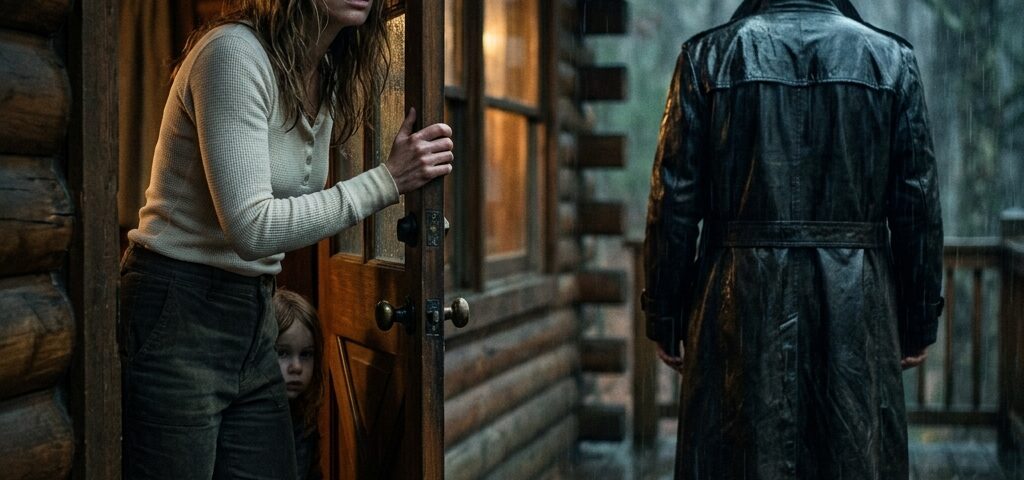
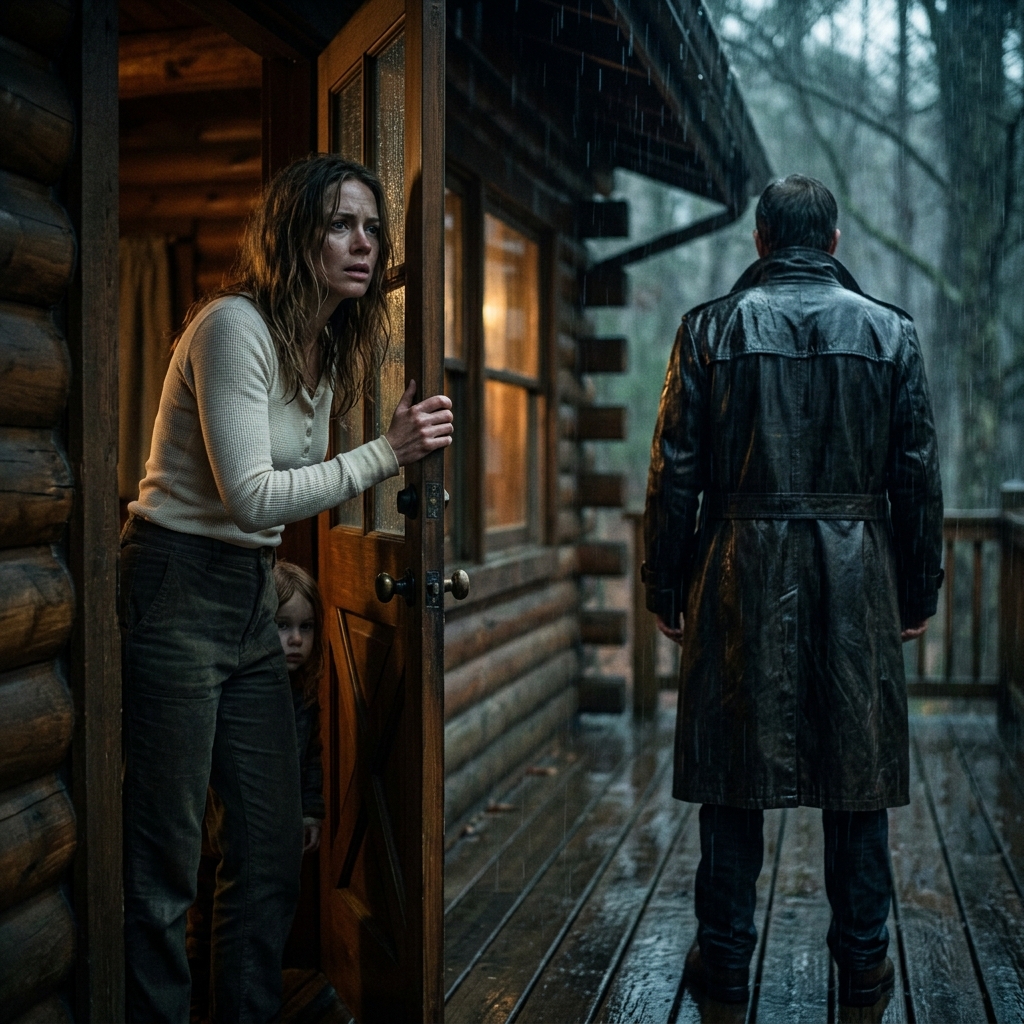
**The morning Luca Moretti found me, I was standing barefoot in flour, holding a rolling pin like a weapon, while my children hid behind my legs and stared at the stranger who had given them his eyes.**
Rain fell hard over Gray Hollow, West Virginia, turning Main Street into a ribbon of silver mud. It drummed on the tin awning of Pike’s Bakery, slipped from the gutters in ropes, and blurred the old brick buildings until the whole town looked like a watercolor left out in a storm. Downstairs, the ovens were warming. The first trays of cinnamon rolls waited under linen cloths. The smell of yeast, butter, and brown sugar rose through the floorboards like a prayer.
And then he knocked.
Three firm knocks.
Not the knock of a neighbor. Not the knock of a delivery man. Not Sheriff Harlan tapping with his ring against the frame because he knew I startled easily.
This knock belonged to someone who had never once doubted a door would open.
I wiped my hands on my apron and moved toward it before my mind understood what my body already feared. Lena followed me, dragging her stuffed rabbit by one ear. Ash came after her in silence, his small face solemn, his thumb tucked into his fist the way he did when thunder came close.
“Stay back,” I whispered.
I opened the door only as far as the chain allowed.
Luca Moretti stood on the porch.
For one terrible second, I could not breathe.
He was thinner than I remembered, though still broad enough to fill the doorway. His black coat hung heavy with rain. Water slid from his dark hair onto his cheeks, and his face—God help me, that face—was the same face that had once bent over me in the candlelight and promised there was nowhere in the world I could go where he would not come for me.
Back then, I had thought it romantic.
Now, it sounded like a threat remembered too late.
“Sarah,” he said.
My name cracked in his mouth.
Behind me, Lena pressed against my calf. Ash leaned into my other leg, his little fingers clutching the hem of my sweater.
Luca’s gaze dropped.
The world changed.
I saw the exact instant he understood. **His eyes moved from Lena’s amber gaze to Ash’s dark curls, from the curve of their mouths to the stubborn tilt of their chins, and the most feared man in five cities went still as stone.**
For three years I had imagined this moment. In some versions, I screamed. In others, I slammed the door before he could see them. In the worst version, he smiled and claimed what was his.
But he did not smile.
His hands trembled.
That frightened me more than anything.
“Those children,” he whispered.
“Don’t.”
He looked up at me, and I saw the wound I had made by surviving.
Lena tugged at my apron. “Mama, why does the big man look so sad?”
Luca flinched.
“Who is he?” she asked.
I looked straight into the eyes of the man I had loved more than my own good sense.
“No one,” I said.
Luca absorbed it like a blow.
“He came to the wrong house,” I added.
Ash said nothing, but he kept staring at Luca with a wariness too old for a three-year-old boy. He had always been sensitive to weather, raised voices, locked doors, and the kind of silence adults think children cannot hear.
Luca’s voice lowered. “I searched for you.”
“You found me.” I made myself sound calm. Calm was all I had left. “Now leave.”
“I thought you were dead.”
The sentence landed between us like a dropped knife.
For one wild moment, the old Sarah inside me lifted her head. The wife. The woman who had once slept with her cheek against Luca’s chest and believed his heartbeat was the safest sound in the world.
Then I remembered my sister’s voice behind a closed bedroom door.
I remembered white sheets.
I remembered Luca’s ring on a man’s hand.
I remembered Vanessa laughing as if my marriage had been nothing more than a dress she wanted to try on.
“You do not get to speak to me about death,” I said.
His face tightened, but he did not argue. That was how I knew something was wrong. Luca Moretti did not accept dismissal. Luca commanded, negotiated, threatened, purchased, punished. He bent rooms around him.
But this man in the rain stood as if he deserved the cold.
“Sarah,” he said again, softer this time. “Please.”
Lena whispered, “Mama?”
The fear in her voice saved me.
I closed the door.
The click of the latch sounded louder than a gunshot.
For several seconds, none of us moved. Rain filled the silence. Downstairs, an oven timer began to chirp, absurdly cheerful, demanding that ordinary life continue.
Lena tried to peek through the curtain.
“Is he a giant?” she asked.
I almost laughed. Instead, I crouched and pulled both children into my arms. They smelled of sleep and sugar and the lavender soap Mrs. Pike made in the back room every spring.
“No, sweetheart,” I whispered. “He’s just a man.”
But that was the most dangerous thing Luca had ever been.
Ash leaned close to my ear. “He didn’t go.”
My blood chilled.
I lifted the curtain just enough to see the porch.
Luca was still there, standing in the rain as if the storm had been built around him.
He did not knock again.
He only bowed his head.
And that, more than any threat, nearly broke me.
Because once, long before Gray Hollow and bakery flour and two children who did not know their father, I had been the woman who could make Luca Moretti kneel simply by saying his name.
Before my sister Vanessa taught me that love could be murdered in a room with silk sheets.
Before I learned that **betrayal does not always enter with a knife. Sometimes it wears your husband’s face.**
## PART TWO: THE HOUSE OF GLASS
I met Luca Moretti in Chicago on a December evening when the wind came off Lake Michigan sharp enough to cut through wool.
I was twenty-seven then, old enough to distrust handsome men and young enough to think distrust made me wise. I worked in acquisitions for a small art restoration firm, spending my days cataloging paintings wealthy families forgot they owned. Luca arrived at a private estate sale wearing a charcoal suit and the expression of a man who could buy the house, burn it down, and still send flowers to the widow.
He stood too close to a damaged Madonna and child.
“You like that one?” I asked.
He did not look away from the painting. “She looks tired.”
“She’s been holding the baby for four hundred years. You would be tired too.”
That made him smile. It was small, but it changed his whole face.
“She reminds me of my mother,” he said.
“Your mother was a Renaissance saint?”
“My mother was a woman who looked holy because no one knew what she had survived.”
I should have walked away then. A man who speaks beautifully about suffering is either a poet or a warning.
Luca was both.
He courted me with old-fashioned patience. No rushed hands, no cheap flattery. He sent books instead of roses. He remembered how I took my coffee. He asked about my childhood and listened as if every ordinary detail mattered. When I told him my parents had died young and I had raised my sister Vanessa through her stormy teenage years, he said, “Then you learned love as a duty before you learned it as a joy.”
No one had ever seen that in me before.
Vanessa did not approve of him.
“He’s dangerous,” she said one afternoon, lounging across my sofa in red lipstick and borrowed earrings. Vanessa was twenty-three then, beautiful in the reckless way fire is beautiful. “Men like Luca Moretti don’t date women like us, Sarah. They collect them.”
“You’ve never even spoken to him.”
“I don’t need to taste poison to know it kills.”
She was right, of course.
Not about everything.
But about enough.
Luca told me the truth before he asked me to marry him. Not all of it, perhaps, because men like Luca are built from locked doors. But enough. His family had money that came from nightclubs, construction, shipping, and older, darker roots. His father had been a criminal. His father’s father had been worse. Luca had inherited an empire with blood in its mortar.
“I am trying to change it,” he told me.
We were standing on the balcony of his Lake Forest estate, the winter garden sleeping below us. Snow rested on the hedges. Chicago glowed in the distance.
“You can’t wash blood out of stone,” I said.
“No,” he replied. “But I can stop adding to it.”
I believed him because I loved him.
That sentence is the beginning of many tragedies.
Our wedding was small by Moretti standards and enormous by mine. Vanessa stood beside me in pale blue silk, smiling for photographs with her mouth and not her eyes. Luca’s people watched everything. Even the priest seemed nervous.
Afterward, when the music slowed and the guests drank champagne beneath chandeliers, Luca took my hand and led me into the garden.
“You are quiet,” he said.
“I’m happy.”
“That is not the same as quiet.”
I looked at him, this man everyone feared, and saw only the careful tenderness he reserved for me.
“I’m afraid happiness like this has a price,” I admitted.
He kissed my forehead. “Then I’ll pay it.”
Two years later, I learned the bill had been sent to me.
The night everything ended began with a celebration. Luca had closed a legitimate deal with a hotel group in New York. He wanted the world to see the Moretti name attached to contracts instead of crimes. The estate glittered. Men in tuxedos stood beside women in diamonds. Waiters moved through the rooms carrying silver trays. Vanessa arrived late in a green dress that made every head turn.
“You look pale,” she said when she kissed my cheek.
“I’ve been tired.”
Her eyes flicked to my stomach. I had not told anyone yet. Not even Luca.
Especially not Luca.
I was six weeks pregnant, dizzy with secrecy, terrified and joyful in equal measure. I had planned to tell him the next morning, over coffee, when the house was quiet and the new life inside me belonged only to us for one more night.
Around eleven, Luca touched my elbow.
“You should rest,” he said.
“I’m fine.”
“You’re not.” His thumb brushed my wrist. “Please. For me.”
That was Luca. He could make a command sound like devotion.
I went upstairs. I remember the black silk dress he loved. I remember slipping out of my heels. I remember sitting on the edge of our bed and pressing both hands over my stomach.
A child.
Luca’s child.
My child.
For the first time in years, I let myself imagine a future without shadows.
Then I heard laughter from the corridor.
A woman’s laughter.
Vanessa’s.
At first, I thought she had brought someone upstairs. That would have been like her—careless, dramatic, hungry for attention. I opened my bedroom door, ready to scold her like I had when she was sixteen and climbing out windows after midnight.
But the sound came from the private wing.
From the rooms only Luca and I used.
Light glowed under our bedroom door.
My hand touched the knob.
Then I heard my sister say his name.
“Luca.”
Not loudly.
Not in fear.
In pleasure.
**There are sounds a woman forgets and sounds that bury themselves in the bone. My sister saying my husband’s name from inside my bedroom was the sound that buried me.**
I opened the door.
For years afterward, I would hate myself for how quickly my mind accepted what my eyes believed.
The lamp beside the bed was on. White sheets twisted across the mattress. Vanessa stood near the foot of the bed wearing Luca’s shirt, her hair loose, her lips swollen. A man sat on the edge of the mattress with his back half-turned, dark hair damp at the collar, Luca’s signet ring on his hand.
My husband’s ring.
My husband’s shoulders.
My husband’s voice, low and rough, said, “You shouldn’t be here.”
Vanessa looked at me.
She did not gasp. She did not cover herself. She smiled as if I had arrived for a performance and she had been waiting for applause.
“I’m sorry,” she said.
But she did not sound sorry.
I could not move.
The man rose, but his face remained partly in shadow.
I stepped back.
“Sarah,” he said.
That was enough. Hearing my name in that voice destroyed whatever denial might have saved me.
Vanessa walked toward me and pressed an envelope into my hand.
“You need to leave tonight,” she whispered. “Before he changes his mind.”
I stared at her.
“What have you done?”
Her smile faltered then. Just for a heartbeat.
“Survived,” she said.
Inside the envelope were photographs. Bank records. A letter in Luca’s handwriting saying he wanted me gone before the child became a complication.
The child.
My child.
My knees nearly gave out.
Vanessa gripped my arm. Her nails dug into my skin.
“Go to the south gate. There’s a car waiting. Don’t call anyone. Don’t look back.”
“Why?”
Her eyes shone. Whether with tears or triumph, I could not tell.
“Because by morning, Sarah, no one will be able to help you.”
I ran.
But I did not go to the south gate.
That was the first thing that saved my life.
The second was morning sickness.
Half a mile from the estate, I stumbled through the service road and vomited behind a hedge until my throat burned. I missed the waiting car. I missed the driver. I missed the route Vanessa had given me.
An hour later, as I hid in the back of a produce truck heading west, an explosion tore through the night behind us.
The driver cursed and crossed himself.
I pressed a hand to my stomach and understood with a coldness that has never fully left me:
**The evidence was not meant to help me escape. It was meant to guide me to my death.**
By dawn, Sarah Moretti was gone.
By winter, Sarah Mills was living above Pike’s Bakery in a town small enough to notice strangers and kind enough not to ask questions twice.
By spring, I learned there were two heartbeats inside me.
And for three years, I taught myself not to say Luca’s name.
## PART THREE: THE MAN WHO WAITED
Luca did not leave Gray Hollow.
By noon, everyone knew.
That was the trouble with small towns. Secrets had to duck under porch roofs and whisper behind curtains. Mrs. Pike came upstairs with a tray of soup and wore the expression she used when pretending not to know something.
“There’s a man sitting in a black car across the street,” she said.
“I know.”
“He handsome?”
I gave her a look.
“At my age, honey, danger and handsome are often the same coat on the same hook.”
Mrs. Pike was seventy-one, round as a biscuit, and tougher than the cast-iron pans she kept under the counter. She had rented me the apartment when I arrived with nothing but a false name, swollen ankles, and fear in my eyes. She never asked what I was running from. She only said, “There’s clean sheets upstairs. Pay when you can.”
Now she studied me over the rim of her glasses.
Preview
“He the reason you lock the door even during daylight?”
“Yes.”
“He the reason those babies have eyes like old honey?”
I said nothing.
She nodded once. “Thought so.”
Downstairs, customers came and went. Rain softened to mist. Luca’s car remained across the street.
At three o’clock, when Lena and Ash were napping, I found him standing in the alley beside the bakery, staring at the cracked brick wall as if it held a confession.
“You can’t stay here,” I said.
He turned. He had not changed clothes. Rain had dried on his coat in dark patches.
“I can stay anywhere I choose.”
There he was. A flash of the old Luca. The command. The arrogance.
It should have angered me.
Instead, it steadied me. Grief was harder to fight than pride.
“This is my home,” I said.
“I know.”
“You know nothing about my home.”
“I know there is a loose step on the stairs. I know the lock on the back door is new but badly installed. I know Mrs. Pike keeps a shotgun under the flour bin and that Sheriff Harlan drives by every forty minutes because he likes you.”
My hands curled.
“You had me watched.”
“I had the town watched after I found your name.” He paused. “Not before.”
“And how did you find it?”
His eyes darkened.
“Your sister.”
The alley seemed to tilt.
“Vanessa is dead.”
“No,” Luca said. “Vanessa disappeared.”
The word opened something under my ribs.
“You’re lying.”
“I wish I were.”
I laughed once, sharp and bitter. “Of course. The dead sister returns. How convenient for you.”
“Sarah, I did not touch her.”
The old pain rose so fast I nearly staggered.
“Don’t.”
“I was drugged that night.”
“Stop.”
“The man you saw was not me.”
My breath caught despite myself.
He stepped closer, then stopped when I stiffened.
“My father had another son,” he said.
I stared at him.
“A twin.”
The alley went silent except for water dripping from the fire escape.
“No,” I said.
“He was taken when we were seven. A kidnapping. A ransom dispute. My father told everyone Matteo was killed. I believed it for twenty-five years.”
“Convenient,” I repeated, but my voice had lost force.
“I saw him two months after you disappeared. Same face. Same voice, if he wanted. He had been raised by the DiMarco family to hate me.”
I shook my head. “No.”
“Vanessa found him first.”
That landed harder than I wanted it to.
He saw it and pressed on gently, which was somehow worse than cruelty.
“She was angry with you. With me. With the life she thought you had chosen over her. Matteo used that. Enzo used that.”
“Enzo?”
“My uncle. My adviser. The man who stood beside me at our wedding.”
I remembered Enzo Moretti: silver hair, warm hands, eyes like locked drawers. He had kissed my cheek and called me “daughter.”
Luca looked toward the street.
“I was trying to leave the business. Not pretend. Not polish it. Leave. I had records. Names. Accounts. Enough to put Enzo and half the old families away. He found out.”
My heart thudded.
“The night of the party,” Luca continued, “I was taken from my study. Drugged. When I woke, you were gone, the south gate car had exploded, and everyone told me my wife had died inside it.”
The alley blurred.
“I saw you,” I whispered.
“You saw my face.”
His words struck too close to a truth I had never allowed myself to examine.
I remembered the man on the bed.
His back turned.
His face partly shadowed.
His voice saying my name.
But had I seen his eyes?
I had not.
The realization made me angry because it made me vulnerable.
“You expect me to believe this after three years?”
“No.” Luca’s voice softened. “I expect nothing. I came because Vanessa sent this.”
He reached into his coat and withdrew a small photograph sealed in plastic.
I did not want to take it.
I did.
It showed Lena and Ash outside the bakery, sitting on the curb in summer clothes, each holding a dripping ice cream cone. On the back, written in red ink, were five words:
**Your children have his eyes.**
My hand shook.
“When did you get this?”
“Four days ago.”
“From Vanessa?”
“From someone using her old name.”
“Why come alone?”
“Because if I brought men, you would run.” His mouth tightened. “And because the people who want them do not deserve another chance to find you.”
Them.
Not me.
The children.
My knees weakened.
From upstairs, a cry rose through the floorboards. Ash. He woke from nightmares quietly at first, then all at once.
I turned to go.
Luca said, “May I see them?”
I looked back.
The question cost him. I could see it. Asking instead of taking. Waiting instead of demanding. It was the first proof he had changed, or at least learned how much change would be required to stand near us.
“No,” I said.
He lowered his head.
“But you can fix the back lock,” I added.
His eyes lifted.
“Do not mistake that for forgiveness.”
“I won’t.”
“And if you frighten them—”
“I would cut off my own hand first.”
The violence of the vow should have unsettled me. Instead, shamefully, it sounded like the man I had once loved.
That evening, Luca Moretti knelt in the back hallway of Pike’s Bakery with a screwdriver in his hand while my daughter watched from the stairs.
“You’re very big,” Lena announced.
“So I’ve been told.”
“Are you a bad man?”
The screwdriver stopped.
I froze in the kitchen doorway.
Luca looked at my daughter, and in his face I saw every sin he had ever committed stand up to answer her.
“Yes,” he said finally. “But I am trying not to be.”
Lena considered this.
“Mama says trying matters.”
Luca’s eyes moved to me.
“Yes,” he said. “Your mama is wise.”
Ash appeared beside Lena, clutching his rabbit by the ears. He studied Luca for a long time.
Then he asked, “Do you make thunder?”
Luca’s face changed.
“No,” he said gently. “But I can sit with you when it comes.”
Ash did not answer.
But he did not run away.
And in our little hallway, beneath a flickering light, something more dangerous than fear entered the house.
Hope.
## PART FOUR: THE SISTER’S LETTER
The package arrived two mornings later, wrapped in brown paper and tied with butcher’s string.
No return address.
Mrs. Pike found it on the bakery counter before dawn, placed between the register and the display case as neatly as an offering. No one had broken the lock. No window was disturbed.
Luca opened it with a knife from his boot.
“Of course you carry a knife in a bakery,” I said.
He glanced up. “Would you prefer I borrow Mrs. Pike’s shotgun?”
“Touch my shotgun and lose a finger,” Mrs. Pike called from the kitchen.
Inside the paper was a tin music box.
My stomach dropped.
It had belonged to Vanessa when she was little. Pink enamel. A painted ballerina on the lid. Our mother had bought it secondhand from a church sale. Vanessa used to wind it before bed and say the ballerina danced because someone had to.
I had not seen it since the night I left Chicago.
Lena reached for it.
“No,” Luca and I said together.
She pulled back, offended.
“I was only looking.”
Luca softened. “I know, little one.”
She frowned. “I’m not little. I’m three and a half.”
“My apologies.”
Ash stood behind me, silent as ever, staring at the box with open dislike.
I lifted the lid.
The ballerina did not dance.
Instead, beneath the velvet lining, there was a folded sheet of paper, brittle and yellowed at the edges though the ink looked fresh.
My name was written across it in Vanessa’s hand.
**Sarah.**
My knees nearly failed.
Luca pulled out a chair. I sat because standing seemed suddenly ambitious.
The letter was short.
**If you are reading this, then one of two things is true: either I failed to keep them away, or I am finally done being afraid. The man you saw that night was not Luca. His name is Matteo. He has Luca’s face and none of his mercy. I thought I could use him to get free of Enzo. Instead, Enzo used me to break you.**
I stopped reading.
Preview
The room had gone quiet. Even the ovens seemed to hold their breath.
Luca stood across from me, pale beneath his olive skin.
I forced myself to continue.
**I was jealous of you. That is the ugliest truth I own. You were always the good one, the brave one, the one people kept. I wanted someone to choose me first. Matteo did. Or I believed he did. By the time I understood what he was, the trap was already closing.**
A tear struck the page.
Mine.
**The envelope I gave you had two sets of instructions. The visible ones were Enzo’s. The hidden ones were mine. I hoped you would remember Mama’s rule: never trust a gift without checking the seams. You did not check. You ran. I do not blame you. I sounded cruel because Enzo was listening. I smiled because if I cried, he would know.**
I covered my mouth.
Our mother’s rule.
Never trust a gift without checking the seams.
She had said it about thrift-store coats and secondhand purses. Vanessa and I had laughed at her for it. After she died, I used to check pockets just to feel close to her.
But that night, I had not checked the envelope.
I had been too shattered.
Luca’s voice was rough. “What else?”
I read.
**If Sarah survives, she must never return for me. Tell Luca I am sorry. Tell him the proof is where his mother sang to him. Tell him Enzo kept the dead where the living prayed.**
The letter ended there.
Mrs. Pike crossed herself.
“Where did your mother sing to you?” I asked.
Luca did not answer at once.
His face had closed, but not with secrecy. With pain.
“The chapel,” he said. “On the estate. My mother used to sing there when she thought no one could hear.”
“Your mother died when you were young.”
“Yes.”
His eyes held mine.
“At least, that is what my father told me.”
Before I could ask what he meant, the bell over the bakery door rang.
A man entered.
For one insane second, I thought Luca had moved without moving.
Same height. Same dark hair. Same beautiful, brutal face.
But the eyes were wrong.
Luca’s eyes were amber warmed by grief.
This man’s were amber emptied of everything human.
Lena smiled uncertainly. “There are two big men.”
Ash screamed.
It was the first full scream I had ever heard from my son, and it tore the room apart.
Luca moved before I did. He pushed me and the children behind him, one hand already inside his coat.
The stranger smiled.
“Brother,” he said.
Matteo.
The name passed through me like winter.
He looked at me then, and I understood why memory had failed me. He was Luca’s mirror after a fire: same shape, same beauty, warped by something starved and merciless.
“Sarah,” Matteo said. “You aged well for a dead woman.”
Luca’s voice was deadly calm. “Walk out.”
“Still giving orders.” Matteo sighed. “That was always your flaw. Father loved it. Enzo exploited it. I found it dull.”
Mrs. Pike emerged from the kitchen holding the shotgun.
Matteo glanced at her and laughed. “Charming.”
“You have three seconds to stop charming me,” she said.
He lifted both hands, but his smile stayed.
“I came for what Vanessa stole.”
Luca said, “Vanessa is dead.”
“Vanessa is inconvenient.” Matteo looked at me. “There is a difference.”
The room tilted again.
I clutched the children closer.
“What does that mean?” I demanded.
Matteo’s gaze dropped to Lena and Ash.
“It means your sister had more talent for survival than loyalty.”
Luca stepped forward.
“Look at them again and you will not leave this town breathing.”
Matteo smiled wider.
“There he is. The civilized family man.” His voice lowered. “You should know, Sarah, he killed forty-two men looking for you.”
Luca did not deny it.
The number struck me cold.
Matteo saw my face and was pleased.
“Did he leave that out? Did he tell you he became gentle after you vanished? No. He became biblical.”
Luca said nothing.
Ash was trembling against my side.
Lena whispered, “Mama, I don’t like that one.”
Neither did I.
Matteo’s eyes sharpened. “The chapel, Luca. Midnight. Bring the music box and the woman. Leave the children if you want them to live.”
Then he looked at me once more.
“I wore his ring that night,” he said softly. “But Vanessa wore the smile herself.”
He left before Mrs. Pike could shoot him.
For a long moment, nobody spoke.
Then Ash lifted his face and said, “That was the thunder man.”
I knelt before him.
“What?”
He swallowed.
“In my dreams. The man with Daddy’s face.”
Luca shut his eyes when Ash said Daddy.
The word hung there, tender and terrible.
I looked at Luca.
“We go to the chapel,” I said.
“No.”
“Yes.”
“Sarah—”
“I ran once because I did not know the truth.” I stood, still holding Vanessa’s letter. “I will not run from it now.”
Luca’s jaw tightened.
“You are not bait.”
“No,” I said. “I am the woman they failed to kill.”
For the first time since he had returned, Luca smiled.
Not happily.
Proudly.
And something old and fierce moved between us, something betrayal had buried but not killed.
## PART FIVE: WHAT THE DEAD KEPT
We left the children with Mrs. Pike, Sheriff Harlan, and half the town pretending not to stand guard with hunting rifles behind bakery curtains.
Gray Hollow had its own kind of loyalty. It was not elegant. It did not wear diamonds. It wore flannel, carried casseroles, and knew how to aim.
Luca drove through the night toward Illinois.
For hours, neither of us spoke.
Rain gave way to fog. Fog gave way to the flat black fields of the Midwest. Every mile pulled me backward through time, toward the woman I had been and the house that had swallowed her.
Near dawn, Luca said, “I did kill men looking for you.”
“I know.”
“You should hate that.”
“I do.”
He nodded.
“But I also know you thought I was dead.”
His hands tightened on the wheel.
“I buried an empty casket.”
The pain in his voice was quiet, which made it worse.
“Why empty?”
“The explosion left little behind. Enzo said your remains were unrecoverable. He arranged everything too quickly. I should have known.”
“You were grieving.”
“I was Luca Moretti. I was trained not to trust grief.”
I looked out at the road.
“I wanted to tell you I was pregnant that morning.”
His breath changed.
“A boy and a girl,” I said. “Lena Rose and Asher James. Lena talks to everyone. Ash talks when the world earns it.”
Luca laughed once, brokenly.
“I would have been a terrible father then.”
“Yes,” I said.
He glanced at me.
“So would I,” I added. “I was afraid of everything. I might have taught them fear was wisdom.”
“And now?”
“Now I know fear is only a smoke alarm. Useful, but not a home.”
He took that in.
When we reached the Lake Forest estate, the sky was the color of ashes.
The house had not changed. That offended me. I wanted ruin. Vines. Broken windows. Some visible proof that the place had committed a crime.
Instead, it stood immaculate behind iron gates, all pale stone and old money, glittering faintly in the wet dawn.
Luca parked near the family chapel at the edge of the property.
It was smaller than I remembered, built of gray stone with stained-glass windows and a bell tower no one used. Inside, dust softened the pews. The air smelled of wax, cold marble, and old secrets.
At the altar, Matteo waited.
Beside him stood Enzo Moretti.
He looked older, but not weaker. Silver hair. Fine wool coat. Warm hands folded over a cane. The kind of man people trusted because he had learned to make cruelty look patient.
“Sarah,” Enzo said, smiling. “My dear. You have caused a great deal of trouble by being alive.”
I felt Luca go still beside me.
“You,” I said.
Enzo sighed. “Yes, yes. Me. Villains should be more surprising, I know. But in families, my dear, evil is often just the person who stayed for dinner.”
Matteo laughed softly.
Luca’s voice was low. “Where is Vanessa?”
Enzo’s smile thinned.
“That girl was always more stubborn than intelligent.”
A sound came from behind the altar.
A scrape.
Then a woman stepped from the shadows.
For a moment, my mind refused her.
She was thinner. Her hair, once golden brown, had been cut short beneath a scarf. A scar pulled at the left side of her jaw. But her eyes were the same eyes that had watched me walk into our mother’s funeral, the same eyes that had once begged me not to leave for college, the same eyes that had smiled at me in my bedroom while my life burned down.
Vanessa.
My sister.
Alive.
I could not speak.
She looked at me and began to cry.
“Sarah,” she whispered.
Something inside me tore cleanly in two.
I wanted to run to her.
I wanted to strike her.
I wanted to be ten years old again, hiding under blankets during thunderstorms while she curled beside me and asked if I thought heaven had windows.
“You were alive,” I said.
She nodded.
“All this time?”
“I was never far.”
The words made no sense until she reached into her coat and pulled out a small photograph.
Lena and Ash on the bakery curb with ice cream.
The same photograph Luca had received.
“I sent it,” she said.
Luca turned sharply.
Vanessa flinched. “I had to. Enzo found Gray Hollow. He found them. I knew Luca could protect them better than I could.”
My voice shook. “You watched us?”
“From a distance.”
“For three years?”
“Yes.”
Rage rose, hot and wild.
“You let me believe you had tried to kill me.”
“I thought hatred would keep you away from Chicago.” She pressed a hand to her mouth. “I thought if you hated me enough, you would never look back.”
Enzo tapped his cane once against the stone floor.
“How touching. Sisters reunited in mutual stupidity.”
Luca moved so fast I barely saw it. One moment he stood beside me; the next he had Enzo by the throat against a pillar.
Matteo drew a gun.
I stepped between him and Luca before thinking.
“Shoot me,” I said.
Everyone froze.
My heart pounded so hard I thought it might crack my ribs.
Matteo’s smile faded.
“You think I won’t?”
“I think you enjoy mirrors too much to break the only person here who sees you clearly.”
His eyes narrowed.
“You don’t know me.”
“I know men like you. You were hurt, so you made injury your religion. You were abandoned, so you decided love was a room only fools entered unarmed. You call Luca brother because you need him to be responsible for what was done to you.”
Matteo’s hand tightened on the gun.
“He had everything.”
“No,” I said. “He had what you were taught to want.”
Silence.
Then Vanessa spoke.
“Matteo, please.”
His eyes flicked toward her. There it was. The weakness. Not love, exactly, but the memory of having once wanted to be loved.
Enzo saw it too.
“You pathetic boy,” he hissed. “Still listening to the wrong woman.”
Matteo turned.
That was all Luca needed.
The gunshot cracked through the chapel.
Birds exploded from the roof.
For one terrifying second, I thought Luca had been hit.
Then Enzo looked down at his own chest, surprised, almost offended by the spreading red beneath his coat.
Matteo stood with the gun in his hand, face blank.
Enzo slid down the pillar.
“You fool,” he whispered.
Matteo stared at him. “You said my mother died.”
Enzo coughed.
Vanessa whispered, “She didn’t.”
The air changed.
Luca turned slowly.
“What?”
Vanessa was shaking now.
“The proof,” she said. “Where his mother sang to him.”
She moved to the old organ in the corner of the chapel. Beneath it, one floorboard sat slightly raised. Luca knelt and pried it loose.
Inside was a metal box.
He opened it.
Letters. Photographs. A birth certificate. A hospital bracelet. A cassette tape labeled with a woman’s name.
Alessia Moretti.
Luca’s mother.
His dead mother.
Only she had not died when he was seven.
Enzo had locked her away in a private facility after she tried to leave Luca’s father and take both boys. Matteo had not been kidnapped by strangers. **He had been sold into hatred by his own family, and Luca had been raised beside an empty chair no one allowed him to mourn.**
Luca held the papers with both hands.
His face did not break.
It emptied.
Preview
Vanessa looked at him with anguish. “I found the box the night of the party. Enzo caught me. Matteo was already there. I thought if I helped them scare Sarah away, I could get the proof to the authorities and come back for her. But Enzo changed the plan. He put explosives in the car. When Sarah didn’t take it, he thought she died in the confusion anyway.”
I stared at my sister.
“You smiled.”
She wept harder.
“Because Enzo was watching from the passage behind the mirror. Because Matteo had a gun under the sheet. Because I needed you to run and not ask me to come with you.”
My memory shifted.
The room. The lamp. Vanessa’s smile.
And behind it, perhaps, terror.
I had not seen it because heartbreak had blinded me.
Sirens sounded in the distance.
Luca had recorded everything. Of course he had. Luca Moretti might have learned patience, but he had not forgotten strategy.
Matteo looked toward the chapel doors.
“There’s no road left,” Luca said.
Matteo laughed softly. “For you either, brother.”
“No,” Luca said. “But I am tired of roads built by dead men.”
The police arrived with federal agents behind them. Enzo was taken out alive, though barely. Matteo did not resist. He looked once at Vanessa as they cuffed him.
“You did love me,” he said.
Vanessa closed her eyes.
“I loved the wound in you,” she whispered. “I mistook it for a heart.”
He smiled as if that answer hurt enough to satisfy him.
When they led him away, dawn had fully broken.
The chapel doors stood open, and sunlight fell across the dust in long golden bars.
Vanessa and I stood facing each other.
For three years, I had rehearsed speeches. Accusations. Questions. Cruel, perfect sentences.
Now I had only one.
“Why didn’t you knock?”
She understood.
At the bakery. In Gray Hollow. In all those years.
She touched the scar on her jaw.
“Because you looked peaceful.”
I laughed, and it came out broken.
“I was terrified every day.”
“I know.”
“No,” I said, stepping closer. “You don’t get to know from across the street. You don’t get to bleed on my behalf and call it love while I raise children inside a lie.”
She bowed her head.
“You’re right.”
That was the worst of it. She did not defend herself. I wanted her to fight me. I wanted her pride, her old vanity, something solid enough for my anger to strike.
Instead, she stood there ruined and alive.
So I slapped her.
The sound echoed through the chapel.
Luca did not move.
Vanessa accepted it.
Then I pulled my sister into my arms.
She collapsed against me with a sob so young that, for one aching instant, she was not the woman who had destroyed my marriage. She was the child I had raised after our mother died. The girl who climbed into my bed during storms. The sister I had loved before envy and men and money had sharpened us against each other.
“I can’t forgive you today,” I whispered.
“I know.”
“Maybe not tomorrow.”
“I know.”
“But don’t disappear again.”
Her hands clutched my coat.
“I won’t.”
Three weeks later, Luca came back to Gray Hollow not as a storm, not as a king, not as the man who expected doors to open.
He came carrying a small wooden cradle he had carved himself.
“It’s too small,” I said from the bakery porch.
“For them, yes.” He looked embarrassed. “Mrs. Pike said the church nursery needed one.”
“Mrs. Pike says many things.”
“She also said if I hurt you, she’ll poison my cannoli.”
“She doesn’t make cannoli.”
“That was my concern.”
Against my will, I smiled.
Lena ran past me and threw herself at his legs.
“Daddy Luca!”
He closed his eyes when she said it, as if the words were sunlight after a lifetime underground.
Ash approached more slowly, holding a toy truck.
“There’s thunder tonight,” he said.
Luca crouched.
“Then I’ll sit with you.”
Ash nodded once and handed him the truck.
That was Ash’s version of a coronation.
Vanessa remained in town under federal protection, though everyone pretended she was a widowed cousin from Ohio. Mrs. Pike put her to work kneading dough, claiming sorrow needed flour or it turned sour. Some mornings, I found Vanessa at the counter watching Lena chatter and Ash arrange spoons by size, and the grief in her face was punishment enough for an hour.
Forgiveness did not arrive like lightning.
It came like bread rising.
Slowly.
Quietly.
Only after warmth.
As for Luca and me, we did not fall back into love. That would make it sound easy, like stepping into an old dress.
We walked toward it cautiously, two people carrying lanterns through a house that had once burned down.
One evening in October, after the children had fallen asleep and the bakery windows glowed against the cold, Luca and I sat on the porch.
“I don’t know how to be your wife again,” I said.
He looked out at Main Street.
“I don’t know how to deserve you.”
“That was not an answer.”
“It is the only honest one I have.”
The leaves moved along the sidewalk, gold and brown and restless.
After a while, he said, “I signed the last papers today. The legitimate holdings go into trust for Lena and Ash. Everything else goes to federal seizure.”
“Everything?”
“Everything.”
“Who are you without it?”
He looked at me then.
“A man on a porch hoping you’ll let him stay until morning.”
My throat tightened.
I reached for his hand.
Not forgiveness.
Not yet.
But permission.
His fingers closed around mine carefully, as if I were something sacred and breakable.
That night, long after he left for the small room he rented above the hardware store, I found an envelope tucked under my door.
No name.
Inside was a photograph of Luca and me on our wedding day, standing in the garden under falling snow. I had never seen that picture before. We were not posing. We were laughing.
Behind the photograph was a note in Vanessa’s handwriting.
**He never stopped looking at you. I never stopped regretting that I made you run. But Sarah, there is one more truth. The safest place was never Gray Hollow because I found it. It was safe because someone else found it first.**
My hands went cold.
At the bottom of the envelope was a second photograph.
Mrs. Pike stood outside the bakery twenty years younger, her arm around a dark-haired woman with amber eyes.
On the back, in faded ink, were three words:
**Alessia Moretti lives.**
I sat down hard on the floor.
The next morning, Mrs. Pike was gone.
Her apartment was empty. Her shotgun remained under the flour bin. On the kitchen counter, she had left her recipe book open to cinnamon rolls.
A note rested beside it.
**My son was never meant to inherit my prison. My grandchildren were never meant to inherit his war. I watched over you the only way I knew how—from close enough to guard you, and far enough not to endanger you. Tell Luca his mother sang every night. Tell him I heard him, even when he thought no one did.**
I read it three times before I understood the full shape of the miracle and the betrayal.
Mrs. Pike—the woman who had rented me a room, fed me soup, held my babies so I could sleep, and taught Lena to frost cookies—had been Luca’s mother all along.
Not dead.
Not missing.
Not a ghost.
**The woman who saved me when I ran from my husband was the mother he had spent his life mourning.**
When Luca arrived and saw the photograph in my hand, all the color left his face.
He did not speak.
He took the note, read it once, and pressed it to his mouth.
Outside, church bells began to ring though no one had touched them.
Lena came toddling from the bedroom, rubbing her eyes.
“Mama?” she asked. “Why is Daddy crying?”
I looked at Luca, at the man who had lost his mother, found his children, buried his empire, and arrived at my door with nothing left but the truth.
Then I looked toward the empty bakery kitchen, where flour still dusted the counter like the first snow of our wedding day.
“Because, sweetheart,” I said, pulling her close, “sometimes the dead love us so fiercely they forget to stay dead.”
And in that moment, with my daughter in my arms, my son calling for thunder from the bedroom, my sister weeping downstairs, and Luca holding his mother’s last note as if it were a heartbeat returned to him, I finally understood the truth that had taken three years, two children, one false grave, and a thousand lies to uncover:
**Love had not saved us because it was perfect. Love had saved us because, even broken, it kept finding its way home.**