Part 2
So Nora did the second reckless thing that day.
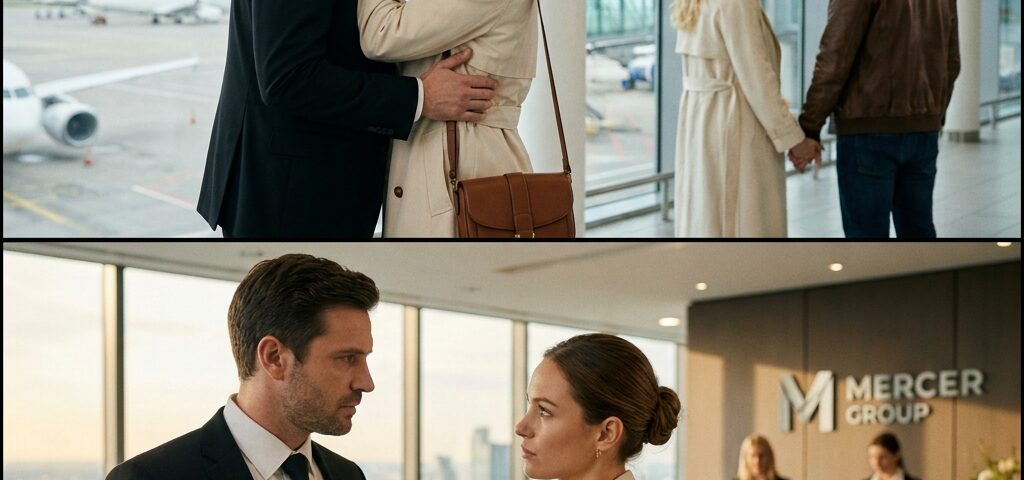
She lifted her chin and kissed him. Three seconds — long enough to read as real, short enough that shame didn’t swallow her whole.
When she pulled back, the stranger studied her with an expression she couldn’t parse. To his credit, he didn’t recoil, didn’t ask if she’d lost her mind. He shifted his bag to his other hand, let her thread her arm through his, and walked.
Nora kept her chin level as they passed Julian.
“Nora, stop,” Julian snapped.
She didn’t look at him. The stranger did — once, briefly, with an expression close to boredom — and somehow that single glance rooted Julian to the spot better than any words could have.
Outside, a black sedan idled at the curb, a driver already stepping forward. “Sir.”
Sir. Of course.
She should have stopped there, apologized, run for a taxi. Instead the stranger opened the rear door and she climbed in, adrenaline apparently now steering the ship.
The door shut. Silence.
For the first time she registered that she was alone in the back seat of an extremely expensive car with a man she’d just ambushed with a fake romance.
“I’m so sorry,” she said. “I know that was completely out of line. I saw my boyfriend kissing someone else, and I panicked — I didn’t want everyone watching me fall apart.” Her voice cracked. She dug through her purse and pulled out every bill inside — a twenty, two tens, a five, some singles — and held it out. “This won’t fix anything. But please. For the trouble. Or the trauma.”
He looked at the money. Then at her.
One corner of his mouth moved. “You are paying me.”
His voice was low, faintly accented, his English flawless.
“Yes. Apparently I’m making this worse.”
He took it — not because he needed it, she understood instantly, but the way a man accepts evidence — folded it carefully, and tucked it into his coat.
She reached for the door handle. “Sorry again. You’ll never have to see me again.”
She was out and into a taxi before he could answer, and she held herself together all the way home — right up until she stepped through her own front door, when she came apart completely.
Part 3
Three years of loving someone who’d looked her dead in the eye that morning and said always do.
Her phone lit up before sunset. Julian. Then again. Then the texts: You misunderstood. That woman kissed me. You embarrassed me. Who was that guy? Were you cheating too?
That last one pulled a short, ugly laugh out of her that turned straight into a sob. He’d kissed a woman like she was oxygen, watched Nora kiss a stranger in self-defense, and decided they were even.
By nine she’d blocked his number. By midnight her eyes were swollen shut. By six the next morning she was pressing ice packs beneath them, whispering to the mirror, “You are going to work. You are going to stand up straight. He does not get to take your life too.”
At 8:45 she walked into Halloran Media in concealer, black slacks, and the composure of a woman who’d survived a private war before breakfast.
Her best friend Priya Malhotra — senior copywriter, sharp eyeliner, the supernatural ability to detect emotional wreckage through solid walls — grabbed her elbow instantly. “Oh no. Your eyes look like two sad peaches. What happened?”
The intercom crackled before Nora could answer. All staff to the lobby. The new CEO has arrived.
“Oh my God,” Priya breathed. “He’s here.”
“Who?”
“The chairman’s son. Theo Nakamura. Been overseas forever — brilliant, terrifying, unmarried, worth more than the state of Georgia.”
“Perfect,” Nora muttered. “Exactly what my morning needed.”
They packed into the lobby with sixty other employees. A black sedan pulled to the curb outside. The glass doors opened. A man walked in wearing a dark suit and sunglasses, moving with a certainty that had nothing arrogant in it.
He took off the glasses.
Nora’s blood went to ice.
The stranger from the airport found her across the lobby instantly and smiled — small, slow, entirely too knowing.
Priya whispered, “Nora. Why does the terrifying billionaire look like he knows you?”
“Because I kissed him yesterday.”
Priya made a noise wholly inappropriate for a corporate lobby. Nora clamped a hand over her wrist.
Across the room, Theo finished with the general manager, who was already offering a full department tour. “That won’t be necessary,” Theo said, voice carrying without effort. “I’ll choose someone.” His gaze swept the staff and stopped. “You.”
Every head turned. Nora’s legs refused every instruction her brain sent them.
She fainted. Or rather, dropped — with commitment.
Priya hit the floor beside her half a second later, already announcing to the room that Nora had been unwell all week, please give her space, and hauled her, with excellent dramatic flourish, toward the wellness room.
The door shut. Nora stood up immediately.
“You fake-fainted,” Priya said, “in front of the new CEO.”
“I panicked.”
“You kissed him yesterday.”
“I panicked then too.”
“You paid him.”
Nora put her face in her hands and told Priya everything — the roses, the red dress, the stranger, the money — and by the end Priya was laughing so hard she had actual tears running down her face.
“This is not funny.”
“It’s catastrophic,” Priya wheezed. “That’s why it’s funny.”
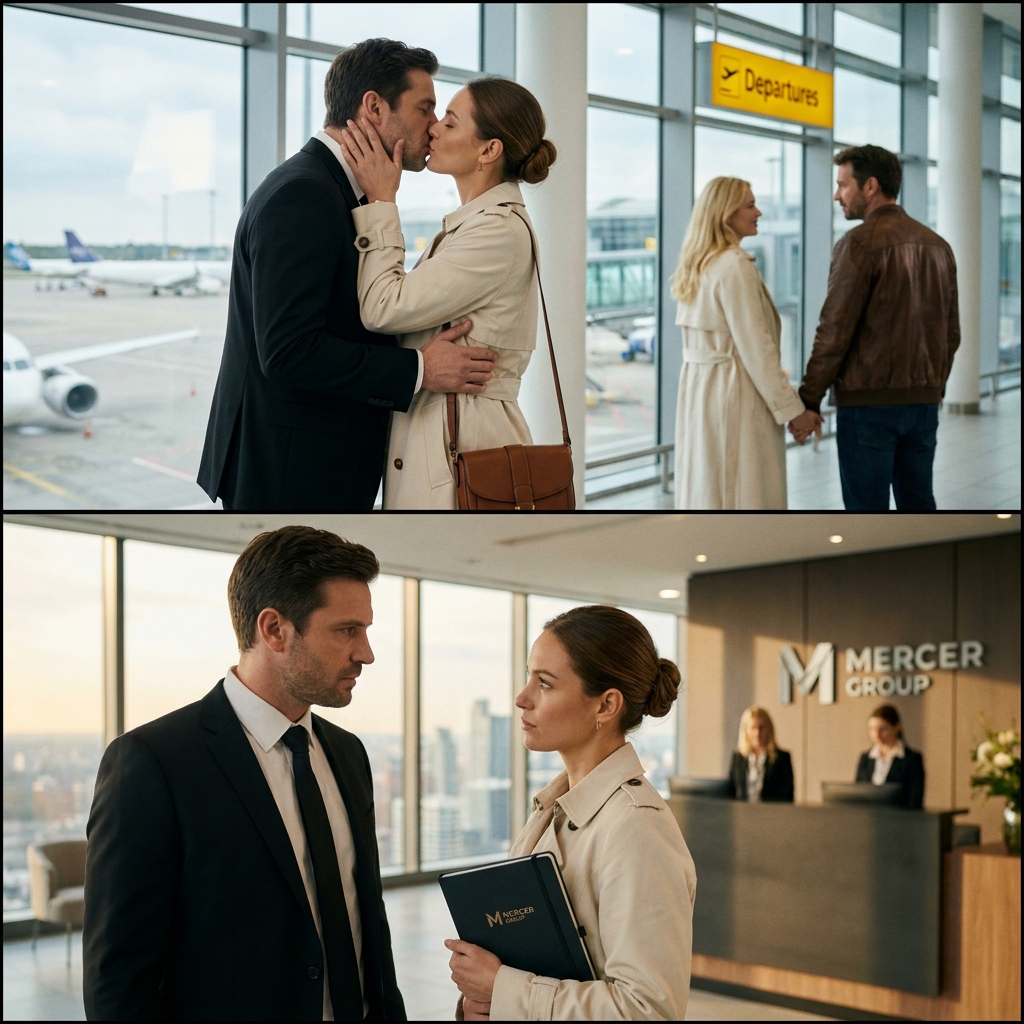
The next morning, Nora walked to the executive floor at nine sharp and told Theo’s assistant she needed to apologize. Inside his glass-walled office, skyline glowing behind him, Theo asked if she was feeling better.
“I didn’t actually faint.”
“I know.”
“I did fall. Just not medically.”
“I know that too.” A pause. “You’ve apologized to me twice now. Once with forty-seven dollars. Once by collapsing in my lobby.”
“It was forty-six.”
“Important correction.”
She looked up. He was smiling — not the slow, dangerous version from the lobby. A real one.
“I’m not angry,” he said.
“Why not?”
“Because you were clearly trying very hard not to break.”
The words landed somewhere she hadn’t braced for.
“What will you accept,” he asked, “as a third apology?”
“Anything reasonable.”
“Coffee. As friends.”
“You’re my CEO.”
“That’s my job. Not my personality.”
She gave him her number before she’d fully decided to.
That evening, Julian was waiting by the entrance when she left with Priya. He blocked her path, called it a misunderstanding, said they were even now. When she tried to step around him, his hand closed hard around her arm.
Theo appeared out of nowhere, and Julian was on the pavement before anyone quite registered the movement, jaw already reddening.
“Do not touch her,” Theo said, and there was nothing performed in it at all.
He drove both women somewhere safe that night, and eventually Nora — after refusing, then reconsidering, then giving in entirely — spent the night in a guesthouse on his estate with her own door code and a lock that was hers alone.
The weeks that followed were not easy, but they were steadier. She filed a report on Julian. Changed her locks. Let Theo’s legal team send a no-contact notice without ever making her feel indebted for it. At work they were rigidly, almost comically professional — Ms. Voss. Mr. Nakamura. Outside it, something else entirely grew: drives home, quiet dinners, questions about her actual dreams that he seemed to actually want answered.
Her father called one week later, voice flat. Come home. Mitchell — Julian — is here. This has gone far enough.
She went. Theo drove her and waited outside until she found she couldn’t get out of the car alone, and he told her, quietly, that she didn’t need to earn her parents’ belief by walking alone into a room built to make her the villain.
Inside, Julian sat like a wronged son-in-law while her father recited his version — that the woman had kissed him, that Nora had humiliated him publicly out of spite. Her mother looked exhausted and half-convinced. Her father told her to apologize.
“No,” Nora said. Small. Unshaking.
“Then don’t expect to be treated like our daughter,” her father said.
That was when Theo stepped through the doorway, calm as still water, and told the room precisely what he’d witnessed at the airport — that Nora had reacted, not betrayed; that Julian had already been served a no-contact notice; that any further contact would carry consequences well beyond a living-room conversation.
They left together. Theo didn’t drive her home. He took her ice skating instead, informed her that struggling not to fall was an excellent cure for heartbreak-induced overthinking, and turned out to be entirely right.
Over the following months, Nora rebuilt herself in small, deliberate pieces — therapy, long walks, brunches with Priya, silence toward every new number Julian tried. Her mother called, eventually, crying, admitting she should have stood. Nora told her she believed her, and that she needed time regardless. She did not rush to make it easier for anyone but herself.
Theo never pushed. He was simply, steadily present — coffee on hard mornings, a hand offered before crowded rooms, a look across a conference table that said I see you, you’re doing fine without a single word spoken.
Three months after the airport, over dinner at a small unmarked Japanese restaurant, he admitted he’d kept the forty-seven dollars in his desk drawer — the first money he’d made since coming home to run the American office. She laughed until she had to cover her mouth.
Outside, under a streetlamp, she stopped walking.
“I’m ready,” she told him.
“For what?”
“For you to ask me properly.”
Something unguarded broke open across his face. “Nora Kessler,” he said, uncharacteristically nervous, “may I take you on a real date that doesn’t begin with emotional wreckage, legal threats, or fake fainting?”
“Yes.”
Their first true kiss happened at her front door with no audience at all — not pride, not revenge, not survival. Just something chosen.
A year later, Julian married the woman in red. Six months after that, they divorced. Priya sent the article with a single coffee emoji and no comment. Nora didn’t reply; she was busy reviewing her department’s new campaign, having been promoted only after a full independent executive review, precisely because she’d threatened to resign the moment anyone assumed she’d gotten it any other way.
Two years after the airport, Theo proposed in the exact spot where her old life had shattered — white roses in hand, Priya crying behind a pillar she thought was hiding her.
“The first time I saw you here,” he said, “you were trying not to fall apart. You kissed me before you knew my name, paid me forty-seven dollars, and left before I could ask if you were all right.”
“I wasn’t.”
“I know. But you became all right. Not because of me. I only had the privilege of standing nearby while it happened. I’m asking if I can keep standing nearby. For the rest of my life.”
She said yes before he’d finished opening the box.
Her parents came to the wedding. Her father apologized weeks beforehand — stiffly at first, then with real tears when she didn’t make it easy for him. “I failed you,” he said. “Then do better slowly,” she told him. “And don’t expect applause for starting late.” He did. Not perfectly. Steadily.
They married in December, under white lights and winter roses, Priya’s speech leaving half the room reaching for tissues, Theo’s father crying and denying it immediately after.
Three years on, their house had gone from elegant to genuinely chaotic — triplets, two boys and a girl, all healthy, all loud, all deeply outraged by the concept of sleep. One quiet, miraculous minute of silence. Then her father walked in with groceries, proudly holding up the correct brand of wipes, and the babies chose that exact second to scream in unison.
Everyone laughed anyway.
And somewhere in the middle of that loud, exhausting, entirely unplanned life, Nora thought back to the yellow dress, the red dress, the kiss meant only to save her pride, and the stranger who never stayed a stranger.
She had once believed betrayal was the end of her story.
It had only ever been the gate. On the other side of it was a life louder, kinder, messier, and far fuller of love than anything she had ever had to beg the wrong man for.