His Family Stole His Files for Tuition. Then the Door Shook.
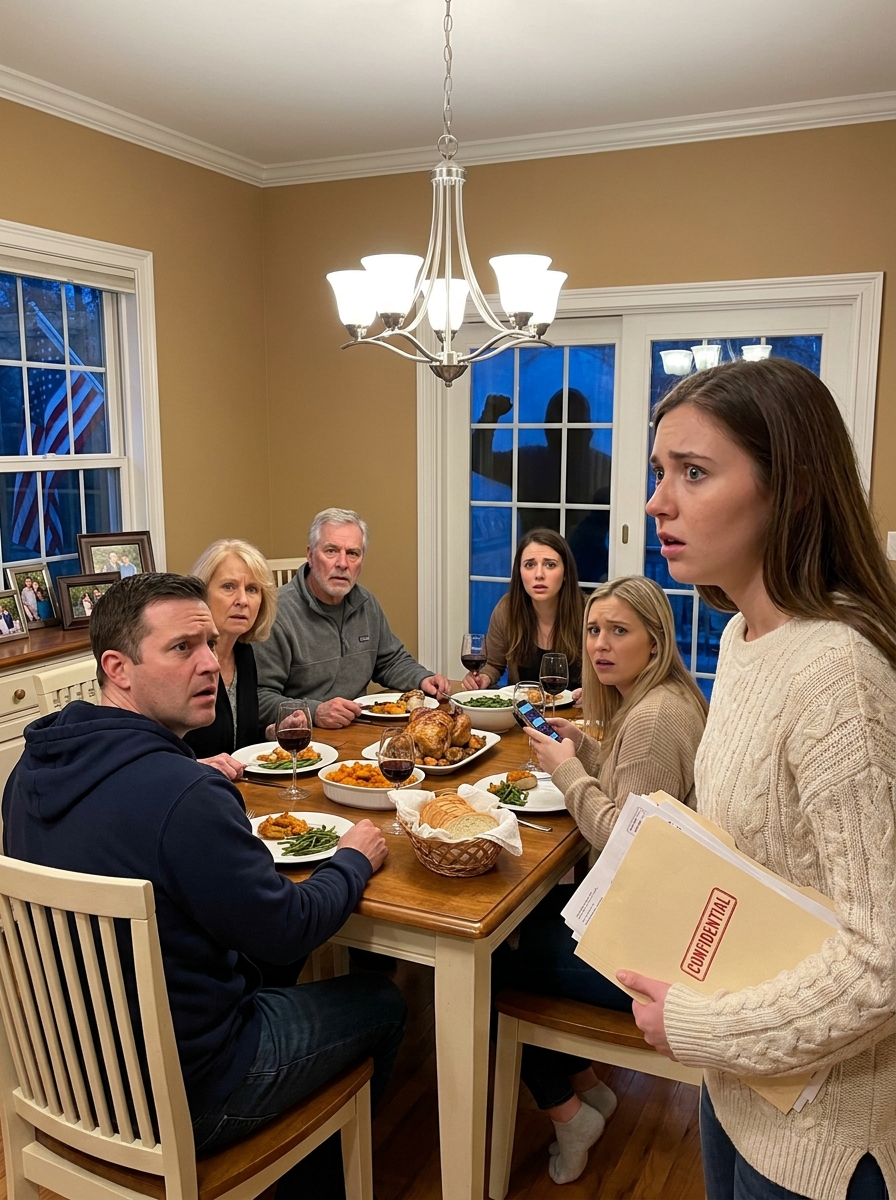
The dining room smelled like pot roast, boxed wine, and the lemon cleaner my mother only used when she wanted the house to look calm.
It was the kind of smell I had known since childhood.
Warm meat, cheap sweetness, fake citrus, and old family rules hiding underneath it all.
The ceiling fan clicked above us in a slow uneven rhythm, moving the warm air around without making the room any cooler.
My parents had set out the good plates.
My mother had ironed the white tablecloth.
My father had opened two bottles of boxed wine and poured them into a glass pitcher like that made it classier.
Everyone was there because my sister Vanessa had been accepted into a private university she had been talking about for months.
She had barely finished community college.
Nobody said that out loud.
Nobody mentioned the three failed semesters.
Nobody mentioned the unpaid parking tickets.
Nobody mentioned the credit cards my father had quietly paid off because Vanessa was always “going through something.”
That was how it worked in our family.
Vanessa made messes.
My parents softened the floor beneath her.
I made boundaries.
They called me cold.
I had driven over in my old SUV with a grocery-store pie on the passenger seat and a headache already forming behind my eyes.
I knew the shape of the evening before it started.
My mother would praise Vanessa like acceptance letters erased history.
My father would make comments about family support.
Some cousin would joke that I was the rich one because I had a steady job, a quiet house, and no visible chaos.
They never understood that being responsible is expensive in ways careless people never see.
I paid for my own repairs.
I took my own calls.
I cleaned up my own mistakes.
That made them think I had extra.
Vanessa had always thought my life was unfair because I did not explain it to her.
I did not explain the late-night calls.
I did not explain the locked office door.
I did not explain why a file cabinet in my house had a latch, a deadbolt, and a camera pointed toward it.
I worked around federal contract compliance, and my home office held restricted documents tied to an active audit.
That was boring to my family.
Boring meant available.
Quiet meant weak.
Locked meant dramatic.
My father had the spare key because of one week years earlier when I had surgery.
I had trusted him to feed my dog, bring in the mail, and check that the house was still standing.
I had given him that key when I could barely walk from the couch to the kitchen without holding the wall.
He kept it.
He never mentioned it again.
That was the trust signal.
A key given during one weak week.
A key kept for a strong betrayal.
Dinner started with my mother glowing like she had personally built Vanessa’s future out of sacrifice and prayers.
Vanessa sat beside her, smiling into her wineglass while my father bragged about how proud he was.
The rest of the family nodded along.
My aunt asked what Vanessa planned to study.
Vanessa gave a vague answer about business and leadership.
My cousin said college was expensive now.
That was when my father looked at me.
Not directly at first.
He did it the way he always did.
A glance, then a sigh, then a little lift of his eyebrows like he was inviting me to be reasonable.
“Family helps family,” he said.
I set down my fork.
I had heard that sentence so many times it had lost all meaning except the one they used it for.
Family helps family meant I should pay.
Family helps family meant Vanessa should receive.
Family helps family meant my parents would call it love when they were really assigning invoices.
Before I could answer, Vanessa stood up.
She walked toward the china cabinet with a grin that was too wide for a normal toast.
Then she reached behind it and pulled out a folder.
My folder.
The blue-gray one with the black binder clip.
For a second, my mind did not catch up with my eyes.
I knew where that folder belonged.
I knew the drawer it should have been in.
I knew the exact position of the cabinet latch because I had photographed it at 6:18 that evening when I found it bent.
Vanessa lifted the folder over her head like she had won a prize at a county fair.
“Look what I found,” she sang.
The table turned toward her.
“My little brother’s savings account.”
Everyone laughed.
It came fast and easy, like they had been waiting for permission.
My mother clapped.
Actually clapped.
My father leaned back with a pleased smile that made something hard settle in my chest.
Vanessa shook the folder until the paper edges snapped in the air.
“Thank you for funding my college tuition,” she said.
The room laughed harder.
My cousin slapped the table.
My aunt smiled without showing teeth.
My mother looked at me like I should be enjoying the honor of being used.
For one ugly second, I wanted to stand up and sweep every plate onto the floor.
I wanted the pot roast, the gravy boat, the boxed wine, and my mother’s good dishes to crash so loud nobody could pretend this was cute.
I reached for my water glass.
Then I made myself set it down gently.
I had spent too many years being called dramatic by people who kept setting fires and handing me the smoke.
I was not going to give them the explosion they wanted.
Control looks like weakness to people who only understand force.
Then one day, control is the thing that buries them.
I looked at Vanessa.
“You took documents from my office.”
My father’s smile tightened.
“We’re family,” he said.
“You broke into my office.”
Vanessa rolled her eyes.
“We used a spare key.”
A couple of cousins laughed again, though not as loudly this time.
The phrase hung there.
We used a spare key.
Not “I found it.”
Not “I thought it was okay.”
We.
My father looked down at his plate.
That was the first honest thing he had done all night.
The room froze and kept moving at the same time.
Forks hovered halfway to mouths.
My aunt stared down at the green bean casserole like vegetables could save her from choosing a side.
The ice in my father’s glass cracked softly.
Somewhere in the kitchen, the oven timer blinked 7:42 PM and kept blinking because nobody stood up to turn it off.
Nobody moved.
Vanessa tossed the folder onto the table.
Papers slid across the white cloth and came to rest beside the gravy boat.
I saw account summaries.
I saw authorization letters.
I saw intake forms.
I saw the transfer schedule clipped together with a black binder clip.
I also saw the red control stamp on one page she had not noticed.
That was the first problem.
The second problem was bigger.
It was not a savings account.
Not for groceries.
Not for vacation.
Not for helping a sister who thought consequences were something other people paid.
The folder held restricted financial documents tied to an active federal contract audit.
The pages were stamped, logged, copied, tracked, and assigned.
They had moved through more formal channels than my family had ever bothered to imagine.
Every controlled copy had a number.
Every access point had a log.
Every page in that folder had a history.
At 6:18 PM, I had photographed the broken cabinet latch.
At 6:31 PM, I had texted my compliance contact.
At 7:09 PM, I had checked the digital access log from the office camera and saved the clip.
It showed Vanessa entering my home office.
It showed my father standing behind her.
It showed the folder leaving the cabinet.
I had not shouted when I saw it.
I had not called my mother.
I had not driven to my parents’ house to demand answers.
I documented first.
People who are used to getting rescued hate documentation because it does not care how charming they sound afterward.
Documentation just sits there.
Flat.
Patient.
Unimpressed.
Vanessa folded her arms and looked at me like I was the one embarrassing everyone.
“I already talked to Dad,” she said.
My father’s jaw moved.
Vanessa kept going.
“We’re transferring everything next week.”
The confidence was remarkable.
The stupidity was almost impressive.
My mother sighed as though I had forced everyone into an unpleasant topic.
“Your sister deserves a chance.”
I turned to her.
“She stole from my office.”
“She didn’t steal,” my mother said.
“She found paperwork.”
That sentence told me more than I wanted to know.
My father looked at me then.
“You should be proud to help your sister.”
For years, I had been the boring one.
The quiet son.
The one who missed birthdays because of work and brought grocery-store pie instead of big gifts.
The one who drove an old SUV even after getting promotions.
The one who did not post vacations because most of my time off got eaten by deadlines, audits, and calls that came after midnight.
Vanessa got rescued.
I got resented.
That had been the shape of our family for as long as I could remember.
When Vanessa needed rent, my parents found a reason.
When she needed a car repair, they found a way.
When she failed a class, they blamed the professor.
When I paid my own way, they called me lucky.
“You don’t even need all that money,” Vanessa said.
“It isn’t money,” I said.
My mother gave a tired little wave.
“Don’t start with technicalities.”
A technicality is just the truth spoken before arrogant people are ready for it.
Vanessa laughed.
“What are you going to do?” she asked.
Her smile spread wider.
“Call the police?”
The table erupted.
My cousin laughed so hard he had to put down his fork.
My father shook his head like I was a child making threats.
My mother gave me that soft little smile she used whenever she thought I was being difficult.
Vanessa lifted one page and waved it inches from my face.
The corner brushed my cheek.
That was the exact moment I stopped seeing her as careless.
Careless is spilling wine.
Careless is forgetting a birthday.
This was chosen.
She wanted me humiliated first and useful second.
I picked up my phone.
Vanessa rolled her eyes.
“Seriously?”
I tapped one number.
Someone answered on the first ring.
“It’s happening,” I said.
The voice on the other end was calm.
“Understood.”
I ended the call and placed the phone beside my plate.
My father smirked.
“Who was that?”
I looked directly at him.
“You’ll find out soon.”
For the first time all night, a crack opened in his confidence.
It was small.
But Vanessa saw it.
Her smile twitched before she forced it back into place.
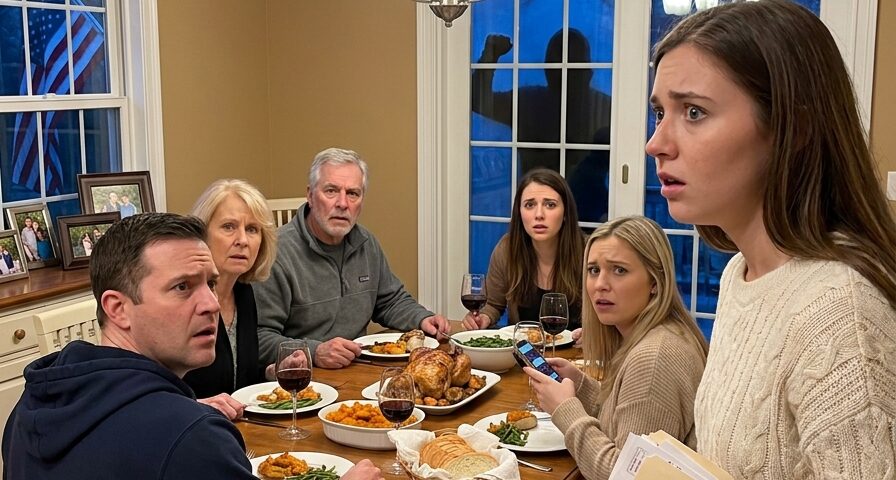
Ten minutes later, someone pounded on the front door so hard the small American flag on my parents’ porch trembled against the window glass.
The room changed all at once.
My mother’s smile disappeared.
My father’s shoulders stiffened.
Vanessa’s fingers went still around the folder.
The second knock came harder.
My mother looked at my father.
He did not move.
From the hallway, my cousin whispered, “Is that police?”
No one answered.
The porch light cut a bright rectangle across the window.
Two silhouettes stood outside.
One held a folder against his chest.
The other looked down at a phone.
My father saw them and went pale.
That told me he understood enough.
Maybe not all of it.
But enough.
Vanessa tried to gather the papers.
Her fingers slipped on the binder clip and sent two pages sliding to the floor.
“Leave them,” I said.
She froze.
It was the first time all night she listened.
My mother reached for the page nearest her.
She read the header.
CONTROLLED DOCUMENT COPY.
Her mouth opened slightly.
No sound came out.
My father noticed another page near his plate.
It was a custody acknowledgment sheet from the audit packet, dated, logged, and marked with the access number.
His lips moved as he read it.
Then he looked at Vanessa.
Then at me.
“Tell me you didn’t already call them,” he said quietly.
I stood.
The chair legs scraped against the floor.
That sound did what my anger had not.
It made every person at that table flinch.
I picked up the folder.
Before I reached the hallway, Vanessa whispered, “Dad, what is happening?”
He did not answer her.
He was staring at the front door like the wood had become a judge.
I opened it.
On the porch stood my compliance contact and a uniformed officer.
Behind them, parked at the curb, was a dark SUV I recognized from previous site visits.
My compliance contact did not look surprised.
He looked tired.
That was somehow worse.
“Evening,” he said.
His eyes moved past me to the dining room.
Then to the papers on the table.
Then to Vanessa.
“Please don’t touch anything else.”
Vanessa made a small sound.
My mother stood so quickly her chair bumped the wall.
“This is a misunderstanding,” she said.
The officer looked at the room, then at me.
“Who removed the documents from the secured location?”
Nobody spoke.
My father opened his mouth.
Then closed it.
Vanessa looked at him like he was supposed to save her.
That had always been their arrangement.
She panicked.
He softened the landing.
Only this time, the floor was not his to pad.
My compliance contact held up his own folder.
“We have the access report, the timestamped message, and the camera clip,” he said.
He did not raise his voice.
He did not need to.
The quiet son had made one quiet call, and the room finally understood that quiet was not the same as helpless.
Vanessa’s face crumpled.
“I didn’t know,” she said.
That was the first sentence people always reached for when consequences arrived.
I didn’t know.
Not I’m sorry.
Not I was wrong.
Just a little bridge back to innocence.
My father stood then.
He put both hands on the table.
“I gave her the key,” he said.
My mother gasped.
Vanessa turned on him instantly.
“Dad.”
He did not look at her.
His eyes stayed on the officer.
“I didn’t know what the files were,” he said.
My compliance contact glanced at me.
I knew what that glance meant.
He was not there to decide who felt bad.
He was there because restricted documents had left a secured location, been handled by unauthorized people, and placed in a room full of witnesses.
Intent mattered.
Access mattered more.
The officer asked everyone at the table to remain seated.
My cousin stopped laughing completely.
My aunt folded her hands in her lap and stared at the tablecloth.
My mother kept repeating, “This is family,” like the word could shrink the problem.
It could not.
The officer asked Vanessa where she got the folder.
She looked at my father.
My father looked at the floor.
That was when she understood he was not going to carry the whole thing for her.
Her mouth trembled.
“I thought it was his money,” she said.
My compliance contact asked, “Who told you that?”
The question moved through the room like a blade.
Vanessa looked at my mother.
My mother went still.
I had expected my father.
I had not expected that.
My mother’s face changed in a way I had never seen before.
The soft smile was gone.
The disappointed-mother expression was gone.
Underneath it was fear.
Vanessa whispered, “Mom said he had accounts he was hiding.”
The room went silent.
Not family silent.
Not awkward dinner silent.
Official silent.
The kind that forms around statements people cannot unsay.
The officer wrote something down.
My mother sat slowly.
“I didn’t mean it like that,” she said.
Of course she didn’t.
People never mean betrayal like that once someone starts writing it down.
My compliance contact asked for the folder.
I handed it over.
He placed it into an evidence sleeve and sealed it at the table while everyone watched.
The sound of the adhesive strip closing was soft.
Final.
My father rubbed both hands over his face.
Vanessa started crying.
Not loudly.
Just enough to invite rescue.
Nobody moved toward her.
For the first time in my life, there was no hand under her fall.
The officer took statements from everyone who had touched or seen the documents.
He asked when Vanessa entered my house.
He asked who had the key.
He asked who discussed transferring the funds.
Every answer made the room smaller.
By 9:12 PM, the folder was gone.
By 9:26 PM, Vanessa had given a statement that contradicted my father’s.
By 9:41 PM, my mother had stopped calling it family and started calling it confusion.
I stood by the hallway with my phone in my hand, answering questions as carefully as I had answered everything else that night.
No extra anger.
No speeches.
Just dates, times, documents, access logs, and names.
My father finally came toward me near the front door.
He looked older than he had at dinner.
“Son,” he said.
That word almost worked.
Almost.
There had been a time when I would have wanted it so badly I might have let it soften me.
But the table behind him was still covered in gravy stains and scattered napkins.
My office had still been opened.
My files had still been taken.
My family had still laughed while Vanessa waved them in my face.
“What do you want me to do?” he asked.
I looked at him for a long moment.
“Tell the truth,” I said.
He swallowed.
Then he looked away.
That was his answer.
In the days that followed, the official process did what family never had.
It separated feelings from facts.
The access log showed the time Vanessa entered.
The camera clip showed my father behind her.
The photographed latch showed forced handling after unauthorized entry.
The witness statements showed the papers had been displayed, mocked, and discussed as available funds.
My compliance contact filed the internal incident report.
The officer’s report attached the access timeline.
The audit team replaced the document copies and reviewed the chain of custody.
My work was not destroyed.
But it was shaken badly enough that I had to sit through meetings where serious people asked serious questions about my home security, my family access, and whether any additional materials had been exposed.
That was the part my parents never wanted to see.
Their little dinner stunt did not just embarrass me.
It put my livelihood under review.
It made my name part of a file.
It made my private trust in my own father a professional liability.
Vanessa called me three days later.
I did not answer.
She texted that she was scared.
Then that she was sorry.
Then that she did not know it was serious.
Then that Mom and Dad had made it seem like I was hiding money from the family.
I saved every message.
Documentation had become a habit.
My mother called next.
Her voicemail was two minutes long.
She cried through most of it.
She said she had never wanted to hurt me.
She said she was only worried about Vanessa.
She said I had always been so independent that she assumed I could afford to help.
That was the closest she came to telling the truth.
She had not thought I needed protecting because I had learned to protect myself.
She had not thought I could be hurt because I had stopped bleeding in front of her.
My father came to my house a week later.
He stood on the porch with the spare key in his palm.
I opened the door but did not invite him in.
He looked down at the key.
“I should have given this back years ago,” he said.
“Yes,” I said.
He held it out.
I did not take it.
“The locks were changed the morning after dinner,” I told him.
His hand lowered.
For the first time, he seemed to understand that some doors do not stay open just because you once had a key.
He asked if I could help Vanessa get out of trouble.
There it was.
Even then.
Even after everything.
The old shape of the family trying to reform itself around me.
Vanessa falls.
I soften the landing.
I looked at my father and saw the man who had fed my dog after surgery, the man who taught me to change a tire, the man who had also stood behind my sister while she entered my locked office.
Both things were true.
That was the hard part.
Betrayal does not erase every good memory.
It just teaches you which memories were never strong enough to protect you.
“I’m not interfering with any report,” I said.
He nodded slowly.
His eyes filled, but he did not argue.
That, more than anything, told me he knew.
The university did not get paid from my documents.
There was no secret savings account to raid.
Vanessa had to face the consequences of entering a locked office, removing restricted documents, and trying to treat controlled audit material like family money.
My parents had to answer for their part in it.
The legal and professional fallout took months.
It was not as cinematic as people imagine.
Most consequences are paperwork.
Statements.
Meetings.
Emails.
Long pauses on phone calls.
People who once laughed getting very quiet when the right document appears.
The family never gathered the same way again.
My aunt sent a short apology card.
My cousin avoided me for a year.
My mother kept trying to rebuild things through holiday invitations and soft messages about forgiveness.
I answered some.
I ignored others.
Forgiveness, I learned, is not the same as access.
You can forgive someone and still change the locks.
You can love your family and still refuse to be their emergency fund, their scapegoat, or their unlocked door.
Sometimes self-respect sounds like silence.
Sometimes it sounds like one short call.
And sometimes it sounds like a knock on the front door so hard every smile in the room disappears.
Years from now, maybe my family will remember that dinner as the night everything went too far.
I remember it differently.
I remember pot roast, boxed wine, lemon cleaner, and the oven timer blinking 7:42 PM while nobody moved.
I remember my sister waving restricted documents inches from my face.
I remember my parents applauding because they thought my life was finally useful to them.
And I remember the tiny American flag on the porch trembling in the glass when consequences arrived.
The quiet son had not raised his voice because he did not need volume.
He had documentation.