I Came Home From My Husband’s Funeral to Reveal His $8.5M Estate Then I Heard My Parents Planning to Take It
“She’s not thinking straight. She hasn’t been right since the wedding. Once Voss signs the papers, we file before she even knows what happened.”
That was my mother’s voice.
She was sitting in my father’s kitchen three days after my husband’s funeral, planning how to take everything he left me. Eight and a half million dollars. Six Manhattan lofts. My entire future, carved up on a Wednesday evening between my parents and my sister like it was already theirs.
But here’s the thing my family didn’t know. Nathan had warned me. Not in some dramatic deathbed confession. Quietly. Carefully. The way he did everything.
And what I did next cost my father his freedom, my sister her fiancé, and my mother every ounce of respect she’d spent sixty years building in that town.
My name is Fay Terrell. I’m thirty-one years old. I’m a museum manager in Manhattan. And two weeks before that Wednesday evening on the porch, I buried the only person who ever truly saw me.
Let me take you back to the beginning. To the morning of Nathan’s funeral, when I stood alone in a half-empty church and realized my family wasn’t coming.
The morning was cold for September. St. Andrew’s Chapel on Ninth Avenue seats two hundred people. Fourteen showed up. I counted them, because there was nothing else to do while the organist played a hymn Nathan never would have picked.
Fourteen. Three of his college roommates. His boss from the architecture firm. Six colleagues from my museum who carpooled from Chelsea. The florist, who stayed because she knew Nathan from the Saturday market. A neighbor from our building. And James Whitfield, Nathan’s attorney, sitting in the back row in a dark suit, hands folded, watching everything.
My mother’s chair was empty. My father’s chair was empty. My sister Chloe’s chair was empty.
I had called all three of them. I called my mother, Patricia Hobbes, at six in the morning the day Nathan collapsed. She picked up on the fourth ring and said, “Oh, Fay, that’s terrible.” Like I’d told her the car needed a new alternator. Then she said, “We’ll talk when you come home. Chloe has a fitting for her engagement dress this weekend, so it’s been hectic.”
My husband was dead. My sister had a dress fitting.
I stood at the front of that chapel and tried to say something about Nathan. About the way he folded his drafting paper into tiny cranes when he was thinking. About the six years we spent together and how every single one of them was better than the twenty-five I’d lived before him. My voice cracked twice. Nobody from my family was there to notice.
Afterward, James Whitfield found me on the chapel steps. He shook my hand, firm and steady. “Nathan loved you,” he said. “He made sure of that.” Then, “Come see me Monday, Fay. It’s important.”
I didn’t understand the weight of those words yet. I would.
Two days later, I drove to Ridgewood. Two and a half hours from our Chelsea loft, through the suburban sprawl and into the kind of small-town New York that tourists forget exists. Population eight thousand. One grocery store. One diner. One church that runs everything.
I passed the wooden sign at the edge of town. Ridgewood Community Church. Gerald Hobbes, Honorary Treasurer. My father’s name in gold letters. He’d held that post for twelve years, which in Ridgewood is practically a political office.
The house looked the same. White siding, green shutters, the porch swing Patricia repaints every spring. I grew up there. I learned to read there. I also learned that some families have a favorite child, and it isn’t always a secret.
Chloe had asthma as a kid. Mild, managed with an inhaler by age ten. But Patricia never updated the narrative. Chloe was delicate. Chloe needed extra support. Chloe got the bigger bedroom, the later curfew, the car at sixteen. I got a library card and the understanding that I could take care of myself.
So I did. Scholarships. Columbia. A career built from nothing. Nathan.
And now Nathan was gone, and I was driving back to the house I couldn’t wait to leave at eighteen, carrying a copy of his will in my bag. Eight and a half million dollars and six Manhattan properties. I hadn’t told anyone yet. And I think, I actually think, some pathetic hopeful corner of me believed this might finally be the thing that made my mother look at me and say, I’m proud of you, Fay.
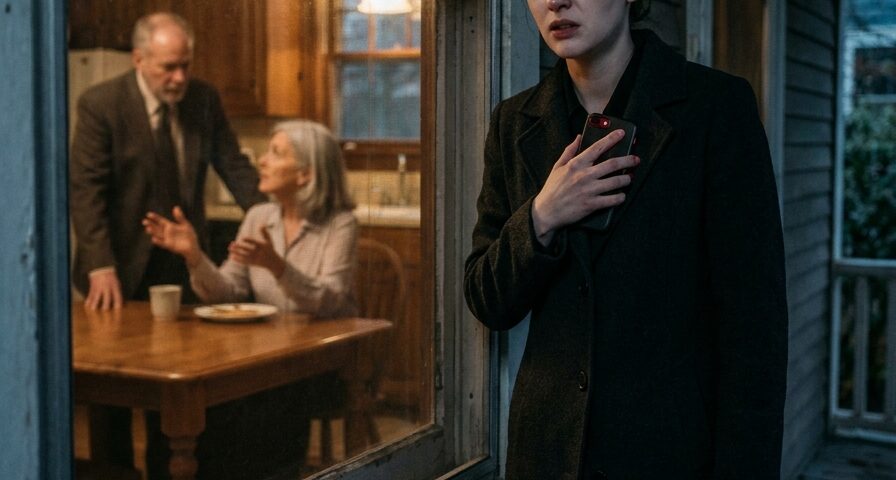
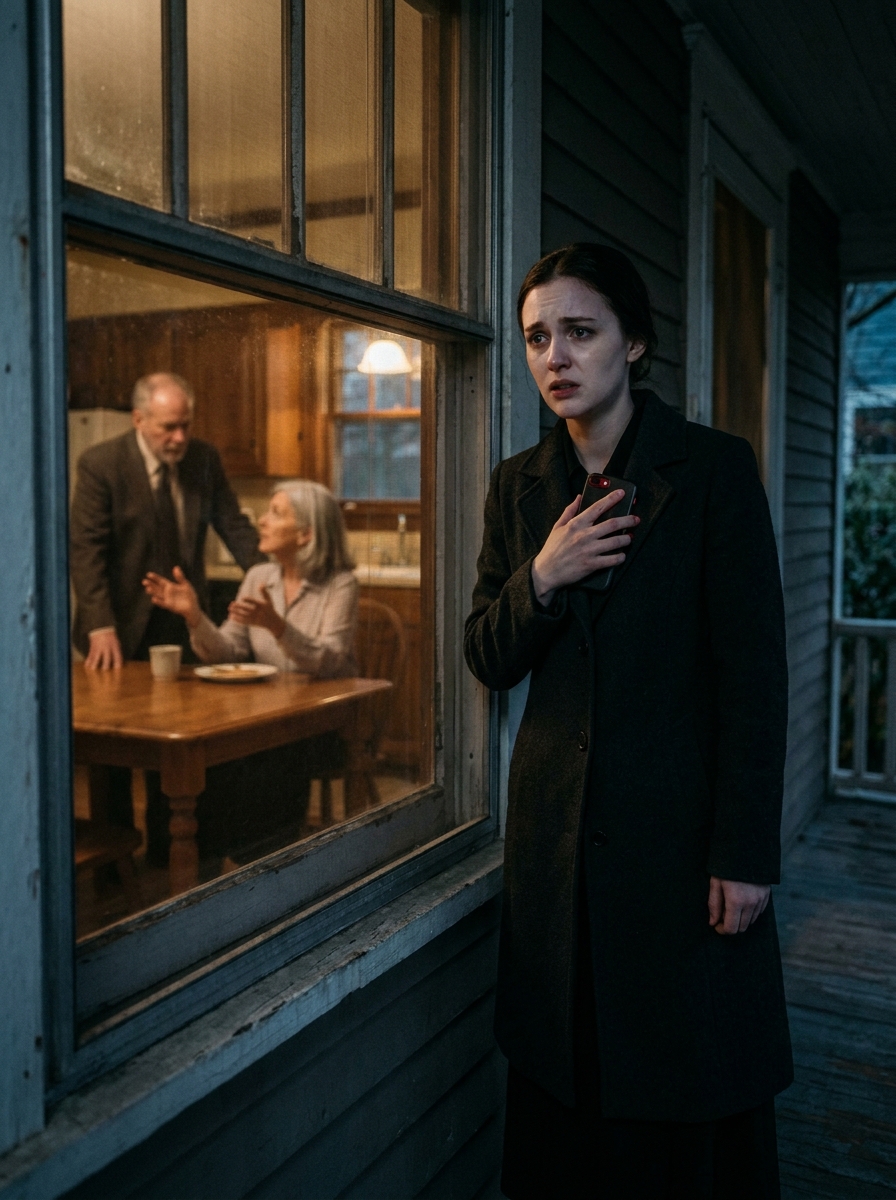
I parked in the driveway. The kitchen window was open, and I heard voices.
I froze on the porch steps.
My mother’s voice came through the screen, sharp and organized, like she was reading a grocery list.
“Voss said if we get her here for seventy-two hours, he can do the evaluation. She just lost her husband. No judge is going to question it.”
My father: “And the money?”
“Chloe becomes guardian. We manage the accounts. Simple.”
Then Chloe’s voice on speakerphone, tinny and eager. “Tell Dad to make sure she doesn’t talk to that lawyer. Nathan’s lawyer gave me a weird vibe at the wedding.”
The wedding. Three years ago. My sister had noticed James Whitfield three years ago and filed him away as a threat.
I stood perfectly still. The porch light was off. A moth tapped against the screen. Inside, my family was discussing how to have me declared mentally incompetent so they could seize my dead husband’s estate.
Patricia again: “She’ll cry for a week and then sign whatever we put in front of her. She always does what she’s told.”
My hands were shaking. My chest felt like someone was sitting on it. And then a strange, cold clarity arrived, and I reached into my coat pocket.
New York is a one-party consent state. I learned that in a compliance seminar at the museum two years ago. I could legally record any conversation I was part of, or any conversation happening three feet from where I stood on a porch with an open window.
I tapped record. The red dot glowed. My mother kept talking. My father kept agreeing. My sister kept planning a future that depended entirely on me being broken.
When I had enough, I stopped the recording, pocketed the phone, and rang the doorbell like I had just arrived.
Patricia opened the door, and her face shifted from calculation to warmth in under a second. She pulled me into a hug. Lavender perfume, the same brand she’d worn my whole life. “My poor baby,” she said. “We’re here for you now.”
The word now hits differently when you’ve just heard someone plotting to strip your legal rights.
Gerald stood behind her in the hallway, hands in his pockets. “You should stay a few days, Fay. Rest. There’s no rush to go back to the city.”
No rush. Because they needed seventy-two hours.
I smiled. “Thanks, Dad. I think I just need to be home for a while.” I watched his shoulders relax.
There was tea on the counter, cookies from the church bake sale. Everything looked like love. Everything sounded like love. I excused myself to my old bedroom upstairs. Same twin bed, same faded quilt, same Columbia graduation photo tacked to the wall with a single rusting push pin, four inches by six. Down the hallway, both walls were covered in Chloe. Prom, cheerleading, sorority formal, engagement party. Forty-seven framed moments. I counted those too.
I locked the door, called James Whitfield, got voicemail, and left a message. Then I sat on the edge of the bed and played the recording through my earbuds. Every word was clear. All three of them, calm and methodical, planning to erase me.
I didn’t sleep.
The next morning, there was a stranger in the living room. Patricia introduced him over coffee. “This is Dr. Voss. He’s an old friend of your father’s from college. I thought it might help to have someone to talk to, sweetheart. After everything.”
Dr. Raymond Voss was sixty-four. Silver hair, wire-rimmed glasses, the kind of cardigan designed to make you feel safe. He shook my hand like we were at a dinner party. “Your parents are worried about you, Fay.”
We sat in the den. Patricia positioned herself on the loveseat like a chaperone. Voss opened a leather notebook.
“Do you find it hard to make decisions right now?”
“No.”
“Do you sometimes hear Nathan’s voice, even though you know he’s gone?”
“No.”
“Have you had thoughts of harming yourself?”
“No.”
Each question was a brick in a wall being built around me. I recognized the pattern because I had spent the last three nights reading about involuntary guardianship proceedings on my phone at two in the morning. Voss wasn’t checking on me. He was constructing a diagnosis.
“Sometimes grief can make us feel like we’re not capable of handling our own affairs,” he said gently. “That’s perfectly normal.”
Patricia leaned forward. “She’s been like this since Nathan died. Shut down. Not herself.”
I answered every question clearly, calmly, without emotion. I gave him nothing. After twenty minutes, I excused myself to get water, walked to the back porch, and called James.
This time he answered, and what he said made my pulse pick up for the first time in days, and not from fear.
“Don’t leave that house yet. I need to tell you something Nathan set up. Can you come to my office tomorrow morning?”
I told Patricia I was going for a drive. “Nathan used to take me driving when I was sad,” I said, and she bought it without blinking. She even patted my shoulder on the way out.
James Whitfield’s office was in Glendale, one town over. Small building, second floor, no receptionist. He was waiting at the door, and inside, he slid a folder across the desk. Nathan’s will. I already knew the headlines: eight and a half million in liquid assets, six lofts, three in Chelsea, two in Tribeca, one on the Lower East Side. All mine.
But James wasn’t done. He handed me a sealed envelope with Nathan’s handwriting on the front. For Fay.
The letter inside was dated two years earlier.
Fay. I know your family. I’ve watched how they treat you. Not the big cruelties. The small ones, the ones you explain away. If something happens to me, James will protect you. Don’t trust anyone who wasn’t at my funeral.
My vision blurred. I pressed my palm flat against the desk and breathed.
Then James explained what Nathan had built. An irrevocable trust. Every asset, the cash and all six properties, held inside a legal structure that cannot be transferred through guardianship. Even if a court declared me incapacitated tomorrow, the trust stayed intact. James was trustee. Nothing moved without his signature and mine together.
“Nathan came to me three years ago,” James said. “Right after your wedding. He said, her family will come for this if I die. Build something they can’t touch.”
I sat in that small office and cried for the first time since the funeral. Not because of the money. Because my husband had known me better than I knew myself, had seen what I kept explaining away, and had loved me enough to build a wall around me from a place he couldn’t reach anymore.
James let me collect myself, then opened a second folder. “There’s something else. Nathan suspected your father had financial problems. Gerald asked him for money four separate times during your marriage. Nathan documented every request.” Four emails, each more desperate than the last. Twenty thousand for home repairs. Fifteen for Chloe’s car. Nathan had declined every time and kept the receipts.
“That’s not proof of anything,” I said.
“No. But if Gerald is the treasurer of a nonprofit, his filings are public record.”
James picked up the phone. “Maggie, I have someone I’d like you to meet.”
Margaret Kesler was a forensic accountant who worked fraud cases for nonprofits across the state. Forty-five, direct, no nonsense. On speaker, she said, “Give me ten days. I’ll pull the 990 forms and compare them with whatever the church has on file. If there’s a discrepancy, I’ll find it.”
Ten days. The church gala, the annual fundraiser where Gerald delivered his treasurer’s report, was in twelve.
I drove back to Ridgewood with a plan I hadn’t owned that morning. Stay in the house. Act grief-stricken. Let them believe I was crumbling. Give Maggie time. Don’t let anyone take my phone.
The next morning, my car keys were gone.
“I moved them to the drawer,” Patricia said from behind the Ridgewood Gazette, not looking up. “You shouldn’t be driving right now, Fay. Not in this state. Let your father take you wherever you need to go.” She turned a page. Conversation over.
By noon, Gerald had scheduled a second appointment with Voss, at the house, no discussion. At two, Chloe called on FaceTime from a bridal boutique, veils draped over every surface. “Hey, so Mom says you should sign a power of attorney while you’re home, so we can help manage things while you grieve.” She held a veil up to the camera. “What do you think of this one?”
“I’m not signing a power of attorney, Chloe.”
“God, don’t be difficult. It’s what families do. It’s not like you have anyone else to help you.” She hung up before I could answer.
That evening, the Wi-Fi password had been changed. Gerald shrugged. “Must have reset during the storm last week.” There had been no storm last week. I checked.
I locked the bathroom door and texted James on cellular data. They’re accelerating. Keys taken, Wi-Fi changed, Voss returning tomorrow. How much time does Maggie need?
He answered in under a minute. Eight more days. Hold your ground.
Eight days. I could do eight days.
At nine that night, my phone rang. Unknown number, 845 area code.
“Fay, it’s your aunt Helen.”
I hadn’t heard Helen Briggs’s voice in eight years. Patricia’s older sister, cut off completely after a fight I was never given details about. Growing up, Helen was the aunt who sent birthday cards with twenty-dollar bills and real handwritten notes. Then one Christmas she simply stopped existing. Patricia said Helen was toxic and jealous, and that was the end of it.
“I saw the obituary on Facebook,” Helen said. “I’m so sorry, sweetheart.” Then her voice changed. “Listen to me carefully. I know what your mother is. She did the same thing to our mother before she died.”
I sat down on the edge of the bed, and Helen told me. Eight years ago, my grandmother Dorothy was diagnosed with mild cognitive decline. Patricia immediately petitioned for guardianship. Not to care for her. To sell her house and control her savings. Helen found out, hired an attorney, and blocked the petition. Dorothy recovered enough to live independently for three more years. Patricia never spoke to Helen again, and rewrote her as the family villain.
“She tried to take Mom’s money using a medical excuse,” Helen said. “And she’s doing it to you now. I can feel it from here.”
The pattern was so clear it was almost elegant. Same playbook. Same target. A woman in the family who was vulnerable and alone.
“If you need a witness,” Helen said, “I’m here. I will not let her do this twice.”
When I hung up, I had three allies. James. Maggie. And the aunt my mother had erased for telling the truth.
Voss arrived at ten the next morning with a briefcase and a printed form, and this time nobody pretended it was casual. Patricia sat beside me at the dining table, not across from me. Beside me, like a mother at a parent-teacher conference. Gerald stood at the window with his arms crossed.
Voss slid the document over. “I think it would be best for you to have family support managing your affairs. Temporary, of course. Just until you’re feeling stronger.”
I read every word. It took four minutes, and nobody spoke. It was a petition for temporary financial guardianship. If I signed, Chloe Marie Hobbes gained legal authority over every financial decision in my life. Bank accounts. Property. Investments. Everything Nathan built, managed by a twenty-seven-year-old who had never held a job for six consecutive months.
I set it down. “I’d like my own attorney to review this first.”
Patricia’s hand landed on my forearm. “You don’t need a lawyer, Fay. This is family.”
“I appreciate that, but I’m not signing anything today.”
The room went cold. Voss clicked his pen. Patricia’s fingers tightened just enough for me to feel the pressure underneath the tenderness. “Sweetheart. We’re trying to protect you.”
“Protecting me and controlling me are not the same thing, Mom.”
I stood, took the form with me, and walked upstairs. Behind me, low and hard, I heard her say, “Fine. We’ll go to court.”
I folded the petition and slid it into my suitcase. Another piece of evidence. Another forty-eight hours survived.
Saturday, Chloe drove up from the city with Ryan. Ryan Alcott was twenty-nine, a software engineer from a normal family in New Jersey. He shook my hand at the door and said, “I’m really sorry about Nathan, Fay. He was a good guy.” He meant it. His eyes didn’t slide away when he said it.
Lunch was almost domestic. Gerald carved a roast. Chloe talked centerpieces. Ryan asked about the museum. Then Ryan stepped outside to take a work call, and the mask dropped in under five seconds.
Chloe leaned across the kitchen island. “Look. Just cooperate. Mom’s doing this for all of us.”
“All of us?”
“Do you know how much my wedding costs? I can’t keep putting it on credit cards.” She lowered her voice. “And Ryan doesn’t know about the debt. He definitely doesn’t need to know about any of this. So sign the papers and everything goes back to normal.”
“Normal.”
“Don’t be selfish, Fay. You don’t even need that money.” She picked up her wine glass and delivered the sentence I will never forget. “Nathan’s dead. What are you going to spend it on?”
I set down my fork and looked at my sister. Twenty-seven. Polished nails. Borrowed confidence. A kind, oblivious man in the backyard who had no idea he was engaged to a stranger.
“You’re right,” I said. “Nathan’s dead. And I’m going to spend his money on whatever I decide. Because it’s mine.”
Three nights later, at 11:14 on a Tuesday, my phone buzzed with an email. From Chloe Hobbes. Subject: Re: Timeline.
It took me three seconds to realize it wasn’t meant for me. Our names sat next to each other in her contacts, and she’d hit the wrong one.
Mom, when is Voss sending the paperwork to the court? Ryan is asking about wedding deposits and I need to lock in the venue this month. Here’s the updated budget attached. Everything marked F accounts is what we’ll pull once the guardianship goes through. Don’t tell Ryan.
The attachment was a spreadsheet. Florist, $4,200, F accounts. Venue deposit, $12,000, F accounts. Photographer, $3,800. Dress, $6,500. Catering, $18,000. Total wedding budget, $48,300. Source for every line: F accounts.
Fay’s accounts. My dead husband’s money, allocated line by line to my sister’s wedding, before the theft had even been accomplished.
I screenshotted everything, the email, the attachment, the timestamp, and sent it to James with one line: Chloe sent this to me by accident. Premeditation and financial motive.
He replied at midnight. This is gold. Combined with your recordings and the audit, we have a very strong case. Don’t let her know.
I deleted the email from my inbox, then from the trash. If she checked her sent folder, she’d never know it had landed.
Helen checked into the Glendale Motor Lodge that Wednesday, six miles from Ridgewood, close enough to matter and far enough to stay invisible. We met at a coffee shop on Route 9. She was sixty-two, taller than Patricia, broader-shouldered, wearing a corduroy jacket and carrying a manila folder containing eight years of receipts from the war over Dorothy. The guardianship petition. The attorney letters. Her counter-filing with the doctor’s report.
“Same doctor trick, same isolation, same story to the neighbors,” she said, tapping the folder. “She didn’t invent a new plan for you, Fay. She dusted off the old one. I stopped her then. You’re stopping her now.”
Before I left, she squeezed my hand. “Your grandmother held on three more years after I filed. She used to talk about you. Said you were the one who got out.”
Meanwhile, Patricia was running a second campaign in parallel, and I started seeing it everywhere I walked. Mrs. Carol intercepted me on the sidewalk, clasping my hands. “Your mother told me you’ve been having such a hard time. She says you won’t eat, won’t sleep.” I had eaten a full plate of pasta the night before and slept six hours, and Patricia had watched me do both. Two blocks later, Mr. Dalton outside the hardware store, same script, different mouth. “Pat mentioned you might need someone checking in on you. She’s worried sick.”
She wasn’t just building a legal case. She was building a wall of witnesses. If this reached a courtroom, the judge wouldn’t only hear from Dr. Voss. He’d hear the entire social fabric of Ridgewood, all primed with the same three sentences. Poor Fay. Always fragile. Nathan’s death pushed her over the edge.
I called Helen that night. “She’s poisoning the well.”
“She did the exact same thing with Mom. By the time I showed up with a lawyer, half the neighborhood was ready to testify against our own mother.” A pause. “How did I stop it? I didn’t wait for permission to tell the truth.”
Then came Maggie’s call. I found my keys in the junk drawer, told Gerald I was going to the pharmacy, and parked behind the Glendale library.
“I’ve got something,” Maggie said. No preamble. “The church’s 990 filings show roughly $180,000 in donations over three years. Gerald’s internal reports to the board account for $133,000. That’s a $47,200 gap. Spread across forty-seven transactions over thirty-six months, each between five hundred and two thousand dollars. Small enough to avoid automatic flags. All routed to a personal account matching your father’s banking information.”
Classic skimming. And the timeline matched Nathan’s emails perfectly. Gerald had already been in the hole when he started asking my husband for bailouts.
“The gala is in eight days,” I said. “Can the findings be presented there?”
“If the church board agrees. You’d need the pastor.”
James was already a step ahead. “Reverend Harris is a straight arrow,” he told me. “Give me twenty-four hours.”
Reverend Thomas Harris, fifty-eight, thirty years ordained, and, crucially, a former auditor for the Episcopal Diocese, a man who read financial statements the way other people read menus. James showed him Maggie’s preliminary numbers, and Harris didn’t speak for two full minutes. Then he said, “Twelve years. I trusted that man.” He convened an emergency closed session of the board. They reviewed everything, called Maggie directly, and made a decision. At the gala, instead of Gerald’s usual treasurer’s report, Maggie would present a certified independent audit, framed as a routine transparency initiative. Gerald would suspect nothing, because there was always a financial segment at the gala. This year, someone else was delivering it.
“Harris said one more thing,” James added. “He wants you there, front and center.”
The last days were a siege. Patricia found out about Helen through Mrs. Carol within an hour of the coffee shop and stood in the kitchen issuing edicts. “If Helen shows up at that gala, I will make a scene. She is not family anymore.” She shadowed me through the house, appeared in doorways, tried my locked phone when I left it on the counter, offered to “organize” my suitcase. She was rattled. Helen was the only person who had ever beaten her.
At dinner, Gerald made his last attempt, setting down his fork over pot roast. “Nathan was a generous man, but he didn’t understand how families work. There are responsibilities. The house needs a roof. Your mother deserves a comfortable retirement. Chloe’s wedding.”
“Nathan left very specific instructions in his will.”
His face reddened. “A will can be contested.”
Patricia’s hand found his knee under the table. A squeeze. A warning.
“All I’m saying is family takes care of family.”
I set my napkin beside my plate. “You didn’t come to my husband’s funeral. I buried Nathan in front of fourteen strangers while the three of you sat in this kitchen talking to a psychiatrist about how to take my money.”
Silence. The candle flickered. Patricia rose, both palms hitting the table hard enough to rattle the plates. “After everything we sacrificed for you—”
I walked out to the porch. Through the window behind me, I heard Gerald’s voice, thin and strained. “She knows. Pat, she knows.”
And Patricia: “She doesn’t know anything. She’s guessing.”
I wasn’t guessing. I was documenting. My phone was still recording in my coat pocket.
Sunday evening. Ridgewood Community Church fellowship hall. A hundred and twenty people at round tables with white cloths and mason jars of wildflowers, under a banner reading Building Together, Annual Community Fundraiser.
Gerald walked to the podium in the blue Oxford shirt Patricia had ironed the night before, inspecting the collar, telling me how proud he was, how he’d rehearsed all week. He adjusted the microphone and smiled at his town.
“This church has always been built on trust. I’ve been honored to serve as your treasurer for twelve years. We’ve had a strong year. Every dollar accounted for. Every cent in service of this community.”
Warm applause, familiar and automatic. Patricia sat front row center, Chloe beside her, Ryan beside Chloe. I sat mid-room. Helen sat in the back, hands folded. James stood by the side exit. Maggie sat two seats from Reverend Harris at the board table.
Harris stood. “Thank you, Gerald. Wonderful report, as always.” He buttoned his jacket. “And now, as part of our ongoing commitment to transparency, the board has arranged an independent financial review of our accounts. I’d like to introduce Margaret Kesler.”
Gerald’s smile faltered by one degree. Patricia sat up straighter.
Maggie connected her laptop, and the real numbers filled the screen. Two columns. Public filings on the left, Gerald’s internal reports on the right.
“Over the past thirty-six months, this church received approximately $180,000 in donations. The treasurer’s internal reports account for $133,000. That leaves a discrepancy of $47,200.” Click. Forty-seven transactions, highlighted in yellow. “Forty-seven individual transfers, five hundred to two thousand dollars each, routed from the church’s donation account to a personal banking account.” She let it sit. “The account holder’s name matches the church’s current honorary treasurer.”
A hundred and twenty heads turned toward my father.
He stood frozen beside the stage, one hand on the curtain, his face gone white. Patricia shot to her feet. “This is ridiculous. Gerald would never.”
Maggie didn’t flinch. “Ma’am, these are public tax filings compared with records obtained through legal channels. The numbers speak for themselves.”
Reverend Harris raised one hand. “Gerald, I think it’s best you step aside while we conduct a full investigation.”
And then Patricia turned and scanned the room until she found me. “You.” She crossed the center aisle, heels clicking on the linoleum, in front of everyone she had ever performed for. “You did this. You brought these people here to destroy your own father.”
I stood up. I had rehearsed this moment in my head for ten days, and discovered I didn’t need the rehearsal.
“No, Mom. I brought the truth. You were the ones who tried to have me declared mentally incompetent so you could steal my husband’s estate.”
Audible gasps from the nearest tables. Patricia’s face cycled through shock, fury, calculation, and landed on performance. “She’s lying. She’s been unstable since Nathan died. Ask anyone.”
“I have recordings, Mom,” I said, evenly and quietly, which carried further than shouting ever could. “I have emails. And I have testimony from your own sister about what you did to Grandma Dorothy eight years ago.”
From the back row, Helen stood. Sixty-two years old, steady as a stone wall.
“It’s true,” she said, and her voice reached every corner of that silent hall. “She tried it with our mother. Guardianship, financial control, the same doctor trick. I stopped her then. Fay is stopping her now.”
Patricia looked at Helen. Then at me. Then around the room at the people she had spent decades cultivating. Not one of them moved toward her. Gerald sank into a chair and dropped his head.
James walked over and placed an envelope in my father’s hands. “This is formal notification that Nathan Terrell’s estate is held in an irrevocable trust. No guardianship, no court order, and no family petition can alter its terms.”
I looked at my mother. “I didn’t come here for revenge. You gave me no choice. It ends tonight.”
She opened her mouth. Nothing came out. For the first time in my life, my mother had no script.
The room was still processing when Chloe grabbed Ryan’s arm. “Let’s go. This is all lies. My sister is having a breakdown.”
Ryan didn’t move. He had been sitting three feet away for five minutes, and he had heard every word, and his fiancée’s name was attached to all of it.
“Is it true?” he asked. Not loud. Not angry. Just clear. “The debt. The guardianship plan. The wedding budget.”
“It’s not what it sounds like.”
“Your father just got caught stealing from a church. And you were going to pay for our wedding with money taken from your grieving sister.”
Chloe’s eyes filled. She reached for his hand. He stepped back, slid the engagement band off his finger, held it for a moment, and set it on the table. Gently. No throw, no scene. Just a man putting down something he couldn’t carry anymore.
“I was going to marry someone who doesn’t exist,” he said, and walked out the side door.
Chloe turned to Patricia for rescue, but Patricia was surrounded, Harris on one side and Mrs. Carol on the other, both talking at once. For the first time in her life, Chloe reached for her mother and found no one reaching back. The ring sat on the white tablecloth, catching the light.
What followed took three months, and here is how it ended.
Gerald pleaded guilty to embezzlement from a nonprofit, a Class E felony in New York. His attorney negotiated full restitution of the $47,200 in exchange for a reduced sentence: three years’ probation and two hundred hours of community service. The man whose name spent twelve years in gold letters on the church sign now picks up litter along the county highway on Saturday mornings.
Dr. Raymond Voss’s medical license was permanently revoked. The state board cited a pattern of inappropriate dual relationships and willful participation in a fraudulent competency evaluation; it turned out I was not his first. The DA opened a separate conspiracy investigation, and his practice closed.
Patricia was never charged. There wasn’t enough direct evidence; she’d been careful to sign nothing. But she lost something no court could restore. The neighbors stopped calling. The church removed her from every committee. Mrs. Carol, who once called her a saint, crosses the street now when she sees her coming. In a town of eight thousand, social death is its own sentence, and it has no parole.
Chloe moved back to Ridgewood with thirty-two thousand dollars in credit card debt and no one left to bail her out. Ryan blocked her number, returned her things in a box, and told their mutual friends exactly why.
And me. I went home to Manhattan, to the loft with the tall windows Nathan loved, his drafting table still covered in paper cranes. I was promoted to associate director at the museum. I used part of the estate to establish the Nathan Terrell Memorial Scholarship for emerging artists, first-generation college students, the kids who don’t have anyone coming to their graduation. I took my own graduation photo down off that bedroom wall before I left Ridgewood for the last time, pulled the rusty push pin, and put the picture in my bag. Downstairs, the house was silent, the recliner empty, an unwashed coffee mug in the sink, and for the first time in my life I didn’t need to know where they were. Driving out of town, I passed the church sign. Gerald’s name had been scraped off, leaving a pale rectangle where twelve years of false trust used to be.
In December, James called. “Nathan left one more thing. He asked me to give it to you three months after everything settled.”
Same handwriting on the envelope. Same blue ink, because Nathan always said black felt too serious for a man who folded paper cranes for fun. I read it in the parking lot with the heater running.
Fay. If you’re reading this, it means you made it through. I’m sorry I couldn’t be there. But I need you to know something. The day I married you was the day I finally understood what courage looks like. It wasn’t me. It wasn’t the houses or the money or the plans I made with James. It was you, walking into Columbia with nobody behind you. Building a career nobody handed you. You are the bravest person I’ve ever known, and you don’t need anyone’s permission to believe that. Not mine. Not theirs. Go be extraordinary. You already are.
I sat in that parking lot until the streetlights came on, then folded the letter and put it in my bag beside the graduation photo. Two small things. Worth more than six lofts and every dollar in every account that carries my name.
In January, the museum opened a new exhibition I curated. Resilience in Art, works of survival and transformation, my name on the placard by the door. Opening night, the gallery was full. Helen sat in the front row; she’d driven three hours, the same way she’d driven three hours to sit in the back of a church hall. James stood by the wine table talking nonprofit tax reform with Maggie, which is apparently what forensic accountants do for fun. I stood at the podium and spoke about art made by people who lost everything and created anyway, about survival as a creative act, about the most powerful decision a person can make, which is deciding that their own story isn’t over. I didn’t mention my family. Everyone in the room who mattered already knew.
Afterward, my phone buzzed. A text from Patricia. I miss you.
Two words. I read them once, put the phone back in my pocket, and didn’t reply. Then I walked back into the gallery, where Helen was studying a sculpture and James was laughing at something Maggie said, and I thought about the woman I’d been four months earlier, standing on a dark porch in Ridgewood, shaking, pressing record with no plan and no allies and no certainty that anything would work.
She figured it out.
Some families are built by blood. Mine, it turns out, was built by the people who showed up when it mattered. On my desk at the museum, beside the nameplate that says Associate Director, there’s a four-by-six graduation photo and two folded letters in blue ink. They’re the only inheritance I’ll ever need.
Because here is the thing Nathan tried to tell me all along, the thing it took losing him to finally learn. The people who love you don’t need you to be small so they can feel big. And anyone who does need that, no matter what they call themselves, was never loving you at all.