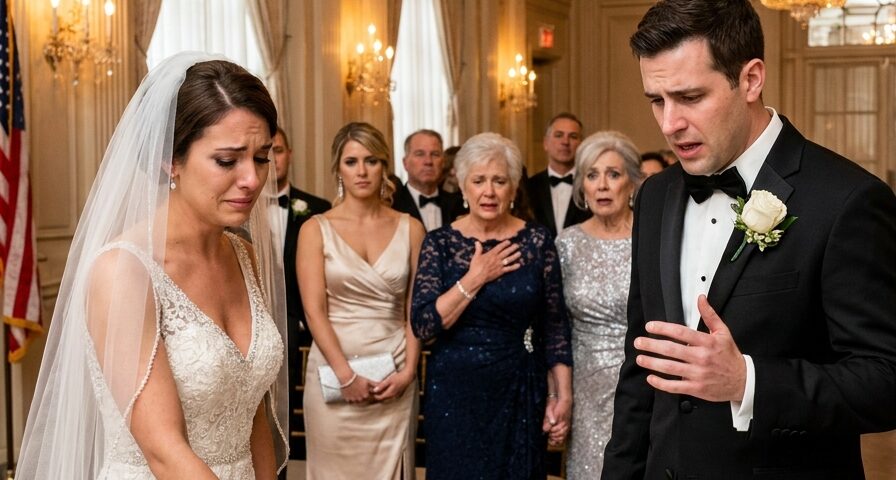
My husband struck me in front of our wedding guests because he thought one public humiliation would make me sign the papers. The ballroom went silent. His mother called it “emotion.” His father looked toward security. But while everyone stared at the mark on my face, my best friend was walking toward me with the clutch I had left behind… and inside it was the one thing his family never knew I had.
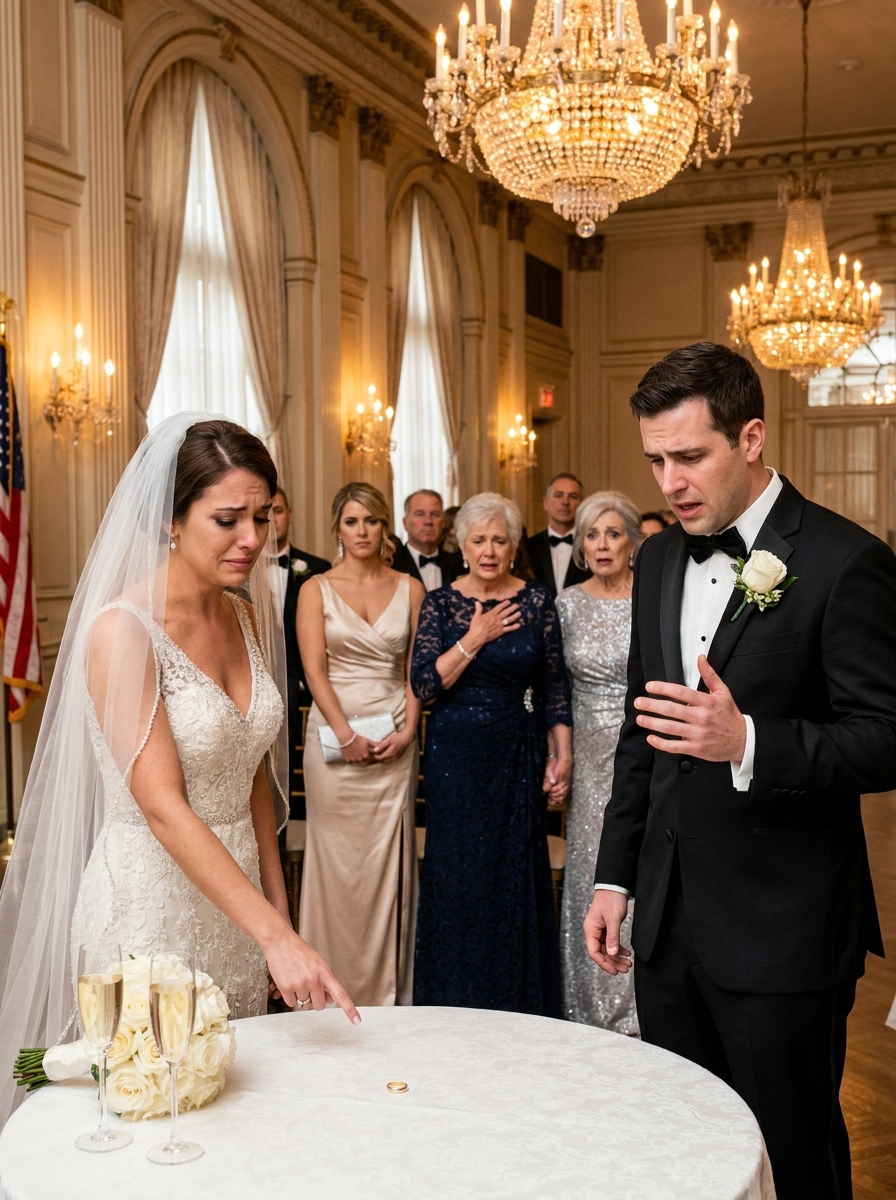
The ballroom at the Kestrel Grand Hotel looked like the kind of place where bad things were never supposed to happen.
That was the trick of it.
Crystal chandeliers poured warm gold light over ivory tablecloths and tall arrangements of white roses. Champagne flutes glittered beside folded linen napkins. Beyond the wall of arched windows, the Pacific moved restlessly against the cliffs, dark water striking stone with a sound too old and honest for a room full of people pretending everything important could be managed with money.
Elena Marsh stood just outside the ballroom doors in her wedding gown, bouquet trembling once in her hands.
Only once.
Then she tightened her grip until her knuckles went pale beneath the ribbon.
Her mother, Ruth, noticed anyway.
Ruth Marsh had spent most of her life noticing small things. A late rent notice tucked under a grocery receipt. A cough that meant her daughter was getting sick. A smile Elena used when she was trying not to worry anyone. Standing beside her now in a navy dress she had saved for special occasions, Ruth reached out and smoothed a piece of lace near Elena’s shoulder.
“You don’t have to hold your breath, sweetheart,” Ruth whispered.
Elena turned to her mother and smiled.
It was a practiced smile. A good one. The kind that had gotten her through job interviews where men glanced at her last name and her shoes before they glanced at her credentials. The kind that helped her walk onto construction sites where older supervisors looked at her hard hat and decided she was someone’s assistant. The kind that said nothing was wrong until she had enough facts to prove what was.
“I’m okay,” Elena said.
Ruth did not believe her.
But she nodded, because mothers sometimes know when pressing a question will only make their child stand straighter.
Across the lobby, Priya Okafor stood near the side entrance, phone in one hand, clutch in the other, eyes fixed on Elena with the alert stillness of someone prepared to move fast if the room turned dangerous. Priya had been Elena’s best friend since college, when Elena worked the closing shift at a pharmacy and showed up to morning lectures with wet hair, gas-station coffee, and structural mechanics notes written in the margins of utility bills.
Priya knew Elena’s quiet.
She knew the difference between peace and containment.
The wedding coordinator gave a small clap.
“Ready, everyone?”
The doors opened.
Three hundred guests turned.
The Kestrel Grand had hosted governors’ fundraisers, coastal charity galas, and weddings for families whose names appeared on hospital wings and university libraries. But that evening, every polished corner of the room seemed designed to celebrate the Rutherford family.
Julian Cade Rutherford stood beneath an arch of white flowers at the far end of the aisle.
He was handsome in the disciplined way wealthy families often trained their sons to be handsome. Dark hair. Clean jaw. Perfect tuxedo. A calm, expensive smile that made older women forgive him before he apologized and made men trust him before he earned it.
His father, Desmond Rutherford, sat in the front row with one ankle crossed over the other, watching the ceremony as though it were a board vote already expected to pass.
Beside him sat Celeste Rutherford, Julian’s mother, elegant in champagne silk, pearls glowing at her throat, mouth curved in a smile that had never once reached anyone by accident.
Celeste had welcomed Elena into the family with flowers, handwritten notes, and compliments that left bruises no one could photograph.
“You’re so grounded,” she had said at a country club luncheon two months earlier, touching Elena’s wrist as if Elena were an interesting object at a charity auction. “It must be refreshing for Julian to be with someone who understands ordinary life.”
Ordinary life meant Ruth’s two-bedroom apartment over a dental office in Long Beach. It meant working nights, scholarships, borrowed textbooks, and learning how to stretch a rotisserie chicken into three dinners. It meant Elena had no trust fund, no old family attorney, no grandfather’s name carved into a civic building.
It meant she was supposed to be grateful.
Elena walked down the aisle anyway.
She kept her shoulders back, chin lifted, bouquet steady now. Guests smiled at her with that soft look people wore at weddings, the expression that said they had already decided this was romantic. A photographer crouched beside the aisle. The string quartet played something tender enough to make lies sound like vows.
Julian’s hand closed around hers at the altar.
Warm. Firm.
Too firm.
His thumb pressed once into the delicate bones of her fingers.
“Smile,” he murmured without moving his lips.
Elena smiled.
The ceremony passed like a scene watched through glass. The officiant spoke of devotion, trust, partnership. Julian’s voice was smooth when he promised to honor her. Elena watched his face as he said the words and wondered, not for the first time, how many powerful men built entire lives on the ability to sound sincere in rooms full of witnesses.
When her turn came, she paused for half a breath.
Not enough for the guests to notice.
Enough for Julian to squeeze her hand again.
“I do,” she said.
Ruth cried into a folded tissue.
The guests applauded.
The quartet swelled.
Julian leaned in for the kiss, his mouth close enough to her cheek that only she could hear him.
“Don’t make tonight difficult.”
Then he kissed her in front of everyone.
The reception began with champagne and applause, with polite laughter floating above the tables and servers moving like shadows between important people. There were speeches about legacy, family, future. Desmond welcomed Elena with a toast that sounded generous until one listened closely.
“My son has always chosen with ambition,” Desmond said, lifting his glass. “Tonight, he has chosen a woman of intelligence, discipline, and remarkable resilience. Elena, we welcome you into a family that understands responsibility.”
The room applauded.
Elena looked at him over the rim of her glass.
Responsibility.
That was what men like Desmond called burden when they intended to place it on someone else.
Julian kept a hand at the small of her back throughout the reception. Not affectionate. Guiding. Steering. Turning her toward guests he wanted impressed. Pulling her gently away when conversations drifted toward her work.
A bank chairman congratulated her and said he had heard she was “quite sharp with buildings.”
“I’m a structural engineer,” Elena said.
“Of course,” he replied, smiling as if she had said something charming.
One of Julian’s cousins asked whether she planned to keep working now that she was married.
“Of course,” Elena said again.
Julian laughed before the woman could respond.
“Elena gets restless without a problem to solve,” he said. “We’ll see how long that lasts.”
The words were light enough to be dismissed.
The meaning was not.
Priya caught Elena’s eye from across the ballroom.
Elena gave the smallest shake of her head.
Not yet.
She had told herself that all day.
Not during the ceremony.
Not while Ruth was trying so hard to believe her daughter had finally married into safety instead of danger.
Not while the hotel shimmered with cameras, donors, executives, social friends, and women like Celeste who could turn hesitation into gossip before the cake was cut.
But the truth had been building around Elena for weeks, one small wrong detail at a time.
Julian’s calls that ended when she entered a room.
Silas Bram, Rutherford Development’s chief financial officer, going silent whenever she mentioned Brightwater Commons.
Technical files disappearing from the consultant portal after she flagged missing soil data.
Desmond’s sudden coldness after she asked whether the foundation assumptions had been independently reviewed.
And then, three nights before the wedding, Julian had mentioned papers.
Not the prenup. That had already been reviewed by lawyers, signed, and filed without drama.
“These are just internal authorizations,” he had said in Elena’s kitchen, opening her refrigerator like he already owned the apartment. “Estate adjustments. Corporate housekeeping. Silas prepared everything. We’ll sign after the first dance before we leave for the honeymoon.”
Elena had looked up from the sink.
“Why after the first dance?”
Julian smiled.
“Because before the wedding, you’d turn five minutes into three weeks.”
“Send them to my lawyer.”
“Elena.”
One word.
Flat. Warning.
She dried her hands slowly on a dish towel.
“What are they?”
“Formalities.”
“Then send them.”
His smile had changed then. Not vanished. Changed. It became the smile he used in public when someone said no and he needed to remind them that no was temporary.
“My family has gone out of its way for you,” he said.
There it was.
The leash dressed as gratitude.
My family accepted you.
My family elevated you.
My family made room at a table you could never have reached alone.
Elena had heard versions of that sentence since the first month they dated. At first, Julian wrapped it in affection. He admired her toughness. Her practicality. Her refusal to be spoiled. Then, slowly, admiration became expectation. He expected her to be grateful for restaurants she never asked to visit, weekends with people who treated her like a scholarship recipient at her own dinner table, introductions that came with invisible price tags.
But Elena had survived too much to mistake access for love.
So the night before the wedding, she did something a bride was not supposed to do.
She prepared for betrayal.
She copied every Brightwater Commons file she still had access to. She saved message logs, report versions, and project folders onto a clean flash drive. She used an isolated laptop with no automatic cloud connection, one she kept for sensitive audits. Then she sewed the flash drive into the lining of her bridal clutch with shaking hands and the kind of focus that made fear useful.
Priya knew.
Ruth did not.
Elena could not bear to put that weight on her mother before the ceremony.
Now, under the chandeliers, the MC announced the first dance.
The room softened.
Guests gathered near the floor with champagne and phones, smiling as Julian took Elena’s hand and led her beneath the golden light. The quartet began a slow song. Cameras lifted.
Julian smiled for them.
Up close, his eyes were cold.
“My father is waiting,” he murmured.
“For what?”
“You know what.”
“The papers.”
“Don’t start.”
“I need to read them.”
His hand tightened at her waist.
The pressure was small and private. The kind of pain designed not to show.
“You’re my wife now.”
The sentence landed between them without a raised voice.
That made it worse.
It was not anger. It was certainty.
Elena looked over his shoulder and saw Ruth standing near the front table, dabbing her eyes with a tissue. Her mother looked proud. Relieved. Almost young in the face for one fragile moment.
Elena’s throat tightened.
She had wanted this to be real for Ruth’s sake, if not entirely for her own.
She had wanted to believe the warning signs were stress, class tension, wedding nerves, corporate arrogance, anything except what they were.
But Julian’s words had stripped the room down to its bones.
You’re my wife now.
Not partner.
Not equal.
Possession.
The song ended. Applause rose. Julian kissed her knuckles for the crowd, then kept hold of her hand as he guided her toward a corridor lined with white lilies and framed photographs of past hotel galas.
Priya immediately moved to follow.
Celeste stepped in front of her with a flute of champagne and a smile sweet enough to rot teeth.
“Let them breathe,” Celeste said. “Brides can get so emotional.”
Priya did not take the champagne.
Elena saw that.
Then Julian pulled her into the private office.
The room smelled of polished wood, cold coffee, and expensive air conditioning. A navy folder sat on the desk beside a silver pen. Red tabs marked signature lines. Silas Bram stood near the window holding a tablet against his chest. Desmond Rutherford sat behind the desk as though the hotel had borrowed the office from him.
“Elena,” Desmond said. “We’ll keep this brief.”
“That depends on the papers.”
Julian shut the door.
The click sounded small.
It did not feel small.
Desmond gestured toward the folder.
“Routine corrections. Technical liability alignment for Brightwater Commons. You reviewed portions of the project as an independent consultant. We need the record to reflect your role clearly before outside financing closes.”
Elena opened the folder.
The first page was enough.
She did not gasp. She did not step back. She did not give them the satisfaction of seeing her body react before her mind finished reading.
The language was clean, professional, and poisonous.
Retroactive technical approval.
Independent structural validation.
Consultant acknowledgment of full review.
Certification of attached reports.
Her name appeared beside inspection dates she had never attended. Her credentials were attached to reports she had never approved. Her signature line waited beneath liability language that would make her responsible for decisions made long before she had seen a single file.
Brightwater Commons was not asking for her expertise.
It was asking for her fingerprints.
She turned the page.
Then another.
The second page was worse. It referenced soil reports she knew had been altered. The third page included foundation approvals tied to missing calculations. The attachments carried digital signatures from technicians she recognized—people who had not been in the state on the dates listed.
Silas watched her too closely.
Desmond tapped one finger against the desk.
Julian stood near the door, jaw tight, impatient with the version of Elena who could read faster than he expected.
“This is fraud,” Elena said.
The room changed.
Powerful rooms rarely change loudly. They tighten. They cool. They reveal who has been waiting for which role.
Silas looked down at his tablet.
Desmond’s eyes narrowed.
Julian let out a short laugh.
“Careful,” he said.
Elena aligned the pages with deliberate precision.
“I never approved these reports.”
“You reviewed the project,” Desmond said.
“I reviewed incomplete files as a courtesy.”
“You raised concerns.”
“I raised concerns that disappeared.”
Silas’s thumb twitched against the tablet.
Elena saw it.
A small thing.
Important.
“No honest engineer signs structural liability after the fact without original reports, full inspection access, complete calculations, and a verifiable document trail,” she said. “This folder is not a formality. It is a frame.”
Julian stepped closer.
“You’re overwhelmed.”
“No.”
“You’re tired.”
“No.”
“You’re embarrassing yourself.”
That almost made her smile.
Men like Julian often believed embarrassment was a weapon. They never understood how liberating it could be once a woman stopped fearing it.
Desmond rose slowly, palms flat on the desk.
“You entered this family today,” he said. “Learn quickly that trust matters here.”
Elena looked at him.
“Trust is not obedience.”
Julian’s hand curled once at his side.
Silas saw it too. His eyes moved to the door, then back to the desk, and in that nervous glance Elena noticed something half tucked beneath the last contract copy. A protocol receipt. A filing reference. A number stamped in blue ink.
Something Silas had brought for internal tracking and left where he should not have left it.
Elena let her clutch slide from her wrist onto the edge of the desk.
Then she leaned forward as if rereading the final page.
Her fingers moved once.
Quick. Smooth.
The receipt disappeared into her clutch.
Silas noticed half a second too late.
His face drained just enough for her to know the paper mattered.
“I’m leaving,” Elena said.
Julian’s laugh vanished.
“No, you’re not.”
He caught her arm before she reached the door.
Not hard enough to break skin.
Hard enough to say he believed he had the right.
Elena looked at his hand.
Then at his face.
“Let go.”
For one moment, he had a choice.
A narrow one, but real.
He could have opened his fingers. He could have stepped aside. He could have preserved the lie a little longer.
Instead, he yanked the door open and pulled her into the corridor.
Maybe he thought the nearness of the ballroom would make her behave. Maybe he thought public pressure would turn her back into a bride. Maybe he had spent his whole life confusing an audience with protection.
It was the worst mistake he made that night.
The corridor opened directly into the ballroom through a wide arch. Many guests had already turned toward it, drawn by the couple’s long absence. The music had thinned. Waiters hesitated with trays in hand. Conversations lost their easy rhythm.
Julian realized he had witnesses.
Pride spoke before caution.
“Apologize to my father,” he said, smiling through fury.
Elena pulled her arm free.
“I don’t owe an apology to someone who tried to use my name to cover a crime.”
The slap came so fast the room did not understand it at first.
A sharp sound.
A sudden turn of her face.
A champagne flute slipping from someone’s fingers and breaking against the floor.
Then silence moved across the ballroom like a stain.
Julian stood in front of her with his hand still raised.
For half a second, he looked stunned—not because he was sorry, but because he had done in public what men like him usually reserved for rooms with locked doors.
Ruth made a sound Elena had never heard from her mother before.
Priya stepped forward.
Elena lifted her head.
The side of her face burned. The skin had already begun to heat beneath the makeup. She could feel hundreds of eyes on her, waiting for what women were trained to do after humiliation. Cry. Plead. Explain. Smooth the room back into comfort.
Elena did none of those things.
Something inside her went completely still.
Not numb.
Clear.
The marriage was over.
Not after a separation.
Not after a family meeting.
Not after Julian issued a statement about stress and misunderstandings.
It ended in the space between his raised hand and her next breath.
She reached for the ring.
The room watched as she slid it from her finger. Slowly. Deliberately. The diamond caught the chandelier light one last time before she placed it on the nearest table beside an untouched champagne glass and a plate of sugared almonds no one would eat.
“This marriage ended the moment you raised your hand,” she said. “Everything else will be handled by lawyers, authorities, and evidence.”
Julian opened his mouth.
Celeste moved faster.
“Elena, darling,” she said, gliding forward with the controlled panic of a woman protecting a family name. “Don’t turn a private emotional moment into a tragedy.”
Several guests looked away.
Not because they agreed.
Because they recognized the machine at work.
Every family like the Rutherfords had one. A way of sanding sharp facts into polite discomfort. Violence became emotion. Fraud became paperwork. A threat became concern. A slap became a moment.
Elena turned to Celeste.
“Don’t call violence emotion. Don’t call fraud a formality. And don’t call me darling again.”
Priya reached her then, holding the clutch Elena had dropped near the office door.
She did not ask if Elena was all right. That would have been too small a question for what had just happened.
Instead, she pressed the clutch into Elena’s hand and whispered, “Car’s outside.”
Ruth pushed through the guests, face pale but fierce. She touched Elena’s shoulder, not trying to hide the mark on her daughter’s cheek. Covering it would have been joining the lie.
“Come home,” Ruth said.
Julian looked toward the security men.
They started to move.
Then a dozen phones lifted at once.
The Rutherfords had built their power in rooms where everyone owed them something. But the ballroom was full of spouses, assistants, distant cousins, vendors, hotel staff, women who had swallowed insults for decades, and men who suddenly understood they had witnessed something no amount of champagne could polish.
“Put the phones down,” Desmond said from the corridor.
No one did.
Elena walked through the parting crowd with Ruth on one side and Priya on the other. The train of her gown whispered across the marble floor. Someone’s chair scraped back. A woman from Celeste’s charity board pressed a hand to her pearls. A waiter stared straight ahead while seeing everything.
At the hotel entrance, the ocean wind hit Elena’s cheek and sharpened the sting.
She stopped on the marble steps.
The veil tugged at her hair.
For one strange, tender second, she thought of Ruth fastening it earlier that day. The antique combs. The baby’s breath. The way her mother had said, “Your father would have loved to see this,” though Elena’s father had been gone long enough that grief had softened around the edges.
Then Elena reached up and pulled the veil free.
It slipped from her fingers and landed on the steps behind her, too white against the damp stone.
She did not look back.
Priya’s car waited along the side drive, away from the line of black vehicles hired by the Rutherford family. Ruth climbed into the back seat with both hands shaking. Priya got behind the wheel. Elena sat in front, clutch pressed to her lap.
For a few seconds, no one spoke.
The hotel glowed behind them.
Inside, music had started again, thin and awkward through the glass.
Priya pulled away from the curb.
Only after the Kestrel Grand disappeared behind the cliff road did Ruth break.
“My baby,” she whispered.
Elena turned in her seat.
“I’m okay.”
Ruth looked at the red mark on her daughter’s face and shook her head.
“No,” she said. “But you will be.”
Elena opened the clutch.
The flash drive was still sewn into the lining. The protocol receipt she had taken from Silas’s folder was tucked beside it. She closed her hand around both like a woman holding a key taken from a locked room.
Priya glanced over.
“What was in those papers?”
“They wanted me to take the fall for Brightwater Commons,” Elena said. “My name on reports I never approved. My signature on liability I never accepted.”
Ruth closed her eyes.
“Oh, Elena.”
“No,” Elena said, surprising herself with the firmness in her voice. “Not oh Elena. Oh them.”
By morning, the video was everywhere.
Not the whole story, of course. The internet rarely begins with the whole story. The first clip was short, shaky, and brutal enough. Julian’s hand. Elena’s face turning. The ring on the table. The bride walking out through a silent ballroom while half the guests held their breath.
The headlines arrived before breakfast.
Rutherford Heir Accused of Striking Bride at Wedding Reception.
Bride Walks Out After Public Altercation at Luxury Hotel.
Luxury Wedding Scandal Rocks Prominent Development Family.
By nine o’clock, Elena’s phone had become a swarm.
Unknown numbers. Former classmates. Reporters. Women she had met once at charity luncheons sending careful messages that said thinking of you and so sorry for what happened, as if they were mailing condolences after a storm.
Julian called eleven times.
She did not answer.
Desmond called once.
She let it ring.
Celeste sent a text at 9:47 a.m.
We should speak privately before this becomes impossible to repair.
Elena stared at the message for a long time.
Then she blocked the number.
Priya had brought her to a townhouse in a quiet neighborhood two miles from the bay, the kind of street where retired neighbors knew exactly when a strange car slowed near the curb and the mail carrier waved at every porch by name. Ruth slept in the guest room after crying herself empty. Elena sat at the kitchen table in borrowed sweatpants, her wedding hair half undone, opening files on an isolated laptop she used for sensitive audits.
The machine had no automatic cloud connection. No personal email logged in. No shortcuts. Just a clean system, an external drive, and enough caution to make her old mentor proud.
Priya set a mug of coffee beside her.
“You need sleep.”
“I need inventory.”
“You need both.”
“I’ll sleep when I know exactly what they tried to put my name on.”
Priya did not argue after that.
She simply sat across from Elena with her own laptop and began saving every public post containing the wedding video before the Rutherfords’ lawyers could pressure platforms to remove it.
The Brightwater files opened one by one.
At first, the discrepancies were small.
Almost elegant.
Numbers adjusted by margins that would not alarm a casual reader. Soil language softened. Recommendations shortened. Risk categories relabeled. A cautionary phrase removed here. A testing date shifted there.
Then came the signatures.
Digital approvals from technicians Elena knew had been out of state on those dates. One from a senior reviewer who had retired six weeks before the timestamp. Another from a junior engineer whose name appeared in an early geotechnical report and vanished from every later version.
Elena leaned closer.
“Naomi Cortez,” she murmured.
Priya looked up.
“Who?”
“A junior geotechnical engineer. She wrote the original infiltration warning.”
“And then?”
“And then she disappeared.”
Priya’s face tightened.
“People don’t disappear from reports by accident.”
“No,” Elena said. “They get removed.”
Near noon, a lawyer named Marisol Vance called.
Elena had met her once at a professional ethics panel, where Marisol had spoken about corporate retaliation with the calm precision of a woman who had watched wealthy men underestimate subpoenas one too many times. She specialized in corporate disputes, fraud exposure, and cases where private harm crossed into public danger.
“I saw the clip,” Marisol said. “I’m sorry.”
“Thank you.”
“I’m going to ask direct questions.”
“Please.”
“Were there threats before the wedding?”
“Yes.”
“Physical?”
“No. Control. Pressure. Documents.”
“Do you have the documents?”
“Copies.”
“Do you have evidence they attempted to assign liability to you retroactively?”
“Yes.”
A pause.
“Do not send me anything by email yet,” Marisol said. “Do not speak to media. File a police report for the assault. Preserve the dress, photographs, video, text messages, voicemails, everything. Write a timeline while your memory is fresh. Stay with someone. Do not meet Julian alone under any circumstance.”
The list was cold.
Blessedly cold.
After a night of gold light, public silence, and emotional wreckage, cold was useful.
“I understand.”
“One more thing,” Marisol said. “If Brightwater Commons is what I think it is, this is bigger than your marriage.”
Elena looked at the folders glowing on her screen.
“I know.”
The police report was filed that afternoon.
The officer who took her statement was kind, which nearly undid her. He did not ask what she had done to upset Julian. He did not call it a disagreement. He photographed the mark on her cheek and asked if she felt safe.
Elena answered honestly.
“No.”
That evening, Marisol came to Priya’s townhouse with a scanner, a secure drive, and a retired forensic examiner named Harold Keene, who wore a cardigan over his dress shirt and handled evidence like it might explode if disrespected.
He logged the flash drive.
He photographed the protocol receipt.
He made verified copies while Elena watched.
“Chain of custody matters,” he said.
“I know.”
He glanced at her over his glasses.
“Most people say that. You sound like you mean it.”
“I build things for a living,” Elena said. “When something fails, everyone asks who touched it last.”
Harold nodded once.
“Then let’s make sure nobody can lie about what you touched.”
Two days later, a state prosecutor entered Elena’s life wearing a gray suit, tired eyes, and the restrained manner of a man who had learned not to promise more than evidence could carry.
Daniel Farrow met her in Marisol’s office, not in a courthouse, not in a police station, not anywhere that would make Elena feel like a suspect before she had even opened her mouth. Marisol sat beside her. Harold had already delivered a preliminary preservation report. Priya waited in reception with Ruth, who refused to stay home no matter how many people suggested it.
Daniel placed a thin folder on the conference table.
“I’m not here to pressure you,” he said.
“That would make you the first man this week.”
A small smile touched his face and disappeared.
“Fair.”
Elena folded her hands.
“You want my files.”
“I want to know whether your files can protect people.”
That was the first answer that made her look at him carefully.
Daniel explained that his office had received complaints about Brightwater Commons months earlier. Families living near the construction site had reported cracks, drainage problems, and rushed relocation offers. A city inspector had flagged concerns, then revised his language after a private meeting with Rutherford Development. Two complaints had stalled. One engineer had resigned. No one had been willing to provide enough documentation to support a deeper investigation.
“Rutherford Development has influence,” Daniel said.
“That’s a polite word.”
“It’s the word I can use in this room.”
Marisol leaned back.
“What are you asking from my client?”
“A formal evidence transfer under protection. Her cooperation on technical interpretation. Nothing raw without copies. Nothing without counsel present.”
Elena studied him.
“You understand they tried to put my name on reports I never approved.”
“Yes.”
“If I give you anything, they’ll say I stole it.”
“They may say that anyway.”
“They’ll say I’m unstable.”
“They’ve already started.”
Priya stepped into the doorway then without knocking, holding her phone.
“Elena,” she said quietly. “You need to see this.”
It was a statement from Rutherford Development.
The language was polished enough to have passed through at least three attorneys and one crisis firm.
A private family matter.
Deep concern for Elena’s wellbeing.
Stress surrounding the wedding.
Commitment to resolving misunderstandings.
Respect for all parties.
No mention of the slap.
No mention of the office.
No mention of Brightwater Commons.
Julian had posted his own statement beneath a black-and-white wedding photograph taken before the ceremony. In it, Elena looked serene and Julian looked devoted.
Some moments are complicated, he had written. I ask for privacy while my wife receives the support she needs.
My wife.
Elena felt the coffee in her stomach turn sour.
Marisol’s voice sharpened.
“Do not respond publicly.”
“I know.”
Daniel watched Elena’s face, not the phone.
“They’re setting a narrative.”
Elena handed the phone back to Priya.
“Then we set a record.”
That became the difference.
The Rutherfords had a narrative.
Elena built a record.
She wrote down everything. Dates. Times. Comments. The first mention of post-wedding authorizations. Julian’s wording in her kitchen. Celeste blocking Priya outside the corridor. Desmond’s language in the office. Silas near the window. The red tabs. The protocol receipt. The phrase technical liability alignment.
She documented the bruise as it faded from red to purple to yellow.
She saved the voicemails.
She let Marisol handle every incoming letter.
She did not go on television, despite three producers calling her brave and one calling her silence a missed opportunity.
Her restraint made some people impatient.
That was fine.
Elena had learned long ago that the loudest person in the room often feared the quietest file.
The first threat arrived six days after the wedding.
It came as a text from an unknown number, but it was not written like the clumsy rage filling her inbox. It referenced Ruth’s morning routine. The small market where she bought peaches. The corner she crossed after church on Sundays. The final line read:
Some people lose more than a marriage when they don’t know when to stop.
Elena’s hands went cold.
She had not been truly afraid when Julian hit her.
Shocked, yes. Hurt, yes. Humiliated in a distant, almost clinical way.
But this touched the part of her life no discipline could protect.
Her mother.
Ruth read the message in Marisol’s office and grew very still.
Then she surprised everyone by getting angry.
“No,” Ruth said.
Elena reached for her hand.
“Mom—”
“No.” Ruth’s voice cracked, but it did not weaken. “I scrubbed office buildings at night so you could study. I ate toast for dinner so you could buy textbooks. I taught you to keep your head up when people wanted you grateful for crumbs. I will not be the reason you bow to these people now.”
Elena closed her eyes.
For a moment she was eight years old again, sitting at a Formica kitchen table while Ruth balanced bills with a pencil and told her, “Numbers don’t lie, honey. People do.”
Daniel escalated the threat.
Marisol filed for protective measures.
Priya installed cameras by the front door and back patio of the townhouse. A retired neighbor across the street, Mr. Larkin, began sitting on his porch with binoculars and a travel mug from dawn until lunch. Ruth called him “our unofficial federal agency,” which made him proud enough to bring over banana bread.
In the middle of fear, the case found its second spine.
Naomi Cortez answered Elena’s message.
They met in a small classroom at a technical college two towns inland. Naomi now taught soil mechanics to students who looked too young to understand how dangerous numbers could become in the wrong hands. She was in her early thirties, with dark hair pulled into a low bun and a face that seemed older around the eyes.
The first thing Naomi saw was the fading mark along Elena’s jaw.
“Julian?” she asked.
“Yes.”
Naomi swallowed.
“Then you already know what they are.”
Elena placed two reports on the desk between them.
One original.
One altered.
“I need to know if this data was yours.”
Naomi did not touch the paper at first.
When she finally did, her fingers trembled.
“Yes,” she said. “That’s mine.”
She sat down hard.
The story came out slowly.
Naomi had flagged water infiltration and soil instability beneath two planned buildings at Brightwater Commons. Her report recommended deeper foundation work, reinforcement, and a revised timeline. The recommendation would have delayed financing and added costs large enough to anger investors.
Silas called her young.
Desmond called her overly cautious.
Julian called her into a glass-walled conference room and smiled while explaining that careers were built by understanding commercial reality.
“I told him commercial reality doesn’t change soil behavior,” Naomi said.
For the first time in days, Elena almost smiled.
“What happened after that?”
“My name came off the report. A revised version appeared. I refused to sign the summary. Two weeks later, my position was eliminated.”
“Did you keep anything?”
Naomi looked toward the classroom door.
“Enough to make me scared.”
That was how the truth began to widen.
Naomi had saved draft reports, internal messages, calendar entries, and photographs from site visits. Nothing dramatic by itself. But together, the documents showed a progression no honest company could explain away.
Warning.
Pressure.
Revision.
Removal.
Replacement.
Harold Keene logged everything.
Daniel’s office began moving with more purpose.
Marisol’s legal letters grew sharper.
Rutherford Development’s public tone grew softer, which meant they were worried.
Julian tried calling again from a blocked number.
Elena answered only because Marisol sat beside her and the recorder was running.
“Elena,” he said, using the low voice he once reserved for apologies that were never apologies. “This has gone far enough.”
She said nothing.
“I know you’re angry.”
Silence.
“I made a mistake at the wedding. I’ll own that privately. But if you keep pushing this Brightwater nonsense, you will hurt people who have nothing to do with us.”
Marisol lifted one finger, warning Elena not to engage too much.
Elena spoke carefully.
“What people?”
“My mother. Your mother. Employees. Families tied to the company. Do you want that on your conscience?”
“You mean the families living at Brightwater?”
A pause.
“Don’t play righteous with me.”
“Did you know Silas prepared false liability papers?”
His breathing changed.
“You were supposed to sign a form.”
“A false form.”
“You don’t understand the scale of what you’re interfering with.”
“There it is,” Elena said softly.
“What?”
“The truth.”
He hung up.
The recording went into evidence.
The next attack came dressed as concern.
A paid article appeared on a business commentary site nobody had heard of until that morning. It suggested Elena had accessed proprietary company materials beyond her authorization. It described her as emotionally volatile. It quoted anonymous sources who said Julian had been worried about her stability before the wedding.
The article did not name Brightwater Commons in detail.
That told Elena exactly where it had come from.
Julian was not trying to win the public.
He was trying to poison the room before any formal proceeding began.
Some colleagues grew quiet. One client postponed a project indefinitely. A former professor sent a one-line email asking if she was being careful. Elena deleted three responses before sending back:
Very.
Then she published a professional note under her own name.
No accusations.
No wedding details.
No dramatic language.
Just a clear explanation of engineering ethics, liability, document trails, and why no professional should certify reports they had not fully reviewed. She wrote about public safety. About the danger of retroactive approvals. About the moral weight of a signature in a field where people slept, worked, and raised children inside the structures those signatures made possible.
It did not go viral.
It did something better.
It reached engineers.
By the end of the day, her inbox held messages from people she respected. Quiet offers. Technical insight. Names of former Rutherford subcontractors. A retired city plan reviewer who remembered Brightwater. A forensic engineer who had mentored her years earlier and wrote:
I wondered when someone would finally pull that thread.
The thread became a rope.
A board meeting record arrived at Marisol’s office in an unmarked envelope.
No return address.
No note.
Just a partial transcript dated ten days before the wedding.
Harold logged it before anyone read it fully.
When they did, the room went silent.
The transcript referenced legal exposure at Brightwater Commons. It recommended redistribution of technical responsibility to an outside consultant connected through pending family integration. It noted that the consultant possessed sufficient credentials and limited institutional protection.
Elena read the line twice.
Limited institutional protection.
Small enough to be isolated.
Competent enough to be credible.
Julian’s name appeared beside the action item.
Manage consultant relationship.
Priya, who had insisted on being there, covered her mouth.
Ruth did not.
“My God,” Ruth said. “They planned you like a budget item.”
Elena stared at the page.
Not because she was surprised.
Because a final tender part of her had hoped Julian’s cruelty had been personal. That he had used the wedding because he was arrogant. That the papers were desperate, improvised, ugly.
But this was colder.
This was strategy.
He had not married her and then decided to use her.
He had chosen her because she could be used.
Daniel obtained a search warrant three days later.
The warrant covered technical files, financial communications, internal liability discussions, devices connected to Silas Bram and senior executives, and all communications referencing Elena Marsh.
It was scheduled for execution the following morning.
Julian called at 7:12 that night.
Marisol told Elena not to answer.
Daniel told her not to meet him.
Ruth told her she had no obligation to look evil in the face twice.
Priya said, “Absolutely not,” before anyone finished explaining.
Elena listened to all of them.
Then she said, “He thinks I still want something from him.”
Marisol’s eyes narrowed.
“Do you?”
“No.”
“Then why even consider it?”
“Because he may talk.”
Daniel leaned forward.
“He may also try to intimidate you, trap you, or claim you came to negotiate.”
“I won’t go alone.”
“No,” Marisol said. “You won’t.”
The meeting happened the next evening in the Rutherford Development tower, a glass building downtown with a lobby full of marble, steel, and plants nobody watered personally. Elena wore a navy suit, low heels, and no jewelry except her mother’s thin silver bracelet. Her cheek had healed enough that makeup could cover the last traces, but she chose not to wear any there.
Not as proof.
As memory.
Marisol entered the lobby with her under the pretense of a scheduled document review. Daniel’s team was already positioned nearby because of the warrant and the threat against Ruth. Elena carried nothing but her phone, a small notebook, and the calm face that had irritated powerful men for most of her adult life.
Julian received her on the top floor.
His office overlooked the city and the dark ribbon of the bay beyond it. On the wall hung framed photographs of completed developments, charity galas, and groundbreaking ceremonies where men in clean hard hats held ceremonial shovels over dirt someone else had prepared.
He looked thinner.
Not weaker.
Just less polished.
“Elena,” he said.
“Julian.”
He gestured toward a chair.
She remained standing.
His mouth tightened.
“You brought your lawyer.”
“She’s in the lobby.”
“I asked for a private conversation.”
“You lost the right to private conversations when you hit me in front of three hundred people.”
His face flushed.
“That clip doesn’t show what happened before.”
“No,” Elena said. “The documents do.”
For nearly fifteen minutes, he circled the room with words.
He spoke of reputation. Of families. Of misunderstandings. Of how Desmond had put too much pressure on everyone. Of how Silas may have overstepped. Of how Elena was smart enough to understand that companies required compromise.
She let him talk.
Men like Julian often mistook silence for ground gained.
Eventually, arrogance did what pressure had not.
It made him honest.
“You were never going to be hurt,” he said.
Elena looked at him.
“What was I going to be?”
He exhaled sharply, as if she were forcing him to explain something obvious.
“A buffer.”
“A scapegoat.”
“A consultant of record. There’s a difference.”
“Not when the record is false.”
He stepped closer, lowering his voice.
“You were the cleanest solution. You had credentials. You had no old alliances. No family attorneys. No board seat. You were close enough to make sense and outside enough to contain.”
There it was.
Not hidden anymore.
Not softened.
The truth stood between them in a room full of glass.
“And the families at Brightwater?” Elena asked.
He waved one hand, impatient.
“Families always show up in big projects. They complain. Adjustments get made. Nothing collapses overnight.”
The sentence chilled her more than any threat had.
Nothing collapses overnight.
As if slow danger were acceptable.
As if people living under cracked walls were merely a scheduling problem.
His phone buzzed.
He glanced down.
For the first time since she entered, real fear crossed his face.
Not guilt.
Fear.
Downstairs, the warrant had begun moving earlier than he expected. Investigators were already entering offices, securing servers, sealing file cabinets, and collecting devices. Through the glass wall of Julian’s office, Elena saw movement near the elevator. Silas Bram appeared with two investigators beside him, pale and sweating, a folder clutched against his chest like a shield that had arrived too late.
Julian turned back to Elena.
“What did you do?”
She picked up her notebook.
“No,” she said. “What did you do?”
Marisol stepped into the hallway then, phone in hand, face composed.
“Elena,” she said. “We’re done here.”
Julian moved as if to follow.
An investigator blocked him with one arm.
“Mr. Rutherford,” the man said, “we need you to remain on this floor.”
Elena walked past him.
He said her name once.
Not loudly.
Not lovingly.
Like a man watching an asset leave the balance sheet.
She did not turn around.
Cases did not unfold the way television promised.
There was no single courtroom gasp that solved everything. No dramatic confession under bright lights. No instant justice wrapped in music.
There were motions.
Hearings.
Forensic reports.
Delayed disclosures.
Bank calls.
Regulatory reviews.
Insurance letters.
Former employees remembering things slowly once they realized someone else had spoken first.
Silas Bram turned before the first major hearing.
Not out of conscience, Marisol said, but fear often did useful work when conscience failed.
His statement confirmed the retroactive liability plan. He named Desmond as the source of pressure, Julian as the one assigned to manage Elena, and himself as the architect of the paperwork that would have placed her signature between Rutherford Development and the consequences of Brightwater Commons.
Naomi Cortez testified with quiet force.
The altered geotechnical reports held under forensic review.
The phantom signatures unraveled.
The fabricated messages meant to paint Elena as an extortionist were traced to a contractor tied to Rutherford’s crisis firm.
The city inspector resigned before he could be removed.
Desmond Rutherford claimed he had been misled by subordinates.
No one believed him enough for it to matter.
Brightwater Commons was halted, then placed under independent structural review. Residents who had been brushed aside as difficult were finally interviewed properly. Temporary housing was arranged. Compensation funds were frozen out of Rutherford accounts after a judge heard enough to lose patience with polite delay.
Elena attended the first resident meeting in a church fellowship hall with folding chairs, fluorescent lights, and a coffee urn that sputtered every fifteen minutes.
It was the least glamorous room connected to the whole case.
It was also the most honest.
A grandmother named Mrs. Wilkes stood and said a crack had run above her grandson’s bed for six months while company representatives told her old buildings settled.
A young father brought photographs of water pooling near a foundation wall after ordinary rain.
A retired postal worker said he had stopped sleeping well because every new sound in the building made him wonder if the ceiling was shifting.
Elena listened to each of them.
Afterward, Mrs. Wilkes approached her near the cookie table.
“You’re the bride,” she said.
Elena almost corrected her.
Then she understood.
“Yes.”
Mrs. Wilkes studied her face.
“My granddaughter showed me that video. I’m sorry that happened to you.”
“Thank you.”
“And I’m glad he did it where people could see.”
Elena’s throat tightened.
It was a terrible thing to be glad for.
It was also true.
Julian’s fall was not cinematic.
That almost made it more satisfying.
He did not vanish in handcuffs from a ballroom. He did not give one grand speech. He did not become humble in a way that made people feel better about having trusted him.
He lost things slowly.
First the board confidence.
Then financing.
Then invitations.
Then the careful language in newspaper business sections that once called him a rising heir shifted into phrases like former executive and ongoing investigation.
Banks tightened.
Partners distanced.
Celeste’s charity friends stopped asking her to chair committees.
Desmond resigned for health reasons, though everyone understood reputation could be a kind of illness in families like his.
Julian tried once more to reach Elena through a mutual acquaintance.
The message was simple.
He wanted to apologize.
Marisol asked if Elena wanted to receive it.
Elena thought of the ballroom. The office. The phrase clean solution. The families at Brightwater. Her mother’s market routine in a threatening text. Naomi’s trembling fingers on the original report.
“No,” she said. “He wants an audience. Not forgiveness.”
A year after the wedding, Elena returned to the Kestrel Grand Hotel.
Not for a wedding.
For a signing.
The hotel had agreed to host the Brightwater reparations and structural remediation agreement because irony had a strange sense of direction, and because the new owners of the project wanted photographs somewhere symbolic. Elena almost refused to go. Ruth told her she did not have to prove anything. Priya offered to sit in the back row and glare at anyone who deserved it.
But Elena went.
She wore a cream suit and her mother’s silver bracelet. Her hair was pinned simply. No veil. No flowers. No ring.
The ballroom looked smaller than she remembered.
That surprised her.
The chandeliers still glittered. The windows still faced the ocean. The marble still shone beneath careful light. But the room no longer felt like a kingdom. It felt like a room.
A beautiful one.
Nothing more.
Residents sat where wedding guests had once whispered. Engineers stood near attorneys. City officials avoided certain eyes. Naomi Cortez sat in the second row with her hands folded, no longer trembling. Priya stood near the side entrance out of habit. Ruth sat in front wearing the same navy dress from the wedding, altered slightly at the sleeves.
When Elena walked to the podium, the room settled.
She had written a speech.
Then she folded it in half.
“I won’t keep you long,” she said.
A few people smiled.
She looked at the residents first.
“For a long time, people in power treated your concerns as inconvenience. They used soft words for hard truths. Delay. Adjustment. Review. They made safety sound negotiable and accountability sound complicated.”
Her voice remained steady.
“It was never complicated. Homes should be safe. Reports should be honest. Signatures should mean something. And when ordinary people say something is wrong, they should not need a scandal before anyone listens.”
Mrs. Wilkes nodded once.
Elena continued.
“I’m grateful to the engineers who kept records, the residents who kept speaking, the attorneys who protected the process, and the people who told the truth even when fear gave them every reason to stay quiet.”
She did not say Julian’s name.
Some ruins did not deserve a place at the ceremony.
After the signing, people gathered in small groups over coffee and pastry trays. No champagne. No string quartet. Just tired relief and the kind of conversations that happen when people have survived something expensive enough to nearly bury them.
Daniel Farrow found Elena on the terrace.
He had kept a careful distance through the case, professional to the point of severity, but there had been moments. Coffee in courthouse hallways. A shared look when Silas contradicted his own deposition. One quiet afternoon after a hearing when Daniel walked Ruth to her car in the rain and held the umbrella entirely over her head, arriving back soaked at one shoulder.
He stood beside Elena now, not too close.
The ocean struck the rocks below with the same restless force it had carried on the night she left in her wedding gown.
“I wondered if coming back here would hurt more,” Elena said.
“Does it?”
She looked through the windows at the ballroom, at the place where a ring had once hit a table and a silence had finally broken.
“It hurts less than lying to myself would have.”
Daniel did not answer quickly.
She liked that about him.
Julian had always filled silence because he wanted to own it. Daniel let silence breathe.
Ruth stepped onto the terrace a few minutes later, carrying two paper cups of coffee.
“I stole these before someone decides they’re decorative,” she said.
Elena laughed.
A real laugh.
Ruth handed one cup to her and looked out at the water.
“You know,” she said, “that hotel owes me a better memory.”
Elena leaned her shoulder gently against her mother’s.
“I think we made one.”
Priya joined them last, slipping through the terrace doors with her phone in one hand.
“No emergencies,” she announced. “No threatening texts. No crisis statements. No one’s mother calling anyone darling.”
“Miracle,” Daniel said.
Priya pointed at him.
“You’re learning.”
The four of them stood there together while the wind moved lightly across the terrace. Below, the water kept striking stone, patient and relentless.
Elena thought of the woman she had been before the mirror in the bridal suite. Bouquet trembling. Smile practiced. Doubt whispering beneath lace and pearls. That woman had wanted love to be enough evidence. She had wanted the good moments to outweigh the warning signs. She had wanted to believe being chosen meant being cherished.
She did not hate that woman.
She felt tenderness for her.
But she did not need to become her again.
Across the ballroom, Naomi laughed at something Mrs. Wilkes said. Ruth sipped coffee with both hands. Priya lowered her phone for once. Daniel leaned on the railing beside Elena, close enough to be present and far enough to ask nothing.
For the first time in a long time, no one was steering her.
No hand at her back.
No folder waiting.
No smile hiding a command.
Elena looked down at her bare left hand. The finger where the ring had been no longer looked empty to her.
It looked available.
For work. For truth. For whatever life she chose next.
The ocean wind touched her face, cool and clean.
This time, it did not sting.