Part 2
I did not sleep that night.
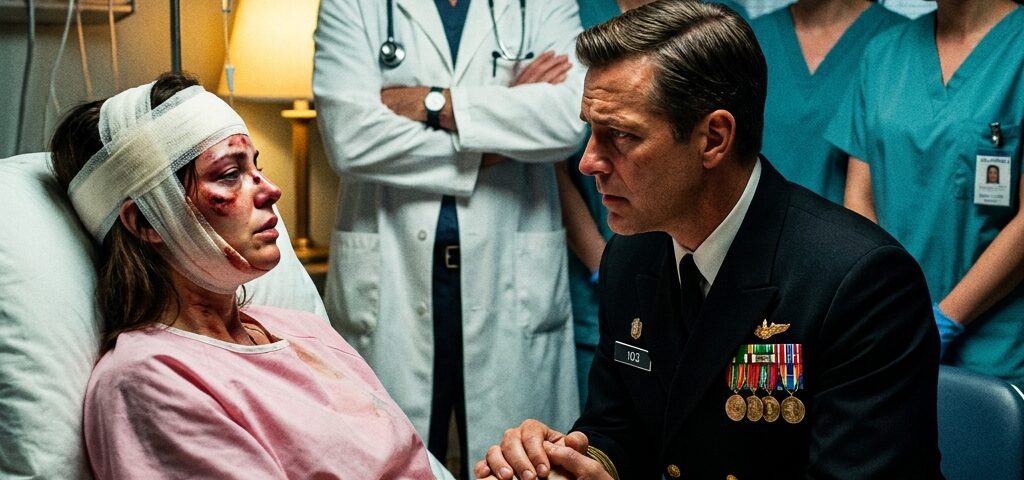
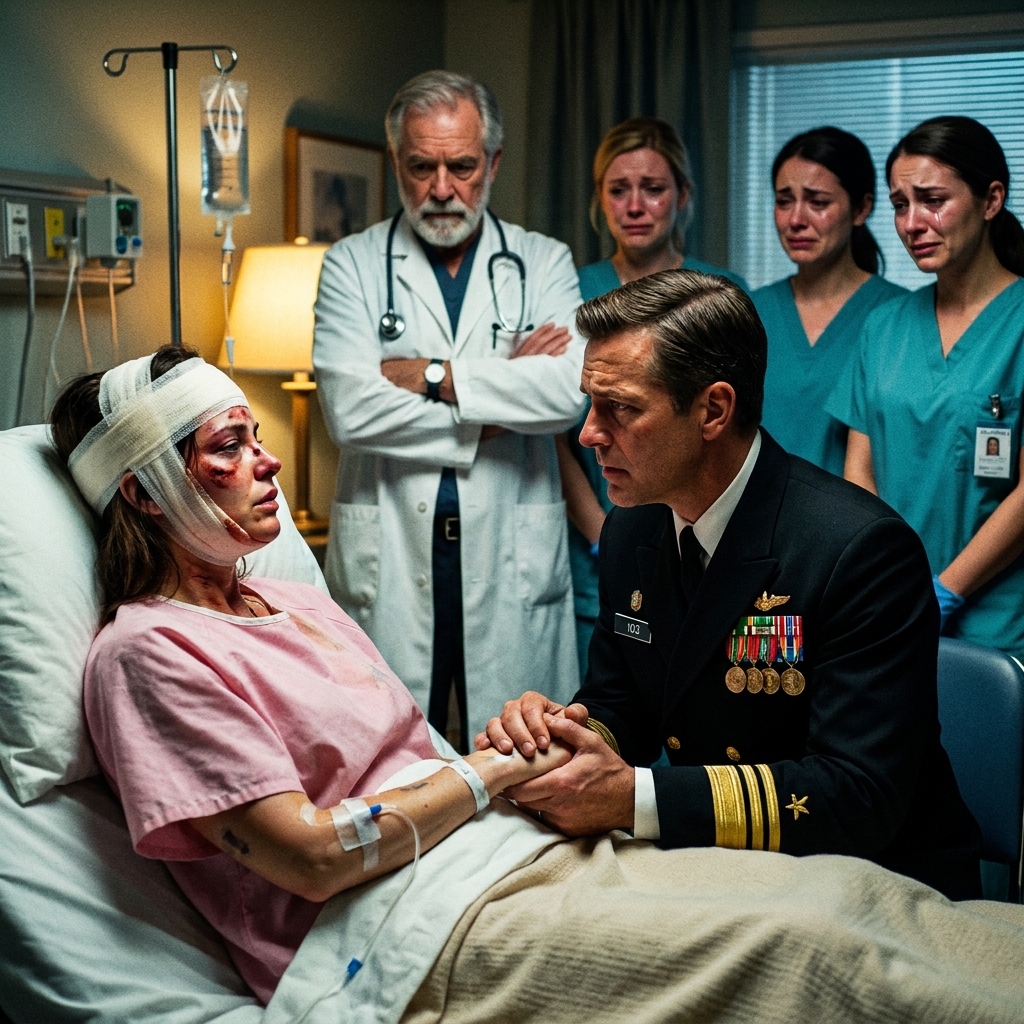
The chair beside Lily’s hospital bed became my whole world. Its plastic arms dug into my elbows. The fluorescent lights hummed above us. Machines whispered and beeped, measuring the fragile rhythm of my daughter’s life while rain kept tapping against the window like fingers asking to be let in.
Lily drifted in and out of consciousness.
Each time her eyes opened, I leaned forward.
“Sweetheart,” I whispered, “don’t try to talk. Just blink if you can hear me.”
Her good eye fluttered once.
I took her hand carefully, afraid even my touch might hurt her.
“You’re safe now.”
The second I said it, I knew it was a lie.
She was alive. She was in a hospital. But safe?
No.
Someone had found her in the dark, broken her jaw in six places, and left her unconscious near the science building like discarded trash. Someone had trusted the rain, the hour, and everyone’s silence to bury what happened.
And maybe they would have succeeded.
If Lily had been anyone else’s daughter.
At 3:12 a.m., a campus police officer finally arrived. His name was Officer Briggs, according to the badge clipped to his belt. He was young, clean-shaven, with tired eyes and a careful way of speaking that made every sentence sound rehearsed.
“Mr. Mercer,” he said, standing just inside the doorway, “I’m sorry about your daughter.”
I looked at him from the chair. “Are you?”
He blinked. “Excuse me?”
“What do you know?”
He glanced at Lily, then back at me. “We’re treating this as an assault. She was discovered at approximately 10:38 p.m. near the east walkway behind Hartwell Science Hall.”
“Who found her?”
“One of our night security guards.”
“Name?”
He hesitated.
That hesitation told me more than his answer would have.
“Officer,” I said quietly, “my daughter is lying there with her face wired together. Do not make me ask twice.”
He swallowed. “Gary Holt.”
“Where is he?”
“Off duty now.”
“Convenient.”
Briggs stiffened. “Sir, I understand you’re upset.”
“No,” I said, standing. “You don’t.”
He took half a step back.
It wasn’t fear exactly. It was instinct. I had seen it in men overseas when they realized the person across from them was no longer speaking from emotion, but from training.
“What cameras cover that walkway?” I asked.
“We’re reviewing footage.”
“That’s not what I asked.”
His jaw tightened. “There are cameras on the science building entrance, the maintenance lot, and the north pedestrian path.”
“And?”
“And there was heavy rain. Visibility was poor.”
I stared at him.
Rain did not erase footage.
Rain did not silence witnesses.
Rain did not fracture a girl’s jaw six times.
“Has anyone from the university contacted me?” I asked.
“They will.”
“When?”
“I can’t speak for administration.”
“Then speak for yourself. Who was with her tonight?”
“We’re still determining that.”
“Her phone?”
“Recovered.”
“Where?”
He looked down at his clipboard.
I stepped closer.
“Where?”
“In a drainage ditch near the walkway.”
Something cold moved through me.
Lily never went anywhere without her phone in her hand or in the front pocket of her hoodie. If it ended up in a ditch, someone threw it there.
“Is it damaged?”
“Yes.”
“By rain?”
He didn’t answer.
I nodded slowly. “You don’t have it, do you?”
Briggs looked up.
I almost smiled. Almost.
“Hospital staff said evidence bag on the chair contained only her hoodie. No purse. No phone. No backpack.”
His face changed, just enough.
There it was.
The first crack.
“Who took her phone, Officer?”
He lowered his voice. “Mr. Mercer, this is an active investigation.”
“No. This is my daughter.”
For several seconds, neither of us moved.
Then Lily’s fingers tightened weakly around mine.
I turned toward her.
Her eye was open.
She was looking at Briggs.
Not at me.
At him.
The officer noticed too.
“Lily?” I said gently. “Do you know this man?”
Her breathing changed. Faster. Shallow.
A monitor beside the bed began to chirp.
Briggs took a step backward. “I should let her rest.”
“Stay,” I said.
He stopped.
Lily’s fingers trembled in mine. Her swollen eye filled with panic.
I leaned close. “Blink once for yes. Twice for no.”
A tear slid toward the bandage at her jaw.
“Did Officer Briggs hurt you?”
She blinked twice.
No.
Briggs exhaled.
I didn’t.
“Did he see who did?”
The monitor chirped again.
Lily closed her eye.
“Sweetheart,” I whispered. “Did he see who did this?”
Slowly, painfully, Lily opened her eye.
Then she blinked once.
Yes.
The room went silent.
Officer Briggs looked as if the floor had shifted beneath him.
“That’s enough,” he said quickly. “She’s sedated. She doesn’t know what—”
I crossed the room before he finished.
I didn’t touch him. I didn’t need to. I stood close enough that he could see every year of war I carried behind my eyes.
“You have ten seconds to start talking.”
Briggs stared at me, his mouth slightly open.
Then, like every weak man caught between fear and duty, he chose the third option.
He ran.
He turned and bolted down the hallway.
I went after him.
The hospital corridor blurred past me. Nurses shouted. A doctor stepped into my path, but I moved around him. Briggs hit the stairwell door with both palms and disappeared inside.
By the time I reached the stairs, I heard his shoes pounding downward.
I followed.
Second floor.
First floor.
Basement.
The stairwell emptied into a service corridor lined with laundry bins and electrical panels. Briggs shoved through a rear exit into the ambulance bay.
Rain exploded across my face.
He was fast.
Younger.
Desperate.
But panic burns hot and short.
Training burns cold and long.
He slipped on the wet pavement near a loading ramp. His knee struck concrete. Before he could get up, I caught the back of his jacket and drove him against the wall.
“Who did it?” I growled.
“Let go of me!”
“Who?”
“I didn’t touch her!”
“But you saw.”
His eyes darted toward the ambulance bay cameras.
Smart. Or trying to be.
I lowered my voice. “You’re on camera now, Officer. So am I. Say something useful before you become the only man I have.”
His face crumpled.
“I can’t.”
“Wrong answer.”
“You don’t understand,” he said, breathing hard. “This is bigger than some drunk campus fight.”
My grip tightened.
His eyes filled with real fear then.
“They told us to stand down,” he whispered.
“Who?”
“Administration. Campus police chief. I don’t know how high it goes.”
“Why?”
“Because of who was there.”
Lightning flashed above the parking lot.
For half a second, the whole world turned white.
“Give me a name.”
Briggs shook his head. “If I do, I’m finished.”
I leaned closer. “If you don’t, you’re worse than finished.”
His lips parted.
Then a black SUV rolled slowly into the ambulance bay.
No siren.
No markings.
Just tinted windows and headlights cutting through the rain.
Briggs saw it and went pale.
“Please,” he whispered.
The rear passenger window lowered three inches.
A voice came from inside.
“Officer Briggs.”
Calm.
Male.
Older.
Commanding without needing volume.
Briggs froze.
The voice continued. “Walk away from Mr. Mercer.”
I turned toward the SUV.
The rain made it hard to see inside. But I could make out a silhouette in the back seat. Broad shoulders. Silver hair. A pale hand resting on a cane.
“Who are you?” I asked.
The man in the SUV ignored me.
“Officer Briggs,” he said again.
Briggs whispered, “I’m sorry.”
Then he twisted hard, broke free from my grip, and stumbled toward the vehicle.
The passenger door opened.
Not for him.
For another man stepping out.
Tall. Thick neck. Black coat. No badge.
Security, but not campus security.
He moved like former military.
So did the second man who emerged from the other side.
My body recognized the situation before my mind did.
Two men.
Covered angles.
One driver still inside.
Unknown man in back seat.
No visible weapons, which meant weapons were close.
I did not move toward them.
The man with the cane spoke from the shadowed interior.
“Mr. Mercer, I’m sorry for what happened to your daughter.”
“Then say it to my face.”
A pause.
Then the rear door opened.
He stepped out beneath a black umbrella held by one of the men.
He was in his late sixties, maybe early seventies, dressed in a charcoal overcoat that looked too expensive for a midnight hospital visit. His hair was perfectly combed. His face was smooth in the way rich men’s faces become smooth, not from kindness, but from a lifetime of other people absorbing consequences for them.
“I’m Charles Varrick,” he said.
I knew the name.
Everyone in Illinois politics knew the name.
Real estate, hospital boards, university donations, campaign money. There was a Varrick wing at Mercy General. A Varrick scholarship at Bradley. A Varrick name carved into half the respectable places where powerful people pretended their money was generosity.
“What does Charles Varrick want with my daughter?”
His expression barely changed.
“To prevent a tragedy from becoming something worse.”
I let out a hard, humorless breath. “Something worse than six fractures?”
He looked toward the hospital windows. “Your daughter was present at an unfortunate incident.”
“She was the incident.”
“No,” Varrick said. “She was a witness.”
The rain seemed to fade for a second.
“What did she witness?”
Varrick studied me.
Behind him, Briggs stood near the SUV like a man waiting for sentencing.
“My grandson attends Bradley,” Varrick said.
There it was.
The shape of it.
The rich boy.
The protected name.
The reason cameras failed and phones vanished.
“What’s his name?” I asked.
“Preston.”
I took a step forward.
Both guards shifted.
Varrick lifted one finger, and they stopped.
“Preston has struggled,” he said. “Pressure. Alcohol. Poor companions. These things happen with young people.”
I stared at him.
He kept speaking as if reading from a prepared statement.
“Tonight there was a gathering. A private gathering. Your daughter attended with friends. Something occurred there. She became emotional. She left. There was confusion afterward.”
“Confusion doesn’t break jaws.”
“No,” Varrick said softly. “But anger does.”
My heart slowed.
That was worse than racing.
“When I find him,” I said, “no amount of money you have will matter.”
Varrick sighed, almost sadly.
“I hoped you would be reasonable.”
“You came to the wrong father.”
“I came to a man with discipline. A man who understands command structure. Sacrifice. The importance of controlling damage.”
I laughed once. “You researched me.”
“Of course.”
His eyes finally met mine fully.
“We know about Mosul. Kandahar. The classified commendation from 2009. We know you are not an ordinary retired soldier, Mr. Mercer.”
The rain ran down my neck.
My past had been locked away in files, buried beneath acronyms and nondisclosure agreements. Men like Varrick were not supposed to know those things.
He stepped closer.
“And because you are not ordinary, I’m speaking plainly. Your daughter will receive the best medical care in the country. Every bill paid. A trust established. Her future protected. In return, this matter ends tonight.”
For several seconds, I said nothing.
Then I asked, “And what happens to Preston?”
“He leaves the university.”
“That’s it?”
“He gets treatment.”
I looked at Officer Briggs.
His head was down.
“You saw it,” I said to him. “Tell me.”
Varrick’s voice sharpened. “Officer Briggs has nothing to say.”
But Briggs was already breaking.
Maybe it was Lily’s face in his memory.
Maybe it was shame.
Maybe fear had simply eaten through his silence.
He looked up at me, rain shining on his skin.
“She tried to stop them,” he said.
Varrick’s jaw tightened.
Briggs kept going.
“There was another student. A boy. They were beating him behind the science building. Four of them. Preston and his friends. Your daughter came from the library. She started recording. She yelled that she was calling the police.”
My hands curled.
“Then?”
“Preston took her phone. She slapped him. He hit her.”
Briggs swallowed.
“He didn’t stop.”
The rain hammered the pavement.
“One punch?” I asked.
Briggs shook his head.
“Two?”
He looked away.
I understood.
Six breaks.
Extreme force.
More than fists, maybe.
“Why didn’t you stop him?”
Briggs squeezed his eyes shut. “By the time I got there, she was down.”
“Then why lie?”
He looked at Varrick.
“Because Chief Ralston told us the university would handle it internally.”
“Where is the other student?”
Briggs said nothing.
I turned slowly toward him.
“The boy they were beating. Where is he?”
Varrick answered first.
“There was no boy.”
Briggs whispered, “Yes, there was.”
The two guards moved at once.
I had expected them to.
The first came from my left, reaching inside his coat. I stepped in before he cleared whatever he was reaching for, caught his wrist, turned it outward, and drove my elbow into his throat. He dropped with a wet gasp.
The second guard was better.
He swung hard, disciplined, aiming for my ribs. I took part of it, felt pain flash through my side, then hooked his arm and slammed him face-first into the ambulance bay pillar.
The driver’s door opened.
I reached beneath the first guard’s coat and pulled out a compact pistol.
Then everyone stopped.
Even Varrick.
I kept the weapon pointed downward.
Not at them.
Not yet.
“Call your men off,” I said.
Varrick looked at the two guards on the ground. One coughed. The other groaned.
“You are making a mistake,” he said.
“No,” I replied. “I made my mistake when I believed institutions protected people.”
Sirens wailed in the distance.
Real police this time, maybe called by hospital staff.
Varrick heard them too.
His expression changed—not fear, but calculation.
He turned to Briggs. “You’ve ruined yourself.”
Briggs looked sick.
Varrick got back into the SUV.
Before the door closed, he looked at me one last time.
“You think this is about my grandson,” he said. “It isn’t.”
The door shut.
The SUV pulled away into the rain.
I stood there breathing hard, pistol still down at my side, while the sirens grew louder.
Officer Briggs sank onto the curb and put his face in his hands.
I looked at him and said, “Start from the beginning.”
He did.
Not all at once. Men like Briggs don’t confess cleanly. They circle the truth first, afraid it might bite.
He told me Preston Varrick and three others had hosted a closed party in an old faculty house near campus, a place used quietly by donors, trustees, and favored students. Alcohol. Drugs. Girls invited and pressured. Boys humiliated if they didn’t belong. The kind of rotten little kingdom that grows when money convinces children they are untouchable.
That night, a freshman named Ethan Cole had been dragged outside after accusing Preston of assaulting someone at the party.
“Assaulting who?” I asked.
Briggs shook his head. “I don’t know.”
“Don’t lie to me.”
“I’m not. I swear. By the time security was called, the girl was gone.”
“And Lily?”
“She wasn’t at the party. She was cutting across campus from the library. She saw them attacking Ethan. She recorded it. Preston saw her.”
He stopped there.
He didn’t have to say the rest.
My daughter, brave and stubborn and incapable of walking away from someone in trouble, had stepped into the path of a monster wearing a rich boy’s face.
“Where is Ethan Cole now?” I asked.
Briggs wiped rain from his mouth.
“That’s the part I don’t understand.”
“What part?”
“When I arrived, Ethan was still alive. Badly hurt, but alive. I called it in. Chief Ralston arrived before the ambulance. He ordered me to help move Lily closer to the walkway.”
My blood chilled.
“Move her?”
“To make it look like she was found alone.”
“And Ethan?”
Briggs stared at the ground.
“They put him in a campus maintenance vehicle.”
I heard the sirens reach the hospital entrance.
“Where did they take him?”
“I don’t know.”
I crouched in front of him.
“Think carefully.”
His eyes met mine.
“Old water treatment plant,” he whispered. “North edge of campus. It’s abandoned. Chief Ralston uses it for storage.”
The first police car turned into the ambulance bay.
Then another.
Uniformed officers jumped out, hands near their holsters, eyes moving from the unconscious guards to the pistol in my hand.
I set it carefully on the ground and lifted my hands.
“My daughter is upstairs,” I said. “She was assaulted. This officer has information about a missing student.”
Nobody moved.
Then a detective stepped from the second car.
Older woman. Gray streaks through dark hair. Sharp eyes. Badge on a chain.
“Daniel Mercer?” she asked.
“Yes.”
“I’m Detective Mara Ellison, Peoria Police.”
Something in her tone told me she already knew more than she should.
She looked at Briggs.
“Officer, are you prepared to make a statement?”
Briggs gave a weak nod.
Detective Ellison looked back at me.
“You need to come inside.”
“No,” I said. “You need to send units to the old water treatment plant north of campus.”
Her face tightened.
“Who told you that?”
“Briggs.”
She turned toward him.
He nodded again.
For the first time, I saw real urgency break through her professional mask.
She grabbed her radio.
Within minutes, the ambulance bay became chaos.
Officers secured the scene. The two private guards were handcuffed and loaded into separate vehicles. Briggs was taken inside, not arrested yet, but watched closely. Detective Ellison pulled me aside near the rear entrance.
“Mr. Mercer,” she said, “listen to me carefully. Do not go to that plant.”
I almost laughed.
She saw it and stepped closer.
“I mean it. Your daughter needs you here.”
“My daughter needs the truth.”
“And you running into an active crime scene will bury it.”
“Do you know Charles Varrick?” I asked.
Her eyes hardened.
“Everyone knows Charles Varrick.”
“That’s not an answer.”
“No,” she said. “It’s a warning.”
Before I could respond, her radio crackled.
A voice came through, distorted by static.
“Unit Twelve to Ellison. We’re at the north access road. Gate is open. Fresh tire tracks.”
Ellison raised the radio.
“Proceed with caution.”
Static.
Then another voice.
“Building door is unsecured.”
A pause.
Rain hissed around us.
The whole ambulance bay seemed to listen.
Then the radio exploded.
“Body! We have a body!”
My chest tightened.
Ellison closed her eyes briefly.
“Status?”
Static.
“Male. Young. Severe trauma. No pulse.”
I looked away.
Ethan Cole.
A freshman.
Someone’s son.
Left in the dark because he had become inconvenient.
Then the officer on the radio spoke again, voice suddenly strained.
“Detective, there’s something else.”
Ellison lifted the radio slowly.
“Go ahead.”
“There’s a second room.”
“What’s in it?”
A long pause followed.
Too long.
When the officer answered, his voice had changed completely.
“Cameras. Monitors. Hard drives. Looks like surveillance equipment.”
Ellison looked at me.
I looked back.
Then the radio crackled one more time.
“And Detective?”
“Yes?”
“You need to see this yourself. One of the screens is still recording.”
I didn’t wait for permission.
I turned and ran back into the hospital.
Not toward the exits.
Toward Lily.
Because suddenly I understood what Varrick had meant.
This wasn’t about his grandson.
Preston was cruel. Violent. Protected.
But he was not the center of the machine.
He was only one of its spoiled little products.
I reached Lily’s room and found a nurse adjusting her IV. Lily’s eye opened when I came in. She looked exhausted, terrified, and trapped inside her own broken body.
I sat beside her and took her hand.
“They found Ethan,” I whispered.
Her fingers tightened.
I could not bring myself to say he was dead.
But she knew.
A sound escaped her throat, small and broken.
“Don’t try,” I said. “Don’t move.”
She stared at me with that one open eye.
Then, slowly, she lifted her other hand.
The nurse started forward. “She shouldn’t—”
“Wait,” I said.
Lily’s fingers trembled as she pointed toward the evidence bag on the chair.
Her blue hoodie.
I grabbed it carefully.
“What is it?”
She pointed again.
Not at the hoodie.
At the front pocket.
I looked inside.
Empty.
Then she shook her head as much as the bandages allowed and pointed lower.
The seam.
I turned the hoodie over.
Near the bottom hem, the stitching had been torn slightly. A small lump pressed beneath the fabric.
My breath stopped.
Lily had always been clever with clothes. She used to hide emergency cash in jacket seams because she didn’t trust campus lockers. I had teased her for it.
My hands shook as I tore open the seam.
Something small and black dropped into my palm.
A microSD card.
Lily closed her eye.
A tear slipped down her cheek.
I stared at the card.
Her phone had been destroyed.
But not before she saved something.
The nurse whispered, “What is that?”
I didn’t answer.
I slipped the card into my pocket just as Detective Ellison entered the room.
She saw my hand move.
She saw my face.
And she knew.
“What did she give you?” she asked.
I looked at Lily.
Then at the detective.
Before I could speak, every light in the hospital flickered.
Once.
Twice.
Then the room plunged into darkness.
The machines screamed.
Somewhere down the hallway, someone shouted.
Emergency lights blinked red above the door.
My hand went instinctively to Lily’s bedrail.
Detective Ellison drew her weapon.
Footsteps echoed from the hallway.
Not nurses.
Not doctors.
Heavy.
Measured.
Coming closer.
Ellison moved beside the door and whispered, “Mr. Mercer, stay behind me.”
But the first figure who appeared in the red glow was not Varrick’s guard.
It was a woman.
Young.
Soaked from rain.
Barefoot.
Her dress torn at the shoulder.
Her eyes wild with terror.
She looked straight at Lily and whispered, “You filmed it, didn’t you?”
Then she turned to me.
“I’m the girl from the party,” she said. “And Daniel Mercer…”
Her voice broke.
“…your daughter wasn’t the only one they tried to kill tonight.”
Behind her, in the red-lit hallway, a shadow moved.
Someone raised a gun.