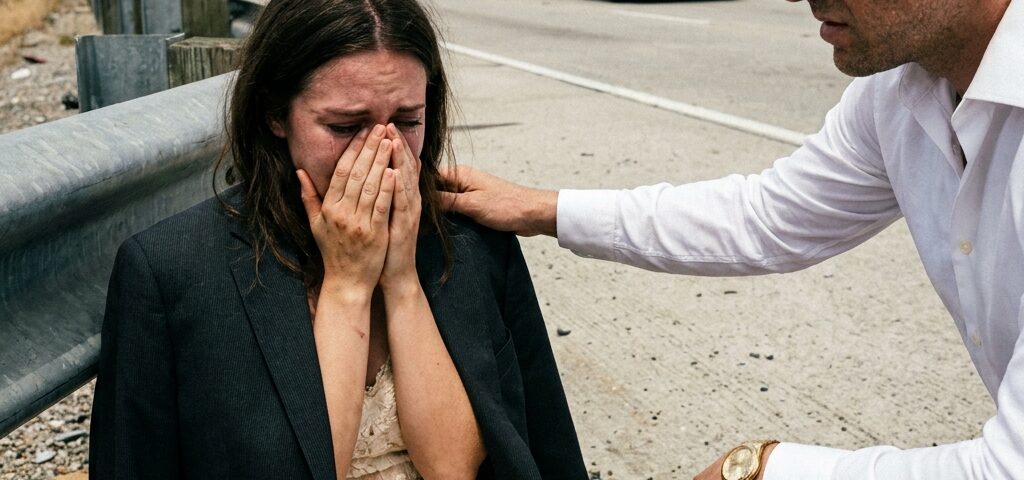
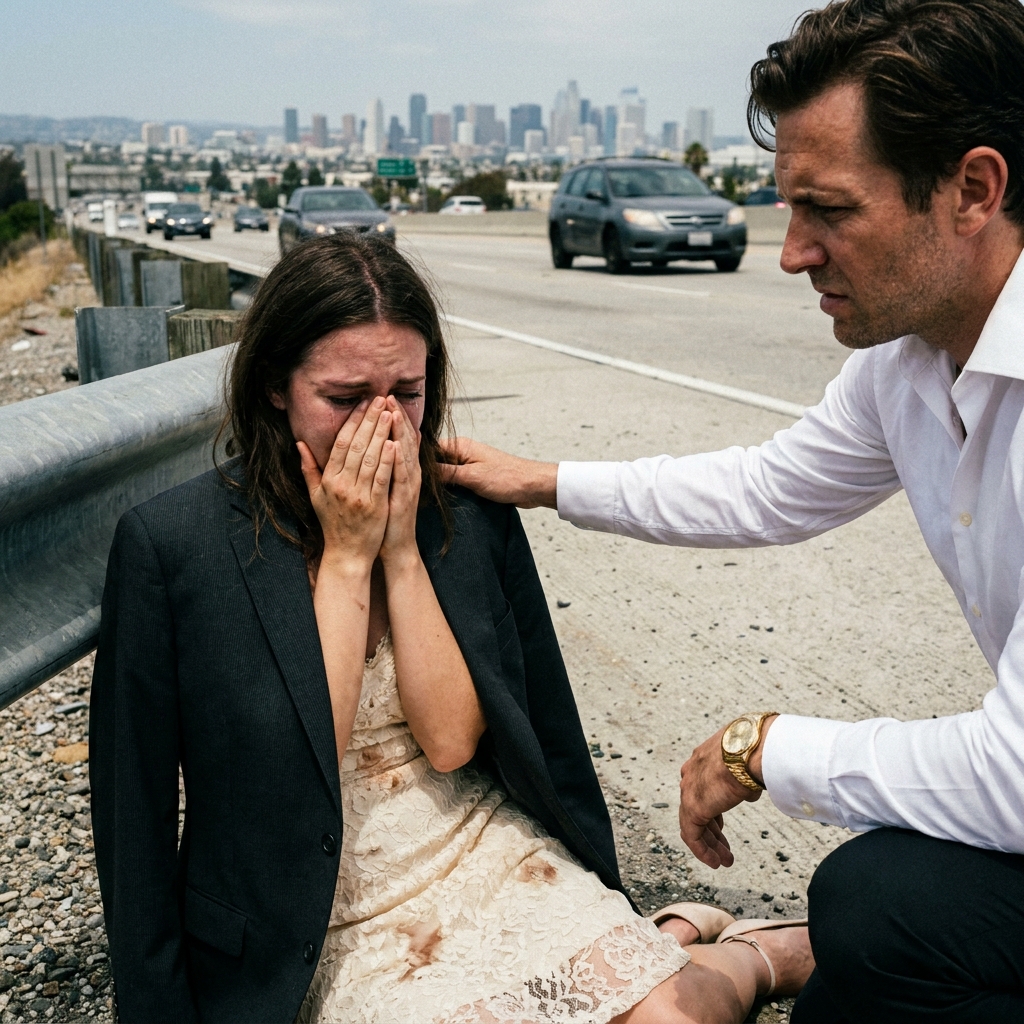
“Then we’ll make sure he never gets another chance to use your son against you.”
Ryan Carter said it quietly, without anger in his voice.
That was what unsettled me most.
Ethan’s anger had always been loud. Doors closed too hard. Cabinets slammed. Words sharpened until they could cut through a room. Even when he smiled, there was a pressure behind it, a warning that the smallest disagreement could turn the entire day cold.
Ryan’s calm was different.
It did not ask me to shrink.
It simply made space for the next decision.
I pressed the phone harder against my ear, even though the receptionist at Caleb’s school had already told me the words I needed most.
Caleb was safe.
He was in class.
He had never collapsed.
My son was not lying on a gym floor gasping for breath. He was not surrounded by teachers and flashing ambulance lights. He was not alone, afraid, calling for me while I raced down the highway in Ethan’s car.
The lie should have relieved me.
Instead, it hollowed me out.
Because if Ethan had lied about Caleb once, he would do it again.
“Ms. Brooks?” the receptionist asked gently. “Are you all right?”
I looked down at my torn sleeve. Blood had dried along my forearm in dark streaks. Small stones were embedded in my palm. My shoulder throbbed so deeply the pain seemed to have a pulse.
“No,” I said, because I was too tired to pretend. “But Caleb is safe?”
“Yes. Would you like me to have him brought to the office?”
My first instinct was yes.
I wanted to hear his voice. I wanted proof. I wanted to tell him I loved him and make sure nothing in his world had shifted, even as mine had cracked open on the side of an interstate.
But then I pictured Ethan walking into that school with his easy smile and his father’s rights folded neatly in his pocket. I pictured him telling someone there had been a misunderstanding, that Serena was emotional, that Serena exaggerated things, that Serena always made everything dramatic.
He had been good at that.
Making me seem smaller than my own truth.
“Please don’t let anyone pick him up except me,” I said. “Not his father. Not anyone claiming to be sent by either of us. No one.”
There was a pause.
“Ms. Brooks, is there a custody concern?”
I closed my eyes.
Ryan, sitting across from me in the back seat, gave one subtle nod toward the phone, as if to say: Say only what is necessary.
“Yes,” I said carefully. “There is an urgent safety concern. I’m on my way. Until I arrive, Caleb stays with school staff. Please document this call.”
The receptionist’s voice changed. It became steadier, more professional.
“I understand. I’ll notify the principal immediately.”
“Thank you.”
When I ended the call, the phone slipped from my fingers onto my lap.
For a moment, I simply stared at it.
The black sedan moved smoothly along the emergency lane before merging into traffic. Inside, the car smelled faintly of leather, rain, and expensive coffee. There was bottled water in the door pocket. A folded blanket across the center console. A first-aid kit already open beside Ryan’s security man in the front passenger seat.
Everything about the car was controlled.
Everything about me was not.
I looked out the tinted window as the highway blurred by. A few minutes ago, I had been on the ground beside those cars, wondering whether anyone would stop. Now I was sitting across from one of the richest men in the country while my blood stained the seat beneath me.
“I can pay for cleaning,” I said.
Ryan looked at me.
“What?”
“The seat.” My voice sounded strange even to me. “I’m bleeding on it.”
For the first time, something in his expression shifted. Not pity. I would have hated pity. It was something softer and sadder.
“Serena,” he said, “the seat is not injured.”
I laughed once.
It broke in the middle and turned into something dangerously close to a sob.
I swallowed it down.
Ryan did not reach for me. He did not tell me I was safe, because both of us were too intelligent to believe that yet.
Instead, he opened a bottle of water and set it in the cupholder between us.
“When you’re ready,” he said.
I picked it up with my left hand. My right trembled too much. The first sip hurt my throat.
“Where are we going?” I asked.
“To your son’s school first, unless you want medical care before that.”
“No. School.”
“I assumed.”
“You don’t know me well enough to assume anything.”
“That’s true.” He glanced toward the window. “But I know enough about parents.”
There was something in his voice then. A door closing quickly over a room I was not allowed to see.
“You have children?” I asked.
“No.”
The answer came too fast.
I noticed.
He noticed that I noticed.
But neither of us pushed.
A man like Ryan Carter probably had secrets stacked higher than the skyline. I had no room to judge. I had one of my own.
One Ethan had never discovered.
One that sat beneath my fear like a locked box.
The car exited the highway and moved through city streets toward Caleb’s private elementary school. Each traffic light felt like a personal insult. Every delay made my pulse climb.
Ryan’s security team spoke quietly through earpieces, using phrases I barely understood.
“Vehicle two is behind us.”
“School perimeter in seven.”
“No visual on gray sedan.”
Gray sedan.
Ethan.
His face flashed in my mind with impossible clarity.
The tight set of his jaw as he drove.
The way he kept glancing at me, not like a husband who once promised forever, not even like a bitter ex.
Like a man making sure an object was positioned correctly before discarding it.
He had waited until I unbuckled my seat belt.
I had done it because I thought we were pulling over near the school. Because he had said, “I think the hospital called again,” and my hands had gone clumsy with fear. Because he knew exactly how to make a mother forget herself.
My stomach turned.
Ryan noticed.
“There’s a medical kit in the front,” he said. “May I have my team clean your hand while we drive?”
“No.”
“All right.”
The immediate acceptance steadied me more than persuasion would have.
I looked at him again.
“Why did you stop?”
His eyes held mine.
“Because I saw what happened.”
“Most people would have kept driving.”
“I’m not most people.”
“That must be convenient.”
A faint trace of amusement touched his mouth. “Occasionally.”
I studied him. He was younger than I expected in person. The articles made him seem untouchable—sharp suit, sharper mind, billionaire before thirty-five, Wall Street’s golden wolf, the man who could predict market tremors before anyone else felt the ground move.
But in the back seat of the sedan, he looked tired.
Not physically. Something deeper.
“You could have called police and left,” I said.
“I could have.”
“But you didn’t.”
“No.”
“Why?”
This time, he looked away first.
“Because once, someone I cared about needed a witness. No one wanted to be one.”
The words sat between us.
I understood more than I wanted to.
“Did they survive?” I asked.
Ryan’s jaw tightened almost imperceptibly.
“Yes.”
But the way he said it made survival sound incomplete.
Before I could ask more, the car turned onto the street where Caleb’s school stood behind iron gates and old oak trees. My chest tightened so suddenly I almost could not breathe.
The building looked ordinary.
That was what nearly undid me.
Children’s drawings were taped inside classroom windows. A crossing guard stood near the curb. A yellow school bus idled half a block away. Somewhere behind those brick walls, my son was sharpening pencils, swinging his feet beneath a desk, maybe wondering what we were having for dinner.
He did not know that his father had used his name like bait.
The car stopped near the entrance.
Ryan’s security man opened my door, then stepped back without offering his hand.
I tried to stand.
Pain flared so violently that the world tilted.
Ryan moved, but stopped himself before touching me.
“Serena.”
“I’m fine.”
“You’re not.”
“I’m walking into that school.”
“Yes,” he said. “You are.”
Something about that almost broke me again.
Not because he challenged me.
Because he believed me.
I climbed out of the car using the doorframe for support. My knees shook. My coat was torn, my hair tangled, blood visible along my sleeve and cheek. I looked like exactly what I was—a woman who had been thrown away and stood up anyway.
The security team formed a loose distance around us, not crowding me, not turning the school entrance into a scene.
Ryan walked beside me.
Not ahead.
Not behind.
Beside.
At the front office, the receptionist’s face went pale the instant she saw me.
“Ms. Brooks?”
“I need Caleb,” I said.
The principal appeared from a side office, a composed woman named Mrs. Hargrove who had always worn pearl earrings and cardigans in soft colors. Today, her eyes moved quickly over my injuries, then to Ryan, then back to me.
“Caleb is safe,” she said immediately. “He’s in the counselor’s office with Mrs. Lane. He thinks he’s there to help sort classroom books.”
That small kindness nearly took my legs out from under me.
“Thank you,” I whispered.
Mrs. Hargrove lowered her voice. “We received your call. No one is permitted to sign him out except you until we have further instructions. His father has not contacted the school today.”
Yet.
The word stood unspoken in all our minds.
Ryan stepped forward slightly. “Mrs. Hargrove, I’m Ryan Carter. Ms. Brooks has just experienced a serious incident on the highway. She needs medical care and legal protection, but she also needs her son released into her care safely. My legal team can coordinate with school counsel if necessary.”
Mrs. Hargrove’s eyebrows lifted at his name, but to her credit, she did not become flustered.
“Mr. Carter, our priority is Caleb.”
“Good,” he said. “Then we agree.”
I almost smiled.
Almost.
A moment later, the counselor’s office door opened.
Caleb came out holding a picture book under one arm.
He was seven years old, with dark hair that never stayed combed and serious brown eyes that made him look older when he was thinking. He had one shoelace untied. There was a sticker on his sweater from some classroom activity.
The sight of him alive and whole hit me harder than the pavement had.
“Mom?”
His face changed when he saw me.
The book fell from his hand.
“Mom!”
He ran toward me, then stopped abruptly a few feet away, his eyes wide with fear.
“You’re hurt.”
“I’m okay,” I said quickly.
It was the oldest lie a mother knows.
Caleb did not believe it.
He came closer carefully, his small hands hovering as if he wanted to hug me but was afraid I would break.
I lowered myself to my knees despite the pain. That pain did not matter. Not compared to the look on his face.
“I’m okay enough to hold you,” I said.
He wrapped his arms around my neck, gentle at first, then tighter.
I closed my eyes and breathed him in—pencil shavings, laundry soap, school cafeteria, the warm sweet smell that had been his since he was a baby.
“I thought you were at work,” he whispered.
“I came as soon as I could.”
“Did Dad do something?”
My eyes opened.
Over Caleb’s shoulder, I saw Mrs. Hargrove look down. Ryan’s face remained calm, but his eyes sharpened.
Children see more than adults want them to.
I pulled back enough to look at my son.
“Something happened today,” I said carefully. “I’m safe right now. You’re safe right now. And I’m going to make sure it stays that way.”
Caleb searched my face.
“Do we have to go home?”
The question was too quiet.
My heart changed shape around it.
“No,” I said. “Not today.”
His shoulders loosened just a little.
I noticed.
So did Ryan.
Mrs. Hargrove offered a private room where I could sit while arrangements were made. Ryan’s security team checked the parking area discreetly. His legal team was called. My injuries were cleaned by a school nurse who tried not to look horrified as she removed gravel from my palm.
Caleb sat beside me the entire time.
He did not cry.
That worried me.
He watched everything with stillness that did not belong on a child. He watched the nurse. Watched Ryan. Watched the door.
Ethan had given him that.
The habit of listening for changes in the air.
“Does it hurt?” Caleb asked as the nurse wrapped my forearm.
“A little.”
“A lot?”
I hesitated.
He narrowed his eyes. “Mom.”
I sighed. “A lot. But it’s being handled.”
Caleb nodded solemnly.
Then he looked at Ryan.
“Are you a doctor?”
“No,” Ryan said.
“Are you police?”
“No.”
“Then why are you here?”
The school nurse froze.
I nearly told Caleb to be polite, but Ryan answered as if the question deserved respect.
“I saw your mother get hurt,” he said. “I stopped to help.”
Caleb considered that.
“My dad hurt her?”
The room went silent.
I reached for his hand.
“Caleb—”
“He did,” my son said, not loudly, not dramatically. Just with terrible certainty.
I felt cold from the inside out.
“How do you know that?”
Caleb looked at his shoes.
“Because he said you were going to make everything hard unless you disappeared.”
The nurse’s hand stopped moving.
Ryan’s expression did not change, but the atmosphere around him did.
I turned Caleb gently toward me.
“When did he say that?”
“Last week. On the phone.” Caleb’s voice shrank. “I wasn’t trying to listen. I was getting water.”
“What else did he say?”
“He said…” Caleb swallowed. “He said nobody would believe you because you looked normal. And because he had papers.”
Papers.
My hidden box seemed to pulse inside my memory.
Not the secret yet.
Another part of it.
For months, Ethan had been building something. Small lies. Strange withdrawals. Deleted messages. Sudden friendliness with people he used to mock. He had asked for Caleb’s birth certificate twice. He had taken photographs of old documents when he thought I wasn’t looking.
And three weeks ago, I had found a folder in the trunk of his car.
Petition drafts.
Custody notes.
A list of my “instabilities.”
My missed calls.
My late bill payments after he emptied the joint account.
My old medical leave from work after Caleb was born.
He had been preparing to make me look unfit.
That was when I went to the safe deposit box.
That was when I moved the evidence.
That was when I learned the thing Ethan never knew I knew.
Ryan’s voice interrupted the spiral.
“Serena.”
I looked up.
He was not asking questions in front of Caleb. He was reminding me to breathe.
I did.
Mrs. Hargrove stepped into the room with a phone in her hand.
“Ms. Brooks,” she said softly, “a man claiming to be Caleb’s father just called the front office. He says there has been a family emergency and he’s coming to pick him up.”
Caleb’s hand tightened around mine.
The nurse looked toward the door.
Ryan stood.
No sudden movement. No intimidation. Just a man rising to meet a moment.
“He is not to enter the building,” Ryan said.
Mrs. Hargrove nodded. “Security has been notified. We are also calling local authorities.”
My instinctive reaction was fear.
Not relief.
Because Ethan was good at talking. Ethan knew how to look worried. He knew how to say my full name with sorrow in his voice, as if I were the problem breaking his heart.
“He’ll say I’m confused,” I said. “He’ll say I’m keeping Caleb from him. He’ll say I hurt myself somehow or jumped out of the car.”
Ryan turned to me.
“Then we’ll rely on what he doesn’t know.”
“What?”
“That my car has cameras.”
The room went still.
I stared at him.
“Cameras?”
“Front, rear, side exterior, and interior dash capture. Standard for my security vehicles.”
The nurse whispered, “Oh, thank goodness.”
But relief did not come fully.
Not yet.
Because evidence did not erase the fact that Ethan was on his way to my son’s school.
Ryan stepped closer, lowering his voice. “Serena, I won’t promise what I can’t control. But I can promise this: what happened on that highway was recorded, and my legal team is already preserving the footage. He can lie, but he can’t make that video disappear.”
For the first time since I hit the gravel, my lungs opened all the way.
Caleb leaned against me.
“Mom,” he whispered, “can we go somewhere Dad doesn’t know?”
I kissed the top of his head.
“Yes.”
I looked at Ryan.
“My sister,” I said. “Maya lives in Queens. Ethan knows where she is, but she has neighbors, cameras, a doorman. She’s safe.”
Ryan shook his head slightly.
“I don’t recommend going anywhere he expects you to go.”
I hated that he was right again.
“I don’t have many options.”
“You have one more than you did an hour ago.”
I studied him.
“You’re offering a place?”
“A secure residence. Staffed. Private. Temporary.”
“No.”
He nodded as if he had expected that.
Caleb looked between us. “Why no?”
“Because we don’t know him,” I said.
Ryan crouched, bringing himself to Caleb’s level the same way he had done with me on the highway.
“Your mother is right to be careful,” he said. “Grown-ups who help should still be questioned. So here is what I can offer. Your mother can call whoever she trusts. A lawyer, your aunt, the police, your principal. They can all know exactly where you are. No secrets.”
Caleb looked at me.
“He sounds like he knows the rules.”
Despite everything, I almost laughed.
“He does.”
Ryan glanced at me. “I learned them late.”
There it was again—that shadow behind his polished calm.
A story.
But not today.
Today, I had Caleb. I had injuries to treat. I had Ethan approaching. And I had to decide whether accepting help from a stranger was safer than pretending I could stand alone while the ground shifted beneath me.
Mrs. Hargrove returned again, more tense now.
“He’s at the gate.”
My blood turned to ice.
Through the window of the office, I could see the front drive beyond the hallway. A gray sedan sat just outside the school gates.
Ethan stood beside it.
He wore a navy coat and the expression he saved for public concern. Brows drawn together. Shoulders tense. Hands open, harmless. A father worried about his child. A man wronged by a difficult woman.
He spoke to the security guard calmly.
Then his gaze moved past the guard, past the office windows.
And found me.
Even from that distance, I saw the moment he realized I was standing.
Not dead.
Not missing.
Not silent.
His face did not change much.
But his eyes did.
Caleb hid against my side.
Ryan saw that.
He stepped slightly in front of the window—not blocking me like property, but shielding a child from being watched.
“Mrs. Hargrove,” he said, “please move Caleb and Ms. Brooks away from view.”
The principal acted immediately.
We were taken to an interior conference room. I could no longer see Ethan, but somehow that was worse. I imagined him smiling. Explaining. Charming.
Minutes passed.
Then ten.
Then twenty.
A police officer arrived. Then another. Ryan’s legal counsel appeared on speakerphone, crisp and composed. The school provided call logs and witness statements about my urgent request to restrict pickup.
The officer assigned to take my statement was a woman named Officer Grant. She listened without interrupting, which made telling the story both easier and harder.
I described Ethan’s phone call. The lie about Caleb. The highway. The door. The pavement. Ryan stopping.
I did not describe the exact moment I understood Ethan had wanted me gone.
Some things had to be lived before they could be spoken.
Officer Grant took notes. When I finished, she looked at Ryan.
“You have video?”
“Yes,” he said. “Already backed up in multiple places. My counsel can provide it immediately.”
Officer Grant nodded. “That will be helpful.”
Helpful.
Such a small word for the difference between being believed and being buried under another person’s version of events.
Ethan was not arrested in front of the school. That would have been too neat, too cinematic, too simple for real life. He was questioned. He denied everything. He claimed I had opened the car door during an emotional episode. He claimed he had panicked. He claimed he intended to call for help but lost his phone.
Then Ryan’s team turned over the first clip.
I did not watch it.
I heard enough from Officer Grant’s expression when she returned.
The public concern vanished from Ethan’s face after that.
He left with the officers voluntarily, but not before he made one mistake.
As they guided him toward the patrol car, he looked back at the school and mouthed two words through the glass doors.
Not to Caleb.
Not to Ryan.
To me.
The files.
My secret turned inside me like a key in a lock.
Ryan had been standing close enough to see.
“What files?” he asked later, after Caleb was settled in the sedan with a blanket and a school-issued granola bar.
I looked out the window as the city passed in gold and gray.
“That’s not your problem.”
“No,” Ryan said. “But it may be connected to why he tried to make you disappear today.”
I stayed silent.
Caleb was asleep beside me, his head against my uninjured arm. The exhaustion had finally taken him. His lashes rested against cheeks still too round for the fear he had learned.
I lowered my voice.
“Ethan works in commercial real estate financing. Or he did.”
Ryan’s eyes sharpened.
“Brooks Capital Advisory?”
I looked at him. “You know it?”
“I know of it.”
“That means yes.”
“It means my firm flagged several unusual transactions connected to them last quarter.”
My pulse quickened.
“What kind of transactions?”
Ryan studied me carefully. “Before I answer, what files do you have?”
The city lights slid over his face. For the first time, he did not look like a stranger who had stepped into my life by chance. He looked like a man standing at the edge of a pattern he had already been trying to solve.
I thought of the safe deposit box.
The copied contracts.
The trust documents.
The recordings.
And the one envelope I had not opened until three nights ago.
The envelope with my father’s name on it.
“I found evidence,” I said slowly. “Ethan was moving money through accounts tied to properties that didn’t exist. Shell developments. Inflated valuations. Investor funds. I didn’t understand all of it, but I understood enough to know it was wrong.”
Ryan’s expression remained controlled, but his attention sharpened further.
“Why not go to authorities?”
“I was going to. Then I found something else.”
“What?”
I looked at Caleb.
Sleeping.
Trusting.
Small.
“I found out why Ethan married me.”
Ryan said nothing.
The car seemed quieter than before.
“My father died when I was nineteen,” I said. “Everyone told me he left debts. That there was nothing. My mother had already passed, and I was alone, so I believed what the lawyers told me. I worked. I survived. I met Ethan years later. He was charming, ambitious. He made me feel chosen.”
My throat tightened, but I continued.
“Three nights ago, I found documents Ethan had hidden. My father didn’t leave debts. He left a private trust. A large one. Restricted until I turned thirty-five or until a verified attempt was made to illegally seize or transfer it.”
Ryan became very still.
“How old are you?”
“Thirty-five next month.”
“And Ethan knew.”
“Yes.”
“He couldn’t access it through divorce.”
“No.”
“But if you were declared unstable, missing, or…”
He did not finish.
He did not have to.
My hand rested protectively over Caleb’s hair.
“He wanted custody,” I said. “Not because he wanted Caleb. Because if I was gone or declared unfit, he could petition through Caleb as my heir’s guardian. At least, that’s what he thought.”
Ryan’s voice lowered. “What do you mean, that’s what he thought?”
I looked at him then.
This was the secret Ethan never knew.
The terrifying one.
The one I had carried alone because speaking it aloud made the danger real.
“Caleb is not Ethan’s legal heir to that trust,” I said. “Not yet.”
Ryan’s brows drew together.
“I don’t understand.”
“Because the trust has a protector clause. If I am harmed under suspicious circumstances before my thirty-fifth birthday, control doesn’t pass to a spouse, a child, or a guardian.”
“Who does it pass to?”
I reached into my torn coat pocket with my good hand and pulled out the folded letter I had kept against my body since the moment I fled our apartment that morning.
The paper was creased. The edges soft from being opened too many times.
I handed it to Ryan.
His eyes moved across the page.
For the first time since I had met him, Ryan Carter lost his composure.
Not loudly.
Not dramatically.
But the color drained from his face.
“This is impossible,” he said.
“That’s what I thought.”
He looked at me, then at Caleb, then back down at the letter.
“My father named a financial guardian I had never met,” I said. “Someone he trusted before he died. Someone who, according to this, would become temporary protector of the entire trust if anyone tried to harm me before my birthday.”
Ryan’s hand tightened around the page.
Outside, the sedan pulled through the gates of a private residence hidden behind stone walls and winter trees.
The car stopped.
No one moved.
I already knew what line he had reached.
I had read it so many times it appeared in my dreams.
In the event that my daughter, Serena Brooks, is placed under threat by coercion, fraud, unlawful confinement, suspicious disappearance, or bodily harm prior to her thirty-fifth birthday, I appoint Ryan Alexander Carter as emergency trust protector and guardian of record over all Brooks family holdings until Serena is restored to safety and legal capacity.
Ryan looked up slowly.
“I knew your father,” he said.
My heart stopped.
But before I could ask how, his phone buzzed.
He checked the screen.
His expression changed again.
A message had arrived from an unknown number.
It contained only a photograph.
A photograph of Ethan standing beside my father twenty years ago.
And beneath it, six words:
Ryan knows why your father died.