PART 2 – I Found My Pregnant Wife Cleaning Their Mess After My Shift
I did not raise my voice at first.
That surprised me more than anyone else.
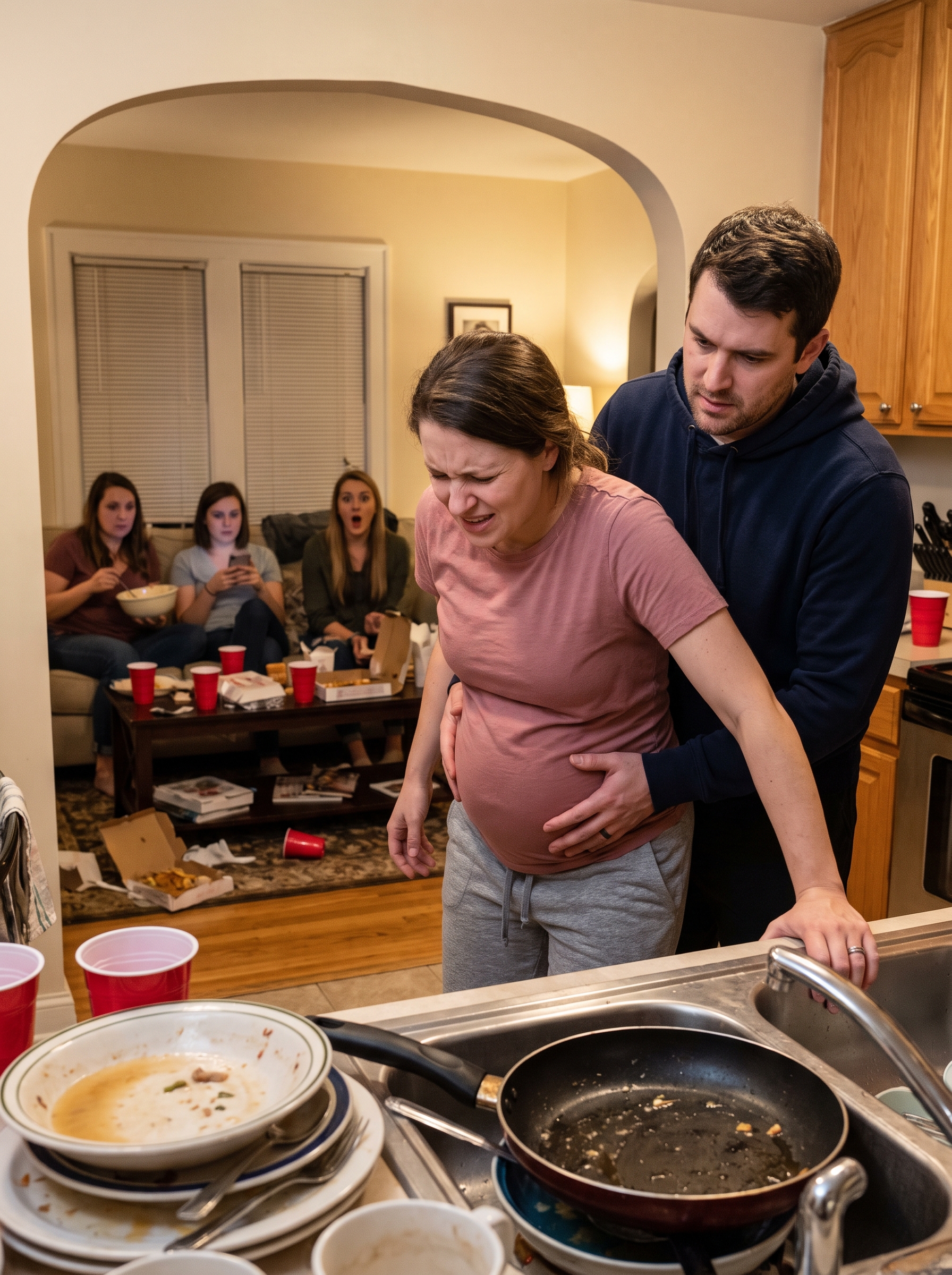
A younger version of me would have stormed into the living room, knocked the television off the wall with one sentence, and dragged every ugly truth into the open. But Emily was bent in my arms, both hands locked around her belly, her breathing shallow and uneven. Anger could wait. My wife could not.
“Em,” I said, keeping my voice low. “Look at me.”
Her eyes fluttered up to mine, frightened and wet.
“It hurts,” she whispered.
“How bad?”
She swallowed. “It comes and goes.”
That was all I needed.
I slipped one arm behind her shoulders and the other beneath her knees, lifting her carefully. She protested weakly, telling me she was too heavy, that she could walk, that I was already exhausted. I ignored every word and carried her out of the kitchen.
The laughter in the living room died only when they saw us.
My mother sat up, frowning as if we had interrupted something important. Brittany lowered the phone. Kayla paused her video. Lily’s mouth hung open, a slice of pizza frozen halfway to her lips.
“What are you doing?” my mother asked.
“Taking my wife to the hospital.”
Emily clutched my shirt. “Ethan, maybe it’s nothing.”
“Then we’ll be relieved when a doctor tells us that.”
My mother threw back the blanket. “Don’t be dramatic. Pregnant women get cramps.”
I stopped at the door and looked at her.
There must have been something in my face, because even Teresa Kane, who had made a career out of pushing past every boundary I had, went quiet.
“Move,” I said.
No one did.
So I stepped around the pile of shoes they had kicked into the entryway, shifted Emily closer against my chest, and opened the door myself.
Behind me, Brittany muttered, “He’s acting like we hurt her.”
I turned back just once.
“You did.”
The hallway outside our apartment smelled of old carpet and somebody’s late dinner. The elevator took too long, each descending number glowing like it had been designed to test my patience. Emily’s forehead pressed beneath my chin. She kept apologizing. For crying. For needing help. For making me angry.
Every apology landed like a stone.
“You don’t apologize for this,” I told her.
She closed her eyes. “I didn’t want to make things harder for you.”
“You’re not the one who did that.”
When we reached the street, the April air was colder than I expected. A thin mist clung to the pavement, turning the streetlights soft and blurry. I got Emily into the passenger seat, buckled her in, and called the hospital’s maternity line before I even started the engine.
The nurse told us to come in immediately.
That calm, professional voice nearly undid me.
At red lights, I glanced at Emily more than the road. She tried to smile each time she caught me looking, but her face had gone pale around the mouth. Her fingers worried the hem of her shirt in small, nervous circles.
“I should’ve told you,” she said.
“Yes.”
The honesty hurt her. I could see it.
I softened my voice. “But I understand why you didn’t.”
She stared through the windshield. “Your mom said I was turning you against them.”
I almost laughed, but there was no humor in it. “They did that themselves.”
At the hospital, everything became bright lights, polished floors, clipped questions, and waiting. A nurse named Carla settled Emily into a bed, wrapped monitors around her belly, and listened for our son’s heartbeat.
The room filled with a steady, fast rhythm.
For the first time that night, Emily breathed.
I lowered my head and pressed my lips to her knuckles.
“There he is,” Carla said warmly. “Strong little guy.”
Emily cried again, quietly this time.
The doctor came in twenty minutes later, a woman with kind eyes and no patience for vague answers. She asked about pain, stress, hydration, swelling, meals, sleep. Emily answered each question like she was confessing to something.
When she admitted she had been on her feet cleaning for most of the evening, the doctor’s expression changed.
“Emily,” she said gently, “you need rest. Serious rest. Stress and exhaustion can trigger contractions, and at eight months, we do not ignore warning signs. Tonight, things appear stable, but I want you off your feet as much as possible.”
I felt Emily’s hand tighten around mine.
“Can she go home?” I asked.
“Yes,” the doctor said. “But home needs to be calm.”
That word hung between us.
Calm.
Our apartment had not been calm in months. I just hadn’t been there to see it.
By the time we left, it was after one in the morning. The city was quiet in the way Chicago only gets quiet when it is tired of itself. Emily leaned against the passenger window, drained but safe. I drove slowly, both hands locked around the steering wheel.
“I don’t want to go back there,” she admitted.
The sentence was barely louder than the heater.
I felt something in me settle into place.
“Then we won’t.”
She turned her head. “What?”
“Not tonight.”
I pulled into the parking lot of a small hotel near Midway, the kind truck drivers used between routes and families used when flights got canceled. The lobby smelled like coffee and lemon cleaner. Emily waited in the car while I paid for a room with a card I already knew was too close to its limit.
When I came back, she looked guilty.
“We can’t afford this.”
“We couldn’t afford what was happening either.”
Our room had beige walls, two lamps, and a view of the parking lot. It was nothing special. But the sheets were clean, the door locked, and no one was laughing in the next room while my wife hurt.
I helped Emily out of her shoes and brought her water from the bathroom sink in a paper cup. She sat propped against the pillows, one hand resting on her belly.
“He’s moving,” she whispered.
I placed my palm beside hers.
A firm little kick pressed against my hand.
For a few seconds, I was not tired. I was not angry. I was just a man in a quiet room with his wife and unborn son, remembering what mattered.
Then my phone started buzzing.
Mom.
I silenced it.
It buzzed again.
Brittany.
Then Kayla.
Then Mom again.
I set the phone facedown on the nightstand.
Emily watched me. “You should answer.”
“No.”
“They’ll say I’m controlling you.”
“They already say whatever helps them sleep.”
She studied my face, perhaps searching for the boy who used to run whenever his mother called, the son who had mistaken obligation for love. I wondered when that boy had disappeared. Maybe he had not disappeared at all. Maybe he had simply grown too tired to keep carrying everyone.
“I need to tell you something,” Emily said.
The carefulness in her voice made me sit straighter.
“What is it?”
She looked down at our joined hands. “I started writing things down.”
“What things?”
“What they said. What they asked me to do. The bills they brought over. The times your mom came by when you weren’t home.”
A cold thread moved through me. “She came when I wasn’t there?”
Emily nodded.
“How often?”
“At first, once a week. Then more. Sometimes with your sisters. Sometimes alone.”
I thought of my mother on our couch, acting like a wronged queen. “Why?”
“She said family should have access to each other’s homes. She said because you paid most of the rent, she had a right to be here.”
“She had no right.”
“I know that now.”
The last word mattered.
Now.
I could hear the work behind it, the quiet rebuilding of a boundary that had been kicked down over and over. Emily reached for her purse beside the bed and pulled out a small notebook with a blue cover. The corners were worn. A grocery receipt marked one page.
“I wasn’t trying to build a case,” she said. “I just thought if I wrote it down, I wouldn’t feel crazy.”
I opened the notebook.
Dates. Times. Details.
Teresa arrived at 2:10, said Ethan should not have married someone “fragile.”
Brittany asked to borrow car, became angry when I said Ethan had keys.
Kayla ordered food on Ethan’s delivery app, said he would pay because he “owes his real family.”
Teresa said baby shower gifts should be stored at her house so she could “inspect what people bought.”
My eyes stopped.
“What baby shower gifts?”
Emily’s face changed.
I knew then there were still rooms in this house of secrets I had not entered.
“The ones from your coworkers,” she said.
My coworkers had thrown us a small shower two Fridays earlier during lunch. Diapers, onesies, bottles, gift cards, a handmade blanket from Mrs. Alvarez in payroll. I had brought everything home myself. Or I thought I had.
“They’re in the nursery closet,” I said.
Emily did not answer.
“They’re not?”
She shook her head. “Your mom took some boxes. She said she wanted to organize them because I looked overwhelmed. When I asked for them back, she said I was accusing her of stealing.”
I stood so quickly the chair scraped the carpet.
Emily flinched, and I hated that my anger made her afraid even when it was not aimed at her.
I sat down again. Slower this time.
“I’m sorry,” I said.
She reached for me. “I know you’re not angry at me.”
“I should have known.”
“How could you? You were working all the time.”
“That’s not an excuse.”
“No,” she said softly. “But it’s a reason.”
The distinction hit me harder than blame would have.
I did not sleep much. Emily managed a few hours, curled on her side with a pillow under her belly. I sat in the armchair by the window, watching rain gather on the glass, reading every page of the notebook until the words blurred.
At 6:30, I called my supervisor.
Marcus answered on the second ring, his voice rough with sleep and concern. “Kane? Everything okay?”
“No.”
I told him enough. Not everything, but enough.
He listened without interrupting.
“Take the day,” he said when I finished. “Take two if you need.”
“I can’t afford—”
“You’ve covered half this warehouse for three months. I’ll put in emergency leave for today, and I’ll talk to payroll about the rest.”
The kindness almost made me defensive. I was used to help coming with hooks. Marcus offered it plainly, then let silence do the rest.
“Thank you,” I said.
“Take care of your wife,” he replied. “The pallets will survive without you.”
When Emily woke, sunlight had turned the curtains gold. For a few minutes, we pretended the world was small. She ate toast from the hotel breakfast bar and laughed when our son kicked the paper plate balanced on her lap.
Then my phone rang again.
This time, I answered.
My mother did not say hello.
“You embarrassed me last night.”
I looked at Emily. She set down the toast.
“You embarrassed yourself,” I said.
There was a pause. My mother was not used to doors that did not open when she pushed.
“I don’t know what that girl told you, but she’s always been dramatic.”
“Her name is Emily. She is my wife.”
“She has you brainwashed.”
“No. She has me informed.”
My mother laughed once, sharp and false. “Informed? About what? That pregnancy makes women emotional? That she doesn’t like sharing you?”
I closed my eyes. Behind them, I saw Emily barefoot at the sink.
“You are going to leave our apartment today,” I said. “All of you. Anything you brought, take it. Anything that belongs to us stays.”
“Our apartment?” she repeated.
“My apartment. Emily’s apartment. Not yours.”
“I am your mother.”
“And I am about to be a father.”
The words changed the air in the room.
Emily looked down at her belly, blinking quickly.
My mother’s voice hardened. “After everything I sacrificed for you?”
I knew that road. I had walked it barefoot my entire life. Every disagreement became a ledger. Every boundary became betrayal. Every kindness she gave became a bill she expected me to spend my life repaying.
“I’m grateful for what you did right,” I said. “I’m done paying for what you keep doing wrong.”
Silence.
Then, quieter, she said, “You’ll regret choosing her over blood.”
I looked at my wife, at the woman who had hidden pain to preserve my peace, at the mother of my child sitting in a cheap hotel room because my family had made our home unsafe.
“I’m choosing my family,” I said, and ended the call.
For a long moment, neither of us moved.
Then Emily covered her face.
I went to her. “Did I make it worse?”
She shook her head, laughing and crying together. “No. I think you finally made it clear.”
We returned to the apartment just before noon.
I asked our neighbor, Mr. Alvarez, to come with us. He lived across the hall with his wife and had once fixed our sink when the landlord ignored three maintenance requests. He was retired, steady, and the kind of man whose presence made people remember manners.
“You sure?” he asked, glancing at Emily.
“I’m sure,” she said.
The apartment door was unlocked.
Inside, my mother was packing slowly, angrily, and badly. Clothes spilled out of plastic bags. My sisters moved through the rooms with dramatic sighs, as if they were the ones being forced from a place they had paid for.
Brittany spotted Mr. Alvarez and rolled her eyes. “Wow. You brought security?”
“I brought a witness,” I said.
That shut her up.
Kayla crossed her arms. “Mom said you’re kicking us out because Emily cried.”
Emily stood beside me, one hand on her belly, the other holding the blue notebook. Her face was pale, but she did not look away.
“No,” she said. “He’s asking you to leave because this is our home.”
The room went still.
It was the first time I had heard Emily say it that way in front of them.
Our home.
My mother’s eyes narrowed. “You’ve gotten bold.”
Emily’s hand trembled, but her voice held. “I’ve gotten tired.”
Mr. Alvarez looked at the pizza boxes, the stained napkins, the dishes stacked in the sink. His mouth tightened, though he said nothing.
I went room by room. In the nursery, the crib stood half assembled, one side rail still leaning against the wall. The closet door was open.
Several shelves were empty.
I turned around. “Where are the gifts?”
My mother appeared behind me. “What gifts?”
“The diapers. The clothes. The blanket. The gift cards.”
Brittany looked at Kayla.
A small glance. Quick. Guilty.
I caught it.
“Brittany,” I said.
She scoffed. “Why are you saying my name like that?”
“Because you know.”
“I don’t know anything.”
Kayla shifted her weight.
Emily stepped beside me and opened the notebook to a marked page. “Your mom said she was taking two boxes to sort them. Brittany carried one. Kayla carried the other.”
My mother gave a weary sigh. “I moved them so they wouldn’t clutter this tiny room. You should be thanking me.”
“Where are they?” I asked.
“At my place.”
“All of them?”
Her face flickered.
There it was.
Not enough for a confession. Enough for truth.
I held out my hand. “Keys.”
“To what?”
“To our apartment.”
“I don’t have—”
“Keys.”
She stared at me, offended, wounded, calculating. Then she reached into her purse and dropped a key ring into my palm. Three keys. One was ours. Two I did not recognize.
Emily noticed them too.
“What are those?” she asked.
My mother snatched the ring back before I could separate them. “Mine.”
I let it go for the moment. There would be time to change the locks.
It took them forty-three minutes to leave.
I know because I watched the clock. Not out of cruelty. Out of disbelief that something so overdue could happen so quickly once I stopped negotiating with guilt.
They left behind crumbs, stains, a cracked glass, and a silence so large it felt like another room.
When the door closed, Emily sank onto the couch.
I knelt in front of her. “How’s your pain?”
“Better.”
“Truth?”
She smiled faintly. “Truth.”
I rested my forehead against her knee.
“I’m sorry,” I said.
She touched my hair. “Ethan.”
“No. I need to say it. I made you share space with people who hurt you because I was afraid of being a bad son.”
“You were trying to keep everyone together.”
“I kept everyone together by letting you be alone.”
Her fingers stilled.
That was the sentence neither of us wanted, because it was true.
Finally, she said, “Then don’t do that again.”
I looked up.
There was no anger in her face. Only exhaustion and hope, standing side by side.
“I won’t,” I promised.
We spent the afternoon reclaiming our apartment.
Not perfectly. Not dramatically. Just one bag at a time. Mr. Alvarez helped carry trash to the dumpster. Mrs. Alvarez came over with soup and the authority of a woman who had raised four children and feared no one. She sent Emily to bed and handed me rubber gloves.
“Clean,” she said.
“Yes, ma’am.”
By evening, the living room smelled like lemon, not grease. The dishes were done. The floor was mopped. The television was off. In the nursery, I tightened the crib screws while Emily sat in the rocking chair reading instructions aloud, occasionally correcting me with a seriousness that made me love her more.
“That’s piece C,” she said.
“It looks like piece D.”
“Piece D has two holes.”
“I have two holes.”
“You are not a crib part.”
I laughed so hard I dropped the Allen wrench.
For the first time in weeks, our home sounded like us.
Later, while Emily rested, I drove to my mother’s apartment to retrieve the baby shower gifts. I did not go alone. Marcus came with me, still in his warehouse jacket, carrying the calm expression of a man prepared to be polite until politeness stopped working.
My mother lived twenty minutes away in a brick building with peeling paint around the buzzer. She opened the door only after I called twice.
When she saw Marcus, her face tightened.
“You brought another witness?”
“Yes.”
“You really think I’m some criminal?”
“I think I want this conversation remembered accurately.”
Her apartment smelled of lavender spray and old smoke. Boxes lined one wall. My son’s diapers were stacked beside her television. A bag of baby clothes sat open on the couch. The handmade blanket was folded over the back of a chair.
Relief hit first.
Then I saw the gift cards.
Or rather, I saw the envelopes they had come in, torn open and empty.
I picked one up. Target. Fifty dollars. Signed by three guys from loading dock.
“Where are these?”
My mother looked away. “I needed groceries.”
Marcus made a small sound under his breath.
I kept my voice even. “Those were for the baby.”
“And the baby needs a grandmother who can eat.”
There it was again: need sharpened into entitlement.
I gathered the clothes, diapers, bottles, and blanket. Marcus helped without a word. My mother followed us to the door.
“You think Emily will stay perfect forever?” she asked. “One day you’ll see people aren’t so simple.”
I paused with a box in my arms.
“No one is perfect,” I said. “That was never the requirement.”
Her expression shifted, but only for a second.
I left before she found another way to pull me backward.
That night, Emily cried over the blanket.
Mrs. Alvarez had washed it for us, and it smelled faintly of baby detergent. Emily pressed it to her cheek, eyes closed.
“I thought it was gone,” she said.
“Most of it was there.”
“Most?”
I told her about the gift cards.
She was quiet for a long time. Then she nodded, as if another piece of a sad puzzle had clicked into place.
“We’ll manage,” she said.
I sat beside her. “We shouldn’t have to manage around them.”
“No,” she agreed. “But we can start managing for us.”
The next week became a strange season of repairs.
The landlord changed the locks after I paid a fee I resented less than I expected. I removed my card from every delivery app. I canceled the streaming services my sisters used. I called the pharmacy and transferred my mother’s prescriptions to her own account, giving the pharmacist her number instead of mine.
Each step was small.
Each step felt like lifting a brick from my chest.
My mother called from different numbers. I did not answer. Brittany sent long messages accusing me of abandoning them. Kayla sent shorter ones, mostly practical, asking whether I could still cover her phone bill until summer. Lily sent nothing for three days.
Then, on Thursday afternoon, she texted Emily.
Not me.
Emily showed me the phone when I got home.
Lily: I’m sorry about the dishes. Mom said you liked keeping busy. I know that sounds dumb now.
Emily stared at the message as if it might change.
“What do you want to do?” I asked.
“I don’t know.”
“You don’t have to answer.”
“I know.”
But she did.
Emily: Thank you for apologizing. I need space right now. I hope you understand.
Lily replied with a heart.
It was not redemption. It was not a scene from a movie where everyone cried and understood everything at once. It was a tiny crack in a very thick wall.
Still, Emily slept better that night.
On Saturday, we finally finished the nursery.
The walls were pale green. The crib stood beneath the window, safely away from the blinds. The rocking chair sat in the corner beside a small shelf holding board books, folded blankets, and a stuffed bear Marcus had brought from the warehouse crew.
Emily stood in the doorway, both hands resting on her belly.
“It feels real now,” she said.
I came up behind her and wrapped my arms around her carefully.
“It’s been real.”
“I know. But this feels like he has a place.”
I looked around the room.
So did we.
That evening, we opened the last box from my mother’s apartment. It held a few onesies, a bottle warmer, and a stack of envelopes from the shower. Most were empty, but one had slipped beneath the cardboard flap, unopened.
Emily smiled. “You missed one.”
I picked it up.
The envelope had my name on it, written in handwriting I did not recognize at first because I had not seen it in years.
Ethan.
No last name. Just Ethan.
My smile faded.
Emily noticed. “What is it?”
I turned the envelope over. It was sealed. No return address.
“Ethan?” she asked.
I sat on the edge of the crib mattress, though I knew I probably shouldn’t put weight there. My hands had gone cold.
“This handwriting,” I said slowly. “I think it’s my father’s.”
Emily became very still.
My father had left when I was twelve.
That was the story my mother told. He walked out. He chose himself. He never looked back. She built my childhood around that version until it became a family law. We did not ask about him. We did not mention him. We did not wonder.
I opened the envelope carefully.
Inside was not a card.
It was a letter, folded twice, and a photograph.
The photo showed my father standing outside a diner, older than I remembered but unmistakable. Beside him stood a woman I did not know. Between them was a boy of about ten with my eyes.
My heart began to pound.
Emily lowered herself into the rocking chair. “Read it.”
I unfolded the letter.
Ethan,
I don’t know whether this will reach you. I gave it to your mother after I heard from Brittany that you and Emily were expecting a son. She told me you wanted nothing from me, and maybe that’s true. But I need you to know I did not leave the way you were told.
I have tried to contact you for years.
There is something your mother never told you.
My hands tightened around the page.
Emily whispered my name, but I could barely hear her over the sudden roaring in my ears.
The next line was only seven words.
You have a brother, and he needs you.