I did not take the baby from her at first.
My body refused the command my heart was already trying to give.
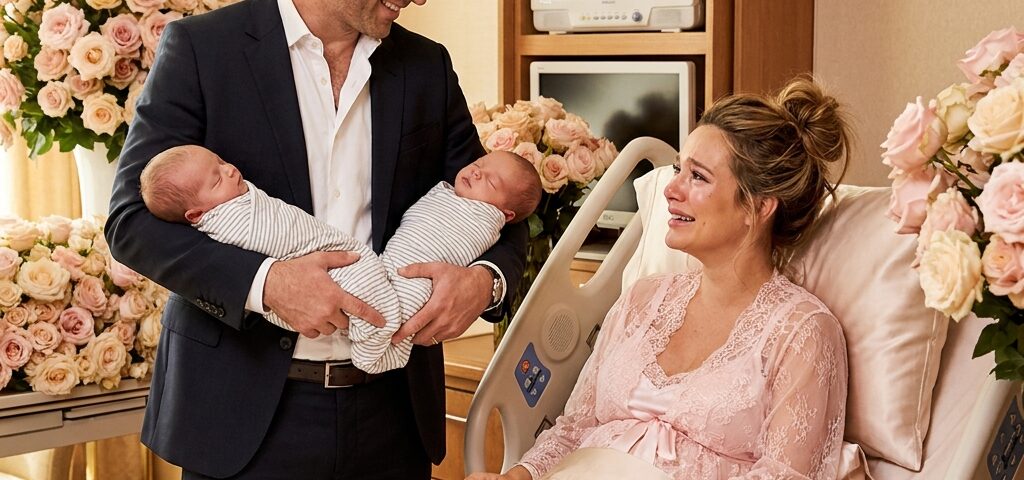
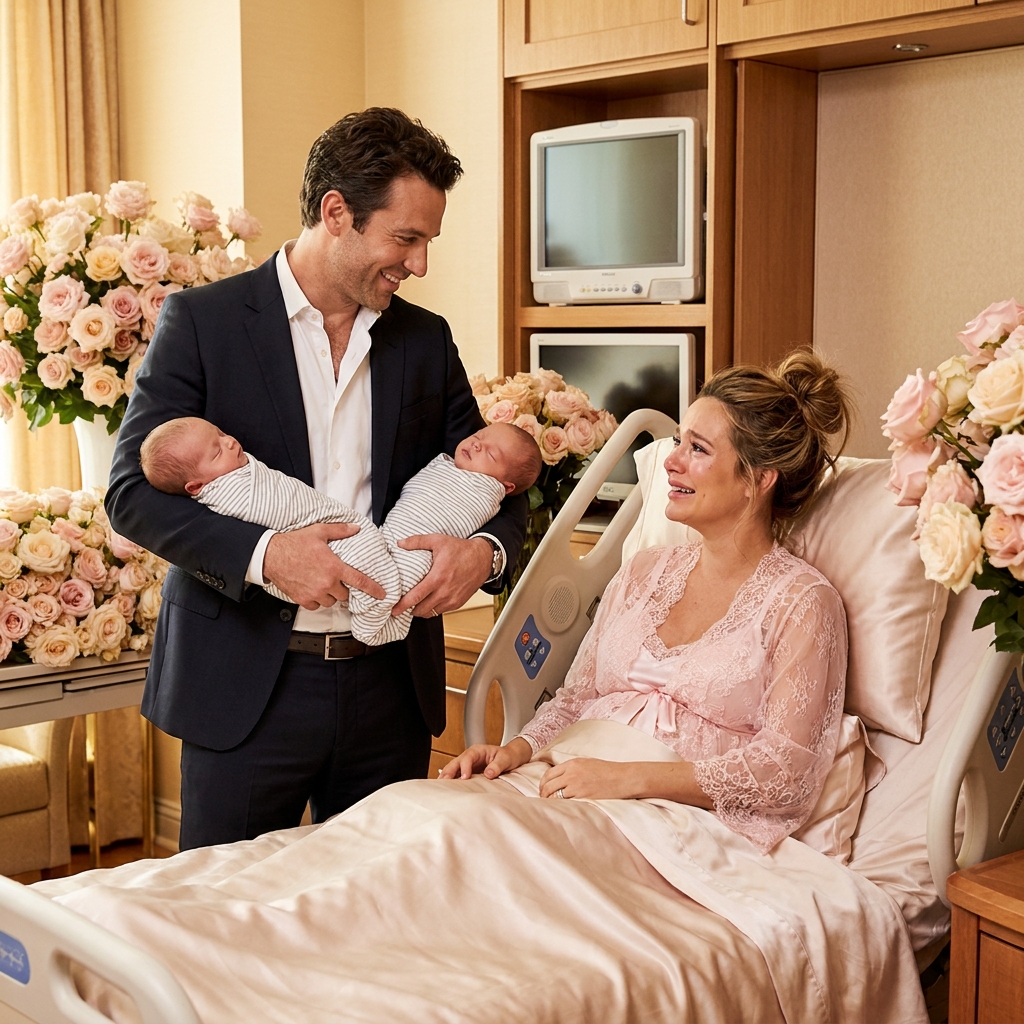
Sylvie’s arms remained extended, the newborn wrapped in a pale hospital blanket with a tiny striped cap slipping low over one ear. The baby’s face was scrunched in sleep, one fist tucked against her cheek, lips moving as if she were dreaming of something only minutes-old children could understand.
“You’re already their father.”
The words stayed in the air between us.
Not you might be.
Not I think you are.
Not there’s a chance.
You’re already their father.
I looked from the baby to Sylvie, and something old and bitter rose in me because that was the shape my pain had taken for seven months. Suspicion first. Always suspicion.
“What does that mean?” I asked.
My voice sounded colder than I intended. Or maybe exactly as cold as I had become.
Sylvie’s face tightened, but she didn’t withdraw the baby. She simply held her there, patient in a way that made me angrier because patience had never been her weapon before. Sylvie had always fought quickly, fiercely, with the kind of fire that filled a room. This quiet version of her unsettled me more than any shouting match ever had.
“It means they’re yours,” she said.
I let out a humorless breath. “We’ve been divorced seven months.”
“Yes.”
“You disappeared after the final hearing.”
“I know.”
“And now you call me to a hospital and tell me I have children?”
“I didn’t call you.”
That stopped me.
Sylvie’s eyes flicked briefly toward the door, then back to me. A shadow passed over her face. Not fear exactly, but caution.
“Then who did?” I asked.
“I don’t know.”
The second baby stirred in the crook of her other arm, making a soft sound. Sylvie glanced down immediately, all her attention narrowing to that small face. The movement was instinctive. Tender. Real.
I had seen Sylvie play many roles in our years together. Brilliant chemist. Relentless executive. Charming hostess when investors came to dinner. Ice queen when reporters circled too close. Wounded wife in court, though I had told myself that was performance too.
But I had never seen her as a mother.
The sight did something to me I was not prepared for.
“Please,” she said, looking back up. “Take her. Just for a moment.”
I should have refused. I should have demanded explanations, documents, proof. That was how I survived. Facts first. Feelings last.
Instead, I stepped forward.
The baby weighed almost nothing.
That was the first thing that undid me.
For a man used to carrying impossible burdens—payrolls, lawsuits, expectations, a family name sharpened into a public brand—the child in my arms felt terrifyingly light. Her head settled against the inside of my elbow. Her mouth opened slightly. She smelled faintly of milk, cotton, and the clean, strange scent of new life.
My throat closed.
Sylvie watched me carefully, and for a moment the hospital room seemed to fold around the three of us. The rain kept ticking against the window. Somewhere down the hall, someone laughed softly. A monitor beeped with quiet regularity.
The baby frowned in her sleep.
The crease appeared between her eyebrows again.
My father had made that expression when concentrating over chess. I made it when reading contracts. I had once teased Sylvie that our children would inherit it and look permanently unimpressed with the world.
Our children.
The thought came too fast. Too dangerous.
I looked away.
“What are their names?” I asked.
Sylvie’s mouth trembled, but she steadied it. “Mara and Elise.”
“Which one is this?”
“Mara.”
Mara.
The name landed somewhere deep.
“And Elise?” I looked at the baby still resting against Sylvie.
“She’s the quieter one,” Sylvie said, almost smiling. “For now.”
There it was. A flicker of the woman I had known before everything collapsed. Before our dining room became a battlefield. Before attorneys began translating pain into settlement terms. Before every look between us carried an accusation neither of us knew how to put down.
I held Mara closer without meaning to.
“How?” I asked.
Sylvie’s gaze lowered.
That single silence said more than her answer could have.
My mind began assembling dates with ruthless precision. Seven months since the divorce. Eight months since the separation hearing. Nine since we had slept in separate rooms. Ten since the night of the company gala, when we had smiled for cameras and barely spoken afterward.
Except one night.
The night before she left.
I remembered it with sudden, unwanted clarity. The storm outside our townhouse. Her standing in the library doorway, hair loose around her shoulders, eyes red but dry. I had been drinking coffee too late, pretending to review a dossier I wasn’t reading.
“I can’t keep doing this,” she had said.
“Doing what?” I had answered, already defensive.
“Being treated like your enemy.”
“You hired a lawyer before speaking to me.”
“Because you froze the accounts.”
“Because you transferred company files.”
“They were my research notes, Adrian.”
“My company’s research notes.”
She had laughed then—not because anything was funny, but because she had run out of ways to be hurt. I remembered the sound. It had followed me for months.
Later, somehow, we had stopped fighting. Or maybe exhaustion had softened us. There had been apologies that were not full apologies, touches that trembled with history, and for one brief night we had reached for the marriage we had already ruined.
By morning, she was gone.
I had told myself it meant nothing.
Apparently, it had meant everything.
I looked down at Mara. “Why didn’t you tell me?”
Sylvie leaned back against the pillows. The effort of sitting upright seemed to catch up with her all at once. Her skin had gone pale beneath the soft hospital light.
“I tried,” she said.
“When?”
“Three times.”
I almost laughed. “I would remember that.”
“You remember what confirms what you already believe.”
The words struck because they were not shouted. She said them with exhaustion, not accusation.
I looked at her.
Sylvie turned her face toward the rain-streaked window. “I called your office first. Your assistant said all personal matters had to go through legal counsel.”
“Because you were suing me.”
“Because I was trying to protect myself.”
“You demanded shares of Vexley Pharmaceuticals.”
“I demanded what I helped build.”
The old argument opened its mouth between us.
Then Elise made a tiny noise, and Sylvie’s expression changed instantly. She looked down, adjusted the blanket, and the old argument went silent. Not settled. Not forgiven. Just suddenly too small for the room.
“I sent a letter,” Sylvie continued softly. “A private one. Not through attorneys. To your home.”
“I never got it.”
“I know that now.”
“What does that mean?”
Before she could answer, the door opened.
A nurse in navy scrubs stepped inside carrying a clipboard. She paused when she saw me holding Mara, then smiled with professional warmth.
“Mr. Vexley?”
I nodded slowly.
“I’m Nurse Elena Torres. I’m glad you made it.” She checked Sylvie’s IV line, then glanced between us with the careful neutrality of someone who had walked into many complicated family stories. “Dr. Kim will be in shortly.”
“How did you get my number?” I asked.
Nurse Torres looked confused. “I didn’t call you.”
Sylvie and I exchanged a look.
“A woman called me,” I said. “Said Sylvie was here.”
The nurse frowned. “Only authorized contacts are supposed to receive updates.”
“I wasn’t authorized?” I asked.
Sylvie’s cheeks colored faintly. “I listed you.”
That hit me harder than I expected.
Seven months of silence, legal battles, and public distance—and she had written my name on a hospital form.
“As emergency contact?” I asked.
“As the father,” she said.
Nurse Torres pretended not to hear. “I’ll check with the desk about the call.”
When she left, the room became quiet again, but not peaceful.
I shifted Mara carefully. “You listed me as their father.”
Sylvie met my eyes. “Because you are.”
“You keep saying that like saying it makes the last seven months disappear.”
“I don’t want them to disappear.”
“Then what do you want?”
She looked at Mara, then Elise. “I want them to have the truth.”
The truth.
It had been the word we both claimed during the divorce. My truth. Her truth. The board’s truth. The lawyers’ truth. The tabloids’ truth once someone leaked that our marriage had collapsed under allegations of betrayal and corporate sabotage.
I had believed the simplest version because it hurt the least to hold: Sylvie had betrayed me. Sylvie had stolen research. Sylvie had planned to leave long before I knew she was leaving.
Simple stories were easier to survive.
But Mara’s tiny hand had opened against my shirt. Her fingers curled in the fabric like she expected me to stay.
I was no longer sure I had survived anything correctly.
The door opened again, this time more softly.
A woman in a white coat entered, her dark hair pulled into a knot at the nape of her neck. She carried a tablet and wore the careful expression doctors used when bringing important news in manageable portions.
“Ms. Vexley,” she said, then turned to me. “Mr. Vexley. I’m Dr. Hannah Kim.”
“Are they healthy?” I asked before I could stop myself.
Dr. Kim’s expression softened. “They’re doing well. Both girls are stable. Small, but strong. We’ll keep monitoring them overnight, especially since labor moved quickly, but there’s no immediate concern.”
Some part of me loosened.
I had not realized how much fear had slipped in beneath the shock.
“And Sylvie?” I asked.
The doctor’s eyes moved to her. “She needs rest. Delivery was uncomplicated in the end, but she came in under considerable stress and exhaustion. That matters.”
Sylvie looked annoyed. “I’m fine.”
Dr. Kim gave her a look that suggested this argument had already happened and the doctor had won. “You are recovering. There’s a difference.”
I almost smiled.
Then Dr. Kim turned serious. “Before we continue, I need to ask whether both of you consent to Mr. Vexley being included in medical discussions concerning the babies.”
“Yes,” Sylvie said immediately.
I looked at her.
No hesitation. No strategy. Just yes.
I nodded. “Yes.”
Dr. Kim tapped her tablet. “There is one thing we need to discuss. During intake, Ms. Vexley mentioned concerns about privacy. Given your public profiles, we’ve restricted access to this room. However, someone did call the front desk earlier asking whether Ms. Vexley had delivered.”
Sylvie stiffened.
“Who?” I asked.
“They didn’t give a name,” Dr. Kim said. “The desk didn’t confirm anything.”
“Was it a woman?”
“I don’t know. I’ll have security review it.”
My grip tightened around Mara.
Sylvie saw it. “Adrian.”
I heard the warning in her voice. Not because she was afraid of me, but because she knew me. She knew how quickly I could become all edges when I sensed a threat.
“I’m not going to storm through the hospital,” I said.
“I didn’t say you were.”
“You thought it.”
“I remembered it.”
The honesty between us was uncomfortable. It had been easier when we only traded polished anger.
Dr. Kim cleared her throat gently. “For tonight, the priority is rest. There will be paperwork in the morning.”
“Paternity paperwork?” I asked.
Sylvie’s eyes flashed. “Adrian.”
“I’m asking a practical question.”
“No,” Dr. Kim said evenly. “Birth certificates, discharge planning, pediatric care. Legal matters can wait unless both parents choose otherwise.”
Both parents.
The phrase moved through me with quiet force.
After the doctor left, Nurse Torres returned with a bassinet. She helped Sylvie settle Elise, then guided me as I laid Mara beside her sister. The babies turned slightly toward each other, as if some invisible thread still joined them from before the world had arrived.
I stood over them, unable to move.
“You should sit,” Sylvie said.
“I’m fine.”
“Dr. Kim just told me that being fine is not the same as recovering. I think it applies broadly.”
Despite everything, a small laugh escaped me.
It surprised us both.
For a moment, Sylvie smiled.
Then her eyes filled with tears so quickly she turned her face away.
I had seen her cry only twice in our marriage. Once at her mother’s funeral. Once in our kitchen after our third failed fertility appointment, when the doctor had gently suggested that stress might be making everything harder and Sylvie had broken a mug against the sink because she could not break the universe.
We had wanted children once.
Quietly at first. Then with calendars, specialists, injections hidden behind bathroom mirrors, hope measured in appointments and blood tests. When nothing happened, we stopped speaking of nurseries. Then we stopped speaking of disappointment. Then we stopped speaking of almost everything that mattered.
Seeing her tears now opened a door in me I had nailed shut.
“Sylvie,” I said.
She wiped her cheek with the heel of her hand. “I’m tired.”
“I know.”
“No, you don’t.” She looked back at me, and her voice cracked. “You don’t know what it was like to find out alone.”
I sat slowly in the chair beside the bed.
The rain made silver lines down the window.
“Tell me,” I said.
She studied me as if looking for the trap.
There wasn’t one. That was new enough between us to feel strange.
“I found out six weeks after I left,” she said. “I didn’t believe the first test. Or the second. I went to a clinic in Queens because I didn’t want anyone recognizing my name.”
“Why not call me then?”
“Because the same week, your attorney filed the motion accusing me of misappropriating proprietary data.”
I closed my eyes.
I remembered signing it. I remembered the legal team laying out the evidence: file transfers, encrypted backups, access logs under her credentials. I remembered my anger because betrayal with paperwork looked so convincing.
“I didn’t know you were pregnant,” I said.
“I know. But I knew what you believed about me.”
“That you stole from the company.”
“That I stole from you.”
The distinction mattered.
A knock interrupted us.
A young woman leaned in, wearing a gray cardigan and carrying a folder against her chest. Her hair was damp from rain, and she looked as though she had run all the way from the subway.
“Sylvie?”
Sylvie’s shoulders eased. “Maya.”
The woman stepped inside and stopped when she saw me.
I recognized her after a second. Maya Laurent. Sylvie’s younger half-sister. During our marriage, she had been finishing graduate school in Boston and rarely visited. She had sent polite holiday cards and once spilled red wine on an investor at our anniversary party, which had made Sylvie laugh for three days.
Maya’s eyes moved to the bassinets.
“Oh,” she whispered.
The folder slipped slightly in her hands.
Sylvie held out one arm, and Maya went to her. They embraced awkwardly around wires and blankets, both of them trying not to cry and failing.
“I came as soon as I got your message,” Maya said.
“I didn’t send one,” Sylvie said.
Maya pulled back. “Yes, you did.”
The room changed.
I stood.
Maya looked from Sylvie to me. “A text. From your number. It said, ‘They’re here. Please come to Mount Sinai. Room 203.’”
Sylvie reached toward the bedside table. “My phone died before the ambulance arrived.”
Nurse Torres had plugged it into a charger beside the bed. The screen now glowed faintly.
Sylvie unlocked it with shaking fingers.
There was no sent message to Maya.
No outgoing call to me.
Maya’s face paled. “Then who texted me?”
I took the phone from Sylvie gently, expecting her to resist. She didn’t.
The call log showed missed calls from Maya, two from Dr. Kim’s office, several unknown numbers from earlier in the day. Nothing outgoing to my private phone.
“Someone wanted us both here,” I said.
Maya hugged the folder tighter.
“What’s that?” Sylvie asked.
Maya glanced at me uneasily.
Sylvie noticed. “He can hear it.”
The trust in that sentence was small, but I felt it.
Maya handed her the folder. “You asked me to keep these until after the babies came.”
Sylvie closed her eyes briefly. “I forgot.”
“What are they?” I asked.
Sylvie opened the folder but did not immediately answer.
Inside were copies of documents. Medical records. A handwritten letter. A sealed envelope with my name on it.
My pulse shifted.
“That letter,” I said.
Sylvie touched the envelope. “The one I sent to the townhouse.”
“It came back?”
“No.” She looked at me. “Maya made me keep a copy before I mailed it.”
Maya gave a faint, apologetic shrug. “Family habit. Assume important things vanish.”
Sylvie handed me the envelope.
My name was written across the front in her handwriting.
Adrian.
No last name. No title.
Just Adrian.
I opened it carefully.
The letter inside was dated six months earlier.
Adrian,
I don’t know whether this will reach you, or whether you will read past the first line. I am pregnant. I found out three weeks ago. The doctor confirmed there are two babies.
I know what you think of me right now. I know what your lawyers have said. I also know that somewhere beneath the anger, you are still the man who held my hand through every failed appointment and told me we would be all right even when neither of us believed it.
I am not writing to ask for money. I am not writing to reopen the war.
I am writing because these children deserve to be known by both their parents, and because I cannot carry the silence alone.
There is more you need to know about the files. I did not take them for myself. I took copies because I was afraid of what I found in the trial reports. I tried to tell you before everything became legal, but someone was already watching my access. I thought if I had proof, you would believe me.
I was wrong to hide it from you. But I did not betray you.
If you can meet me without lawyers, call the number below. I will come anywhere public. I will bring what I have.
Sylvie.
By the time I finished reading, my hands were no longer steady.
The room had gone silent.
Sylvie looked down at the babies. Maya watched me as if prepared to step between us if necessary.
I read the letter again.
Trial reports.
Watching her access.
I thought if I had proof, you would believe me.
“What trial reports?” I asked.
Sylvie inhaled slowly. “VX-143.”
The old project name moved through me like a buried wire sparking alive.
VX-143 had been one of our most promising early neurological compounds. We had discontinued it after Phase II due to inconsistent efficacy and concerns about side effects. At least, that was what the internal summary said. I had trusted the summary because it came from people I trusted.
People I had built the company with.
“Sylvie,” I said carefully, “that program ended years ago.”
“It was supposed to.”
“What does that mean?”
She leaned back, exhausted. “I found irregularities in archived patient data. Nothing obvious at first. Missing adverse event notes. Lab values recoded. Follow-up reports that didn’t match the original site submissions.”
I stared at her. “Why didn’t you come to me?”
“I tried.” Her eyes sharpened despite her fatigue. “You were in Zurich. I sent a flagged memo through compliance. The next day, my access was restricted. Two days later, your CFO asked me why I was downloading proprietary documents. By the end of the week, your lawyer had drafted the first warning letter.”
I thought of Daniel Mercer.
My CFO for eleven years. Calm, meticulous, indispensable Daniel. The man who had stood beside me during every acquisition, every crisis, every brutal quarter. Daniel, who had told me with grave reluctance that Sylvie’s access logs were “deeply concerning.” Daniel, who had advised swift action before regulators became involved.
A hard pressure built behind my ribs.
“Daniel handled the internal review,” I said.
“I know.”
Maya shifted. “Sylvie didn’t want to tell you without proof.”
“I had proof,” Sylvie said. “Then the drive disappeared.”
“The drive?” I asked.
“The original backup. The one I made before my access changed.”
“Where was it?”
“In my apartment.” Her mouth tightened. “Someone broke in three days before the preliminary hearing. Nothing obvious taken. Jewelry untouched. Cash in a drawer untouched. Just one locked box in my closet opened.”
I remembered hearing about the break-in through attorneys. At the time, my lawyer had suggested Sylvie staged it to support her story. I had wanted to believe that because it made everything fit.
I sat back down slowly.
My life, which had already shifted once tonight, tilted again.
Maya touched Sylvie’s shoulder. “You need rest.”
“I know.” Sylvie’s eyes remained on me. “But he needs to hear this.”
“I’m listening,” I said.
Those two words changed something in her face.
For years, Sylvie had accused me of hearing only what I could solve. Perhaps she was right. Listening required surrendering the illusion that command was the same as care.
She reached into the folder again and took out a second packet.
“These are copies of what I could reconstruct from emails, screenshots, old lab notes. Not enough to prove everything. Enough to show something was wrong.”
I accepted the packet but did not open it yet.
There was too much in my hands already.
Maya walked to the bassinets and looked down. “They’re beautiful.”
Sylvie’s face softened. “Mara has Adrian’s frown.”
“I noticed,” Maya said.
“I do not frown that much,” I said automatically.
Both sisters looked at me.
For the first time in what felt like years, Sylvie laughed.
It was small and tired, but real.
The sound broke something open inside me.
I looked at the babies because looking at Sylvie was becoming difficult. Mara and Elise slept side by side, unaware that their arrival had pulled old secrets into fluorescent light.
“Why come back to New York?” I asked. “You could have delivered anywhere.”
Sylvie hesitated. “Because I wanted them born where we began.”
My throat tightened.
We had begun in New York. Not in boardrooms or courtrooms, but in a Columbia University lab where Sylvie had corrected my equation in front of six graduate students and then bought me terrible coffee because she felt slightly guilty. We had been young, ambitious, and certain the future would yield to effort.
I had loved her first for her mind.
Later for her courage.
Somewhere along the way, I had forgotten to love her gently.
A soft knock came at the door.
Nurse Torres entered again, but this time her expression was serious. “Mr. Vexley, may I speak with you in the hallway?”
Sylvie immediately stiffened. “About what?”
The nurse glanced toward the babies. “Security reviewed the call records from the front desk. Someone came in earlier asking for Ms. Vexley’s room.”
“Who?” I asked.
“A man. Mid-fifties. He said he was family.”
Maya frowned. “We don’t have anyone like that in New York.”
“Did he give a name?” Sylvie asked.
Nurse Torres hesitated. “He signed the visitor log.”
My phone buzzed before she could say more.
I looked down.
Daniel Mercer.
For several seconds, I simply stared at his name lighting up my screen.
Sylvie saw it too.
The old version of me would have answered immediately, stepped into the hall, gathered information, controlled the situation.
The man holding his ex-wife’s letter in a maternity room did not move so quickly.
I let it ring.
Daniel called again.
Then a message appeared.
Adrian, I heard Sylvie delivered. Do not sign anything tonight. We need to talk before you make a mistake.
The room seemed to draw in a breath.
Maya whispered, “How does he know?”
Sylvie’s face went white.
Nurse Torres looked between us. “The man who signed in earlier,” she said quietly. “His name was Daniel Mercer.”
For a long moment, no one spoke.
My phone buzzed once more.
This time, it was not Daniel.
It was an unknown number.
A photo appeared on the screen.
The image showed Mara and Elise asleep in their bassinet, taken from inside this room less than ten minutes ago.
Beneath it was one sentence:
Ask Sylvie what she really hid in the second envelope.
I looked up slowly.
Sylvie was staring at the folder on her lap.
Inside it, beneath the papers she had already given me, was another sealed envelope.
This one was not addressed to me.
It was addressed to our daughters.