Part 2
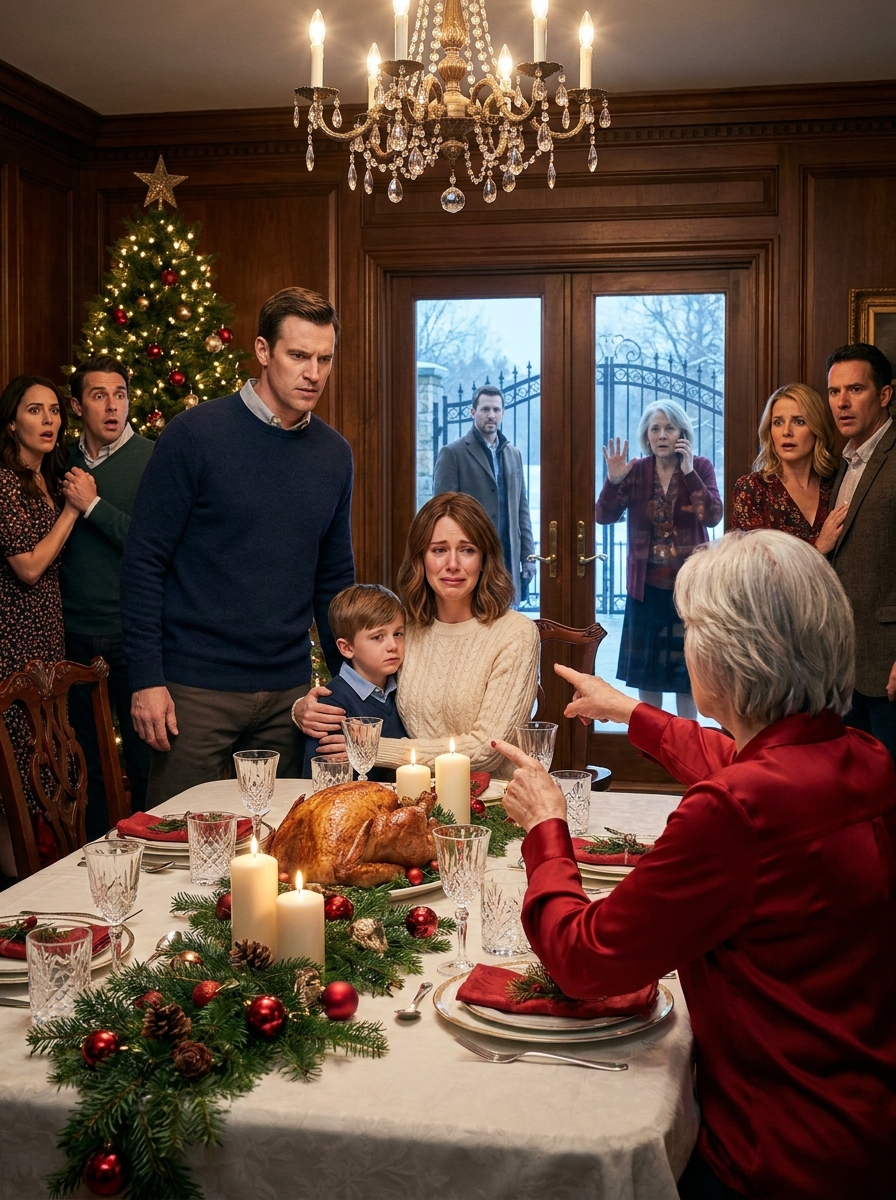
My mother’s head snapped up.
She set her fork down again. Different this time. Not the click of judgment. The clatter of someone who hadn’t expected to be called out.
“Excuse me?” she said.
I didn’t raise my voice. I was very careful not to.
“We’re leaving,” I said. “Oliver, say goodbye to everyone.”
The table seemed to hold its breath.
Oliver slid off his chair slowly, the way kids do when they’re not sure what’s happening but can feel that something is. He carried his cloth napkin with him for a second before realizing it and setting it back on the table. He went around to my father first.
“Bye, Grandpa.”
My father pulled him into a hug that lasted a beat longer than normal. When he let go, he kept one hand on Oliver’s shoulder and didn’t look at my mother.
“Bye, buddy,” he said. His voice was rough around the edges.
Oliver went to Mason next, which I hadn’t expected. Mason — twelve years old and too cool for most things — stood up from his chair and hugged my son. An actual hug. Garrett watched this with his jaw tight and his hands flat on the table.
Oliver reached my mother last.
He stood in front of her. She was still seated. He was still small.
“Bye, Grandma,” he said.
She started to reach for him. “Oliver—”
“We need to get going,” I said. Not loud. Not angry. Just final.
Jess was already up, folding her napkin, gathering her things with the quiet efficiency of someone who had rehearsed this exit a hundred times in her head even if she never believed she’d have to use it. She kissed my father on the cheek. She said goodbye to Brooke. She said nothing to my mother.
I got our coats from the front closet. The pine wreath above the door dropped two needles onto the floor as I reached past it.
“Tom,” my mother said from the hallway.
I turned around.
She was standing at the edge of the dining room, arms crossed, chin up. She looked the way she always looked when she had decided she was the one who’d been wronged.
“You’re being dramatic,” she said.
I looked at her for a long moment.
“Merry Christmas, Mom,” I said.
Then I opened the front door and we walked out.
The drive home was twenty-two minutes.
I know because I watched the clock.
Oliver sat in the back seat with his seatbelt on and his face turned toward the window. Highway lights slid across the glass in long orange stripes. He didn’t ask for music. He didn’t ask how long until we got home. He didn’t tell us anything about astronauts or zero gravity or the Russian cosmonaut whose name he’d practiced all morning.
He just looked at the dark.
Jess had her hand on my arm the whole way. Not saying anything. Just her hand there, warm through my sleeve.
About halfway home, Oliver spoke.
“Dad,” he said.
“Yeah, buddy.”
A pause. “Did I do something wrong?”
The question landed somewhere in my chest I didn’t have a name for.
“No,” I said. “You didn’t do anything wrong. Not even a small thing.”
“Then why did we leave?”
I looked at him in the rearview mirror. He was watching me, careful, still holding it together.
“Because sometimes,” I said slowly, “when someone hurts a person we love, we leave. That’s it.”
He seemed to turn this over. “Grandma hurt my feelings.”
“I know.”
“On purpose?”
I thought about the look on my mother’s face when she said it. Measured. Deliberate. The expression of someone who believed they were doing something useful.
“I don’t know,” I said. Which was as honest as I could be.
He turned back to the window.
We didn’t speak again until we pulled into the driveway.
Jess put Oliver to bed while I stood in the kitchen and looked at nothing. I heard her reading to him upstairs — something with dragons — her voice low and steady, the kind of steadiness that takes enormous effort to hold.
I poured two glasses of water and sat at the kitchen table.
When she came back downstairs, her composure had come down. She sat across from me, wrapped both hands around one of the glasses, and looked at me directly.
“He fell asleep fast,” she said. “Which probably means he was exhausted from holding himself together.”
“Yeah.”
She was quiet for a moment. Then: “Tom. That was not the first time.”
She wasn’t accusing me. Her voice was too tired for that. She was stating a fact the way you state a fact when you’ve been waiting a long time for someone else to finally see it too.
“The summer before last,” she continued. “When she told him his drawings looked like a baby did them. You laughed it off. She said she was kidding.”
“She wasn’t.”
“No,” Jess said. “She wasn’t.”
We sat with that.
“What do you want to do?” I asked.
She looked at me a long time. “I want you to decide that she doesn’t get to be around him. Not until she understands what she did. And I don’t think she’s going to understand it easily.”
“She’ll say we’re overreacting.”
“She’ll say a lot of things,” Jess said. “That’s not our problem.”
I looked at the two glasses of water between us.
“Okay,” I said.
One word. But we both knew what it meant.
Part 3
I called my mother the next morning.
December 26th. Oliver was still asleep. Jess was in the shower. The Christmas tree in the corner still had its lights on from the night before, which felt like the wrong kind of warmth for what I had to do.
She picked up on the second ring.
“Tom.” Her voice was already prepared. Already positioned.
“Mom.”
“I hope Oliver isn’t upset. I was trying to help him.”
I closed my eyes. “Help him how?”
“He doesn’t read a room. You know that. At some point someone has to say it.”
“He’s eight years old.”
“I was a teacher for thirty years. I know how children develop. A boy his age needs to understand that not everyone wants to hear everything he thinks.”
“He was talking about space,” I said. “At a family dinner. He was happy.”
“He interrupted three times.”
“He’s eight.”
“Tom—”
“He wasn’t rude. He wasn’t unkind. He wasn’t doing anything except being himself. And you looked at him across the table and told him that who he is makes people like him less.”
The line went quiet.
“I didn’t mean it like that,” she said.
“Then how did you mean it?”
A pause. When she spoke again, her voice had shifted — not toward softness. Toward the closed-door thing. The thing I had grown up on the other side of.
“You always took everything personally. You did it as a child. And now you’re teaching Oliver to do the same thing.”
I had been expecting this. I had actually prepared a response in the shower that morning. But when she said it, the words still landed wrong, like a door shutting in a room I thought was open.
“Okay,” I said. “I want to be clear. Oliver won’t be seeing you until you’re ready to apologize to him directly. Not to me. Not to Jess. To him.”
She made a sound that wasn’t quite a laugh. “An apology. To an eight-year-old.”
“To your grandson. Yes.”
“Tom, this is completely—”
“I mean it. This isn’t a negotiation.”
She hung up.
I didn’t tell Jess the call had gone badly. She knew just from looking at me.
We spent the 26th quietly. Oliver slept late and came downstairs in his pajamas and ate cereal and watched two episodes of a nature documentary about deep sea creatures. On the surface, he was fine. He was cheerful. He was himself.
But something had shifted.
I noticed it for the first time that afternoon, when he started telling Jess about a bioluminescent jellyfish he’d seen on screen. He got three sentences in, then slowed.
He glanced at her face quickly.
Checking.
Then he finished the sentence in a lower voice.
Jess nodded and asked him a follow-up question, kept him talking. But I had watched his eyes during that flicker. The half-second of uncertainty before he went on.
He had never done that before.
Not once.
Oliver had always talked the way some kids laugh — not because someone wanted him to, but because the thought of not doing it simply hadn’t occurred to him. The idea that his words could make someone like him less had never entered his world.
It was there now.
I sat with that all afternoon and into the evening, turning it over.
That night, after Oliver was asleep, I told Jess what I’d seen. The hesitation. The checking of her face.
She put her hand over her mouth.
“Okay,” she said, after a long moment. “We have to be really deliberate with him. For a while.”
“I know.”
“She planted something in him,” Jess said quietly. “And we’re going to have to work to pull it out.”
The days between Christmas and New Year’s had a strange suspended quality, like a room after an argument where the furniture is all still in the right place but nothing feels right about it.
My mother did not call back. My father called once, briefly, mostly to check on Oliver, careful not to take sides. He sounded tired in a way I recognized — the tiredness of a man who had spent decades managing something he could not change and was too far in to stop now.
Garrett texted on the 28th: She’s not going to come around easily. You know how she is. Maybe give it some time?
I read it twice.
Then I turned my phone face-down on the counter.
I wasn’t angry at Garrett. He’d spent forty years smoothing things over with my mother the way my father had, the way I had — until I ran out of reasons to. He wasn’t wrong that she wouldn’t come around easily. But that was a description of the problem, not an argument for patience.
Oliver was checking faces mid-sentence.
We were past patience.
Part 4
On the 29th, Oliver asked if he talked too much.
We were building a puzzle on the living room floor — a thousand-piece map of the solar system that Jess had bought him for Christmas. He was good at puzzles. Systematic. Patient in a way that surprised people who assumed loud kids were scattered.
He found an edge piece, fit it in, and without looking up said: “Dad. Do I talk too much?”
I set down the piece in my hand.
“No,” I said. “Why?”
He shrugged one shoulder. Still looking at the puzzle.
“Grandma said.”
“I know she did. And she was wrong.”
“But she was a teacher. She knows about kids.”
I thought carefully. Not because I didn’t know what I believed, but because he was eight, and the wrong words land in eight-year-olds and stay there.
“Buddy. You remember when you told me about how plants grow toward light? You taught me that in October. The tropism thing.”
He looked up. “Phototropism.”
“Right. You told me that, and I didn’t know it, and I thought about it for three days. That’s what happens when you talk. You put things in people’s heads they didn’t have before.” I paused. “Is that too much?”
He considered it. The way he always did — genuinely, taking his time.
“No,” he said.
“Grandma made a mistake,” I said. “People who love us make mistakes sometimes. That one was a bad one. But it doesn’t make her right.”
He picked up another piece. Turned it in his fingers.
“Are we going to see her?” he asked.
“Not for a while.”
“Because of what she said.”
“Yes.”
He nodded slowly, then fit the piece into place. Saturn slid into its orbit on the floor between us.
“Okay,” he said.
That evening I did what Jess and I had decided.
I removed my mother from the family group chat — the one where we’d shared Oliver’s first day of school, his gap-toothed smile at six, his first chapter book, eight years of ordinary days. I adjusted the shared photo album we kept for grandparents. Then I texted her once, plainly:
Until you apologize to Oliver directly, we won’t be including you in family updates. This isn’t punishment. It’s what protecting him looks like right now.
She responded four hours later. One sentence.
I can’t believe you’re doing this over a dinner conversation.
I didn’t reply.
Jess was standing at the kitchen window when I set my phone down. The tea she’d made was leaving a ring on the windowsill.
“Okay?” she asked.
“Yeah,” I said. “I think so.”
“She’ll try to go around you,” Jess said. “Your dad. Garrett. Eventually she’ll try me.”
“I know.”
She turned from the window. “I’ll be ready.”
She was.
Three days later, my mother called Jess directly. Jess answered, listened for about forty seconds, and then said with remarkable calm: “Diane, this conversation needs to happen with Tom. I’m going to hang up now.” And she did.
She mentioned it to me that night like it was nothing. Like she’d dealt with a wrong number.
“How do you do that?” I asked.
“Practice,” she said, and smiled briefly in the dark.
New Year’s Eve, we stayed home.
Jess made a beef stew that had been simmering all day. Oliver wore his dinosaur pajamas and we played board games on the living room floor until nine, and then Jess let him stay up for the countdown. At midnight, he cheered and blew his paper horn and immediately started telling us something he’d read about the ancient origins of New Year’s celebrations — Babylon, four thousand years ago, something about crops and debts and second chances.
He talked the whole way through the explanation.
He did not check our faces once.
I looked at Jess over his head. She was already looking at me.
Part 5
My mother’s letter came on January 9th.
Handwritten. Five pages, which surprised me. I’d expected a paragraph — defensive, closed, more about her own feelings than his.
I sat at the kitchen table and read it.
The first two pages were what I’d expected. An explanation of her intentions, a defense of her honesty, a reference to her years in the classroom. I almost stopped there.
But on page three, something shifted.
She had written: I’ve been thinking about what I saw at the table. Not what I said — what I saw. Oliver looked at me like I had turned off a light. I have spent thirty years in classrooms, and I know what it looks like when someone turns off a child’s light. I told myself all week that I wasn’t that. I don’t believe that anymore.
I read that paragraph three times.
She wrote about her own mother. A house where being loud was a liability and being noticed was dangerous. She wrote about a lifetime of believing she was teaching children to survive by making them smaller. She wrote about how she was beginning to understand, late, that she had confused protection with harm.
The letter ended: I am not asking you to forgive me quickly. I understand why I’m being kept at a distance and I believe I’ve earned it. But I would like, if Oliver is willing, to speak to him myself. To tell him that what I said was wrong. He should hear it from me — not filtered through someone else.
I sat with it for a long time.
Then I carried it upstairs and handed it to Jess without a word.
She read it carefully. Her expression didn’t shift much. When she finished, she set it on the blanket between us.
“What do you think?” I asked.
“I think she means it,” Jess said. “I think writing that cost her something real. I also think it doesn’t undo what she did.”
“No.”
“But I don’t think permanently keeping Oliver from her is what this was ever for,” she said. “It was always about her understanding what she did. And she’s starting to.”
“Starting to.”
“That’s all we can ask right now.”
I called my mother two days later.
We talked for a long time. I told her what I’d watched happen to Oliver in the week after Christmas — the hesitation before speaking, the checking of faces, the sentence finished in a smaller voice. She listened. She didn’t interrupt, didn’t explain, didn’t reframe.
When I finished, there was a pause.
“I did that,” she said.
Not a question.
“Yes.”
“I don’t know how to undo it,” she said.
“You talk to him. You tell him the truth, the way you did in the letter. And then you let him be who he is, every single time, without commentary.”
A silence. Then she said, quietly, “What if he talks too much?”
It took me a moment to understand she was genuinely asking.
“There’s no such thing,” I said. “Not for a kid with something to say.”
She made a small sound on the line — a breath, or something close to a cry, quickly closed.
“Okay,” she said.
Two weeks later, my mother came to the house.
Not for a holiday. Not for dinner. A Saturday in January — gray sky, the kind of cold that makes a lit kitchen feel warmer than it is. We had told Oliver she was coming and asked him, carefully, if he wanted to see her. He thought about it, really thought, and said yes.
She sat at the kitchen table. Oliver sat across from her.
Jess and I stayed in the room, but stepped back.
My mother looked at my son for a long moment. He looked back at her, calm and open in the way he always was.
“Oliver,” she said. “I want to say something.”
He waited.
“What I said at Christmas was wrong. Not unkind — wrong. You were sharing things you loved, and I made you feel like that was a problem.” She paused, and I could see the effort it took. “You are not a problem.”
Oliver was quiet for a moment.
Then he said: “I was going to tell you about the cosmonaut. I never got to.”
Something moved across my mother’s face. Something old making room for something new.
“Will you tell me now?” she said.
He lit up — not the full brightness of Christmas dinner, not yet, but the beginning of it. The kindling catching.
He told her the cosmonaut’s name. He told her about the sixteen sunrises. He told her about the tears that stick to your eyes in zero gravity because there’s nothing to pull them down.
She leaned forward, slightly, the way people do when they are actually hearing something.
When he finished, she said, “That’s remarkable. How do you know all of that?”
He shrugged, already happy again. “I just read a lot.”
“Keep reading,” she said.
Things weren’t the same after that.
I want to be honest about that, because it would be easy to pretend that afternoon closed everything. It didn’t. My mother and I had harder conversations ahead — about my childhood, about patterns, about the ways certain silences get passed down through families like heirlooms nobody asked for. There were months that went better than others.
But Oliver healed fast, the way children do when the people around them are working hard to make sure they can.
By February he was talking again. Fully. Without hesitation.
He told Jess about a new series on the deep ocean. He told me about a species of jellyfish that was technically immortal. He told his second-grade teacher about phototropism and she wrote it on the board.
He did not pause mid-sentence to check anyone’s face.
He did not wonder, silently or out loud, whether the things inside his head were too much for the people around him.
He was just Oliver.
Curious. Loud when he was excited. Gentle when someone else was sad.
The kind of boy who asks a stranger if she has a favorite planet, then remembers the answer two weeks later.
Which was — and always had been — exactly enough.