When the poorhouse door closed behind Clara Whitcomb, the sound was softer than she expected.
It did not slam.
It clicked.

A small, tidy sound, like the county had finished a chore and put the broom back in the corner.
She stood on the porch with a battered suitcase in one hand and the rest of her life in the other.
A worn wool coat missing two buttons.
A weathered Bible with another girl’s name inked inside the cover.
Twelve dollars folded into her palm.
The morning smelled of coal smoke, wet wood, and boiled coffee leaking through the poorhouse walls behind her.
March wind rolled down from the mountains and pushed at the hem of her skirt as if even the weather thought she ought to move along.
Mrs. Kettle stood in the doorway, blocking the warmth inside with her broad shoulders.
“That is more than some girls leave with,” she said.
Clara looked at the money in her hand.
She had learned young that people often called a thing generous when it cost them nothing they wanted to keep.
“Thank you,” she said, because silence sometimes became a weapon only when a person had enough power to survive using it.
Clara did not have power yet.
She had only the hill.
She had come to Alder Creek at seven years old, after fever passed through the valley and stopped at her family’s cabin.
Her mother died before dawn.
Her father died before the next sunset.
People later said they had been good folks.
They said her mother had a gentle voice.
They said her father never cheated a man on work or measure.
They said these things at funerals, in church aisles, and over pie tins they did not have to leave behind.
Then they sent Clara to the county poorhouse.
The cabin on Larkspur Hill burned a few years later, or so she was told.
No one ever explained why the fire started.
No one ever explained why the ruins were left alone.
No one ever explained why, when Clara asked whether the land still belonged to her father’s name, Mrs. Kettle pressed her lips together and said, “For now.”
For now became a phrase Clara kept in her pocket like a nail.
It was sharp.
It reminded her not to get comfortable.
On the day she turned eighteen, Mrs. Kettle asked where she meant to go.
Clara looked down the muddy road, past the general store, the livery stable, the church with the small American flag stirring beside its front steps, and the ridge beyond town.
“To my place,” she said.
Mrs. Kettle frowned.
“You have no place.”
“I have my father’s hill.”
“That hill is nothing but stone and brush.”
“There used to be a cabin.”
“There used to be half a cabin,” Mrs. Kettle said. “It burned years ago.”
Clara’s fingers tightened around the suitcase handle until the cracked leather bit her palm.
“Then I’ll build something that won’t.”
By noon, Alder Creek had turned her decision into entertainment.
A girl leaving the poorhouse was not unusual.
A girl leaving the poorhouse for a burned hill with twelve dollars was the kind of thing people enjoyed discussing from safe rooms.
At the general store, a man said she would last three nights.
At the livery, someone guessed two.
At the church steps, Mrs. Vale said, “Poor thing,” with the tone people use when they have no intention of helping.
Clara walked anyway.
The road up Larkspur Hill was not much of a road anymore.
It was a scar of mud and stone, cut through dead grass and thorn brush.
Snow lay in dirty patches along the ditches.
The suitcase banged against her knee.
The Bible pressed against her ribs inside the coat.
The twelve dollars felt too light to be called savings.
When she reached the top, she found the cabin exactly as memory and neglect had left it.
The chimney still stood, blackened and stubborn.
Half the foundation was visible through weeds.
Charred beams lay where they had fallen.
A broken hinge poked out from ash-packed earth.
Wind moved across the hill without asking permission.
Clara stood in the ruin until the cold moved through her shoes.
Then she set the suitcase down.
She opened the Bible to the blank pages in the back.
March 14, 7:10 a.m.
Coat issued.
Bible issued.
Twelve dollars issued.
She wrote slowly, because the pencil was short and her fingers had gone stiff.
Then she began sorting what remained of her father’s house.
Wood worth saving.
Wood worth cutting.
Wood too rotten to trust.
By the second day, her palms had blistered.
By the third, the blisters opened.
By the fourth, the store refused her flour on credit.
“Orders,” the clerk said, without meeting her eyes.
He did not need to say whose orders.
In Alder Creek, one man owned enough of the town that his displeasure could travel ahead of him.
His name was Gideon Rusk.
He owned the general store.
He owned the livery stable.
He owned the grain scales.
He held notes on farms, wagons, tools, and futures.
Men called him practical because they owed him money.
Women called him careful because they knew he listened through walls without standing near them.
Children said, “Yes, sir,” before he even finished speaking.
Gideon did not visit Clara the first week.
He let the town laugh first.
That was his way.
He preferred people softened by hunger, cold, and public embarrassment.
By the second week, Clara had built a shelter from feed sacks, rope, and two boards that had not burned all the way through.
It was not shelter so much as an argument against dying.
At night, the wind slid through every seam.
She slept curled around the Bible because paper kept no one warm, but the act of holding something made the dark feel less complete.
She dreamed of the cabin before the fire.
Her mother’s hands dusted with flour.
Her father’s laugh by the stove.
Smoke from the chimney because someone inside was waiting.
By day, she worked until her arms shook.
She pulled nails from blackened boards and straightened them on a flat stone.
She dragged stones back into the foundation line.
She cut brush with a dull blade and cataloged every usable scrap in the Bible.
March 15.
Six straight boards.
One hinge.
Two window latches.
March 17.
Flour refused on credit.
March 19.
North wall stones counted.
Forty-three intact.
She did not write that she cried once behind the chimney where no one could see.
Some records are for proof.
Some truths are only for surviving.
Gideon came on the fourteenth day.
Clara heard the horse before she saw him.
The metal shoes struck stone in a clean rhythm that did not belong to a man working for his supper.
She was standing inside the old foundation with mud to her knees and a bruise along one cheek where a beam had slipped the day before.
She had three piles laid out with careful order.
Gideon noticed the order first.
That mattered.
Men like Gideon feared competence more than tears.
“Miss Whitcomb,” he said, drawing rein beside the ruin. “You’ve certainly kept yourself busy.”
Clara rested both hands on the shovel handle.
“I have.”
His gaze moved over the hill.
It moved over the creek below.
It moved over the ridge road and the stretch of land beyond it where wagons might one day pass more often if the county improved the crossing.
Clara watched him measure what everyone else had mocked.
“A mighty ambitious place for one young woman,” he said.
“It’s the only place that belongs to me.”
Gideon smiled with his mouth and not his eyes.
“There’s no shame in admitting some land is more trouble than it’s worth. I would be willing to relieve you of that burden.”
“You want my hill.”
“I want to keep you from starving on it.”
“That sounds generous.”
“It is.”
Clara looked at his gloves.
They were clean.
A man who came to a burned hill in clean gloves had not come to help.
“No,” she said. “It only sounds that way.”
Something changed in Gideon’s face.
Not anger.
Not yet.
Accounting.
He was recalculating what it might cost to remove a girl who had not learned to be grateful on command.
“Your father died owing money,” he said.
Clara’s stomach tightened.
“My father paid every honest debt.”
“To some people.”
“To every honest one.”
The horse stamped once.
Down by the road, two men had stopped near a wagon and suddenly found a wheel very interesting.
Mrs. Vale stood farther off with a basket over her arm.
No one came closer.
Alder Creek had always been better at witnessing than helping.
Gideon leaned forward.
“Young people often mistake stubbornness for strength.”
For one heartbeat, Clara imagined raising the shovel.
Not to strike him.
Just to make him step back.
Just to make one man in Alder Creek understand that a girl with mud on her skirt was not the same thing as a girl with no boundary.
She did not move.
Anger spends quickly.
Land does not.
“And older men,” she said, “often mistake wanting something for believing they already own it.”
Silence settled hard over the hill.
Even the wind seemed to pause.
Gideon tipped his hat.
“Winter always comes back.”
Clara looked past him at the patches of snow shrinking under thin sunlight.
“So does spring.”
He rode away.
But he did not look defeated.
He looked delayed.
That worried Clara more than his threats.
The next days became colder.
Not by weather alone.
The store would not sell her beans except for cash.
The livery boy stopped speaking when she passed.
A woman from church left a loaf of bread on the road below the hill but did not climb up to hand it to her.
Clara took it anyway.
Pride could wait until after supper.
On March 27, she found the county tax notice tucked under a stone near the road.
It was damp at the edges.
Her father’s name had been crossed once and rewritten in a clerk’s narrow hand.
The amount was small enough to seem harmless and large enough to hurt a girl with twelve dollars.
Clara dried the paper by her lantern and copied the details into the Bible.
County tax notice.
Received March 27.
Delivered without witness.
She did not know why those words mattered.
She only knew that a thing written down could not be denied as easily as a thing remembered.
Before sunrise the next morning, she woke shaking from cold.
Her shelter snapped and whispered around her.
The sky had begun to pale behind the ridge.
Ash lay over the old foundation in a dull black crust.
For two weeks, she had been trying to rebuild a cabin.
That morning, staring at the chimney stones, Clara understood the mistake.
A house could burn.
A ledger could lie.
A girl could be handed twelve dollars and called fortunate.
But the hill had stood for generations.
If there was an answer, it would not be in the walls.
It would be under them.
She opened the Bible to the back page.
Larkspur Hill.
March 28.
Before sunrise.
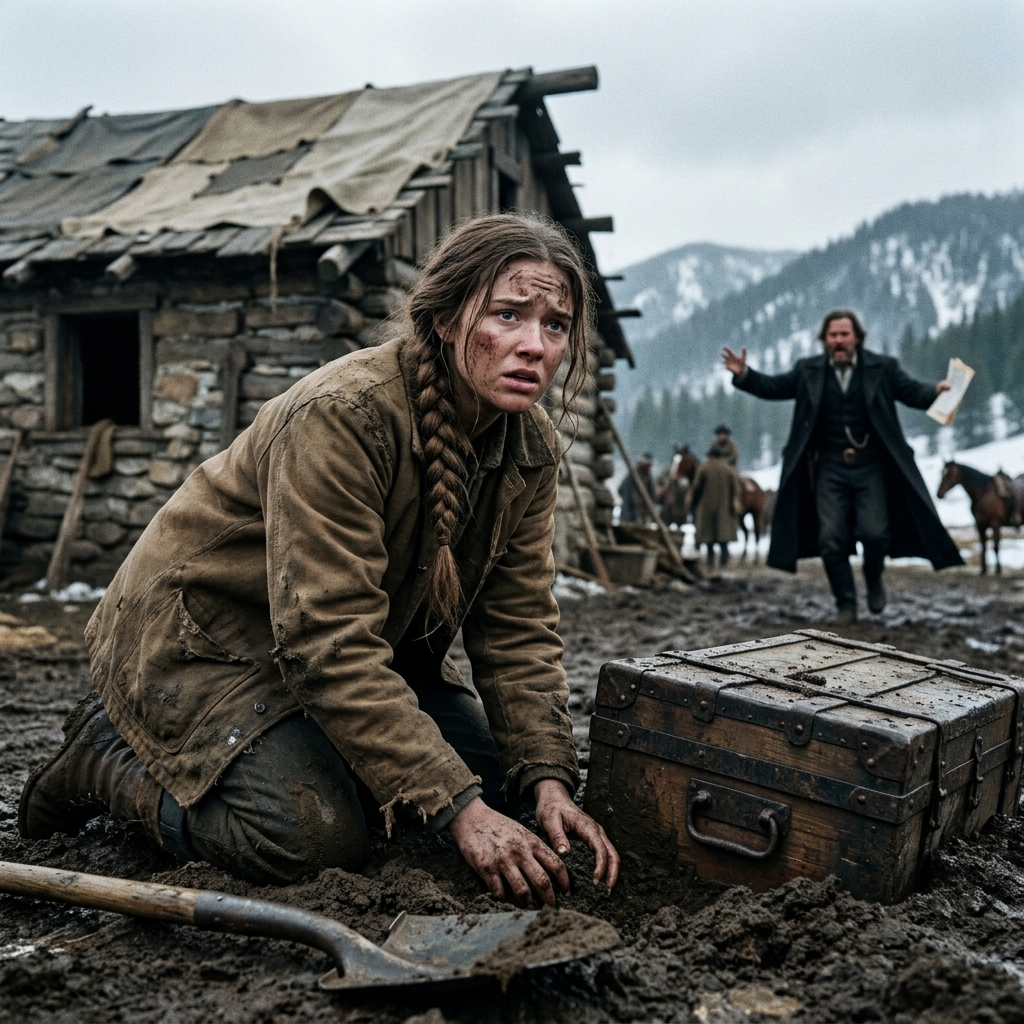
Then she picked up the shovel and drove it into the frozen earth.
The first strike jarred her shoulders.
The second cut through ash.
The third hit something that was not earth at all.
The sound was flat and hard.
Clara stopped breathing.
She knelt and scraped with both hands.
The dirt was cold enough to sting.
Ash packed under her nails.
A splinter opened the side of her thumb.
She kept clearing.
A corner appeared.
Dark wood.
Iron strapped.
Buried deep beneath the cabin floor.
Not lost.
Hidden.
Down by the road, a horse snorted.
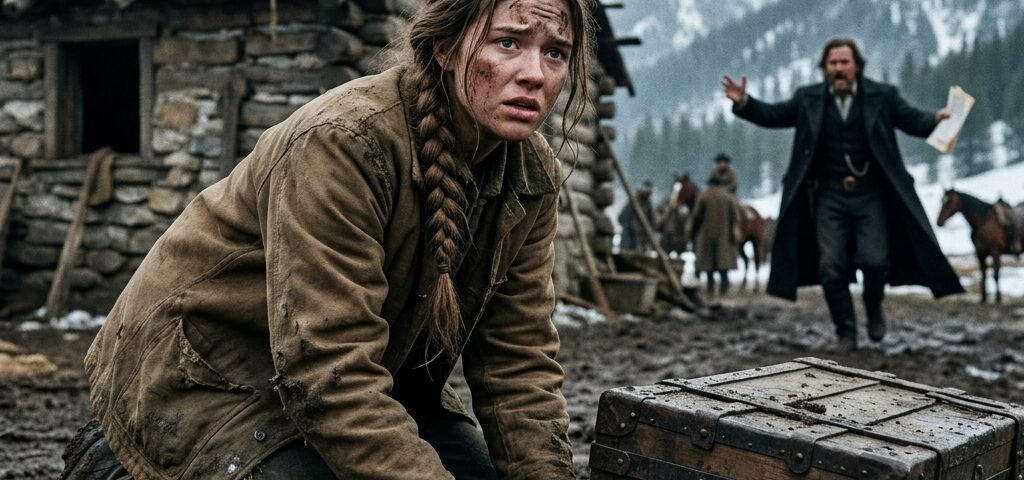
Clara looked up.
Gideon Rusk had come back.
This time, he had not come alone.
Mrs. Kettle stood by the split-rail fence with one hand pressed to her mouth.
One of Gideon’s men held a folded paper stamped with the county clerk’s seal.
Gideon saw the hole.
Then he saw the box.
All the smoothness drained out of him.
“Step away from that,” he called.
Clara placed her bleeding hand on the lid.
Mrs. Kettle whispered from the fence, “Clara… don’t open it in front of him.”
That was when Clara knew the box had a history bigger than the fire.
Gideon swung down from the saddle and started up the hill fast.
Too fast for dignity.
Too fast for a man pretending he had only come about taxes.
Clara dug her fingers beneath the iron lip and pulled.
The lid did not open.
Gideon was halfway up the slope.
“That property is under claim,” he shouted.
“Whose claim?” Clara called back.
He lifted the stamped paper.
“The county recognizes debt against the estate.”
Clara looked at Mrs. Kettle.
The older woman’s face had gone gray.
“What debt?” Clara asked.
No one answered.
So Clara did the only thing left.
She set the shovel blade beneath the rusted edge of the lid and leaned her whole weight onto the handle.
The wood groaned.
Gideon broke into a run.
The lid cracked upward.
Inside was a bundle wrapped in oilcloth.
Clara snatched it before Gideon reached her.
He grabbed for her wrist.
She stumbled back, clutching the bundle against her chest.
“Give it here,” he said.
His voice had lost every trace of gentleness.
Mrs. Kettle cried, “Gideon, don’t.”
That stopped him for half a second.
Not because he respected her.
Because she had said his name like a confession.
Clara tore the oilcloth open with shaking fingers.
Inside were papers.
Old papers.
A deed.
A bill of sale for timber.
A receipt bearing Gideon Rusk’s father’s signature.
And beneath them, a letter written in her father’s hand.
Clara knew the shape of that writing from the one birthday note Mrs. Kettle had allowed her to keep at the poorhouse.
The letters leaned slightly right.
The word Clara always looked as if her father had taken extra care not to hurry it.
Gideon lunged.
Clara stepped back onto the foundation stones.
“Read it,” Mrs. Kettle said, suddenly louder.
Gideon turned on her.
“Be quiet.”
But Mrs. Kettle did not lower her eyes.
For eighteen years, she had enforced the county’s rules because rules were safer than guilt.
Now she looked at Clara and saw not a ward leaving with a coat and twelve dollars, but a child who had been kept from the truth long enough for powerful men to grow comfortable.
“Read it,” she said again.
Clara unfolded the letter.
The paper trembled in her hands.
My Clara, it began.
If this reaches you, then I was right to hide what I found.
Clara’s vision blurred.
She blinked hard and kept going.
The hill is yours by deed, free of debt, witnessed and paid in full. If any man says otherwise, look to the receipt beneath this letter and ask why Gideon Rusk’s family took money for land they later claimed was never settled.
Gideon said, “That paper is old.”
Clara looked up.
“So is the lie.”
The hired man shifted by the horse.
Mrs. Kettle began to cry without making a sound.
Clara read the receipt next.
It named her father.
It named Gideon’s father.
It named the hill.
Paid in full.
The words sat there in brown ink, plain and stubborn as stone.
Alder Creek could ignore hunger.
It could laugh at a girl climbing a hill.
It could mistake silence for consent.
But paper had a way of embarrassing men who built their power on everyone else’s poor memory.
Gideon reached again.
This time, Clara raised the shovel between them.
Not high.
Not wild.
Just enough.
“No,” she said.
It was the same word she had said when he offered to relieve her of the land.
But now it had witnesses.
Mrs. Kettle stepped through the fence gap.
“I saw the original deed once,” she said.
Gideon froze.
“You saw nothing.”
“I was a young clerk at the poorhouse office when Clara was brought in,” Mrs. Kettle said. “Her father’s papers were collected. Most went missing by week’s end. I told myself it was not my affair.”
She looked at Clara.
“I have told myself that for eleven years.”
The hired man let go of the reins.
The horse lowered its head to the dead grass, unaware that a town’s oldest quiet had just split open.
Gideon still tried to smile.
It failed.
“No one will take the word of a poorhouse matron and an orphan girl over mine,” he said.
Clara folded the deed, the receipt, and the letter back into the oilcloth.
Her hands were still shaking, but not from cold now.
“Then we will take the papers to the county clerk,” she said.
Gideon laughed once.
“You think a clerk will stand against me?”
Mrs. Kettle wiped her cheek with the heel of her hand.
“Not one clerk,” she said.
From the road below came the sound of wagon wheels.
Mrs. Vale had returned.
So had the two men from the broken wagon.
So had the livery boy.
So had half the people who had spent two weeks watching Clara fail from a comfortable distance.
They had come for gossip.
They stayed for proof.
Clara looked at them and understood that witnessing could become something else if enough shame gathered in one place.
Not courage, exactly.
Not yet.
But motion.
By noon, the papers were on the county clerk’s desk.
By one o’clock, the clerk had pulled the old index book from the shelf with hands that were not nearly as steady as he wanted them to seem.
By 1:22 p.m., he found the entry.
The original deed had been recorded.
The debt Gideon claimed had no matching lien.
The tax notice had been filed improperly.
The hill belonged to Clara Whitcomb.
Free and clear.
Gideon Rusk stood in that office with his jaw clenched while the clerk made a certified copy.
Mrs. Kettle signed a statement.
Mrs. Vale signed as witness.
The livery boy, who had not spoken to Clara for days, held the door open when she left.
“Miss Whitcomb,” he said.
It was the first time anyone in town had put respect in front of her name and sounded as though they meant it.
Clara did not smile.
Not because she felt no joy.
Because some victories arrive carrying the weight of all the years they should have come sooner.
That evening, she climbed Larkspur Hill again.
The cabin was still burned.
The wind was still cold.
Her hands still hurt.
But the hill felt different under her feet.
Not rescued.
Recognized.
She set the certified copy of the deed inside the Bible, behind the pages where she had recorded every board, hinge, notice, and hour.
Then she built a small fire in a ring of stones and sat beside it until stars appeared over the ridge.
Mrs. Kettle came near dusk with a basket.
Bread.
Beans.
Coffee.
Two buttons wrapped in a scrap of blue cloth.
She placed the basket beside Clara and stood awkwardly, as if apology were a language she had never learned to speak aloud.
“I should have told you,” she said.
Clara watched the fire.
“Yes.”
Mrs. Kettle flinched, but she accepted the answer.
After a while, Clara picked up one of the buttons.
“Can you sew?” she asked.
Mrs. Kettle let out a broken little breath.
“I can.”
So they sat beside the fire while the older woman stitched the coat Clara had been handed as if it were charity.
Below them, Alder Creek glowed in small squares of lamplight.
Tomorrow, people would tell the story differently.
Some would say they always believed in Clara.
Some would say Gideon had gone too far only this once.
Some would say the papers had changed everything.
They would be wrong.
The papers had proved everything.
Clara had changed it when she walked up the hill with twelve dollars and refused to leave.
Years later, people would remember the morning she found the box as the day Alder Creek learned what kind of woman Clara Whitcomb had become.
But Clara remembered something else.
She remembered the poorhouse door closing with a click.
She remembered the coat with missing buttons.
She remembered everyone thinking the mountain would swallow her dreams before winter could.
And she remembered the first sound of iron striking the hidden box beneath the ash.
That was the sound of a girl with nothing left to lose discovering that the hill had been telling the truth all along.