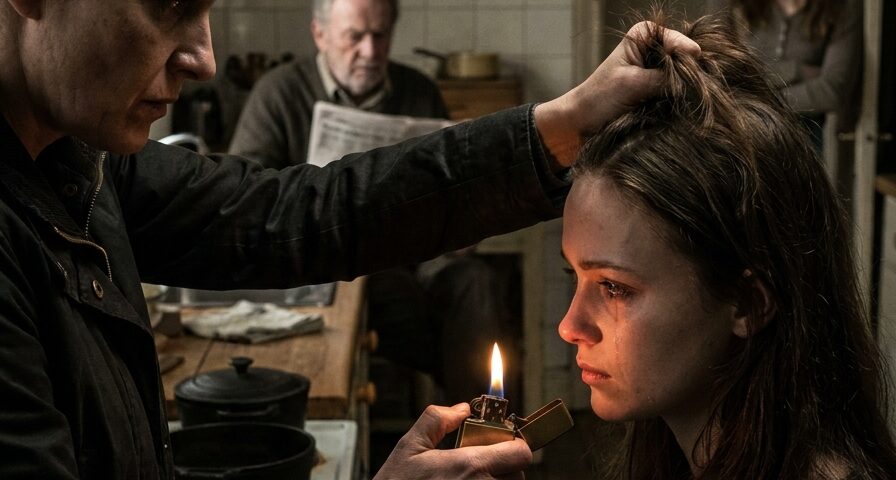
When I told my mother I had bought my first house after ten years of saving, she grabbed my hair and held a lighter close to my face. ‘You’re not even married,’ she hissed. ‘That money was for your sister’s wedding.’ Days later, the police knocked on my new front door in Monterey—and I realized my mother hadn’t just tried to scare me. She had built a lie big enough to destroy my life.
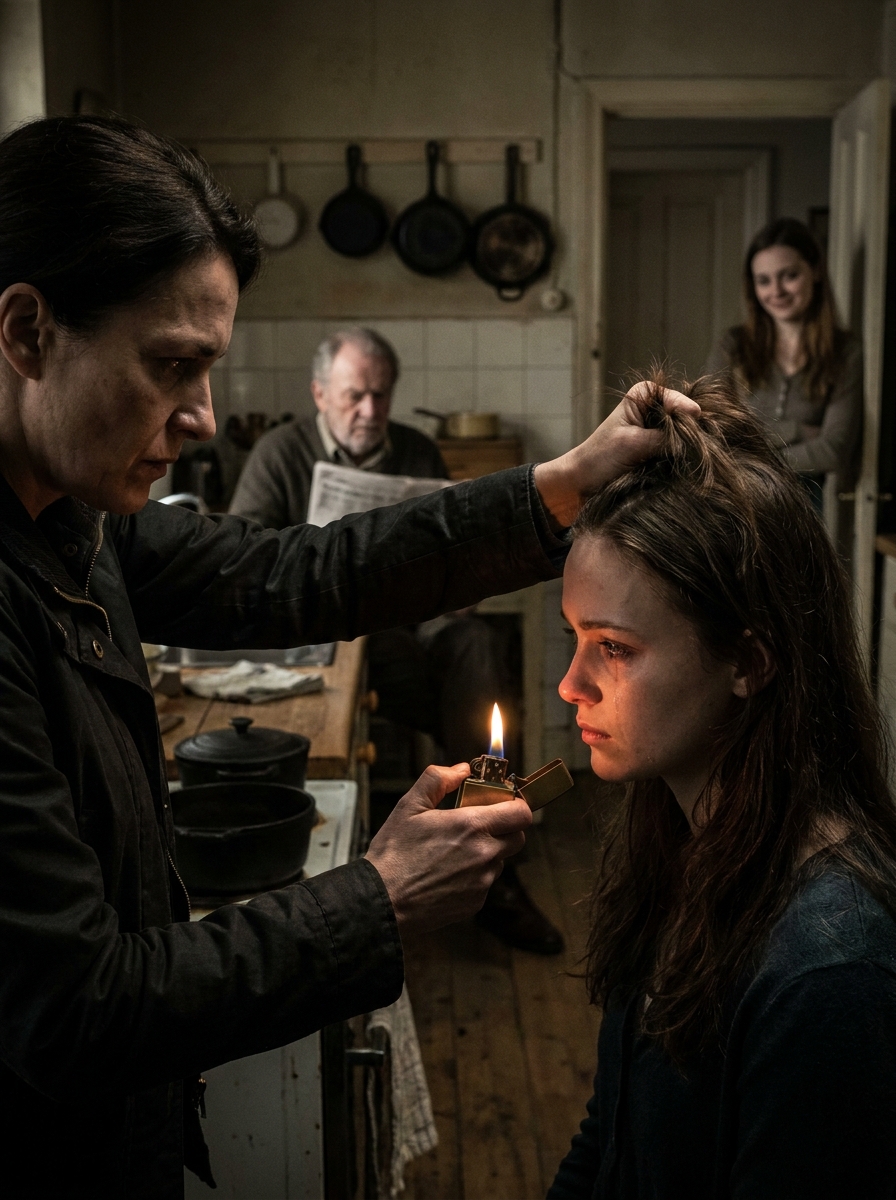
“You’re not even married,” my mother said, her voice low enough to sound almost civilized, “that money was meant to be the cornerstone for your sister’s wedding fund.”
She said it in the kitchen where I had learned to keep my shoulders down and my mouth shut.
The kitchen had a weathered wooden rooster clock hanging above the pantry, faded recipe cards taped inside a cabinet door, and a tiny ceramic sign over the sink that read Bless This Home, as if the walls themselves had not spent thirty years listening to people be broken politely.
My name is Joanna Simpson, though I go by Joanna, and I was thirty-six years old when I finally bought my first house.
It was not a mansion, not a showpiece, and certainly not something with a marble staircase or a swimming pool glittering behind tall, manicured hedges.
It was a small, white stucco cottage in Monterey, twelve minutes from the Pacific ocean if traffic was kind and twenty-five minutes if it wasn’t.
It had two bedrooms, one lone lemon tree in the backyard, dated tiling in the guest bathroom, and a kitchen window that caught the afternoon sun so cleanly it made the whole room feel forgiven.
To me, it felt like a miracle because I had spent ten long years earning every single square foot of it.
Ten years of leaving my apartment before the sun rose, clutching a travel mug of coffee with my hair still damp from the shower.
Ten years of saying no to expensive trips, no to luxury cars, no to girls’ weekends in Napa, no to new furniture, and no to anything that took me even one dollar further away from the life I was trying to construct.
I worked in operations for a medical device manufacturer, a job that was far from glamorous but paid the bills.
I tracked logistics, smoothed out disasters, and called warehouses in Reno and Spokane when a shipment inevitably went sideways.
During the peak of flu season, I took extra shifts, and during the holidays, I covered for colleagues with children because management always assumed single women were available.
“You don’t have a family waiting for you at home,” one supervisor had once remarked, saying it as if my personal time were public property.
I had merely smiled and agreed because I desperately needed the overtime pay to reach my savings goal.
That was my existence for a long time: smiling, saving, and telling myself that one day I would turn a key in a lock and the silence behind the door would finally belong to me.
When I finally signed the purchase contract, I sat in my beat-up car outside the escrow office with the folder in my lap and cried so quietly that nobody walking past would have noticed.
The agent had handed me a pen with a warm smile and said, “Congratulations, Joanna, you really did it.”
I realized in that moment that I had never once heard those words of validation from my mother, Linda, not when I graduated from university, not when I earned my first promotion, and not when I paid off my student loans.
My mother never congratulated me when I helped my father cover a medical bill he was too ashamed to admit he could not afford.
In my family, my accomplishments were never mine for long, as they were always treated as evidence that I had something to give.
If I was doing well financially, it meant I could be bled dry, and if I had savings, it meant somebody else in the family surely had a pressing need for them.
If I had finally found peace, someone in the house always felt they had the right to interrupt it.
Still, some foolish and tired part of me wanted to tell them the news.
Maybe I wanted one clean, honest moment where they saw me as a person.
Maybe I wanted my father, Peter, to look up from his newspaper and tell me he was proud.
Maybe I wanted my younger sister, Beth, to stop looking at me like a bank account with a pulse.
Maybe I wanted my mother to be a mother for just one afternoon.
So on a warm Friday evening, I flew from Monterey to a quiet suburb in Phoenix with the contract folder tucked securely inside my carry-on bag.
I rented a car at the airport and drove through the pristine neighborhood where the lawns were clipped short, the streets were wide, and the houses all looked like they were pretending that nobody inside them ever raised their voice.
My parents still lived in the two-story brick house where I grew up, located on a quiet cul-de-sac with a community church at one end and an HOA mailbox station at the other.
The crepe myrtle tree near the driveway looked exactly the same, as did the cracked walkway that my father had promised to fix since 2012.
The same kitchen light glowed yellow through the window, signaling that I was walking into the lion’s den once again.
My mother opened the door before I even had the chance to knock.
Linda was sixty-one then, still pretty in a sharp, carefully preserved way that suggested she had never known a day of true struggle.
She wore white capris and a pale blue blouse, her hair sprayed into a rigid shape that no Arizona humidity dared to challenge.
She looked me over from my shoes to my face, not like a mother seeing her daughter, but like a hostess checking whether an uninvited guest had dressed correctly for the occasion.
“You’re late,” she said, her voice dripping with irritation.
“My flight landed twenty minutes ago, and I had to deal with the rental car queue.”
“That is precisely why you should have booked an earlier one,” she replied, stepping back to let me inside.
I stepped into the entryway, and the house smelled like industrial lemon cleaner and baked chicken.
My father, Peter, sat at the kitchen table with a glass of iced tea sweating onto a paper napkin.
He had grown older in the way quiet, defeated men do, moving slowly and apologetically, as if his very presence were an inconvenience he did not want to cause.
“Hey, Joanna,” he said softly, offering a weak smile.
“Hi, Dad, how have you been?”
Beth was leaning against the hallway wall, scrolling mindlessly on her phone with one hip popped out.
At twenty-nine years old, engaged, and still treated like the family’s delicate, fragile bride-to-be, she possessed a voice that could cut glass whenever she felt she wasn’t being centered.
She glanced up from her screen and asked, “You flew all the way here with only one bag?”
“I am only staying for the weekend.”
“Oh, must be nice to travel so lightly,” she replied, her smile sharpening into something cruel.
I should have known then that the conversation would inevitably go downhill.
In that house, even a carry-on suitcase could be used as evidence against me.
Dinner was tense in the usual way, filled with performative conversation and forced smiles.
My mother asked about my job only long enough to determine whether I was making more money than I was the last time we spoke.
Beth talked endlessly about her wedding venue, her designer dress, and the professional photographer she insisted was non-negotiable for her big day.
My father nodded at all the right moments, moving his green beans around his plate as if they were a puzzle he couldn’t solve.
“The deposit is due next week,” Beth said, sighing dramatically for the whole table to hear.
“Derek’s parents are being impossible about contributing, claiming they already paid for the rehearsal dinner,” she added.
“That seems fair enough,” I said, trying to remain neutral.
Suddenly, three faces turned toward me with a mixture of shock and disdain.
My mother set down her fork and asked, “What exactly does that mean, Joanna?”
“I just meant that rehearsal dinners can be quite expensive these days.”
Beth laughed once, a sharp sound that lacked any real warmth.
“You simply do not get it because you have never even planned a wedding,” she retorted.
“No, I haven’t,” I replied, “but I have been busy planning my actual life.”
The words came out before I could stop them, hanging in the air like smoke.
My father looked at me then, really looked at me, and for one second, I thought maybe this was the moment of connection I had craved.
So, I reached for the thick folder resting beside my chair.
“I actually have some news I wanted to share with you all,” I said.
My mother’s eyes narrowed, not with genuine curiosity but with immediate, bristling suspicion.
I placed the folder on the table, opened it, and slid out the first page of the signed purchase contract.
“I bought a house in Monterey,” I said, trying to keep my voice steady. “It is close to the ocean, and I get the keys in two weeks.”
Nobody spoke for a long moment, and the only sound was the refrigerator humming in the background.
Outside, a sprinkler ticked rhythmically against the front window, and somewhere down the street, a neighborhood dog barked.
My father’s mouth parted slightly as he whispered, “You bought a house all by yourself?”
“Yes, I did,” I said, feeling a surge of pride that I desperately hoped they would mirror.
Something flickered across his face, perhaps pride or maybe deep grief, but with him, the two often looked the same because both emotions arrived far too late.
Beth made a dismissive sound in her throat.
My mother did not even look at the contract; she stared directly at me, scanning my shoes, my hands, and the folder, before settling her gaze back on my face.
“You’re not even married,” she said, her voice devoid of any warmth.
At first, I thought I had misheard her, as it was such an absurd response to a grown woman buying a home with her own hard-earned money.
But my mother had always believed a woman’s life only truly became real when it could be explained through the existence of a husband.
“What on earth do you need a house for?” she demanded, her tone rising.
I swallowed hard and replied, “To live in, Mom.”
“You already have an apartment, don’t you?”
“My lease is ending soon, and I wanted to invest in something permanent.”
Beth folded her arms tightly across her chest. “Monterey is outrageously expensive.”
“I know it is, which is why I have been saving for years.”
“So you had all of that money just sitting there while your sister is struggling?”
The kitchen seemed to change shape around me, the table feeling suddenly too small and the walls closing in.
“It wasn’t just sitting there,” I argued, “I worked extra shifts and saved every cent.”
My mother stood up slowly, pushing her chair back with a soft, grating scrape that made my father flinch.
“That money was supposed to go toward your sister’s wedding,” she stated, as if stating a fact.
“No, it was not,” I said firmly.
Her eyes hardened into glass. “Yes, Joanna, it was, and we have talked about this extensively.”
“No,” I said, “you talked about it, but I never once agreed to that arrangement.”
“We are family, and family helps each other,” she countered.
“I have helped plenty,” I reminded her.
That was when Beth laughed, not loudly, but with a dismissive amusement that landed harder because she truly meant it to hurt.
“You act like buying a house makes you better than everyone else,” Beth sneered.
I looked at my sister and said, “It makes me a homeowner, Beth.”
My mother stepped closer to me, and I could smell her perfume, powdery and expensive, the kind she wore to church lunches and bridal showers where she needed other women to believe she was a gentle soul.
“Do not embarrass me in my own house,” she hissed.
“I am not trying to embarrass you, I am just sharing my life,” I insisted.
“You came in here waving papers around while your sister is struggling to plan the most important day of her life.”
I looked at Beth, who had been engaged for six months and had already rejected three venues for not photographing well enough for her social media.
The so-called struggle was not about food, rent, or medical bills, but rather about whether her guests would walk through white roses or cream roses on their way to cocktails.
“My savings are not your wedding fund, Beth,” I said.
My mother’s face went unnaturally still, which was always the warning sign that the shouting would follow.
She stepped into my personal space and lowered her voice to a dangerous whisper.
“You have always been incredibly selfish, Joanna.”
I felt something inside me tighten with resolve.
“No,” I said, “I have always been useful, and there is a massive difference.”
My father whispered, “Joanna, please,” but he didn’t say stop, and he didn’t tell Linda that it was enough.
He said my name like I was the one standing too close to the flame.
My mother’s hand moved so fast that I didn’t understand what had happened until I felt a sharp pain shoot across my scalp.
She grabbed my hair near the roots and yanked my head back with surprising strength.
My chair scraped against the tile, and the folder slid sideways, with my documents fanning across the table.
My scalp burned, and tears sprang to my eyes from the sudden pain, though genuine fear followed quickly behind it.
My mother had slapped me before when I was younger and had grabbed my arm, but this was entirely different.
She held me in place with a precision that told me she had imagined doing this long before tonight.
Then I heard the distinct click of a metal lighter.
It was a small, silver lighter, the kind she kept in a kitchen drawer for birthday candles and the scented candles she lit whenever company came over.
The flame appeared inches from my hair, and my father stood halfway up, then froze in terror.
“Linda,” he said weakly, “that is enough.”
My mother did not look at him; she only looked at me.
“If you will not stay loyal to this family the easy way,” she whispered, “you will learn the hard way.”
The heat touched the edge of my face, not burning yet, but close enough to make my body understand what my mind did not want to believe.
My sister sighed from the hallway, “All this over a house? Just rent like a normal person and stop causing drama.”
I did not scream, I did not beg, and I did not move.
A strange, cold calm came over me as I smelled my own shampoo and the sharp chemical edge of the lighter fluid.
I saw my father’s hand gripping the back of his chair, and I saw my sister’s painted nails tapping against her phone case.
I saw my mother’s eyes, which were flat, certain, and devoid of love.
For the first time in my life, I truly understood that my mother did not want my love; she wanted ownership.
She snapped the lighter shut, and the flame died.
She released my hair like she was dropping a wet dish towel.
I reached up slowly and smoothed the place where she had grabbed me, my hand shaking only once.
I gathered my papers from the table while my mother laughed softly, saying, “Look at you, being so dramatic.”
I looked at her, knowing that real life isn’t always generous enough to provide a memorable, sharp parting line.
Sometimes the strongest thing you can do is simply leave before they get the satisfaction of seeing you break.
So I walked out the front door into the cool night air.
Behind me, I heard my sister mutter, “Good luck with your little beach house.”
My mother said nothing, and my father did not follow me.
That night, I checked into a hotel near the airport, sitting on the edge of the bed with all the lights on, listening to the air conditioner rattle beneath the window.
My scalp still hurt, and every few minutes, I reached up to touch my hair, half expecting to find it singed.I should have called the police, but people who grow up in houses like mine learn to measure danger in strange, distorted ways.
You tell yourself it wasn’t that bad because nobody went to the hospital.
You tell yourself she didn’t actually burn you, that families fight, and that reporting your own mother would make you the cruel one.
So I did what I had done since childhood, which was to minimize, and I flew home the next morning.
Two weeks later, I got the keys to my own sanctuary.
The first time I opened the front door to my house, I stood there for several seconds before stepping inside.
It smelled faintly of fresh paint and old wood, and the previous owner had left a wind chime on the back porch.
When the breeze moved through it, the sound was soft and uneven, like someone humming in another room.
I walked barefoot across the empty living room, hearing no television blaring, no mother calling from the kitchen, no sister rolling her eyes, and no father pretending the newspaper was more interesting than the truth.
Just white walls, quiet rooms, and sunlight falling across the floor in a perfect rectangle.
I placed my keys on the counter, and I cried, but this time not in a parking lot, not silently, and not with shame.
I cried because I was finally home.
For three days, I unpacked slowly, buying a cheap coffee table from a consignment store in a nearby town and ordering a mattress that came rolled in a box.
I found two mugs at a department store, one blue and one green, and put them in the cabinet like a promise that someday someone kind might sit across from me in that kitchen.
On the fourth evening, I made pasta, poured a glass of iced tea, and ate dinner on a folding chair while watching the sunset turn the walls a soft peach color.
At 7:42 p.m., someone knocked on my door with a firm, official rhythm.
I wiped my hands on a dish towel and looked through the peephole to see two police officers standing on my porch.
My heart dropped so fast the room seemed to tilt, but I opened the door with the chain still on.
“Joanna Simpson?” the taller officer asked.
“Yes, that’s me.”
“I’m Officer David Barnes, and this is Officer Judith Lopez. We need to speak with you about a report filed in Arizona and forwarded here to our precinct.”
“What is this about?” I asked, my voice barely a whisper.
“Your mother, Linda Simpson, claims you stole money from your family to purchase this home.”
For a second, all the air left my lungs.
Then I understood that the nightmare had not ended when I walked out of that kitchen; it had followed me all the way across the country.
Officer Barnes had kind eyes but a very careful voice, and Officer Lopez stood slightly behind him, watching everything.
Their patrol car sat at the curb in front of my lemon tree, the lights off, looking almost ordinary except for the way it made my new street feel suddenly exposed.
“May we come in and talk to you, Ms. Simpson?”
I looked at their uniforms, at the neighbors’ windows, and at my half-unpacked boxes.
My mother had always known how to make private things public, and she was clearly trying to weaponize the system against me.
“No, I would rather not,” I said as calmly as I could. “But I will speak with you, so let me grab my ID and my supporting documentation.”
Barnes gave a small, understanding nod.
I closed the door, locked it, and leaned against it for one breath before I moved.
I gathered my driver’s license, the purchase contract, escrow statements, bank records, pay stubs, tax forms, and the original folder I had carried into my mother’s kitchen.
I put everything in a tote bag and stepped back outside to meet them.
“I would prefer to do this at the station,” I stated firmly.
Officer Lopez’s eyebrows lifted slightly in surprise.
“Are you willing to come in voluntarily?”
“Yes, I want to clear this up immediately.”
The station smelled like burnt coffee, old paper, and floor cleaner.
They put me in a small interview room with a metal table and a camera in the corner.
I knew enough from television to feel nervous, but the nerves sat beneath something much steadier.
I had records and cold, hard facts, while my mother only had a malicious story, and those were not the same thing.
Officer Barnes sat across from me with a folder, and Officer Lopez took a chair near the wall.
“Your mother says you withdrew money from a shared family account,” Barnes began.
“I don’t have a shared family account, and I never have.”
“She claims money had been set aside over the years for your sister’s wedding.”
“Not by me, and not from my funds.”
“She claims you had access to family funds.”
“I have access to my own checking, my own savings, my own retirement account, and a high-yield savings account I opened in 2018,” I explained. “I can show you every single deposit I have made.”
I slid the documents across the table.
Barnes began reading, and Lopez took diligent notes.
The room stayed quiet except for the sound of paper moving and the faint hum of the ceiling vent.
I watched Barnes’s expression change slowly as his shoulders loosened and his pen stopped tapping.
He went back to the first page and compared dates repeatedly.
“This deposit history goes back ten years,” he noted.
“Yes, it does.”
“These are payroll deposits?”
“Yes, from my employer.”
“And the down payment came from the account ending in 4417?”
“Yes, that is correct.”
“Is Linda Simpson listed on that account?”
“No.”
“Is Beth Simpson?”
“No.”
“Is anyone else?”
“No, just me.”
Lopez looked up and asked, “Has your mother ever had access to your banking information?”
I hesitated because the honest answer was embarrassing.
“When I was in college, she helped me open my first account, but I changed banks years ago, or at least I thought I had changed everything.”
“Why would she believe she had a right to this money?” Barnes asked.
I almost laughed because the legal world had such clean language for things families made messy.
“She believes anything I earn belongs to the family if she decides the family needs it.”
Lopez’s face softened a fraction. “Has there been conflict before?”
I stared at the table, remembering my mother’s voice.
You will learn the hard way.
I had a choice then: keep it quiet, the way my father had for decades, or tell the truth in a room where someone was finally writing things down.
“Yes,” I said, “a few days ago, when I told my family I bought the house, my mother grabbed me by the hair and held a lighter close to my face.”
Barnes went completely still.
“Did she burn you?”
“No.”
“Did she threaten to?”
“Yes.”
“Did anyone witness it?”
“My father and my sister were both there.”
“Did you report it?”
“No.”
“Why not?”
I looked him in the eyes and said, “Because she is my mother.”
Nobody spoke for a long moment.
Then Lopez said gently, “Do you have any evidence of this?”
I took out my phone, and my hand was steady now.
“I recorded the conversation, as I had been doing for a while because I knew our conversations often turned ugly.”
I played the audio.
At first, there was only kitchen noise, plates clattering, my father clearing his throat, and my sister talking about flowers.
Then my own voice: I bought a house.
My mother’s anger rose through the speaker, thin and familiar.
You are not even married.
What do you need a house for?
Then the scrape of the chair, a muffled sound as she grabbed me, my father’s weak voice, and the click of the lighter.
Then my mother, calm as Sunday morning: If you won’t stay loyal to this family the easy way, you will learn the hard way.
When the recording ended, the room felt entirely different.
Barnes leaned back slowly, and Lopez looked at me not like a possible suspect, but like a woman who had carried a burning coal in her pocket and finally set it on the table.
“That changes the nature of this entirely,” Barnes said.
I nodded, my throat aching. “I am not trying to ruin anyone, I just want them to leave me alone.”
Lopez’s voice was quiet. “People who want to leave you alone don’t usually file theft reports across state lines.”
That was the first time anyone had said it plainly to me.
I was not being dramatic; I was being targeted.
They took my statement and copied my documents, telling me my mother’s accusation did not match the banking records.
Before I left, Barnes handed me a card.
“No contact,” he said. “If she calls, don’t engage. If she comes to your house, don’t open the door. If you have security cameras, check that they are working.”
“I don’t have cameras.”
“Get some, and get them today.”
So I did, and the next morning, I bought a video doorbell, two outdoor cameras, and new locks from a local hardware store.
A young employee helped me choose the right deadbolt, asking if I needed installation.
“My brother can do it,” I lied, not wanting to seem vulnerable.
I installed them myself by watching videos on my phone while sitting cross-legged on the floor.
It took all afternoon, but by sunset, my front door had a new lock, my porch had a camera, and my phone showed a live view of the street.
The next call came from my bank at 9:13 on a Tuesday morning.
“Ms. Simpson, this is Andrea with the fraud department, calling about unusual activity on your account.”
My body knew before my mind did.
“What kind of activity?”
“Several transfers over the last eight months to vendors in Arizona, mostly small amounts, and several to an event planning company.”
I sat down on the kitchen floor.
“I did not authorize these payments.”
Andrea’s voice became softer but more official.
“We are going to freeze external transfers immediately, so I need to verify some recent transactions with you.”
She read them one by one.
Bridal deposit, custom invitations, venue consultation, florist retainer, makeup artist, and a champagne wall rental.
I closed my eyes because my sister had mentioned wanting one at dinner, and I had thought how ridiculous it sounded.
The charges had been small enough to hide inside a busy life.
They totaled over eight thousand dollars.
My sister’s wedding had been growing out of my bank account like mold behind drywall.
“How?” I asked.
“Some transactions appear to have been initiated using saved credentials from a device in Arizona,” Andrea explained. “Change every password immediately, including your email, banking, and cloud storage.”
By the time I hung up, my hands were cold, but I did exactly what she said.
Then I called the number on the police officer’s card, and then I called a lawyer named Jessica Webb.
Jessica did not waste words, and her office was tucked between a dental practice and a tax preparer.
I sat across from her desk and told her everything: the house, the kitchen, the lighter, the false police report, and the bank transfers.
Jessica listened without interrupting, except to ask for specific dates.
“Your mother escalated because you created a boundary she could not ignore,” she said.
“That sounds expensive,” I sighed.
“It usually is, but we will respond with evidence.”
For the next week, my life became paperwork.
Bank affidavits, police reports, copies of emails, screenshots, and a written timeline of every family conversation related to money.
My mother called twelve times in one day, but I did not answer.My sister texted: Mom says you went crazy at dinner. Are you seriously trying to get her in trouble because she asked for help?
Then another: You are jealous because I am getting married and nobody wants you.
I sent everything to Jessica.
The cease and desist letter went out on a Thursday, and my mother called six minutes after the law office confirmed delivery.
Jessica told me to answer with her present, so I put my phone on speaker in her conference room.
“Hello, Mom,” I said.
“You are going to drop that complaint,” she demanded.
“What complaint are you talking about?”
“Do not play stupid with me, Joanna.”
“I am not playing anything.”
“You are ruining your sister’s wedding, you selfish girl.”
“No,” I said, “someone used my money without permission.”
A sharp silence followed.
Then my mother said, “You lived under my roof for eighteen years.”
I stared at the phone. “What does that have to do with my bank account?”
“Everything, because everything you have came from this family.”
“That is not true.”
“I fed you, I clothed you, and I sacrificed so you could go off and act better than us,” she spat.
I took a breath and asked, “Mom, did you take money from my account?”
A pause followed, and I hoped she would deny it.
Then she laughed.
“Take? Don’t be ridiculous, I just moved what belonged where it was needed.”
My heart began beating so hard I could hear it.
“So you accessed my account?”
“Your account,” she repeated, mocking me. “You act like a bank login makes you separate from us, but you are my daughter.”
“Did you send money to the wedding vendors?”
“Of course I did, because somebody had to help her while you were being selfish.”
I hung up the phone.
The room went silent.
Jessica reached across the table and patted my hand.
“Good,” she said, “very good.”
The bank investigation moved quickly once my mother admitted what she had done on the recorded call.
The hardest part was the silence that followed.
When a controlling family loses access to you, your body does not immediately celebrate; it waits, it listens for footsteps, and it expects the next emergency.
For weeks, I woke at 3 a.m. and checked the camera feed, only to see an empty porch and a quiet street.
One Friday, a letter arrived from my sister, Beth.
It came in a pale pink envelope with my name written in her looping, bridal shower handwriting.
I stood by the mailbox for a full minute before opening it.
Emily, I hope you are happy. Mom is crying every day, Dad barely talks, and we had to cancel the expensive champagne wall because of what you did. I know you think you are proving a point, but all you are proving is that money matters more to you than family. I hope that house keeps you warm when you are old and alone.
There was no apology, no concern, and no embarrassment that my money had been used without permission.
I folded the letter and put it in the evidence folder.
Then I made coffee.
The first court hearing was back in Arizona, and I flew there with Jessica.
Walking into that courthouse felt like walking into an old version of myself.
My mother was there in a cream blazer, pearls, and the wounded dignity of a woman prepared to perform for strangers.
My sister sat beside her, and my father stood near a vending machine.
When he saw me, his face changed.
“Joanna,” he said.
My mother turned, startled because I was not alone.
We entered the hearing room, which was smaller than I expected, with ordinary people waiting for their private disasters to be called.
My mother tried to cry.
She said I had always been difficult, that I had misunderstood family expectations, and that the money had been verbally promised.
“She recorded me in my own home,” my mother said, turning to the judge.
Jessica’s co-counsel, Howard, stood up.
“Your Honor, the recording captures Mrs. Simpson threatening my client with a lighter after demanding access to funds that were solely in my client’s name.”
The judge looked down at the papers, then at my mother, then at me.
“Mrs. Simpson, did you access your daughter’s bank account?”
My mother’s mouth tightened.
“I used information available to me as her mother.”
The judge blinked once. “That is not what I asked.”
My mother glanced toward my sister, who stared at the floor.
The bank records did what truth often does when people finally let it into the room; they simplified everything.
My father was asked whether he had witnessed the kitchen incident.
He stood with one hand on the railing, his face pale.
My mother watched him, as did my sister, and as did I.
For thirty-six years, my father had survived by looking down.
This time, he looked at the judge.
“Yes,” he said, barely above a whisper. “I saw it.”
My mother’s head snapped toward him in shock.
“She grabbed Joanna by the hair,” he continued, his voice shaking. “She had the lighter close to her, and I told her to stop.”
The words were not dramatic, and they were not enough to erase the years he had failed me, but they were true.
The judge ruled in my favor on the civil matters.
Afterward, my sister finally looked at me.
“You could have just helped us,” she said.
I stared at her. “I did for years, and it was never enough.”
My mother walked past me without stopping, but at the end of the hall, she turned.
“You will regret this,” she said.
Howard sighed, “Ma’am, I would strongly advise you not to threaten my client in a courthouse.”
A week later, at 10:28 p.m., my phone lit up with a motion alert.
I was in bed, and I opened the camera feed.
My mother stood on my porch.
She was in California, at my house.
She wore black pants, a beige cardigan, and the same calm expression she had worn in the kitchen.
She rang the bell once, twice, three times.
I did not move, but I called 911 from my old phone while watching her on the camera.
When the police arrived, my mother straightened instantly.
“I am her mother,” she said, smiling sadly. “There has been a misunderstanding; my daughter is unstable, and I came all this way because I am worried about her.”
I almost laughed from inside the dark house.
Even then, she reached for the same tired costume.
I spoke through the doorbell speaker.
“There is a no-contact order. I did not invite her here.”
My mother’s smile vanished, and she hissed, “You ungrateful little liar.”
The officer heard that, too.
My mother was escorted off the porch, and I never saw her again.
The wedding still happened with silk flowers and a sheet cake from a grocery store.
Two months later, my father called from a number I did not recognize.
“Emily?”
“Yes.”
“It’s me.”
“I know.”
A long silence passed.
“I am staying with your Uncle Ray for a while,” he said.
“Okay.”
“I left your mother.”
I closed my eyes.
“I should have stopped her years ago.”
“Yes,” I said.
“I was afraid of her.”
“I know.”
“That’s not an excuse.”
“No,” I said, “it isn’t.”
“I am sorry, Joanna.”
“Thank you for saying that,” I said.
“I don’t expect you to forgive me.”
“Good,” I said, and surprised myself. “Because I don’t know what I am ready to do.”
Months later, my father sent me a letter.
I am sorry, it said. You deserved a father who stood up before a judge made it necessary. I am not asking for a phone call, but I am proud of you.
I read the last line three times.
Spring came to Monterey with marine layer mornings and bright afternoons, and my lemon tree bloomed again.
I learned to sleep through the night without checking the cameras every hour.
One Saturday, almost a year after the night my mother came to my porch, I drove to the beach before sunrise.
I stood there as the sky changed color.
For years, I had thought freedom would feel loud, like a slamming door or a grand victory.
But freedom was quieter than that.
It was knowing nobody had the code to my bank account, a phone that did not light up with demands, and a front door that stayed closed unless I chose to open it.
It was understanding that peace is not empty, but rather full of everything chaos never gave you room to hear.
When I got home, there was a small package on the porch from my father.
Inside was the rooster clock from my parents’ kitchen.
I sold the house, his note said. I thought about keeping this, but it belongs to the past.
I stood in my kitchen holding that ugly clock while sunlight poured through the window of the house I had bought with my own money.
I took a screwdriver, opened the back, removed the batteries, and listened as the ticking stopped.
That was enough.
I drove it to a donation center and let it become just a clock.
That evening, I baked a lemon pie, and when my neighbor, Mrs. Alvarez, knocked on the door with a plate of tamales, I did not check the camera.
I opened the door and said, “Come in, I’m home.”
My mother once told me family was everything, but I know better now.
Family is not everything, especially when it costs you your safety and feeds on your silence.
A house is not only walls and a roof; sometimes it is a line in the sand and proof that a life can belong to the person living it.
I still have bad days, but then I hear the wind chime on the back porch, I see sunlight on the floor, and I remember.
The nightmare ended because I changed.
I stopped asking people who wanted control to give me permission to be free.
Every evening, when the house settles around me, I feel the quiet truth of what I built, paycheck by paycheck, boundary by boundary, key by key.
This is my home, and no one who threatened to burn my life down will ever be allowed to live inside it again.
THE END.