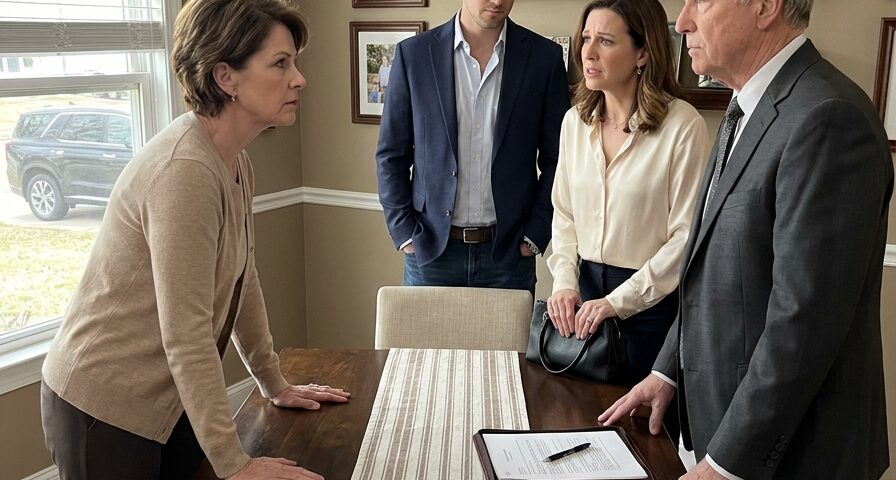
My husband Walter sat across from me at our kitchen table and said…
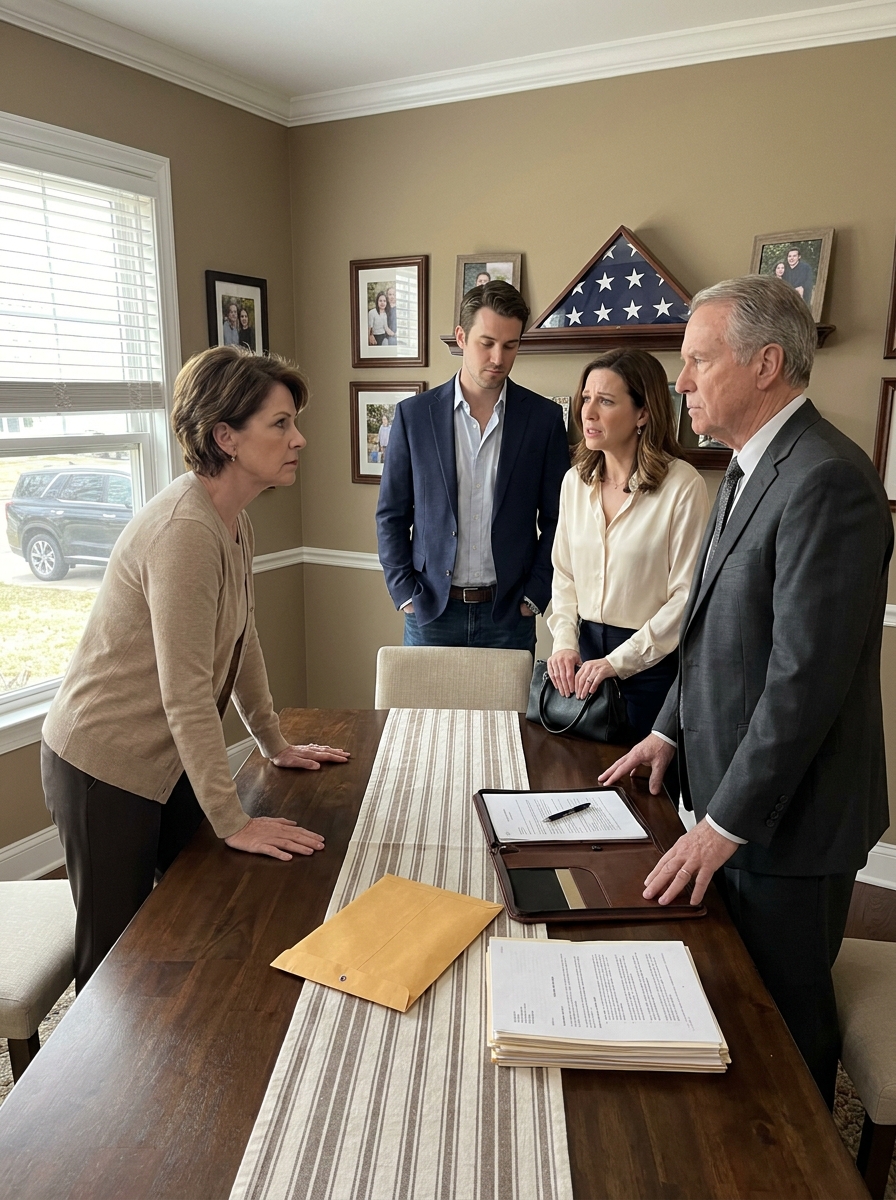
My Husband Secretly Told Me to Move Everything Out of Our Joint Accounts — 72 Hours Later, My Son Came to the Door With a Lawyer
There is a sound a house makes when it knows something is wrong.
I do not know how else to explain it. It is not a creak in the walls or a draft slipping under the door. It is quieter than that. Heavier. Like the rooms themselves are holding their breath.
I noticed it the night my husband, Walter, came home from his doctor’s appointment and did not say a word about what they had told him.
He set his keys on the kitchen counter the way he always did. He poured himself a glass of water. Then he stood at the kitchen window, looking out over the backyard we had tended together for thirty-one years.
I asked him how it went.
He said, “Fine.”
Walter had never been a man who wasted words, but that night, fine was not the word I needed to hear.
Somewhere deep in my chest, I already knew it.
We built everything ourselves.
And I do not mean that in some soft, sentimental way. I mean it literally. Walter started his trucking company out of a one-car garage in 1987 with a secondhand flatbed, a handshake agreement with a lumber supplier two counties over, and more nerve than money.
I kept the books on yellow legal pads for the first three years.
By the time our son, Denton, reached middle school, we had fourteen trucks. By the time he graduated high school, we had forty-one. We were not flashy people. We lived in the same house we had bought when we first got married, only adding to it twice when the business grew and the family needed more space.
We drove practical cars. We paid our bills on time. We sent Denton to a good school and paid cash for it.
What we had, we earned.
I say that because it matters to what came next.
Three weeks after that quiet night at the kitchen window, Walter sat me down at the dining room table.
It was the same table where we had signed mortgage papers, celebrated birthdays, argued over every major decision, and eaten thousands of ordinary dinners that I would later wish I had appreciated more.
He looked older than he had the day before.
Not by years.
By truth.
Then he told me.
Stage four.
Pancreatic cancer.
The doctor had given him a timeline, and Walter had spent three weeks carrying it alone before he could make himself say it out loud to me.
I did not cry right away.
I held his hand and listened.
That was what we did. We listened to each other. Even when the news was the kind that rearranged everything inside you, we listened first.
But then Walter said something I did not expect.
“I need you to do something,” he said, “and I need you to do it before the end of the month. Before anyone else finds out.”
I stared at him.
“What?”
“I need you to take your name off the joint accounts,” he said. “Open two new accounts in your name only. Transfer everything into them.”
For a moment, I thought grief had misunderstood him for me.
“Walter, what are you talking about?”
He was quiet for a long moment.
Then he said, “Denton’s wife has been calling the company attorney. Asking questions she has no business asking.”
Her name was Suki.
Denton had married her six years earlier in a ceremony we paid for, at a venue she chose, with a guest list she controlled. I had smiled through all of it because she was my son’s wife, and I wanted to believe she loved him.
I had tried.
For six years, I had tried.
“What kind of questions?” I asked.
Walter looked at me with the kind of tired that does not come from one bad night.
“She already knows I’m sick,” he said. “Someone told her. And she is trying to understand what happens to the company when I’m gone.”
I sat with that for a long time.
“She is not entitled to anything,” I said finally.
“No,” Walter said. “But she will try anyway. And Denton will let her.”
That was the hardest part.
Not what Suki might do. We both knew who Suki was by then, even if we rarely said it plainly.
The hard part was Walter saying out loud what we had both been unwilling to admit for years.
Our son had become a man who let his wife lead him into places he never would have gone on his own.
I opened the accounts the following Tuesday.
By Thursday, I had transferred everything Walter told me to move. He sat at the kitchen table with his reading glasses on, checking each confirmation number against a handwritten list.
When it was done, he folded the paper, put it inside an envelope, and wrote my name across the front.
“Do not open this until you need to,” he said.
I wanted to argue.
I wanted to tell him I needed it now. I needed everything now. I needed a cure, a promise, a miracle, some reason to believe the man sitting across from me would still be sitting there next spring.
But Walter’s eyes were steady.
So I took the envelope and placed it in the back pocket of my winter coat, where I kept things I needed to remember but did not want to look at.
Walter died on a Sunday morning in March, fifty-nine days after he told me he was sick.
He went quietly, the way he had lived.
I was holding his hand.
The hospital room smelled faintly of lavender soap because I had brought a bar from home. Walter hated the smell of hospitals, and by then there were so few things I could still do for him that the soap felt important.
He was sixty-four years old.
I drove home by myself because I had asked everyone to leave me alone that morning. I sat in the driveway for a long time before I went inside.
The house was just a house then.
Full of thirty-one years of life.
And completely, utterly silent.
I did not sleep that night.
I sat in Walter’s chair by the window and watched the sun go down and come back up.
Denton called the next morning.
He said he was sorry.
He said he loved me.
He said he would come by Wednesday so we could go through some things together.
I said, “Okay.”
At first, I did not think much of it.
Going through things sounded normal. There was a lot to sort out. Papers. Arrangements. The service. The company. The kind of awful practical details that arrive immediately when your heart has not even accepted the loss yet.
I told myself I was reading too much into the way he said it.
Wednesday came.
Denton arrived at eleven.
Suki was with him, which I expected.
But there was a third person with them.
A man I did not recognize stood on my porch carrying a leather folio. He wore a suit that was a little too expensive for a house call.
I looked at my son.
He would not quite meet my eyes.
“Mom,” he said, “this is Mr. Ferris. He is an attorney.”
I stepped back and let them in because what else do you do?
Your son shows up at your door three days after his father dies, and you let him in. You make coffee. You sit across from the boy you raised and try to find him somewhere in the man’s face.
Mr. Ferris placed his folio on my dining room table and opened it as if he owned the room.
He said he was there on behalf of certain interested parties regarding Walter’s estate.
I raised one hand.
“My husband has been gone for seventy-two hours,” I said.
He paused.
“I understand this is a difficult time.”
“Do you?” I asked. “Because I have not even chosen the flowers for his service yet.”
Suki reached across the table and touched Denton’s arm.
It was a small gesture, but I had seen it before. With Suki, that touch was never only affection. It was a signal. A command.
Denton straightened.
“Mom, we just need to understand what is happening with the company,” he said. “What the transition plan looks like. Dad would have wanted everything to be clear.”
I looked at my son for a long moment.
Walter had worked himself half to death, then the rest of the way, building something for this family. Denton had grown up watching it. He had spent two summers working in dispatch before deciding the business was not for him, which was fine. We never pushed him.
He went into real estate and did well enough. We were proud of him.
But somewhere in the last six years, well enough had started to look smaller next to what Walter had built.
And I think that was when the math changed in Denton’s mind.
Or maybe in Suki’s mind first.
Then his.
“Your father had a plan,” I said. “You will hear about it when the time is appropriate.”
“We would like to hear about it now,” Suki said.
She had a particular way of speaking. Very level. Very controlled. Like every word had been rehearsed in front of a mirror.
I had always found it unsettling.
Now I found it something else entirely.
I stood.
“I would like you all to leave,” I said.
Mr. Ferris looked uncomfortable.
Denton looked at Suki.
Suki looked at me.
“Mom—”
“You brought a lawyer to my house,” I said. “Three days after your father died. Without calling. Without asking. You sat at his table, and you brought a man with a folio.”
I kept my voice steady.
I had learned a long time ago that the steadier your voice, the harder it lands.
“Get out of my house,” I said. “All three of you.”
They left.
I stood in the kitchen until I heard the car pull out of the driveway.
Then I went to the coat closet, reached into the back pocket of my winter coat, and took out the envelope Walter had given me.
I sat down at the dining room table and opened it.
His handwriting was neat and small, the way it had always been.
The letter explained everything.
Not just the accounts. He had already walked me through those.
It explained the rest.
The company structure, which Walter had quietly reorganized eighteen months earlier with a different attorney, one Suki had never had reason to contact. The majority ownership, which had been transferred solely into my name before his death. Fully documented. Fully legal.
The minority share, twenty percent, set aside in a trust for Denton.
Accessible when he turned fifty-five.
Non-transferable to a spouse.
Protected from divorce.
Protected from Suki.
At the bottom of the letter, written in different ink, as if Walter had added it later, were the words that finally broke me.
I am sorry I did not say this sooner. I saw it coming for a long time. I just did not want it to be true.
I folded the letter and held it for a while.
Then I called our real family attorney, Elaine, who had known us for twenty years, and told her everything.
What followed was not quick.
And it was not easy.
But it was thorough.
Mr. Ferris, it turned out, had not been retained by Denton. Not jointly. Not by any legitimate representative of Walter’s estate.
He had been retained by Suki directly, using a credit card in her own name.
Six weeks before Walter died.
Six weeks.
Which meant she had known, or suspected enough to prepare, before the rest of the family had been told anything.
When Elaine uncovered that through billing records Mr. Ferris had not been careful enough to hide, it opened a different kind of question.
How had Suki known about Walter’s condition?
Who had told her?
The answer came from an unexpected place.
There was a woman who had worked as an administrative assistant at Walter’s doctor’s office for eleven years. Her name still makes me close my eyes when I think about it, because the connection was so old and so thin that no one thought to look for it.
Years earlier, back in college, Denton had dated her briefly before he ever met Suki.
Suki had found her.
Maintained a quiet relationship with her over the years.
And when Walter’s diagnosis came through, that woman made a phone call she never should have made.
She lost her job.
She faced a licensing board review.
She never worked in health care again.
Suki was served with papers related to the unauthorized disclosure of protected medical information. There were civil proceedings. Eventually, there was a settlement I am not permitted to discuss in specific terms.
But I will say this.
It was significant enough that Suki could not simply walk away from it.
As for Denton, my son sat across from me in Elaine’s office on a Tuesday afternoon in May, seven weeks after his father’s funeral.
For the first time since all of it had begun, Suki was not in the room.
She had her own attorney by then.
Elaine had made it very clear that their interests were no longer the same.
Denton looked like he had not slept in a long time.
Honestly, he looked like his father.
The tired version.
The version Walter became when something heavy was sitting inside him and he had not yet found the words for it.
I did not speak first.
I waited.
Finally, Denton said, “I did not know about the doctor’s office.”
I believed him.
That was the hard part.
I believed him.
“But you knew she hired Ferris,” I said.
He did not answer.
Which was its own answer.
“You let her,” I said. “You knew what she was doing, and you let her bring that man to my house three days after your father died. You sat there and let her speak.”
Denton put his face in his hands.
I had rehearsed that moment.
For weeks, I had imagined myself saying all the things that came to me at three in the morning, when grief and anger took turns with me and neither one let me rest.
I had a whole speech ready.
Hard things.
True things.
The kind of things a mother should never have to say to her son.
But sitting there, looking at him, I found I did not want to give the speech anymore.
What I felt, more than anger, was another kind of grief layered on top of the first.
The grief of watching someone you love become less than who they were.
The grief of knowing you can raise a child with everything you have and still lose him to weak choices and the wrong company.
“Your father loved you,” I said. “He left you a share of everything he built. He made sure you would be taken care of. And you sat in that room.”
Denton said nothing for a long time.
Then he whispered, “I know.”
The company is still mine.
I run it now with a management team Walter helped me choose in those last months. He had been thinking ahead even then, making sure I would not be alone with it.
We have sixty-three trucks now.
I go into the office three days a week.
I know every driver’s name.
Denton and Suki divorced eight months after Walter’s death. He called me the night it was finalized. We talked for a long time.
We are not all the way back to where we were.
I do not know if we ever will be.
But we talk now.
Honestly, that is more than I hoped for in those dark weeks when I sat in Walter’s chair and watched the sun come up.
I still wear the winter coat.
The pocket is empty now, but I keep the coat.
There is something I learned from all of this that I did not expect to learn.
It was not really about money, though money was what they were after. It was not even only about greed, though greed was certainly there.
It was about love.
Real love.
The kind that prepares for you even when it is tired. Even when it is scared. Even when preparing means sitting at a kitchen table with reading glasses on, checking confirmation numbers against a handwritten list because the person you love will need solid ground after you are gone.
Walter knew what was coming.
He could not stop it.
But he made sure everything he had built, everything we had built together, landed somewhere safe.
It landed here.
With me.
And I intend to take care of it.
I have had a lot of time to think about what happened.
Not just the legal side. Not just the paperwork, the accounts, the company transfer, the settlement.
The deeper question underneath all of it.
How does a family end up in a room like that?
How does a son sit across from his grieving mother with a lawyer’s folio on the table and tell himself it is acceptable?
I do not think Denton was born that way.
I raised him.
I know who he was before.
What I have come to understand is that people make choices. Small ones. Quiet ones. Over and over. Each choice either builds something in you or takes something away.
Denton made a series of small choices.
He looked away when he should have looked closer.
He stayed quiet when he should have spoken.
He let someone else steer him.
And those choices accumulated until they became the man standing at my door seventy-two hours after his father’s death.
That was not fate.
That was not punishment from above.
That was what his choices had been making him all along.
Walter understood that.
That is what I keep coming back to.
In those last months, exhausted and sick and frightened in ways he never admitted out loud, he still made the harder choice every time.
He could have ignored what he suspected about Suki.
He could have told himself it probably would not matter, that Denton would never let things go that far.
Instead, he sat at the kitchen table and did the work.
He protected me.
Not out of bitterness.
Not out of suspicion.
Out of love that was also wise.
That combination is rarer than people think.
Walter could see people as they were without needing them to be different in order to love them. He saw what Suki was. He saw what Denton had allowed himself to become.
And he loved his son anyway.
You could see it in the trust.
He made sure Denton was not cut off entirely. He made sure there would still be something waiting for him at fifty-five, if he found his way back to himself.
That kind of intelligence is not cold.
It is the opposite.
It takes real courage to look clearly at something painful and still respond with care instead of cruelty.
As for me, I will not pretend the last year has been easy.
There are mornings when I still reach for Walter before I remember. There are days when I look across the room at his empty chair, and the grief is as fresh as it was the first week.
I do not think that ever fully goes away.
Maybe it is not supposed to.
But I also know I am still standing.
The company is still running.
Sixty-three drivers show up to work every morning because Walter built something real, and I have kept it real.
There is a kind of strength you do not know you have until you absolutely have to find it.
I found it.
I am still finding it.
Denton called last week.
We talked about nothing important. The weather. A restaurant he tried. A memory of his father from when he was young.
It was a small conversation.
But it was honest.
And right now, honest is enough.