I Found My Son By The River After Midnight …
Bleeding, My Son Whispered, “Her Dad Said People Like Us Deserve This.” And My Sister Knew Exactly What To Do.
I found my son eleven days before Thanksgiving, lying on the gravel bar at Hutchins Landing, one boot missing and his body half-hidden in the cold shine of my headlights.
For a second, my mind refused to understand what I was seeing.
The river moved quietly beside him. The night was black enough to swallow the trees. Gravel crunched under my boots as I ran toward him, calling his name in a voice I barely recognized as mine.
“Caleb.”
He didn’t answer.
I dropped to my knees beside him, my hands already shaking before I even touched him. He was thirty-four years old, but when I rolled him carefully onto his back, he felt light in my arms, too light, like the boy I used to carry in from the truck after long drives home.
His face was swollen. His coat was torn. His breath came shallow and uneven.
But he was alive.
I kept saying that to myself.
Alive.
Alive.
Alive.
His good hand caught the front of my jacket, fingers twisting into the fabric with whatever strength he had left.
“Mama,” he whispered.
“I’m here,” I said. “I’m right here, baby.”
His eyes tried to focus on me.
Then he said the sentence that I would hear in my sleep for months afterward.
“Her daddy did this. He said people from the hollow don’t get a seat at his table.”
The river kept moving.
The woods stayed silent.
And something old in me, something my father had planted long before I was a wife, a widow, or a mother, rose up from a place I thought life had buried.
I wrapped Caleb in the quilt I kept behind the truck seat and got him into the cab with the help of Burl Hutchins, the man who had found him while checking lines near the landing.
Burl was a good man, the kind these hills still grow if you know where to look. He stood there under the swinging light of his lantern, jaw tight, eyes turned toward the river like he wished the water itself could explain what had happened.
“I called for help,” he said quietly. “But you know how far out we are.”
I knew.
Out here, help always came late. Trouble never did.
Caleb grabbed my sleeve again before I could shut the door.
“Mama,” he breathed, fighting for every word. “Don’t take me where he has people.”
A different woman might have dismissed that as fear talking.
I didn’t.
I had lived in Kentucky long enough to know what a powerful man’s name could do in a small county. I knew whose campaigns he funded, whose cousins he employed, whose buildings carried his name over the front entrance in polished steel.
I also knew my son.
Caleb did not make things up.
I looked at Burl.
He looked back at me for a long second, then lowered his voice.
“Cora,” he said, “tonight I saw nothing but catfish.”
I nodded once.
Then I drove.
My name is Cora Greer, and I was born sixty-three years ago in a four-room house at the head of Sawmill Hollow. My mama said I came into this world during a thunderstorm, hollering louder than the rain. My daddy said that was because creek water was already running in my veins.
People in town used to say that like an insult.
Creek kids.
Hollow folk.
Coal dust under the fingernails.
Secondhand boots and church supper casseroles.
My mama never took offense. One time outside the IGA, an older woman said, “You people always smell like creek water.”
Mama just smiled and said, “Yes, ma’am. And creek water cuts through rock.”
I didn’t understand the full weight of that sentence until the night I found my son on that riverbank.
My daddy, Amos Greer, came up in the mines like his father before him. When the mines started breaking men faster than families could bury them, he took to guiding fishermen, hunters, and anyone willing to pay for a day on the Crooked Fork.
He taught me and my little sister Ramona everything the river and ridges had to teach.
How to read tracks in mud.
How to sit still long enough for the woods to forget you were there.
How to listen before moving.
How to know the difference between fear and warning.
Most important, he taught us that panic is a luxury poor people cannot afford.
I carried that lesson into adulthood.
I married a good man named Elton. He died six years ago in the garden, right between the tomato rows, which is exactly where he would have chosen if the Lord had asked him. I spent thirty-one years keeping the books for the county school district: payroll, purchase orders, audits, budgets so tight they could make a grown superintendent sweat.
People think bookkeeping is dull.
Mostly, they’re right.
But thirty-one years of ledgers will teach you something.
People lie.
Numbers wait.
My son Caleb inherited that from me.
He was the kind of boy who noticed when a story didn’t add up. When he was sixteen, he used to sit with me at the kitchen table while I balanced bus garage accounts, asking why one fuel invoice looked different from the rest.
“Because somebody thinks we won’t notice,” I told him.
He noticed everything after that.
He worked his way through Eastern Kentucky on loans, night shifts, and stubbornness. Then he earned an accounting degree and got hired by Vane Development, the largest construction outfit in that part of the state.
That was where he met Bryn Vane.
The owner’s daughter.
When Caleb first told me he was bringing her home for Sunday dinner, I braced myself.
I expected a polished girl who would look at my linoleum floor, my canning jars, and my old kitchen curtains like they belonged in a roadside museum.
But Bryn walked in wearing jeans, hugged me before I knew what to do with my hands, asked for seconds on soup beans, and spent two hours on the porch asking how to make green tomato chow-chow.
She loved Caleb like he was the prize, not the project.
That mattered to me.
Her mother, Carolyn, was polite but distant the few times we met. She had the quiet manner of a woman who had spent years learning which parts of herself to hide.
Her father, Hollis Vane, was different.
Hollis shook my hand at the wedding like he was inspecting it. He found the calluses, gave them one glance, and never really looked at me again.
At the reception, while Caleb and Bryn were dancing under strings of warm lights, I heard Hollis speaking to a man from the bank.
“Well,” he said, “you can pull a boy out of the hollow…”
He didn’t finish.
He knew I had heard him.
He wanted me to.
I let it pass.
That is the part I still regret sometimes. Not because one insult would have changed Hollis Vane. Men like that do not get corrected by one sharp sentence at a wedding.
But because silence has a way of teaching cruel people that they are safe.
Two years before the night at Hutchins Landing, Caleb and Bryn lost their first baby.
A rainy March evening. A mountain road. Brake trouble coming down Pike Ridge. Caleb fought the truck into the guardrail instead of over the edge, and both he and Bryn lived.
The baby didn’t.
I sat with Bryn in the hospital while she cried until she had no sound left. Carolyn stood near the window, pale as paper. Hollis stood in the hallway taking business calls about zoning and permits.
I remember looking at him through the glass and thinking, That man has something missing in him.
I did not yet know what else he had hidden.
After I brought Caleb home from the river, I did what had to be done first.
I cleaned what I could. I checked his breathing. I wrapped and supported what needed support. I wrote down the time, what I saw, what he said, what I did. My hand trembled, but my handwriting stayed clear.
Document everything.
That was not emotion.
That was training.
Caleb drifted in and out, his face gray under the kitchen light. I sat beside him with broth cooling on the table and my father’s old clock ticking above the stove.
After a while, he began to talk.
For four months, Caleb had been finding things in the books at Vane Development that did not sit right.
At first, it was small. A duplicate invoice. A subcontractor he had never heard of. Materials billed to one property but delivered to another. Then he started looking deeper.
The problem was tied to the Vane Veterans Homestead Fund.
That fund was Hollis Vane’s pride. It was the thing he posed beside in newspaper photos. Ribbon cuttings. Oversized keys. Smiling men in service caps. Speeches about giving back to those who had served.
Donations came in by the millions.
Houses went up on paper.
But paper, Caleb knew, is not lumber.
He cross-checked invoices against actual lot inspections. He matched payments to companies. He traced transfers through maintenance vendors, suppliers, and consulting accounts that looked ordinary until you asked why no one could find their offices.
By his count, millions meant for disabled veterans had been routed away from the homes they were promised.
And the houses?
Some were unfinished frames.
Some were little more than studs, tar paper, and photographs taken from flattering angles.
Caleb had copied the records quietly over weeks. He kept a decoy file where someone might expect to find it, but the real drive was hidden in a coffee can full of drywall screws on a shelf in his garage.
That was my boy.
Always learning.
Always listening.
Never carry the only copy.
Never let someone know the full shape of what you have.
Then Caleb made the one mistake honest people keep making.
He gave a dishonest man a chance to become honest.
He went to Hollis privately.
Family to family, he said.
He told Hollis what he had found. He said the fund could still be corrected. Money could be returned. The men who had been promised homes could still get them. It did not have to become public if Hollis chose to fix what he had done.
Hollis smiled.
That was how Caleb remembered it.
Not angry.
Not nervous.
Smiling.
“He told me he’d sleep on it,” Caleb whispered from my couch, his lips barely moving.
Two nights later, three men took him from the dark end of the company parking lot.
They drove him out to Hutchins Landing.
They hurt him carefully, like men who had done ugly work before and knew exactly how far they could go.
Then they took his phone, wallet, keys, and the decoy drive.
Before they left him there, one of them crouched down and delivered Hollis’s message.
The marriage was over.
The baby Bryn was carrying now would be raised as a Vane.
No hollow blood at his table.
When Caleb told me that, something inside me went quiet in a way anger never could.
Because rage is hot.
This was not hot.
This was the stillness right before a storm chooses where to land.
It was past one in the morning when I stepped onto the porch to breathe.
The frost had silvered the yard. My truck sat near the woodpile. The house was dark behind me except for the kitchen light, where Caleb slept under my quilt.
That was when I noticed something wrong.
Not obvious.
Just wrong.
My father used to say the woods tell you when they’ve been touched, if you care enough to look.
I got a flashlight and crouched near the rear bumper. Tucked behind it was a small black device, fixed in place where most people would never see it.
Someone had followed us.
Or planned to.
Either way, Hollis knew where Caleb was, and he was deciding what to do next.
A frightened woman would have ripped it off and smashed it.
My father’s daughter did not.
I stood there in the cold, thinking of traplines, bait, current, and the long patience of creek water. Then I handled the matter quietly and sent whoever was watching that signal in the wrong direction.
No shouting.
No drama.
Just enough misdirection to buy us time.
At dawn, my sister Ramona rolled up the drive in her old Bronco, and I felt my spine straighten just seeing her climb out.
Most people called her Mona.
I called her Ramona when the world was serious.
She had spent thirty years working financial cases for the state, public corruption when they let her, complicated money trails when men in good suits thought no one could follow the thread. She retired with a pension, a bad knee, and a phone full of people who still answered when she called.
She walked into my living room, saw Caleb’s face, and stopped.
For a moment, she was not an investigator.
She was his aunt.
Then her eyes hardened.
“Hollis will have people watching hospitals, bus stations, and houses by tonight,” she said. “He’ll do it politely. Concerned father-in-law. Worried family. Maybe even a story about Caleb being unstable or stealing from the company.”
I nodded.
“That’s what I thought.”
Ramona poured herself coffee like it was any other morning.
“We need time,” she said. “Quiet time. Somewhere his money doesn’t know exists.”
I said two words.
“Daddy’s camp.”
Ramona looked at me, and for the first time that morning, she almost smiled.
“Daddy’s camp.”
The camp sat eleven miles up the Crooked Fork on a piece of land our father bought for back taxes in 1968. One room, a sleeping loft, a wood stove, a hand pump, no electricity, and no address that mattered to any computer.
The last quarter mile had to be walked.
That was the point.
We moved before full daylight.
Phones stayed behind on my kitchen table, plugged in and innocent. We paid cash for what we needed. We used old roads, old habits, and the kind of caution people call paranoia until it saves them.
Caleb made one short call from a prepaid phone Ramona had tucked away from her working days.
It was to Bryn.
He and Bryn had created that number after the wreck two years earlier. A just-in-case number, because some part of that girl had already learned to fear her father, even if she had not admitted it out loud.
Caleb said five words.
She answered with four.
The next evening, just after dark, Bryn came up the river trail behind Burl Hutchins, four months pregnant, carrying a duffel bag and her grandmother’s Bible.
When she saw Caleb, she did not scream.
She did not faint.
She walked to him, placed both hands on her belly like she was shielding the child from the sight, and said, “Tell me everything. Then tell me how I can help.”
That was when I knew for certain.
Bryn might have been born a Vane, but creek water finds its own.
The next ten days at Daddy’s camp were the longest quiet of my life.
A retired doctor Ramona trusted came twice, told no one, and checked Caleb properly. He made sure Bryn and the baby were all right too. When he let us hear the heartbeat through a small portable monitor, the whole cabin went still.
That sound filled the room like a little engine.
Fast.
Stubborn.
Alive.
I watched Caleb hear his child and become something stronger than pain.
Nights, I sat on the porch wrapped in my father’s old coat, listening to the woods. The cold came up through the boards. The river moved unseen beyond the trees. Every crack of a branch made me lift my head.
But the woods stayed honest.
Days, we built the case.
Ramona spread Caleb’s records across the table. Bank statements. Vendor files. Invoices. Lot reports. Donation records. Transfers. Names that appeared where they should not have been. Signatures repeated too often. Companies that existed only long enough to receive money and vanish behind other companies.
I did what I had done for three decades.
I tied numbers to dates.
Dates to documents.
Documents to signatures.
Signatures to people.
By the fourth night, the truth had a shape.
A hard one.
Ramona leaned back, rubbing her bad knee.
“It’s good,” she said.
Caleb looked up from the table.
“Good enough?”
“It’s better than good.”
But her face stayed troubled.
“The money trail will hold,” she said. “Federal program funds, transfers across state lines, shell vendors. That part gets us past county influence. Hollis can know every local official from here to Lexington, but he won’t own everyone once this leaves his circle.”
I heard what she wasn’t saying.
“And the attack?”
Ramona’s mouth tightened.
“That’s harder. Men with no names. No clear faces. A message carried secondhand. Hollis could deny it.”
Bryn sat near the stove, one hand on her belly.
“He won’t just deny it,” she said. “He’ll make Caleb look like the problem.”
Ramona nodded.
“That’s why we need someone inside that house.”
The call came on the sixth day.
Bryn’s prepaid phone rang while we were eating beans and cornbread at the table. Only two living people had that number.
She answered, listened, and went pale.
Then she put the phone on speaker.
Her mother’s voice came through low and steady.
“I know he’s hurt,” Carolyn said. “I know where the money went. And I know things none of you know.”
No one moved.
“The Hilltop Diner in Carsonville,” she continued. “Thursday. Eleven in the morning. I’ll come alone.”
Then, after a pause, she added something I will never forget.
“I’ve been alone in this for a long time.”
Ramona did not trust it.
That was her nature, and thank God for it.
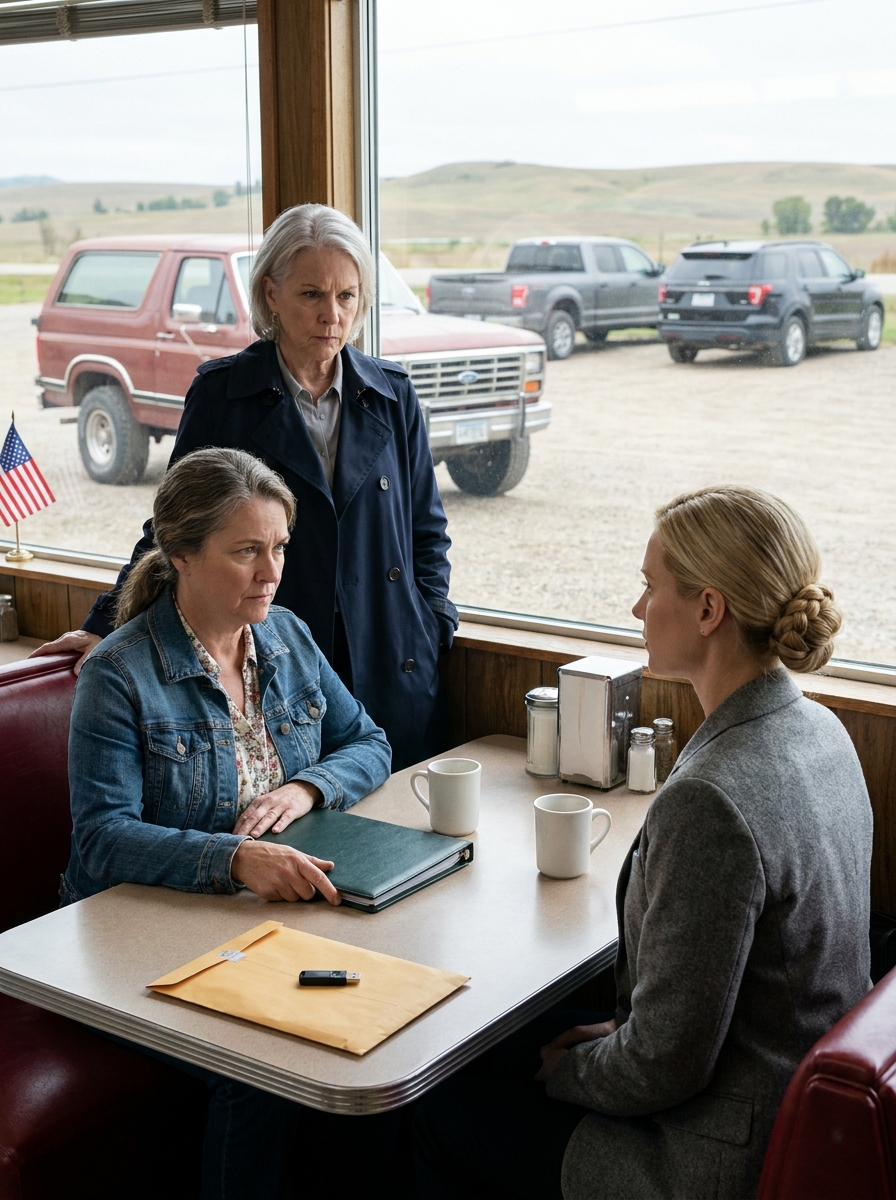
She considered every possibility: trap, leverage, fear, guilt, manipulation. In the end, we chose the diner because it had windows on three sides, two exits, and a parking lot where no one could hide much of anything.
Ramona arrived early and sat in a corner with biscuits and a newspaper, looking like any retired woman killing time over coffee.
I walked in at eleven sharp.
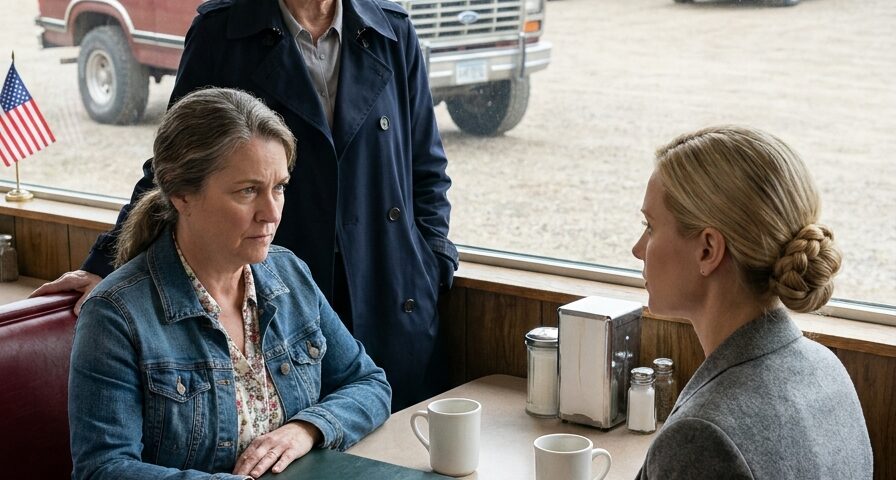
Carolyn Vane sat in the back booth wearing a plain gray coat, no jewelry, both hands wrapped around a mug that had long gone cold.
She looked smaller than I remembered.
Not weak.
Worn down.
Like a woman who had spent twenty years living inside a house where every door locked from the outside.
I slid into the booth across from her.
For a few seconds, neither of us spoke.
Then she reached into her bag and placed a green ledger book on the table.
Beside it, she set a thumb drive.
“I know about the fund,” she said.
Her voice was steady, but her hands shook.
“I found the first statements two years ago while looking for insurance papers. I photographed what I could. I kept copies in a safe deposit box under my maiden name.”
I looked down at the ledger.
“Why now?”
Her eyes lifted to mine.
“Because now I know about your son.”
There it was.
Not guilt.
Not entirely.
Recognition.
She had been standing in the same storm, just in a different room.
Carolyn told me she had known for years that Hollis moved money through false vendors and private accounts. At first, she told herself it was business. Then she told herself it was tax strategy. Then she stopped telling herself anything that sounded like truth.
But the fund changed things.
The missing houses.
The staged photographs.
The speeches.
The veterans.
“That money was supposed to build homes,” she said. “He stole from men who had already paid more than enough.”
Her fingers tightened around the coffee mug.
Then she told me about the crash on Pike Ridge.
The night before Caleb and Bryn lost their baby, Carolyn had overheard Hollis in his study, speaking quietly on the phone. She heard the make of Caleb’s truck. She heard him say, “Before the weekend.”
Three days later, the brakes failed.
Later, she found a cash withdrawal that matched another one from nineteen years earlier, around the time Hollis’s first business partner drowned at Lake Lockmere.
That partner, she said, had been pushing for an audit.
Hollis walked away from the boat.
The other man did not.
“For nineteen years,” Carolyn said, “I told myself it was coincidence. Then my daughter lost her baby, and I started keeping everything.”
Her voice frayed at the edges.
“I am done protecting him.”
I had walked into that diner prepared to face a Vane.
Instead, I found a hostage who had finally learned where the lock was.
I reached across the table and took her hands.
Her hands were softer than mine.
Colder too.
“Then let’s finish it,” I said.
After that, Ramona moved like the professional she had never stopped being.
No speeches.
No midnight confrontations.
No dramatic visits to Hollis’s office.
That kind of thing belongs in movies, and movies get people hurt.
Ramona made one careful call to a woman she had once worked with, someone now in a federal office in Lexington. Then came a long gray week of waiting while the wheels began to turn beyond Hollis Vane’s reach.
Caleb’s drive and my reconciliations told the money story.
Carolyn’s ledger told the inside story.
Her testimony opened doors none of us could have opened alone.
The old mechanic shop that had salvaged Caleb’s truck after the Pike Ridge wreck still had part of the brake assembly on a shelf. Experts later found markings that spoke louder than memory.
The man tied to those quiet cash payments, the one who had appeared under different names on different payrolls, folded when officials found him.
He gave them the boat.
The wreck.
The men at the gravel bar.
The orders.
All of it.
Hollis Vane had built his whole life on the belief that money could turn truth into fog.
But even fog lifts when enough light hits it.
They came for him on a Tuesday morning.
He was standing at a podium outside a courthouse-style building, cameras lined up in front of him, flags moving in the wind behind him. He had gathered the press to announce a new wing of veterans housing, as if the world itself had a taste for irony.
Federal officials stepped onto the platform while he was still speaking.
In the photo that ran statewide, his mouth is open mid-sentence.
For once, no one cared what he had to say.
The months afterward were hard.
I will not dress that up.
Cases like that do not resolve just because the truth is clear. There were meetings, statements, reviews, attorneys, hearings, and long days when everyone was tired of telling the same painful facts again.
Twice, someone in a serious suit suggested the family might prefer a quiet settlement.
Bryn was eight months pregnant the second time.
She sat across from that man, one hand resting on her belly, and said, “My father taught me one useful thing. Never take the first offer.”
Then she showed him the door herself.
In the end, there was no quiet settlement.
There were formal consequences no amount of money could soften.
Hollis Vane’s financial schemes were laid bare. The fund was restructured under new oversight. Money was recovered where it could be. The men tied to the attack on Caleb faced their own reckonings. The old death at the lake and the crash on Pike Ridge became part of a larger truth Hollis could no longer bury under donations and speeches.
He was sentenced to twenty-six years.
He will be older than I am now before anyone has to think about him walking free.
Carolyn divorced him before the first snow.
The day the Veterans Homestead Fund handed over its first real set of keys under new management, there were no cameras.
Carolyn insisted on that.
No podium.
No speech.
No man smiling beside a veteran he had used for his own image.
Just Carolyn, standing on a fresh porch, placing keys into the hand of a Marine who had waited far too long for a house he could move through with dignity.
She cried afterward in her car where no one could see her.
Then she drove home and kept working.
That is how you know when change is real.
Not when people perform it.
When they keep doing it after the audience leaves.
My granddaughter was born on a cold bright morning in March.
She came into this world hollering like she had opinions already, and it turned out she did.
They named her Pearl, after my mother, who carried that name through coal camps, lean winters, and every kind of hard season without once letting anyone bow her head.
Both her grandmothers were in the room when she was born.
Carolyn and me.
Two women from opposite sides of a table Hollis had tried to control.
When Pearl cried, Carolyn reached for my hand.
I let her take it.
There are some understandings that do not need to be explained to anyone else.
Caleb’s hand healed, though one finger still bends a little when he points. Pearl thinks it is the funniest thing in the world. Every time he points at a bird or a tractor or the moon, she laughs like God himself made that finger crooked just to entertain her.
Caleb no longer works for Vane Development.
That name came down piece by piece.
He keeps the books now for a builders’ co-op he started with two other sons of veterans. Every account squares to the penny. Every invoice gets checked. Every donor can see where the money goes.
Somebody raised him right at a kitchen table in the hollow.
Bryn runs community outreach for the housing fund now. She does it quietly, without speeches, without glossy photos unless the families themselves want them. She says a house is not a prop. It is a promise with walls.
Carolyn brings Pearl books and piano toys.
I bring her the river.
Last month, I took Pearl down to the Crooked Fork below Daddy’s camp. The water was cold and clear under the shade. I held her chubby little legs and let her feet touch the creek.
She slapped the water with both hands and laughed.
Carolyn stood on the bank in city shoes, watching.
Then she laughed too.
I thought about everything that water had cut through to reach us.
Rock.
Root.
Mud.
Old coal land.
Old shame.
Old names people used when they wanted us small.
People like Hollis Vane believe a table is something you build to keep others away. They spend fortunes making it longer and longer while removing chairs from everyone they consider beneath them.
He called us hollow folk like it was an ending.
Creek trash.
People from the ridge.
People with old trucks, patched quilts, and family buried in churchyards with leaning stones.
But those words only told on him.
Because here is what I know at sixty-three, and what he will have many years to think about where he is now.
Creek water does not ask permission.
It does not beg for a seat.
It cuts through rock and makes its own valley.
And everything green grows there.
Pearl has that water in her veins from both sides now.
Her mother’s stubborn heart.
Her father’s honest hands.
Carolyn’s quiet courage.
Ramona’s sharp mind.
And ours, the old water, running all the way back up the hollow.
When Pearl is old enough, I will take her up the river trail to Daddy’s camp. I will hang that old coat over her shoulders when the air turns cold, and I will begin teaching her what my father taught me.
Not the hard lessons first.
Those can wait.
The first lesson is simple enough for a child.
Sit still.
Pay attention.
The woods will tell you the truth if you are patient.
And the truth, sooner or later, tells everything.
Sometimes at night, I still see Caleb on that gravel bar in my headlights.
I still hear his whisper.
I still feel the weight of his body as Burl and I lifted him toward the truck.
People think a story like ours turns on one terrible night, but that is not true.
Every ending was planted years earlier by choices people made when they thought no one was keeping score.
Hollis believed money could replace character, and for a long time, it looked like he was right.
He bought respect.
He bought silence.
He bought smiles, headlines, rooms, and names on buildings.
But a man who steals from wounded veterans is never only stealing money. He is practicing contempt. And contempt spreads. It stains the whole floor until one day the man standing on it falls through.
His own podium.
His own cameras.
His own downfall.
He built it one dishonest dollar at a time.
Caleb built something too.
He built the kind of life where people came when he needed them.
A wife who climbed a river trail while carrying his child.
A stranger named Burl who knew when to look away and when to help.
An aunt who understood that you do not win against powerful men by shouting at them.
A mother-in-law who finally chose truth over comfort.
And an old mother who still remembered what her daddy taught her about patience, signs, and the river.
Honest people collect allies differently than crooked people collect witnesses.
That is what I learned.
Decency alone would not have saved us. Decency had to be joined with knowledge. Numbers. Records. Timing. Memory. The kind of wisdom that looks boring while you are learning it and priceless when the night turns dangerous.
Thirty-one years of ledgers taught me that numbers wait patiently to tell the truth.
Ramona’s years of casework taught her that you do not perform bravery for an audience. You make the right call to the right person and let the work begin.
Daddy’s river taught us when to disappear, when to stay still, and when to move.
None of that looked important when we were young.
Most wisdom doesn’t.
It looks like homework, old stories, dull jobs, quiet habits, long shifts, and listening to people everyone else thinks are outdated.
Then one night, it becomes the only thing standing between your family and the dark.
The last thing I would tell Pearl, or any young person who thinks the world belongs only to those who speak the loudest, is this.
Do not bend your spine for money.
Do not let comfort make you careless.
Do not mistake a powerful man for a good one.
And when fear tells you to run while anger tells you to do something foolish, sit still long enough to hear what the woods are saying.
The truth has a sound.
It may be quiet at first.
But it keeps moving.
Like water under stone.
Like a creek through a hollow.
Like a family that was counted out and showed up anyway.