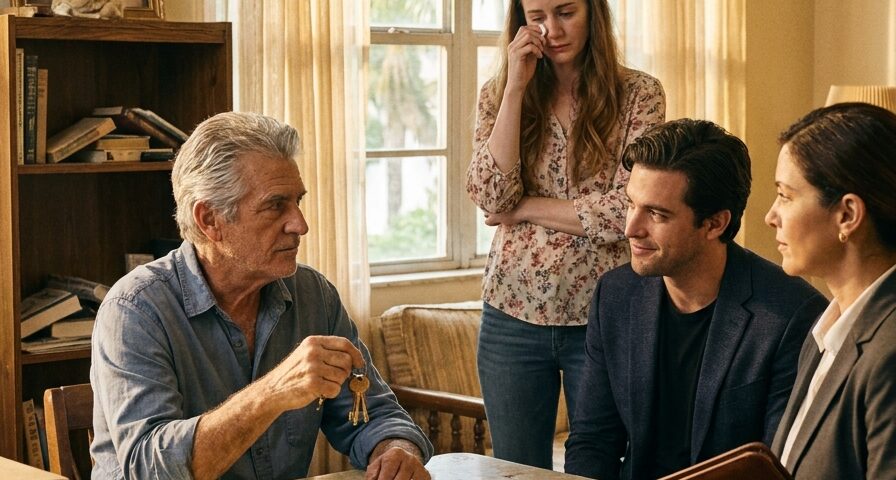
My son-in-law married my daughter with a smile…
My Son-in-law Married My Daughter To Take My House. After The Wedding, He Came With A Notary…
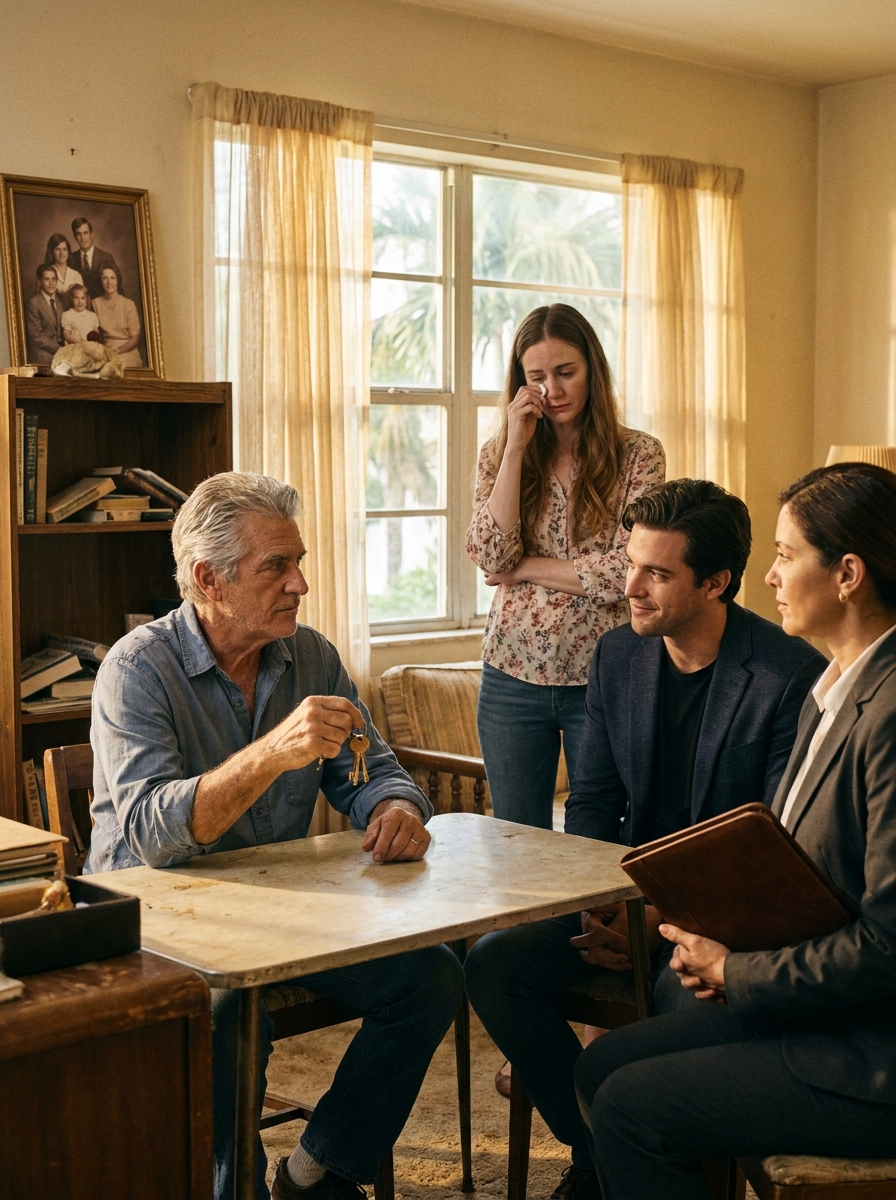
“We just sold this house,” my son-in-law said, standing in my living room like he had already won. “You’re moving to a house for the elderly.”
I looked at the notary beside him, then at my daughter, who could barely meet my eyes.
Then I smiled.
“Great,” I said. “Let’s go to the police station first. They’re very interested in what I sent them about you.”
That was the moment Cody Jenkins turned pale.
My name is Nathan Parker. I am sixty-three years old. I live in Miami, Florida, and I spent four decades doing things the honest way. I worked double shifts at the port. I paid my taxes. I raised one daughter. I buried one wife. I kept every promise I ever made, even the ones that cost me something.
I had never asked anyone for more than he was willing to give. I had never taken what did not belong to me. So when a twenty-nine-year-old man with a rented image, a leased BMW, and eyes that measured every room he entered decided my home was his for the taking, he made one mistake.
He assumed an old widower living alone would not notice.
He was wrong.
What happened that Tuesday morning in October did not begin on that Tuesday morning. It started eighteen months earlier, on the day my daughter, Caitlyn, brought Cody Jenkins home for the first time.
My late wife, Britney, always said I had good instincts about people. She passed seven years ago from breast cancer, the kind of loss that does not leave a clean wound. Before she died, she held my hand in that quiet hospital room and said, “Nathan, keep an eye on our girl. She trusts too easy.”
Then she smiled faintly and added, “Just like I did when I met you, except you were actually worth it.”
I laughed because she wanted me to. Then I cried when she slept. And after she was gone, I kept that promise as best I could.
So when Caitlyn walked through my front door one evening in April and said, “Dad, I want you to meet someone,” I was already paying attention.
Cody Jenkins came in behind her like he owned the place.
That was the first thing I noticed.
He was not nervous the way a decent man usually is when he meets his girlfriend’s father for the first time. He did not step in carefully. He did not look at Caitlyn with gratitude. He walked in slowly, hands in his pockets, eyes moving across my living room as if he were appraising the walls, the floors, the furniture, the windows.
Like he was calculating square footage.
He shook my hand and said, “Mr. Parker, beautiful home. How long have you had this place?”
Not nice to meet you.
Not Caitlyn talks about you all the time.
The first thing out of his mouth was a question about my property.
“Thirty-one years,” I said.
He smiled. “Must be worth a lot now. Miami real estate has gone crazy.”
“I suppose it has.”
I did not like him.
I did not say that to Caitlyn, because I had learned something about adult daughters. Telling a twenty-six-year-old woman you do not like her boyfriend is often the fastest way to make sure she marries him.
So I smiled. I made dinner. I passed the rice. I asked polite questions.
And I watched.
Over the next several months, what I saw made the hair on the back of my neck rise the way it used to during night shifts at the port, when you learned to recognize trouble before it got close enough to introduce itself.
Cody Jenkins did not appear to have a real job.
He called himself a real estate investor. He had a clean website, a polished LinkedIn profile, and four different LLCs listed under his name. But when I looked closely, none of those businesses seemed to have much weight behind them.
He drove the BMW. He wore the watch. He picked up checks at restaurants, which impressed Caitlyn and did not impress me at all. I had been around enough hustlers in my life to know that a man who always pays for dinner is either genuinely generous or buying goodwill he plans to cash in later.
Cody was not generous.
I started digging quietly.
Nothing dramatic. Nothing reckless. I was not law enforcement. I was just a father paying attention.
I spoke to my neighbor Alicia, who worked in county records, and asked her to keep her eyes open for anything with Cody’s name on it. I called my old friend Morgan, who had spent twenty years in title insurance and had seen almost every kind of property fraud a person could imagine.
I asked him, hypothetically, how someone might try to steal a house from an elderly parent of a spouse.
Morgan did not even pause.
“You want the long list or the short list?” he asked.
“Morgan,” I said, “I want every method you know, in order of how common they are.”
He gave me two hours of his time and a yellow legal pad full of notes.
I took that legal pad home and read it three times.
I did not know it yet, but that yellow legal pad would help save everything.
Caitlyn and Cody got engaged in November.
I hugged my daughter. I told her I loved her. Then I spent the next hour in my garage pretending to organize tools while I tried to steady myself.
She was happy. I had to remember that.
She looked the way Britney used to look when joy took over her whole face. Lit from the inside. Young and certain and completely unaware that love, in the wrong hands, could become a weapon.
I was not going to take that happiness from her based only on suspicion.
Not yet.
Not without proof.
But I was going to be ready.
The next morning, I called Morgan again.
“I need you to walk me through the irrevocable trust thing,” I said.
He went quiet. “Nathan, are you sure? Once the house goes into an irrevocable trust, it is not something you just undo over coffee.”
“I know.”
“How bad is it?”
“I don’t know yet,” I said. “But I’d rather have the umbrella and not need it than need it and watch the storm come through my roof.”
Morgan sighed. “I’ll call my attorney. Her name is Sierra. She’s good. She’ll set it up clean.”
Two weeks later, I sat across from Sierra in her office on Brickell Avenue. She was sharp, organized, and spoke in the clear, direct way of someone who did not waste words.
She explained everything.
The house would go into an irrevocable trust. I would remain the sole beneficiary and trustee during my lifetime. The property could not be sold, transferred, or encumbered without my explicit written consent as trustee, with witnesses, notarization, and a mandatory seventy-two-hour review period built into the process.
Any attempt to sell or transfer the property without that exact procedure would not merely be challenged.
It would be void.
As in, legally, it never happened.
Sierra slid the documents across the desk and said, “This is about as strong as I can make it. Nobody is taking this house from you without going through a process that requires your cooperation at every step.”
I signed.
I did not tell Caitlyn.
I did not tell anyone except Morgan and Sierra.
I went home, placed the trust documents inside a fireproof safe in my bedroom closet, and returned to watching.
The wedding took place in June at an outdoor venue in Coral Gables, one of those places with Spanish tile, soft white walls, and bougainvillea climbing everywhere. There were one hundred and twenty guests. The air smelled like flowers and warm stone. Caitlyn wore Britney’s veil.
That part nearly broke me.
I walked her down the aisle thinking about my wife the entire time. I imagined Britney crying happy tears, embarrassing herself in front of everyone, and not caring one bit.
Cody stood at the altar in a white tuxedo with his practiced smile.
I watched his eyes during the vows.
He barely looked at Caitlyn.
His gaze kept moving over the guests, toward the venue staff, down to his phone when he thought no one noticed.
I noticed.
I gave the toast. I said the right things. I danced with my daughter. I shook Cody’s hand and called him son, which cost me more than anyone in that room knew.
Then I went home and called Alicia.
“I need to know if anything has been filed in the last six months with Cody Jenkins’s name on it,” I said. “Anything at all.”
“Nathan, it’s eleven o’clock at night.”
“I know. I’m sorry. First thing tomorrow?”
She sighed the way only a woman who had known you for fifteen years could sigh.
“First thing tomorrow,” she said.
I did not know it then, but what Alicia found the next morning was the last piece I needed.
She called me at 8:47.
“Nathan.”
Her voice was flat, and that alone made my stomach drop.
“There is a quitclaim deed that was filed three weeks ago,” she said. “Pre-dated to February.”
I sat down slowly. “Whose name is on it?”
“Yours as grantor. Cody Jenkins and Caitlyn Jenkins as grantees.”
For a long moment, I did not move.
“Alicia,” I said, “I did not sign that deed.”
“I know,” she said quietly. “And Nathan, the notary stamp on it is from a man whose license was suspended in January. His name has come up twice in fraud investigations this year.”
My daughter had been married less than twenty-four hours.
“I need a certified copy of that document,” I said.
“Already printing it.”
“Don’t tell anyone.”
“Nathan,” she said, “I’ve worked in this office for seventeen years. You think this is my first rodeo?”
I drove to her office, picked up the copy, and went straight to Sierra.
She looked at it for less than a minute before placing it flat on her desk.
“This is forgery,” she said. “The trust structure alone makes it void. But the forged signature and suspended notary make this a criminal matter. You need to go to the police.”
“Not yet.”
She looked up. “Nathan.”
“Not yet,” I said again. “I want him to play his hand all the way out. I want him to show up at my door thinking he has already won. Because when I go to the police, I want to walk in with an open-and-shut case.”
Sierra studied me for a long moment.
“You’re going to let him think it worked.”
“For a little while.”
She leaned back in her chair, and for the first time, she almost smiled.
“Don’t wait too long.”
“I won’t.”
I went home. I made coffee. Then I started building the file.
Over the next three months, while Cody and Caitlyn lived in their rented condo in Brickell, and I played the part of the unsuspecting sixty-three-year-old widower in his paid-off house, I assembled the most complete document package of my life.
Morgan helped me trace Cody’s LLCs.
Two were shell companies with no real assets, no real business activity, and addresses that led to storefront mailboxes. One had been used as the alleged buyer in two previous property deals that had gone bad, including one in Hialeah where an elderly woman nearly lost her home before her grandson hired a lawyer who caught the fraud in time.
That woman’s name was in public court records.
Morgan found her.
Her grandson found me.
What mattered was that he had documentation of the same pattern: forged quitclaim deed, suspended notary, fake LLC structure, different house, same Cody Jenkins.
I added everything to the file.
Sierra’s office also looked into the man who had stamped my forged deed. By the time they finished, we had a copy of a sworn statement from a separate case in which someone admitted to personally handing Cody cash in exchange for fraudulent notary work.
The file grew thicker.
Then, in late September, Cody made the mistake I had been waiting for.
He filed the fraudulent deed with the county recorder’s office, the same office where Alicia worked.
Now there was an official public record of his forgery, time-stamped and documented. He needed that filing to show a clean chain of title to a potential buyer, because as I soon learned, he had already found one.
The house had been offered quietly.
No MLS listing. No public sign. No open house.
An off-market private sale.
My house, listed for nine hundred thousand dollars.
The deal was set to close in forty-five days.
Alicia called me the second she saw it.
“Is there a buyer under contract?” I asked.
“There’s a purchase agreement on file. Cash buyer. LLC.”
“Forty-five days,” I said.
“Nathan, you need to move.”
“I am moving.”
I called Sierra. I called Morgan. Then I called the Miami-Dade Police Department’s Financial Crimes Unit, where, over the previous three months, I had quietly developed a relationship with a detective who was patient, sharp, and very fond of receiving organized evidence.
I delivered my package in person.
Printed. Tabbed. Indexed.
Forty-seven pages, with a cover letter written by Sierra.
The detective went through it slowly, asking questions here and there. When she finished, she looked up at me.
“Mr. Parker,” she said, “this is one of the cleanest evidence packages I’ve ever received.”
“When do you think he’ll make his move?” she asked.
“I’d give him about two weeks.”
She nodded. “We’ll be ready.”
“So will I.”
I did not know exactly how right I was.
It took eleven days.
It was a Tuesday morning, overcast in the way Miami gets in October before a front comes through. I was drinking coffee on my back porch, looking at the yard Britney and I had planted together. Bird of paradise. Sea grape. The old mango tree that gave us more fruit every summer than we could ever eat.
I was thinking about my wife, the way I often did on quiet mornings, when I heard a car pull into the driveway.
Then another.
I did not move right away.
I set my coffee down slowly.
I already knew.
The knock came hard.
Three sharp raps.
I walked through the house, past the living room where I had taught Caitlyn to walk, past the kitchen where Britney had made Sunday dinners for thirty years, and opened the front door.
Cody Jenkins stood on my porch in a pressed sport coat, smelling like expensive cologne.
Behind him was a woman in a blazer carrying a leather portfolio.
The notary.
And beside her stood my daughter, looking as though she had not slept in two days.
Caitlyn would not meet my eyes.
In that moment, I knew one of two things had happened. Either she knew and had gone along with it, or she had only just found out and was horrified.
I told myself it was the second one.
I kept telling myself that.
Cody looked at me with the expression of a man who believed he held every card in the room.
“Nathan,” he said, “do you mind if we come in?”
“Sure, Cody,” I said. “Come on in.”