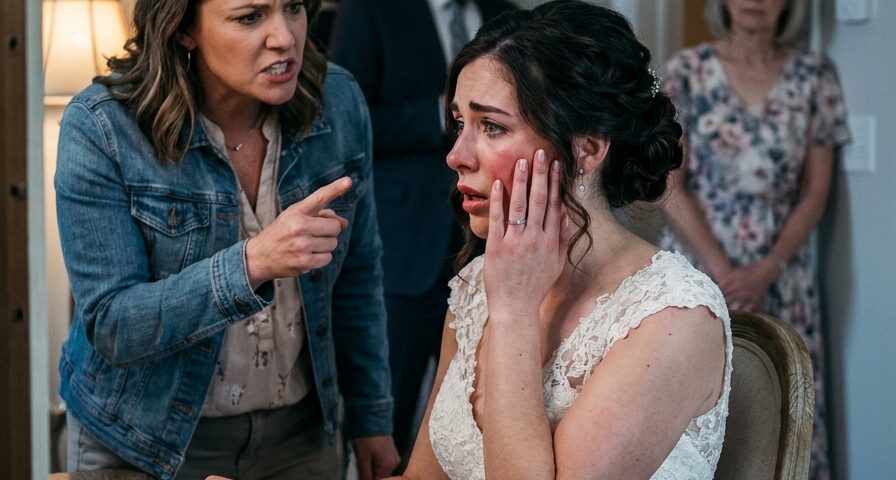
PART 2: One Sentence in an Old Letter Exposed the Truth My Family Buried for Years
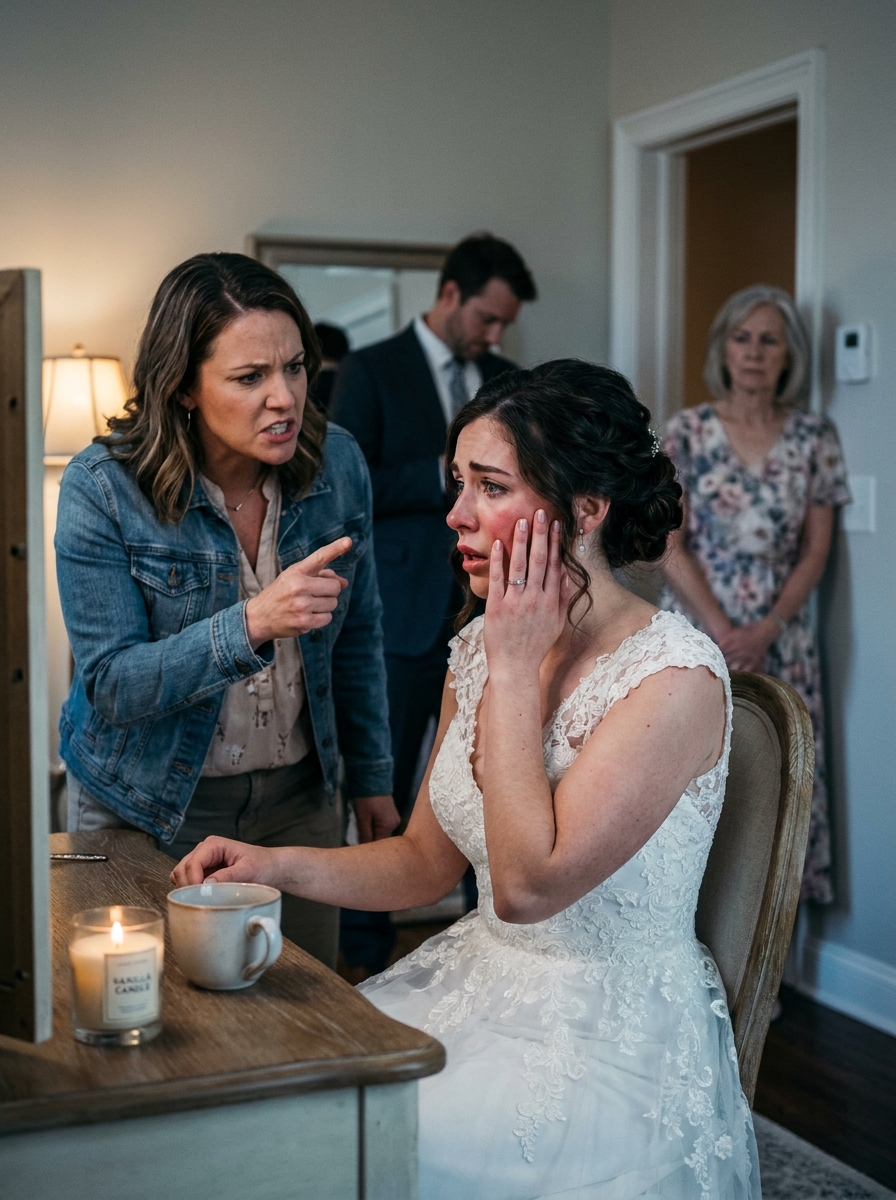
Ask your mother what happened to the first will.
The sentence sat on the page like a match held close to paper.
For a moment, no one moved.
The chandelier above us kept pouring golden light over the white tablecloths, the flowers, the untouched plates, the polite little place cards that suddenly seemed to belong to another life. Somewhere near the back of the room, a glass tapped against porcelain. Outside the window, Dad had lowered his phone. Stella stood beside him, one hand pressed to the glass as if she could stop whatever was about to happen from crossing the room.
But it was already inside.
My mother looked at the page, then at me.
Her lips parted, but no sound came.
“Mom,” I said quietly, “what happened to the first will?”
Ryan’s hand tightened around mine under the table. Not to hold me back. To remind me I was not alone.
Paul closed the folder halfway, his expression careful. “Mrs. Larson, you don’t have to answer here.”
My mother’s eyes filled so quickly it startled me. She reached for the back of the nearest chair, fingers curling around the carved wood.
“I didn’t destroy it,” she whispered.
The room seemed to lean toward her.
At the windows, Dad pushed open the garden door and came inside with Stella right behind him. Stella’s face was still sharp with anger, but something flickered when she saw Mom’s tears.
“What did you just say?” Stella asked.
Mom looked at her, then at me, and in that single glance I saw something older than fear. I saw a secret that had been carried so long it had grown roots around her heart.
“I said I didn’t destroy it,” Mom repeated. “I hid it.”
Dad went still.
Stella laughed once, but it sounded brittle. “You hid a will?”
“I hid a truth,” Mom said.
The words changed the air.
Paul rose. “I think we should move this discussion somewhere private.”
“No,” I said, though my voice shook. “Not yet.”
My mother flinched, and I hated that part of me still wanted to comfort her. She looked smaller than I remembered, her pearls resting against the hollow of her throat, her hands trembling as though she were cold.
“Billy,” she said, “please.”
“All my life,” I said, “everyone in this family has asked me to step outside the room before the real conversations started. I’m tired of standing in hallways.”
No one answered.
Clare, who had been silent near the bar, crossed the room and touched my shoulder. “I’ll ask the staff to give us the dining room,” she said softly.
Within minutes, the room emptied with the confused grace of people pretending not to notice a family coming undone. Chairs whispered against the floor. Coats were gathered. Doors closed. The music from the lobby became a muffled thread.
Then there were only six of us: Mom, Dad, Stella, Ryan, Paul, and me.
My mother sat down.
For the first time that evening, Stella did not take the largest space in the room. She stood behind a chair, gripping it with both hands.
Mom looked at the envelope in front of me.
“Your grandmother gave me the first will two years before she died,” she said. “She asked me to take it to her lawyer because she was afraid your father would talk her out of it.”
Dad’s jaw tightened, but he did not interrupt.
“I read the first page,” Mom continued. “I shouldn’t have. But I did. And once I saw the name, I panicked.”
“What name?” I asked.
She wiped beneath one eye with her knuckle, almost like a child.
“Billie Rose.”
My breath caught.
Grandma was the only person who ever called me that.
When I was small, I had thought it was one of her strange little inventions, like calling the moon “God’s porchlight” or referring to thunder as “the clouds moving furniture.” Billie Rose had sounded like something sweet she kept only for me.
Stella stared at Mom. “Who is Rose?”
Mom closed her eyes.
“My sister.”
The answer opened a door in my memory.
A faded photograph on Grandma’s mantel of a young woman with dark curls and a crooked smile. A name never spoken for long. A bedroom at Grandma’s house that stayed locked until I was twelve. The way Grandma sometimes watched me when I laughed, her eyes shining as though joy had startled her.
I leaned forward. “What does your sister have to do with me?”
Mom covered her mouth.
Dad looked down at the floor.
And suddenly I knew before she said it.
My whole body went quiet.
Mom reached for my hand across the table, but stopped halfway, afraid I would pull away.
“Rose was your birth mother,” she whispered.
The chandelier hummed faintly.
Somewhere far away, a car passed on wet pavement.
I heard Stella inhale sharply.
Ryan’s hand stayed wrapped around mine, steady and warm, but everything else inside me seemed to tilt. I looked at Mom, waiting for anger, for pain, for some enormous feeling to rise up and knock me over.
Instead, the first thing that came out was almost foolish.
“So Grandma Ruth was really my grandmother.”
Mom nodded, tears slipping freely now. “Yes.”
“And you?”
Her face crumpled. “I am your mother in every way I knew how to be. But I didn’t carry you.”
The words hurt. They also healed something I had never known was wounded.
Stella sank into the chair behind her. “You all knew?”
“Not Stella,” Dad said.
Stella turned on him. “But you did?”
Dad’s silence answered.
Mom pressed both hands flat on the table, as if steadying herself against a storm. “Rose was young. Brilliant. Stubborn. She wanted to raise you. She had already named you Billie after our grandfather and Rose after herself, because she said every child deserved to inherit at least one flower.”
My throat closed.
“She became very ill after you were born,” Mom said. “It happened quickly. Before she died, I promised her you would never feel unwanted. Your father promised too. We adopted you before you were six months old.”
I looked at Dad.
His eyes were red.
“I loved you,” he said roughly. “I did. I still do.”
“But?” I asked.
He looked away.
That small word had found the crack.
Mom answered for him. “But grief makes people selfish sometimes. Fear does too. We already had Stella. Money was tight. Ruth helped us more than we admitted. Your father felt watched. Judged. I felt guilty. And when Ruth made that first will, she included Rose’s savings, the Harbor Street condo, and a trust that was always meant for you.”
Stella’s face had gone pale. “So Grandma wasn’t favoring Billy over me.”
Mom looked at her daughter. “She left you your own share. A generous one. The first will was fair. But it explained why Billy had a separate inheritance.”
“Rose’s,” I said.
Mom nodded.
Something in Stella’s expression faltered. For years, my sister had worn confidence like a polished coat. Now it slipped, and underneath I saw the little girl she must have been: watching Grandma hold me too long, hearing a nickname no one explained, deciding love must be a thing with winners and losers.
“I thought,” Stella whispered, “I thought she just chose you.”
The room fell silent again.
Paul opened the folder with controlled care. “Mrs. Larson, where is the first will now?”
Mom looked at Dad before answering.
“In Ruth’s cedar chest,” she said. “At the house.”
Dad rubbed both hands over his face. “Marianne.”
“No,” Mom said, and something in her voice strengthened. “No more.”
Dad lowered his hands.
Mom turned to me. “I kept it because I told myself I was protecting you. Then your father borrowed from the trust after his business failed. Then Stella needed money for the condo investment. Then everyone kept saying we would put it back before you noticed.”
Stella stood so abruptly the chair scraped behind her. “Dad told me that money was cleared.”
Paul’s gaze moved to Dad.
Dad’s shoulders sank. “I told myself it was temporary.”
“You told me it was available,” Stella said.
“I know.”
“You let me use Billy’s inheritance?”
“I thought the condo would make enough to repay it.”
My heart was beating hard now, but strangely, the pain no longer felt like a blade. It felt like a door being forced open after years of damp swelling.
“And Grandma found out,” I said.
Mom nodded. “She suspected. That’s why she transferred the condo deed directly to you before she died. She said if people were determined to confuse love with ownership, she would make ownership very clear.”
Despite everything, a laugh rose in my throat. It broke halfway into a sob.
That was Grandma.
Soft hands. Sharp mind.
Stella looked at me then, really looked at me, and for once there was no performance in her face.
“I didn’t know about Rose,” she said.
“No,” I answered. “But you knew about the money.”
She swallowed.
“Yes.”
The answer cost her something. I saw it.
Paul closed the folder. “Then the next step is simple. We retrieve the first will. We file the deed and the supporting documents with the probate court. We do an accounting of the funds, rent, and transfers. Quietly, properly, and legally.”
Dad nodded without lifting his head.
Mom whispered, “Billy, I am so sorry.”
I looked at her hand still resting halfway across the table.
For a long moment, I did not move.
Then I placed my fingers over hers.
Not forgiveness. Not yet.
But a beginning.
Mom bowed over our hands and cried without sound.
Across the table, Stella stared down at the linen, and a tear fell so cleanly onto the white cloth that it disappeared at once.
That night, we went to Grandma Ruth’s house.
The rain had stopped, leaving the streets shining under the lamps. Ryan drove. I sat beside him with Grandma’s letter in my lap, my thumb resting over her handwriting.
At the curb, the old house waited beneath its sycamore tree, warm yellow light glowing from the porch. The sight nearly undid me. I had spent half my childhood inside those walls, eating cinnamon toast at the kitchen counter, sorting buttons from coffee tins, listening to Grandma hum while she watered the violets.
I had thought the house held memories.
I had not known it held answers.
Mom unlocked the door with shaking hands.
Inside, the air smelled of lemon oil and old books. Nothing had changed, and everything had.
Stella lingered by the entryway. “I haven’t been here since the funeral.”
“I know,” I said.
She looked at me quickly, but I had not said it cruelly.
Mom led us upstairs to Grandma’s sewing room. The cedar chest sat beneath the window, covered by a folded quilt patterned with blue stars. Mom knelt before it and pressed both palms to the lid.
“I used to come up here and tell myself I would take it out tomorrow,” she said. “Then tomorrow became another year.”
She opened the chest.
The scent of cedar rose like breath from the past.
Inside were quilts, bundles of letters tied with ribbon, a small velvet case, and a large manila envelope. Mom lifted it with both hands and gave it to Paul.
He checked the seal, then looked at me. “Billy?”
I nodded.
He opened it.
The will was there.
So was a letter.
Not from Grandma.
From Rose.
My hands shook when Paul passed it to me.
On the front, in looping handwriting, someone had written:
For my daughter when she is ready to know how loved she was.
I looked at Mom.
She nodded through tears.
I unfolded the letter carefully.
My darling Billie Rose,
I have only held you for seventeen days as I write this, and already you have rearranged the world. You make a tiny sound when you sleep, like a question you expect the stars to answer. I wish I could be the one to answer every question. If I cannot, then let this be the first answer: you were wanted. Completely. Joyfully. Without hesitation.
My sister Marianne will raise you if I cannot. She is braver than she thinks. Ruth will watch over both of you because watching over people is the only thing she has never been able to stop doing.
There is a little home on Harbor Street. I stayed there when I was afraid, and it became the place where I learned fear does not get the last word. One day, it will be yours. Not because walls matter, but because shelter does.
Use it well, little flower.
Love,
Rose
By the time I finished, the room had blurred.
Ryan stood close behind me, one hand resting lightly between my shoulders.
Stella had turned away toward the window, but I could see her reflection in the glass. She was crying.
Dad picked up the velvet case from the chest. “Your grandmother wanted you to have this too.”
He handed it to me.
Inside was a small gold locket engraved with a rose.
I opened it.
On one side was a photograph of Rose, young and laughing.
On the other side was a picture of me as a baby, wrapped in a yellow blanket.
Stella made a small sound.
I looked up.
“That blanket,” she whispered. “I gave you that.”
Mom turned. “You remember?”
Stella nodded slowly. “I was four. I thought babies got cold because they came from heaven and weren’t used to weather yet.”
A laugh escaped Mom through her tears.
Stella wiped her face quickly. “Grandma told me I could choose something to welcome you. I picked my yellow blanket because it was my favorite.”
She looked at the photograph as though it had reached across the years and touched her.
“I loved you first,” she said, almost to herself. “Before I learned how to be jealous.”
No one spoke.
The truth had not made the past simple. It had made it human.
Paul spent the next week doing what Paul did best: turning chaos into folders.
The first will was verified. The deed transfer was recorded. Bank statements appeared. Rental deposits were traced. Stella produced documents without being asked twice, which was new enough to feel like a weather change. Dad met with Paul alone and came out looking ten years older, but lighter somehow, as if confession had weight and he had finally set some of it down.
There were consequences.
The court recognized my ownership of the Harbor Street condo. Stella signed the necessary papers to correct the title. The rental income she had collected was calculated into a repayment agreement. Dad sold the fishing boat he loved but never used, and a portion of his retirement account was placed into structured repayment under Paul’s supervision.
No one went to prison.
No one stood on a courthouse step shouting.
Justice, I learned, did not always look like thunder. Sometimes it looked like signatures. Receipts. Hard conversations. Monthly payments made on time. The slow dignity of things being put back where they belonged.
And still, the hardest part was not legal.
It was Saturday morning breakfast at Mom’s house, three weeks later, when she placed a plate of blueberry pancakes in front of me and said, “Rose hated blueberries.”
I looked up.
Mom froze, spatula in hand. “I’m sorry. I shouldn’t have—”
“No,” I said. “Tell me.”
She sat across from me.
So she told me.
Rose loved thunderstorms and cheap sunglasses. Rose sang badly but confidently. Rose once painted all of Grandma’s garden stones purple because she said gray was a color with no imagination. Rose had wanted to study architecture because she believed houses could either hold people gently or make them feel small.
Every story entered me like light through a window.
Dad spoke less, but when he did, he did not defend himself anymore.
“I was ashamed,” he told me one evening on the porch, while Ryan helped Mom carry dishes inside. “Ruth saw right through me. I thought if she loved you specially, it meant she saw what I wasn’t doing right.”
“And Stella?”
He closed his eyes. “I taught her to count what other people received instead of naming what she needed.”
The porch swing creaked beneath us.
“I can’t fix it with one apology,” he said.
“No,” I answered.
He nodded.
Then he reached into his jacket pocket and handed me a small envelope.
Inside was a check. Not enough to fix everything. Enough to prove the first payment had not waited for comfort.
“I’ll make every one,” he said.
“I know Paul will make sure of that.”
Dad almost smiled. “Your grandmother would have liked him.”
“She chose him,” I said.
That made him laugh, just once.
It was the first easy sound I had heard from him in months.
Stella was harder.
For a while, we communicated through Paul, then through short emails, then through messages that began with practical matters and accidentally became something else.
I found another rent receipt from March.
I’ll send it.
Thank you.
Also, I found the yellow blanket.
You kept it?
Apparently, yes.
A few days later, a package arrived at my apartment.
Inside was the blanket, faded nearly cream with age, soft at the edges, folded with unusual care. A note lay on top.
I don’t know whether I have the right to give this back. Maybe it was always yours. Maybe it was ours before I forgot how to share.
I am sorry for what I took. I am more sorry for what I let myself believe.
Stella
I sat on the floor with the blanket in my lap until Ryan came home and found me there.
He did not ask whether I was all right.
He sat beside me and leaned his shoulder against mine.
The Harbor Street condo was on the third floor of an old brick building with arched windows and a green door. Stella had described it for years as an “asset,” a “unit,” a “smart investment near the riverfront.”
But when Ryan and I went to see it for the first time after the title was corrected, I understood why Rose had called it a little home.
Sunlight entered through tall windows and spread across worn pine floors. The rooms were modest but graceful, with sloped ceilings and deep sills wide enough for plants or books or a child’s folded arms. In the kitchen, blue tiles framed the sink. One had a tiny rose painted in the corner.
Ryan ran his thumb over it. “Did Stella know about this?”
“I doubt she noticed.”
He smiled faintly. “You did.”
There was a locked storage closet at the end of the hallway. None of Stella’s keys opened it. Paul found a smaller key in Grandma’s cedar chest, tied with red thread and labeled only H.S.
The lock resisted at first.
Then it turned.
Inside were file boxes, a rolled rug, two folding chairs, and a wooden sign wrapped in brown paper.
Ryan helped me carry the sign into the living room.
I unwrapped it.
The paint was chipped, but the words were clear.
ROSE HOUSE
Beneath it, in smaller lettering:
A soft place to begin again.
I sat back on my heels.
Ryan was quiet.
In the first file box were photographs. Women standing on the front steps with suitcases. Children drawing at the kitchen table. Grandma Ruth younger, wearing a blue raincoat, her arm around a woman with tired eyes and a baby bundled against her chest.
Ryan reached for that photograph.
Slowly.
Too slowly.
“What is it?” I asked.
He stared at the baby.
Then at the woman.
His voice changed. “That’s my mother.”
The room seemed to hold its breath.
“What?”
He sat down on the floor, still holding the picture. “That’s my mom. And that baby is me.”
I moved closer.
The woman in the photograph was younger than I had ever seen Ryan’s mother, but the eyes were unmistakable. So were Ryan’s, even in the round face of the infant sleeping against her.
Ryan turned the photo over.
On the back, Grandma had written:
Marisol and Ryan. First winter at Rose House. Brave as morning.
Ryan pressed his hand over his mouth.
“My mom used to talk about a woman who helped her when I was a baby,” he said. “Mrs. R, she called her. She said they had a room with blue tiles and a window that looked at the river. I never knew…”
He looked around the room.
“I never knew it was here.”
I felt the whole story shift beneath us.
Grandma Ruth had not only left me property.
She had left me proof of the kind of person she had been when no one was watching.
Ryan called his mother from the kitchen.
I heard his voice break when he said, “Mom, do you remember Mrs. R?”
A silence.
Then, through the speaker, Marisol Vega began to cry.
She came the next day.
She stood in the doorway of the condo, one hand at her chest, and looked at the blue tiles as if she had walked into a dream that had waited thirty years to be believed.
“This window,” she whispered. “I used to stand here with Ryan when he wouldn’t sleep.”
Ryan put an arm around her.
Marisol touched the wall. “Ruth told me her daughter Rose had been frightened here once, and that a house remembers how to be kind if people keep teaching it.”
I closed my eyes.
A soft place to begin again.
The phrase followed me for days.
I had planned to sell the condo.
That had been the sensible thing. Take back what was mine. Pay legal fees. Put the past behind me in clean numbers.
But houses, I was learning, could ask questions.
What did you inherit?
What will you continue?
Paul warned me that turning the condo into charitable housing would be complicated. Zoning. Insurance. A board. Funding. Boundaries. Paperwork.
Clare, who had somehow become both my friend and unofficial general of common sense, listened to all of this over coffee and said, “Complicated is not the same as impossible.”
Ryan said, “You don’t have to make it Grandma’s dream.”
“I know,” I said.
“Or Rose’s.”
“I know.”
He waited.
I looked at the photograph of Marisol and baby Ryan propped against the sugar jar.
“But maybe it’s mine too.”
The first person I told after Ryan was Stella.
We met at a small park halfway between our apartments. It was late afternoon, and children were chasing each other around the fountain, their laughter rising into the branches.
Stella arrived with no sunglasses, no perfect red lipstick, no armor.
Just my sister, holding two paper cups of coffee.
“I didn’t know what you drink anymore,” she said.
“You never knew.”
A flash of old hurt crossed her face, but she nodded. “Fair.”
We sat on a bench.
I told her about Rose House. About Marisol. About Ryan.
Stella listened without interrupting.
When I finished, she looked across the park. “Grandma helped Ryan’s mother in the same place I tried to turn into a profit machine.”
“You didn’t know.”
“No,” she said. “But that doesn’t erase what I did know.”
A little boy near the fountain dropped his toy boat. His sister picked it up and handed it back. He considered this for a moment, then hugged her so hard they nearly fell over.
Stella watched them.
“I want to help,” she said.
I was ready for it, but not ready.
“With the money?” I asked.
“With anything. Filing. Painting. Carrying boxes. Sitting in a room while no one trusts me yet.”
I looked at her hands wrapped around the coffee cup.
“I can’t put you near the finances,” I said.
“I know.”
“Not for a long time.”
“I know.”
“Maybe not ever.”
Her mouth trembled. “I know.”
That was when I believed she meant it.
“You can come Saturday,” I said. “We’re cleaning the storage closet.”
Stella nodded.
Then she gave a small, uncertain laugh. “Should I bring anything?”
I thought of the locket. The baby photograph. The yellow blanket.
“Bring the blanket,” I said.
Spring came slowly that year, as if the whole world were learning how to thaw.
Rose House became a project before it became a place. Clare organized a fundraiser at the restaurant and somehow convinced half the town to donate furniture, paint, books, and enough canned soup to feed a small army. Paul created a nonprofit structure with the patience of a saint and the expression of a man who regretted all his life choices but would continue making the correct ones anyway.
Dad fixed the broken railing on the stairs.
Mom sewed curtains for the bedroom.
Stella showed up every Saturday in old jeans and worked until her hands were red. She sanded window frames, labeled donated dishes, and once spent forty-five minutes gently removing gum from the underside of a table without announcing her sacrifice to anyone.
That, more than anything, impressed Clare.
“She may survive,” Clare murmured to me.
“High praise.”
“From me? Enormous.”
There were still difficult days.
Once, I found Stella crying in the kitchen, holding one of Grandma’s old mugs.
“I wasted so much time hating you for being loved,” she said.
I leaned against the counter beside her.
“I wasted time believing I had to earn staying.”
She looked at me.
Neither of us apologized for crying.
We had both done enough apologizing for things we had not caused.
Later, Mom brought over a box of Rose’s sketches. Houses with wide windows. Rooms marked reading corner, sunny bed, safe shelf. On one page, Rose had drawn the Harbor Street apartment and written across the top:
Not a hiding place. A launching place.
That became the line we painted in small blue letters above the inside of the green front door.
By early summer, Rose House was ready for its first resident.
The morning of the opening, I stood alone in the finished apartment before anyone arrived.
The floors shone. The blue tiles gleamed. A vase of daisies sat on the kitchen table. In the bedroom, the yellow blanket lay folded at the foot of the bed, no longer a symbol of jealousy or theft or loss, but of welcome.
On the wall hung three photographs.
Rose laughing in sunlight.
Grandma Ruth in her blue raincoat.
Marisol holding baby Ryan on the front steps of Rose House.
I touched the frame gently.
Ryan came in behind me. “They’re here.”
My heart jumped. “Already?”
He smiled. “Beginnings are impatient.”
Downstairs, everyone had gathered near the green door. Mom stood beside Dad, her fingers tucked through his arm. They were not magically healed. None of us were. But they were there, and they were honest, and sometimes that was the bridge before forgiveness.
Stella waited near the stairs with a welcome basket in her hands.
Clare was pretending not to cry by rearranging muffins.
Paul held a clipboard, because of course he did.
Marisol Vega stood near the door, her eyes bright. When she saw me, she took both my hands.
“Your grandmother would be very pleased,” she said.
“I hope so.”
“She would also tell everyone they were standing in the wrong place and blocking the hallway.”
I laughed.
Then the door opened.
A young woman stepped inside with a little girl beside her. The woman’s name was April. She had been referred through a local family support organization Paul had helped us partner with. She looked nervous and exhausted and determined not to show either.
Her daughter, Lily, clutched a stuffed rabbit with one ear.
I knelt to her height.
“Hi, Lily. I’m Billy.”
She studied me seriously. “Our names rhyme.”
“They do.”
“Is this where we sleep?”
“For a while,” I said. “For as long as you and your mom need a soft place to begin again.”
April’s eyes filled.
Stella looked down quickly, then stepped forward with the basket.
“There are snacks,” she said, voice gentle. “And clean towels. And a night-light shaped like a moon because my sister said every room needs one.”
Lily peered into the basket. “I like moons.”
“Good,” Stella said. “This one is excellent.”
Mom led April upstairs, speaking softly about curtains and extra blankets. Dad carried the suitcase. Clare followed with muffins. Paul pretended this was all standard procedure, though he had to remove his glasses twice.
Ryan stayed beside me at the bottom of the stairs.
“You did it,” he said.
I looked up toward the apartment, where Lily’s voice floated down in wonder as she discovered the window seat.
“No,” I said. “We continued it.”
Stella paused halfway up the stairs and looked back at me.
For a moment, I saw us as we had been in the photograph I did not possess but could almost imagine: a four-year-old girl giving her favorite blanket to a baby, not yet knowing the world would teach her to be afraid of having less love.
She smiled, small and real.
I smiled back.
Outside, sunlight fell across the green door. The river moved beyond the street, bright and steady. Somewhere in the rooms above, a child laughed, and the sound filled the old walls as if the house had been waiting years to exhale.
I thought of Grandma Ruth’s letter.
I left you more than money.
She had.
She had left proof, yes. She had left justice. She had left a name, a mother, a sister, a story, and a door.
But most of all, she had left us a way to become better than what we had broken.
I stepped inside Rose House and closed the green door gently behind me, not to shut out the past, but to keep the warmth in.
THE END